
There are two kinds of mornings in America.
The first kind is the normal kind, where you wake up, check your inbox, and discover that a company you applied to three weeks ago has finally reached out—only to inform you they have “decided to move forward with other candidates” while also assuring you that your résumé will be kept “on file,” which is corporate for “we have placed your life in a dusty drawer next to a broken printer and a half-eaten donut from 2019.”
The second kind of morning is the one where the universe snaps, the simulation glitches, and the nation collectively decides we have had enough of job hunting as a recreational cruelty sport.
That’s the morning when H.I.R.E. rolled in.
Not with a gentle announcement. Not with a tasteful press release. Not with a LinkedIn post written in the voice of a CEO who “started as an intern” despite being born into a hedge fund. No. H.I.R.E. arrived like a siren through your blinds, like a knock on your door that sounded suspiciously like opportunity refusing to take “circle back” for an answer.
And the thing is, it wasn’t even presented as radical. It was presented as obvious, which was somehow more terrifying.
A bipartisan decision, apparently. The kind that makes both sides stare at each other like, “Wait… we agree? Should we call someone? Is this allowed?” CNN ran it with twelve panels and a scrolling banner that said “WORKFORCE ENFORCEMENT: HOPE OR THREAT?” Fox ran it with a serious anchor squinting into the camera like the concept of benefits might be contagious. Everyone was confused. Everyone was suspicious. Everyone—quietly, privately—felt a small, indecent flicker of relief.
Because H.I.R.E. didn’t come for your identity. It came for your unemployment.
It came for the people who have been “actively searching” so long their browser auto-fills “job application” the moment they type the letter J. It came for the ones who can complete a Workday application in under seven minutes because it’s basically muscle memory now, like they’re in the Olympics of being overlooked. It came for the ones who have rewritten the same résumé so many times they’ve developed Stockholm syndrome with bullet points. It came for the ones who can recite their own “tell me about a time you overcame a challenge” story like a stage monologue, except the stage is Zoom and the audience is three muted rectangles labeled “Hiring Manager,” “Recruiter,” and “Carol (she is here for culture).”
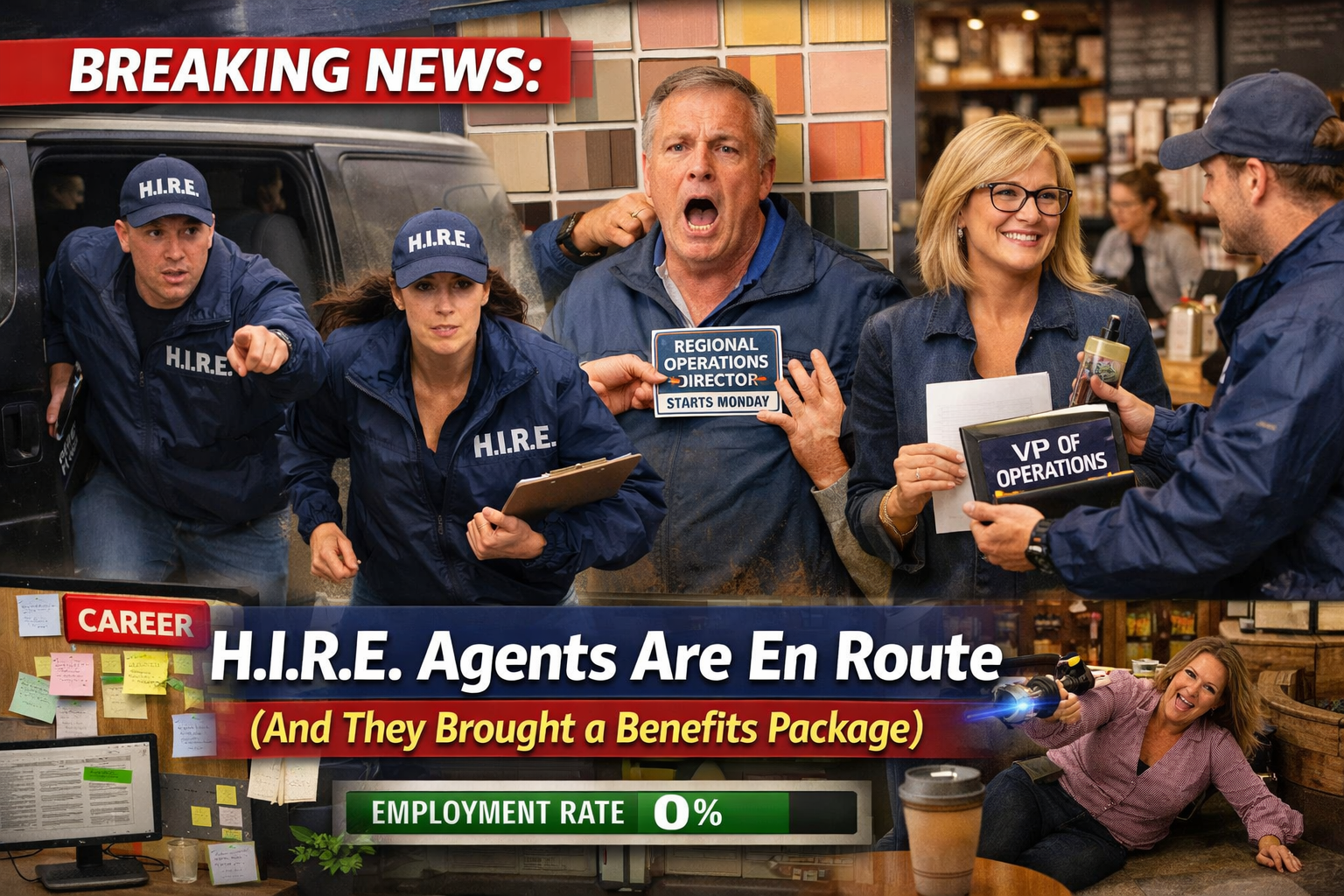
And most importantly, H.I.R.E. came with a van.
A black van, navy windbreakers, clipboards, and the kind of cheerful authority usually reserved for people who think “quick question” is a personality type.
No paperwork. No résumé revisions. No unpaid projects. No 17 rounds of interviews, each one somehow less informative than the last. Just a simple, stunning sentence delivered with the confidence of a system that finally remembered humans are not CAPTCHA puzzles:
“You’re hired. Get in.”
The Raid on the ATS (And Other Acts of Public Service)
The first thing H.I.R.E. did was go after the Applicant Tracking Systems.
Not politely. Not with negotiations. Not with a vendor meeting and a slide deck called “Optimizing Candidate Pipelines Through Empathy.” They went after the ATS the way you go after a raccoon in your attic: with urgency, gloves, and the clear understanding that something has been living inside your walls for too long and it’s time to reclaim your home.
Agents stormed corporate offices like it was a hostage situation, and in a way, it was—except the hostages were qualified candidates trapped in a digital labyrinth built by someone who thinks a “talent acquisition funnel” should be shaped like a meat grinder.
They yanked open conference room doors mid-meeting.
On the whiteboard: “HIRING GOALS Q1” and “CULTURE FIT” and the ominous phrase “we want someone hungry.”
An agent stepped forward, scanned the room, and spoke calmly, like someone who had seen too much.
“Show me your rejection templates.”
The recruiter tried to laugh. A light, nervous laugh. The laugh of someone who has never been held accountable for the phrase “While your background is impressive…”
The agent didn’t laugh back.
They plugged into the ATS like it was a criminal database, and within minutes they had the receipts: auto-rejections sent at 2:07 a.m., candidates disqualified because they wrote “managed” instead of “orchestrated,” applicants filtered out because they didn’t list Excel in fourteen separate synonyms, humans rejected in the time it takes a microwave to decide you don’t deserve warm food.
H.I.R.E. displayed the evidence on a big screen.
“Here,” the agent said, pointing at a line item like it was a crime scene. “This candidate has fifteen years of experience and got rejected because they didn’t have ‘minimum three years of TikTok synergy.’ That job is for Accounts Payable.”
The hiring manager shrugged. “We’re just looking for someone who can wear multiple hats.”
The agent leaned in slightly, the way a teacher leans in when the class clown tries it one more time.
“Multiple hats is a wardrobe. Pay accordingly.”
Then they did something truly unprecedented: they made the system reverse itself.
Instead of filtering people out, it filtered logic in.
Instead of “must have 12 years experience in software released last Tuesday,” it asked, “Can this person do the job?” Instead of “culture fit,” it asked, “Does the company treat people like people?” Instead of the phrase “fast-paced environment,” it translated it automatically into “we are understaffed and emotionally committed to chaos.”
And then the raids moved outward.
Home Depot. Starbucks. The quiet corners of public libraries where people whisper “I just need health insurance” like it’s a confession. They found job seekers the way meteorologists find storms: tracking patterns of despair, long gaps between hope and response, sudden spikes in “new message” notifications that turned out to be yet another webinar invitation.
They tackled a man near the paint samples.
He screamed, “I HAVE A MASTER’S DEGREE!”
They replied, “Excellent. Congratulations. You’re now a Regional Operations Director. Starts Monday. Dental kicks in first of the month.”
They didn’t even let him spiral.
They didn’t let him explain his gap.
They didn’t ask why he left his last job, as if leaving a job isn’t often the most rational response to being slowly drained by corporate nonsense.
They just handed him a water bottle, a benefits package, and an email signature that didn’t contain the word “seeking.”
Somewhere, an ATS shuddered and died, and the nation felt it like a spiritual unclenching.
The Starbucks Extraction (Where Experience Is No Longer Treated Like a Liability)
Starbucks became a hotspot, not because job seekers love caffeine—though they do—but because job seekers love a place where it’s socially acceptable to stare into the middle distance for long stretches of time while pretending you’re “just reviewing notes.”
H.I.R.E. moved through the line with efficiency, scanning faces like a talent scout for a league that finally values grown-ups.
In one corner, a woman sat with a laptop open and the thousand-yard stare of someone who has done more unpaid “take-home assignments” than some companies have done profitable quarters.
Her screen showed the latest request: “Please create a full marketing strategy, a 90-day plan, three ad concepts, a budget breakdown, and a brand voice guide. This should take no more than two hours.”
Two hours. Of course. The same way building a house takes no more than two hours if you don’t count walls, plumbing, or reality.
An agent approached her table.
“Ma’am,” he said gently, the way you speak to someone who has been through something and doesn’t need more performative cheerfulness. “We know you’ve been laid off, restructured, downsized, outsourced, and placed on executive pause.”
She tried to smile. The tired smile of someone who has been trained to appear grateful for scraps.
“I’m still applying,” she whispered, like it was a moral duty.
The agent glanced at her résumé on the table, and his eyes narrowed in recognition.
“This résumé still smells like courage and KPIs,” he said. “And frankly, we respect it.”
Her voice got smaller. “But I’m over 50…”
And there it was. The sentence so many people carry like a weight, the sentence that becomes an invisible stamp on their forehead in hiring processes that worship youth like it’s a skill.
The agent’s face softened, but his voice sharpened.
“Exactly,” he said, like the answer had been obvious all along. “You’re now in charge of six VPs and an $80 million revenue target. They’re lucky to have you. Stand up.”
Across the room, Karen from HR rose like a startled goose, clutching a binder labeled “CULTURE.”
“Wait!” Karen shouted. “She hasn’t taken the DISC assessment! She hasn’t met the culture committee! She hasn’t completed the values alignment maze!”
H.I.R.E. didn’t even flinch.
They didn’t argue.
They didn’t schedule a follow-up meeting.
They didn’t ask Karen to “share more context.”
They gave Karen a gentle HR-approved zap—the kind of zap that doesn’t injure, just resets you back to factory settings where you remember you are not the gatekeeper of human livelihoods.
Karen dropped the binder.
The room applauded, not because they’re violent, but because they’re exhausted, and this was the first time in years anyone had defended a candidate with actual force instead of “thoughts and prayers.”
H.I.R.E. escorted the woman out.
She didn’t even have to close all her browser tabs.
They did it for her, like a compassionate act, like tucking in a child, like saying, “You don’t have to keep proving you deserve a paycheck.”
Outside, the van door slid open.
Inside were other people who looked stunned, holding offer letters like they were fragile artifacts: a man who had been “overqualified” for three years straight, a woman who had been told she was “not quite senior enough” after leading teams since dial-up, a guy who had been ghosted so thoroughly he started to believe his emails were going to a parallel dimension.
Someone in the back whispered, “Is this real?”
An agent nodded. “It’s real. And your manager is required to respect your lunch break.”
The van drove away, and somewhere in corporate America, a hiring manager felt an unfamiliar sensation: consequences.
LinkedIn Evidence Lockers and the Death of “Circle Back”
Back at H.I.R.E. headquarters, the scene looked like a cross between a precinct and a group therapy session run by someone who understands spreadsheets.
They had whiteboards covered in case notes.
“SUBJECT: Ghosted 39 times.”
“SUBJECT: Rejected by a job they didn’t apply for.”
“SUBJECT: Asked to do a seven-step interview process for a role paying less than their current streaming subscriptions.”
Agents reviewed LinkedIn posts the way detectives review surveillance footage.
“This one,” an agent said, tapping a screen, “has been posting motivational updates since 2022. ‘Day 814 of the search. Staying positive.’ That’s not positivity. That’s a hostage note written to themselves.”
Another agent scrolled through comments.
“Here’s the part where twelve strangers say ‘Keep going!’ and one recruiter writes ‘Following!’ and then disappears like a magician.”
A third agent leaned back, rubbing his temples. “How did we normalize this?”
No one answered, because the truth was too embarrassing.
We normalized it the way you normalize anything that hurts: slowly, collectively, with enough inspirational posts to convince yourself it’s character building instead of a systemic failure.
H.I.R.E. didn’t do inspiration.
H.I.R.E. did assignments.
“This candidate,” an agent announced, “has been unemployed for eighteen months and has the audacity to still be kind. That’s leadership. Give her a team. Give her authority. Give her a salary that doesn’t require an apology.”
“This one,” another agent said, “was told they were ‘too direct’ in interviews. Translation: they answered questions like an adult and didn’t play corporate Mad Libs. Perfect. Put them in charge of operational clarity.”
They created titles like they were reclaiming dignity:
Director of Not Being Ghosted.
Vice President of Paying People Like It Matters.
Head of Recruitment Policy Reform (for the guy ghosted by a job he didn’t even apply for, because if anyone understands chaos, it’s him).
They also abolished certain phrases on sight.
“Circle back” was removed from the language.
“Fast-paced environment” was reclassified as a warning label and required hazard pay.
“Competitive salary” was banned unless followed immediately by actual numbers.
“Culture fit” was replaced with “Does this team behave like humans.”
And then came the greatest miracle of all:
The unemployment rate dropped to zero.
Not because everyone suddenly became “more hireable,” not because people learned new skills overnight, not because someone finally cracked the code of the perfect cover letter, but because the system stopped pretending it couldn’t see them.
People got assigned a new title, a new team, and—most sacred of all—a new email signature that didn’t say “Consultant (Freelance, kinda, sometimes).”
The economy didn’t collapse.
The sky didn’t fall.
The world didn’t end.
It just… started to function in a way that felt suspiciously humane.
Final Thoughts: If You Hear the Knock, Don’t Hide
If this whole thing sounds absurd, it’s because it is.
But it’s also absurd that we built a society where someone can work for twenty years, lead teams, solve problems, survive layoffs, rebuild careers, keep families afloat, and still be treated like a suspicious package because they didn’t tailor their résumé to include the exact phrase “cross-functional stakeholder alignment” in the third bullet point under a job they held in 2014.
It’s absurd that companies claim they want experience and then flinch when it arrives with wrinkles, wisdom, and boundaries.
It’s absurd that we turned hiring into theater, where candidates audition for the privilege of being overworked, underpaid, and told they should be grateful for the “opportunity.”
H.I.R.E. is a fantasy, sure.
But the part that hits too close is what it reveals: the problem was never that people didn’t want to work. The problem was that the gatekeepers treated employment like a prize humans must earn through humiliation, instead of a basic exchange of skill for stability.
So if you hear a knock on your door and see two friendly agents in navy jackets, don’t run.
Don’t start explaining your employment gap like you’re on trial.
Don’t apologize for the layoff that happened to you.
Don’t offer a personal brand statement or your “why.”
Just pack a lunch.
Because in this version of America—the one where common sense got weaponized in the name of compassion—the van isn’t taking you to an interview.
It’s taking you to a paycheck.
And honestly?
It’s about time.






Your point of view caught my eye and was very interesting. Thanks. I have a question for you.