There was a time when job interviews were noble, dignified affairs — where people wore suits that smelled faintly of desperation, arrived ten minutes early, and sat nervously in lobbies reading mission statements printed on fake parchment. You shook hands, pretended to admire the office décor, and tried not to sweat through your one good shirt. Back then, rejection felt human. You could at least tell from someone’s tone of voice that they weren’t calling you “a great fit” just to never speak to you again.
But then came the era of remote everything. Suddenly, the professional world decided that your living room was now your conference room, your cat was your coworker, and your webcam was the window through which your entire career potential would be judged. The Zoom interview was marketed as a miracle — “a convenient, efficient, human-centered way to connect talent with opportunity!” — which sounded inspiring until you realized it meant putting on dress pants to sit alone and stare into a glowing rectangle that reflects your every insecurity back at you.
The first time I had a Zoom interview, I made the rookie mistake of trusting my Wi-Fi. It betrayed me immediately. My camera froze on a frame where my eyes were half-closed and my mouth was mid-sentence, making me look like I’d been spiritually ejected from my own body. My interviewer thought I was deep in thought. I was actually deep in technical difficulty.
There’s something about Zoom that manages to strip away everything human about communication. Eye contact? Impossible. Body language? Useless. The subtle cues that make conversation flow? Gone, replaced by micro-glitches and a 2.3-second lag that turns every “Go ahead” into a duet of chaos. You can’t even tell if someone’s laughing at your joke or just buffering in silence.
Yet here we are, forced to perform in this dystopian audition space — where the stakes are high, the lighting is low, and the camera is always judging. If Dante were alive today, the ninth circle of Hell would be a Zoom interview with “unstable connection detected” flashing across the screen while a recruiter says, “So, tell me about a time you handled conflict.”
Grab your ring light, silence your notifications, and pray your dog doesn’t bark during your closing statement — because we’re diving into the three inevitable stages of every Zoom interview: preparation, performance, and post-traumatic reflection.
The Pre-Interview Ritual (How to Have a Nervous Breakdown in 1080p)
Preparation for a Zoom interview is less about professionalism and more about surviving the psychological warfare of seeing your own face too long. You start the morning determined to look composed, intelligent, and employable. By the third camera check, you look like you’ve been through a minor exorcism.
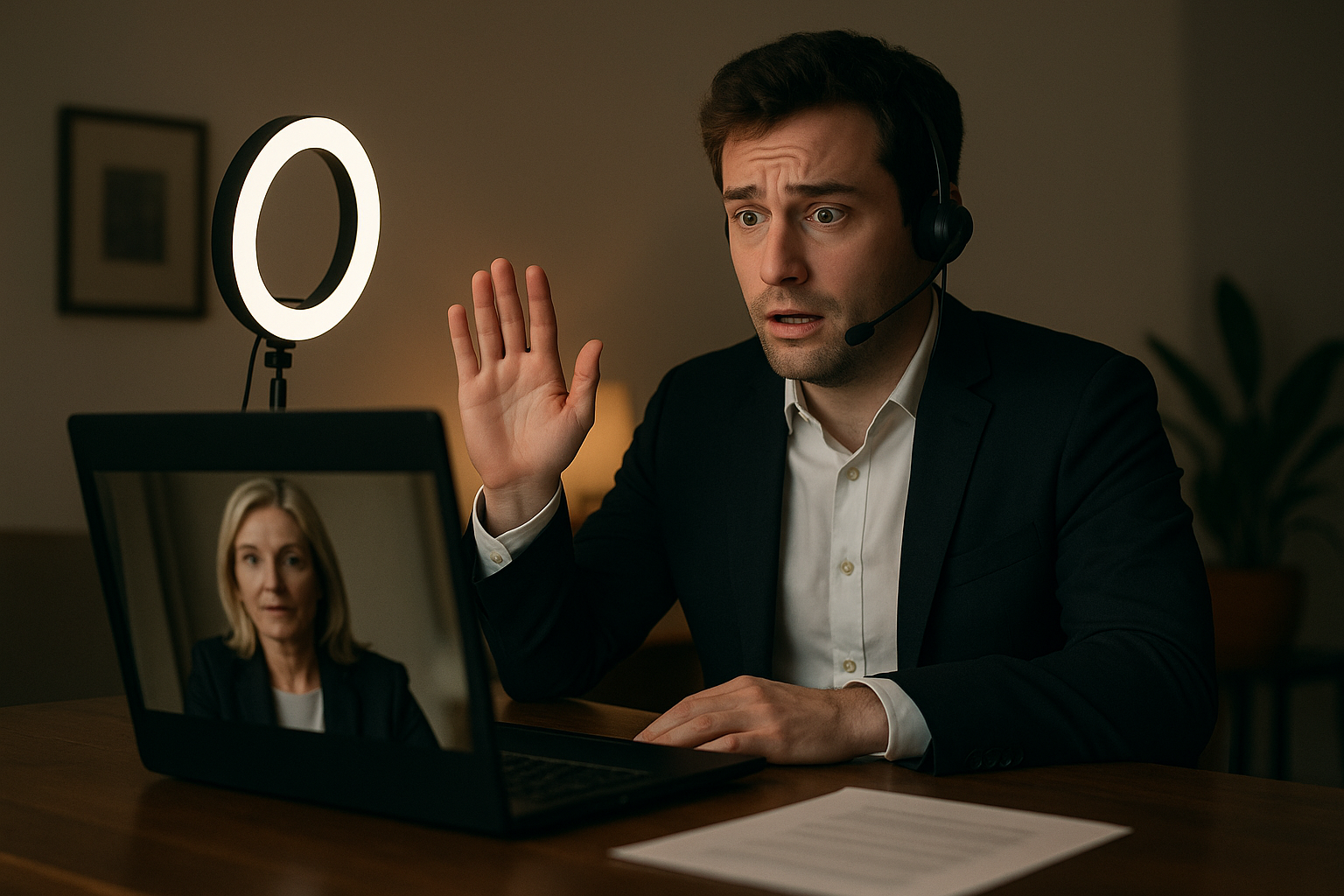
You experiment with lighting: blinds open, blinds closed, lamp on, lamp off, ring light tilted at a 37-degree angle like a NASA launch. Each adjustment somehow makes you look worse. You realize, with creeping horror, that you do not, in fact, have a “good side.”
Then comes the background selection. You scan your home for anything that says “stable adult” instead of “lives off frozen waffles and trauma.” You consider virtual backgrounds but quickly remember how horrifying it looks when your head phases in and out of a fake office like a ghost in mid-promotion. You settle on your real wall — minimal, neutral, possibly depressing — and hope your interviewer interprets it as “focused” rather than “soulless.”
Five minutes before the meeting, your Wi-Fi begins acting like a toddler refusing bedtime. You close everything, restart Zoom, and whisper threats to your router. Your palms sweat, your laptop fan screams, and suddenly, your keyboard becomes slippery terrain. You wonder if the company will value resilience as much as they value punctuality.
The moment finally comes. You click “Join Meeting.” For a brief, terrifying second, you’re the only person there — staring at your reflection like a gladiator waiting for battle. Then, the screen flickers. The recruiter appears. You both wave. You both say “Hi.” You both stop. You both say “Oh, sorry, go ahead.” You both stop again. The silence stretches so long it becomes a new form of communication — mutual embarrassment.
Congratulations. The interview has begun.
The Interview Performance (Now Streaming Live: Your Anxiety)
Every Zoom interview starts the same way: with a fragile sense of hope that this one will be different. Spoiler alert — it never is.
The recruiter begins with the classic, “So, tell me a little about yourself.” You’ve rehearsed this line fifty times in front of a mirror, timing your pauses like a stand-up comedian delivering a TED Talk. You’re halfway through your answer — “I’m passionate about problem-solving and building collaborative environments—” when your internet decides to buffer, and all they hear is “…passionate…problems…collab…”
You freeze. They freeze. You unfreeze first but don’t know if they can hear you. So, you smile — the universal symbol for “I am panicking internally.”
They ask you to repeat yourself. You try, but now you’re second-guessing every word. “Passionate” suddenly sounds desperate. “Collaborative environments” sound like you’re joining a cult. You start to sweat under the heat of your ring light, which now feels like an interrogation lamp.
Then comes the behavioral question gauntlet. “Tell me about a time you faced a challenge.” You reach deep into your past for a polished story that demonstrates resilience, leadership, and emotional intelligence — but mid-answer, your cat jumps on your lap like a furry omen. You try to subtly push it away while maintaining eye contact, resulting in a visual that looks suspiciously like you’re negotiating with an invisible force.
And just when you think you’ve regained composure, your Zoom notification pops up: “Internet connection unstable.” You silently curse your service provider while pretending to be deeply moved by the company’s mission statement.
There’s also the matter of facial expression. On Zoom, every reaction feels exaggerated. Nod too little, you look cold. Nod too much, you look unhinged. You try to find the middle ground — “thoughtful interest” — but your camera catches you mid-blink, transforming your professional demeanor into “sleep-deprived raccoon seeking employment.”
Eventually, the recruiter asks, “Do you have any questions for us?” and you try to sound curious and strategic, even though what you really want to ask is, “Are you even hiring, or is this an elaborate social experiment to test my Wi-Fi endurance?”
The Post-Interview Spiral (Now Featuring Existential Dread and Refresh Button Syndrome)
When the meeting ends, you sit there for a moment — still smiling because you’re afraid the camera might still be on. Then you close Zoom and stare into the abyss of your desktop wallpaper, processing what just happened.
Did you say “you too” when they wished you luck with your job search? Did you accidentally call them by the wrong name? Did your camera reveal the laundry mountain behind your chair?
You replay the conversation like a crime scene investigator, analyzing every awkward laugh and delayed response. You start to wonder if you’re even qualified for any job that involves technology. You refresh your inbox. Nothing. You refresh again. Still nothing. By the fifteenth refresh, Gmail is practically sighing at you.
Days pass. You begin to accept that you’ve been ghosted. You tell yourself it’s fine — that the job probably wasn’t a good fit anyway — but you still check your spam folder every morning like a pilgrim searching for divine signs.
Finally, you get the email:
“Thank you for your time. We’ve decided to move forward with other candidates whose experience more closely aligns with our needs.”
You read it five times, trying to decipher the subtext. “More closely aligns” could mean anything — maybe they wanted someone taller. Maybe someone whose Wi-Fi didn’t resemble Morse code. Maybe someone who didn’t panic when asked about Excel.
You close your laptop and whisper, “Maybe I’ll just start a YouTube channel.”
Final Thoughts: Humanity.exe Has Stopped Responding
The Zoom interview isn’t just a hiring tool — it’s a social experiment designed to test the limits of human composure. It’s a mirror that reflects your confidence, insecurities, and technical failures all at once. It’s a digital arena where professionalism battles chaos, and chaos usually wins.
But maybe that’s okay. Maybe the point isn’t to appear flawless — maybe it’s to survive. To adapt. To prove that even through lag, echo, and the haunting glow of a webcam, you still showed up.
Because anyone can perform in a conference room, but it takes a special kind of resilience to pitch your career ambitions while your neighbor’s leaf blower competes for airtime.
So here’s to every applicant who’s ever frozen mid-sentence, who’s accidentally unmuted too soon, who’s smiled through technical despair — you’ve faced the modern gauntlet and lived to tell the tale.
You may not have gotten the job, but you’ve earned something far greater: the ability to look straight into the digital void, smile through the lag, and say, “You’re still on mute.”
😂0😍0😢0😡0👍0👎0