Welcome to 2025 — a year where job hunting feels less like finding employment and more like surviving a dystopian reality show sponsored by Indeed and emotionally funded by your last shred of self-esteem. The economy is “recovering,” which is corporate-speak for “we laid everyone off and rehired half of them as contractors without benefits.” Recruiters still open with “We were really impressed by your background” before ghosting you faster than your ex who joined a pyramid scheme.
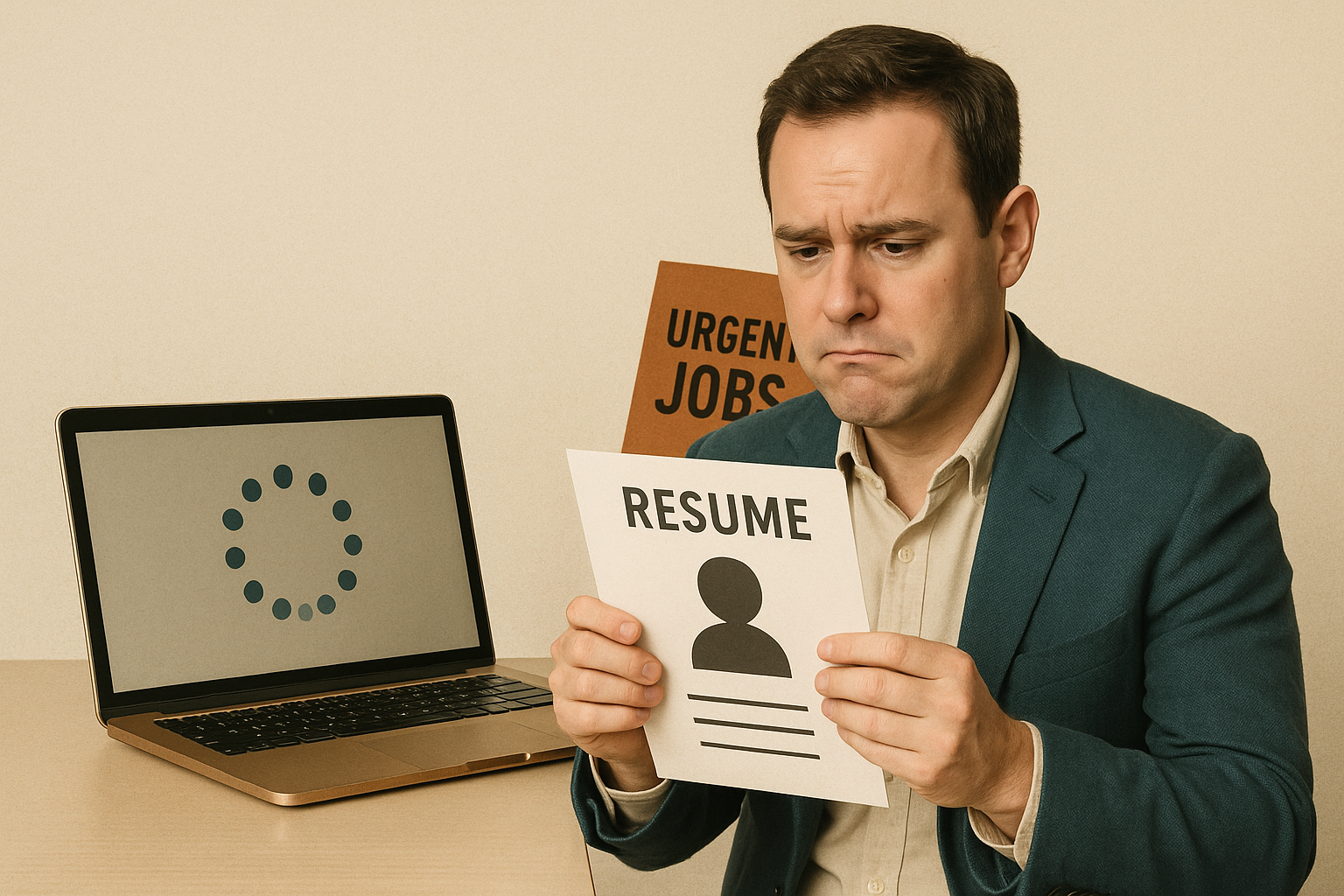
Your résumé now lives in 37 databases, two black holes, and one questionable third-party app that swears it’s “helping employers find top talent.” Meanwhile, your inbox is full of “We regret to inform you” emails that read like breakup letters written by AI. Every time you hit “Submit Application,” you can almost hear your soul whisper, “Don’t do this to us again.”
The modern job market has evolved — or mutated — into a high-stakes arena where you’re expected to sell your personality, your portfolio, your punctuality, and occasionally your sanity. LinkedIn has become a digital Hunger Games district where unemployed gladiators post motivational quotes like “Rejection is redirection” while secretly refreshing their inbox every seven minutes.
And the recruiters? They’re out there too — hiding behind keywords, LinkedIn filters, and cheerful emojis — waiting to pounce on anyone who dares to message “Just following up.” Welcome to job hunting in 2025, where the future is automated, and so are your rejections.
The Algorithm Decides Your Worth
Once upon a time, people got jobs by walking into offices and shaking hands. Now, in 2025, you upload your résumé into a digital void and hope an algorithm — trained on 90% bias and 10% caffeine — decides you’re employable. The ATS (Applicant Tracking System) doesn’t care that you saved a sinking department or survived a narcissistic manager. It only cares that you didn’t forget to include the word “synergy.”
You spend three hours tailoring your résumé for one posting. You add “innovative,” “proactive,” and “team-oriented” like digital incense, hoping to appease the mighty gods of HR. Then you click “Submit.” Within seconds, you get an automated email: “We have decided to move forward with other candidates.” How? The ink on your rejection wasn’t even dry.
Sometimes, you apply for a role you’re clearly qualified for — only to be told you’re “not the right fit.” Other times, you get a “We’ll keep your résumé on file” message, which is corporate code for “We deleted it faster than your last Tinder match.” You start wondering if the ATS is even real, or if it’s just one intern with Excel and too much power.
By month three, you’re starting to add random buzzwords for fun. “Cross-functional ninja”? Sure. “Strategic thought influencer”? Why not. “Proactive unicorn with deep blockchain empathy”? Absolutely. At this point, you’re not applying for jobs anymore — you’re performing digital stand-up for robots.
Networking — or as We Call It, Professional Begging
Networking used to mean meeting people. Now it’s an elaborate form of begging, performed in digital spaces full of strangers pretending to care about each other’s “career journeys.” You attend virtual coffee chats where everyone’s camera is mysteriously off, and every sentence begins with “Happy to connect!”
You comment on people’s posts like, “Love this insight!” or “So true, Sarah!” hoping that Sarah — who works at a company you applied to — will notice your name and whisper it into the HR abyss. Spoiler: she won’t. Sarah’s too busy posting “We’re hiring!” while never answering messages from the desperate masses.
Then there are the “networking events.” You log into Zoom with your best blazer and worst Wi-Fi, only to realize you’re one of 173 faces in a gallery view. Someone’s dog barks, someone else forgets to unmute, and the host says things like “Your next opportunity could be in this room!” Technically true, but only if the room includes a time machine.
By the end of it, you’ve got six new LinkedIn connections, three unanswered DMs, and one existential crisis. You pour yourself another cup of coffee and mutter, “Maybe I’ll just start a podcast.”
The Interview Circus
You finally get an interview. You iron your shirt, rehearse your “Tell me about yourself” answer, and pray your Wi-Fi holds up. Then the interviewer says, “We’re using a conversational AI for our first round.” Translation: you’ll be talking to a chatbot named Karen who has better grammar than your high school English teacher.
You answer questions into your webcam, staring at your own reflection like it’s an episode of Black Mirror. Karen nods politely, asks about your strengths, then evaluates your tone, eye contact, and enthusiasm on a scale of 1 to 10. You spend the rest of the day wondering if you smiled too much, not enough, or just the wrong kind of human.
If you make it to a real person, you get a panel of six managers who look like they’re trapped in a witness protection program. They ask questions like, “Where do you see yourself in five years?” and “How do you handle stress?” You want to say, “You mean this kind of stress?” but you smile and deliver a polished, trauma-free answer.
By round five, you’ve done three assessments, a presentation, and a virtual escape room with HR. They tell you they’re “down to two final candidates” — and then ghost you for six weeks. When they finally reply, it’s the classic: “We went in a different direction.” You consider asking if that direction involved common decency, but you settle for closing your laptop dramatically and whispering, “Good luck with your culture fit.”
Final Thoughts: The Art of Staying Delusionally Hopeful
Job hunting in 2025 is no longer about finding work — it’s about maintaining hope while dancing in the absurd. You become a master of rejection resilience, caffeine consumption, and forced optimism. You tell yourself “Something better is coming” while simultaneously applying to everything from Senior Strategist to Part-Time Donut Technician.
But here’s the thing: despite the chaos, the algorithms, and the rejection templates written by emotionless bots, you still show up. You still write cover letters no one reads. You still hit “Apply Now” with trembling hope. Because deep down, there’s a stubborn little voice — the same one that’s kept you going through worse — that whispers, “Maybe this one will be different.”
And maybe, just maybe, it will be.
Because if there’s one thing corporate America hasn’t managed to automate yet — it’s your ability to rise again, caffeinated, sarcastic, and slightly unhinged.