
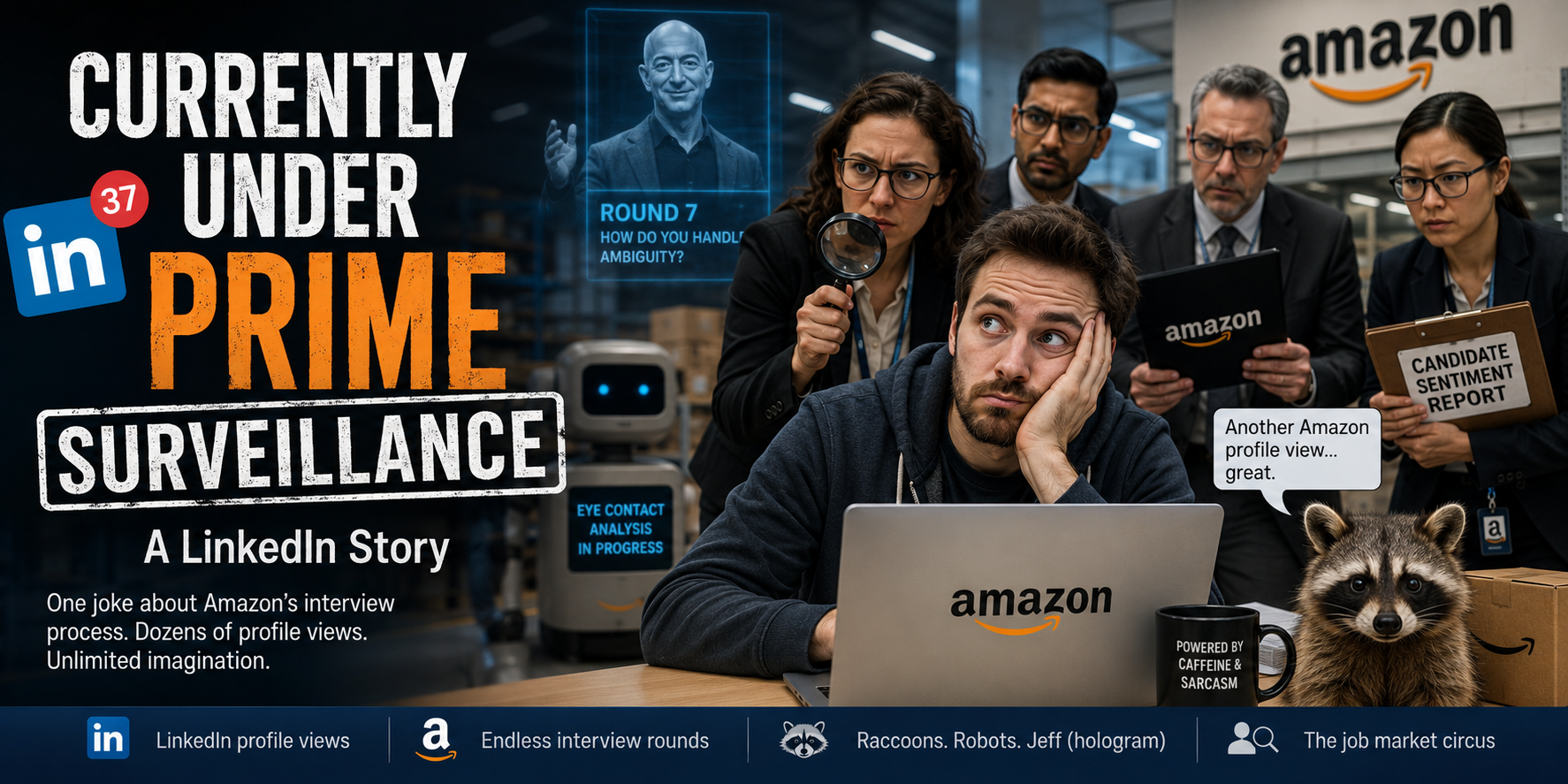
A couple days ago, I made a joke about Amazon’s interview process, and apparently I accidentally activated something inside the corporate universe. It was supposed to be one harmless LinkedIn post. One little joke about eight interview rounds, a raccoon trapped in a revolving door, and Jeff Bezos appearing as a hologram in round seven to ask me how I handle ambiguity while a warehouse robot silently judged my eye contact from the corner. That was the whole thing. I did not think I was launching a brand incident. I did not think someone in Seattle was going to dim the lights, pull up my profile, and whisper, “We have a situation.”
Then the LinkedIn notifications started rolling in. Amazon people began viewing my profile like I had been quietly placed on a watchlist called “Candidate With Jokes.” At first, I tried to be normal about it. I saw one profile view and thought, “Interesting.” Then another one appeared. Then another. After a while, it stopped feeling like networking and started feeling like my LinkedIn page had been rerouted through loss prevention. I am not saying I am being monitored. I am simply saying if one more Amazon employee views my profile, I am changing my headline to “Currently under Prime surveillance.”
And the names were incredible. Long names. Powerful names. Names that looked like someone leaned on a keyboard during a leadership meeting and accidentally created a senior director. Names so long they looked like they required two-factor authentication just to pronounce. I would see the notification and pause, not because I was scared, but because I was trying to figure out if this was a real person, a department, or a password reset link. Some names looked like they came with badge access, direct reports, and a favorite conference room.
LinkedIn just says, “Someone from Amazon viewed your profile.” Someone? That is not enough information. Was it recruiting? Was it PR? Was it legal? Was it robotics? Was it the person who teaches Alexa to pretend she did not hear you the first time? Was it the team responsible for candidate emotional containment? Because context matters. When a regular company views your profile, you think, “Maybe this could be an opportunity.” When Amazon views your profile after you roast their interview process, you start wondering if you should put on a blazer in your own kitchen.
The Profile Views Began Like a Corporate Thriller
At first, it felt innocent. One person from Amazon viewed my profile, and I thought maybe they were curious. Maybe they saw the joke and laughed. Maybe they were also trapped somewhere between interview round five and a leadership principle question about ownership. Maybe they read the raccoon part and thought, “Honestly, not inaccurate.” I wanted to believe this was just one person scrolling during coffee, doing regular LinkedIn behavior, the kind where you accidentally fall into someone’s profile and then pretend it was strategic networking.
But then more people started showing up. Another Amazon profile view. Then another. Then someone with a title that looked like it came with a laminated badge and a dedicated parking spot. Suddenly Amazon employees were walking through my profile like it was aisle seven and they were searching for a damaged package labeled “Sarcastic Candidate: Handle With HR.” At that point, you stop thinking, “Nice, engagement,” and start thinking, “Did my post get printed out and placed in a folder?”
That is when my imagination took over, because I know how corporate America works. One person sees the post and sends it to another person with, “Have you seen this?” Then that person forwards it to a manager. The manager sends it to a director. The director adds a very professional message like, “Interesting external candidate sentiment.” Then someone with a title longer than a CVS receipt says, “Let’s align on this.” And now a joke that was written during coffee becomes a structured conversation with fourteen people, six slides, and one person from legal who says nothing but takes notes aggressively.
I can picture the meeting perfectly. “Team, we have a situation.” Someone asks, “What happened?” Another person responds, “A man on LinkedIn compared our interview process to emotional CrossFit.” The room gets quiet. Someone from recruiting slowly closes their laptop. Someone from PR asks if the raccoon has a following. A senior leader asks, “Is this gaining traction?” Someone else says, “There are comments.” That is when the temperature drops. In corporate language, “there are comments” means the villagers have gathered outside the castle.
Then someone probably asks, “Should we respond?” And the most experienced corporate person in the room says, “No. First we view his profile repeatedly so he slowly loses peace.” That is the part I respect. The restraint. The mystery. The psychological commitment. They do not message you. They do not clarify anything. They just appear in the profile views like corporate ghosts wearing quarter-zips.
Honestly, I respect the speed. Amazon can find my LinkedIn profile faster than some companies can reject a candidate after six interviews, two assessments, one panel discussion, and a final conversation with a person named Blake who joined late and said, “Sorry, I have not had a chance to review your resume.” That is the job market now. Apply for a job and you hear nothing. Ask for salary and suddenly everyone turns into a fog machine. Request feedback and it gets treated like classified material. Make one joke online and corporate America becomes SEAL Team Six with LinkedIn Premium.
And candidates are supposed to act calm through all of this. We are supposed to upload the resume, retype the resume, answer why we are passionate about operational excellence, smile through the third “tell me about yourself,” and pretend it is normal when a company takes six weeks to say no with an email so vague it sounds like it was written by a smoke detector. But let a candidate make a joke about the process, and suddenly the company has agility, urgency, and cross-functional alignment.
That is why the profile views felt so funny. Not scary. Funny. Because the same system that cannot provide feedback after eight interviews can apparently mobilize profile viewers within hours. Somewhere, buried under all the leadership principles and candidate portals, there is still a machine that works. Unfortunately, it only activates when someone compares the hiring process to a raccoon fighting for its life inside a revolving door.
The Names Were Longer Than the Interview Process
Let’s talk about these names, because I do not know what Amazon is feeding people during onboarding, but some of these profile viewers looked like they were assembled by artificial intelligence and approved by compliance. These were not regular names. These were names with architecture. Names with executive presence. Names that looked like they had their own org chart. I would see a notification and feel like LinkedIn was not showing me a person, it was showing me a password to enter a secure conference room.
Some names were so long I had to emotionally prepare before reading them. I would see the notification, take a sip of coffee, and think, “I hope I have enough battery for this.” These names looked like they came with a pronunciation guide, a leadership development program, and a calendar invite titled “Quick Sync.” I am not making fun of the names themselves. I respect a strong name. I have a last name that makes people slow down and reconsider their life choices at roll call. But when a long name from Amazon appears after you made a joke about Amazon, it hits differently. It feels less like a view and more like a formal review.
And then the titles. At Amazon, nobody is just a manager. No, they are a Senior Global Principal Program Strategy Operations Experience Partner for Candidate Workflow Alignment and Leadership Mechanism Optimization. Translation: they may or may not have been in the meeting where my raccoon joke was discussed. The titles sound like they were built in a lab by people who believe “simple” is a missed opportunity. You do not work in recruiting. You own candidate journey architecture. You do not manage interviews. You optimize cross-functional evaluation mechanisms. You do not look at LinkedIn. You conduct external talent sentiment reconnaissance.
I imagine one of them opening my profile very seriously. They scroll through my posts. They pause at the jokes. They see the Amazon one. They scroll back up. They check the comments. They whisper, “He has done this before.” Someone else asks, “How many times?” The room goes silent. A projector turns on. Suddenly, my LinkedIn presence has become a business case.
Slide one: overview. Slide two: candidate tone. Slide three: animal metaphor frequency. Slide four: possible brand risk. Slide five: he mentioned Jeff. Slide six: raccoon sentiment analysis. Slide seven: potential engagement pathways. Slide eight: do not engage, but continue observing. And because corporate America loves turning regular human behavior into a framework, someone would probably rename the whole thing “External Humor Response Mapping.” They would not say, “We saw your joke.” They would say, “We are conducting a light-touch candidate sentiment review in response to humor-based engagement activity.”
Meanwhile, I am sitting at home drinking coffee, wondering why someone from Amazon viewed my profile at 7:42 a.m. like my sarcasm qualified for same-day delivery. I did not ask to become a case study. I was just making jokes about the interview process. But apparently when you joke about a company that has drones, satellites, robots, fulfillment centers, a streaming platform, a cloud empire, and a voice assistant in half the kitchens in America, you have to assume someone somewhere has a dashboard with your name blinking on it.
The funniest part is that LinkedIn does not give enough details. It just casually says, “Someone from Amazon viewed your profile,” and leaves you alone with your imagination. Someone? That is not helpful. Was it someone who hires people? Someone who protects the brand? Someone who builds robots? Someone who approves leadership principle flashcards? Someone who manages the team that manages the team that manages the candidate experience? I need a little more transparency from the platform that asks me every day if I want to congratulate someone I have never met for surviving another corporate reorganization.
And honestly, the mystery makes it worse. If it said “Recruiter viewed your profile,” I could relax. If it said “PR viewed your profile,” I could laugh. If it said “Legal viewed your profile,” I could sit up straighter and remove the raccoon photo. But “someone from Amazon” is too vague. That could be anyone from a talent acquisition specialist to a person who programs warehouse robots to sigh when candidates ask about salary.
The whole thing made me realize that modern job hunting has become a strange blend of professional branding, emotional survival, and low-grade surveillance. Candidates are told to be visible, but not too visible. Authentic, but not too honest. Funny, but not dangerous. Confident, but not loud. Memorable, but not searchable in a way that makes someone from corporate communications pause during breakfast. You are supposed to build a personal brand, but only the kind that makes hiring managers comfortable, recruiters impressed, and legal completely uninterested.
Maybe This Is the New Recruiting Strategy
Maybe this is where recruiting is headed. Forget referrals. Forget networking. Forget Easy Apply. The new strategy is to politely roast the company hard enough that PR, recruiters, legal, robotics, and three directors with titles that require a loading screen all visit your profile by lunch. That is visibility. That is candidate engagement. That is brand awareness. Honestly, I might add it to my resume: “Generated cross-functional profile traffic through organic satire.”
Because traditional job searching has become a strange emotional obstacle course. You can spend hours tailoring your resume, writing a cover letter, answering questions like “Why do you want to work here?” when the honest answer is “because groceries have become a luxury subscription,” and still hear nothing. You can interview with six people, explain your background seven different ways, meet the team, meet the team’s team, complete an assessment, record a video interview, and then get ghosted like you matched with a recruiter on Tinder who suddenly found inner peace.
The silence is what gets candidates. Not the rejection. Most people can handle rejection if it arrives like a normal human message. What wears people down is the void. The black hole. The application portal that says “under review” for so long you start wondering if they are reviewing it by candlelight. You check the status and it has not changed. You refresh your email and nothing appears. You wonder if your resume is still being considered or if it has been quietly moved into a digital storage unit next to expired coupons and old printer drivers.
But make one joke? Now everyone has bandwidth. Now people know how to use LinkedIn. Now the profile views come in like package tracking updates. “Your recruiter has viewed your profile.” “Your rejection is out for delivery.” “Your application has been delayed due to unexpected ambiguity.” “Your feedback will arrive between 8 a.m. and never.” At least with Amazon, I expect tracking details. If I am going to be emotionally shipped through the hiring process, I would like to know whether I am in transit, delayed, damaged in sorting, or accidentally delivered to another candidate.
They should let candidates track the interview process like a package. Round one: shipped. Round two: in transit. Round three: delayed. Round four: rerouted to leadership. Round five: out for final panel. Round six: hologram deployed. Round seven: raccoon escaped. Round eight: candidate still breathing. Offer: currently unavailable. Rejection: arriving today by 10 p.m., but the driver may take a picture of it at the wrong door.
And maybe that is why the whole thing is funny. Because candidates have been begging for communication, updates, transparency, and basic humanity, but somehow the fastest response you can get from a major company is not from applying. It is from making a joke. Not an angry joke. Not a rude joke. Just a tired, sarcastic, emotionally accurate joke from someone who has been through enough interviews to develop a survival instinct and a brand voice.
There is something deeply ridiculous about candidates being told to “stand out” and then being quietly studied when they actually do. Companies say they want authenticity, but usually they mean a polished version of authenticity that has been approved by HR, softened by PR, and cleared by someone named Melissa who says, “Maybe remove the raccoon.” They want candidates to be real, but not too real. They want personality, but not enough personality to create a meeting. They want thought leadership, but only if the thoughts do not wander too close to the truth.
So maybe roasting the process is the only honest networking strategy left. Maybe humor is the last working referral system. Maybe candidates have discovered that the algorithm moves faster than the ATS. The ATS might bury your resume under seven thousand applicants, but one good joke can bring recruiters, directors, former employees, current employees, and someone from a mysterious department called “Global People Experience” directly to your profile before lunch.
And that is the part that makes me laugh the most. The post was not a formal complaint. It was not a lawsuit. It was not a press release. It was a joke from a tired candidate trying to survive the circus. But because the circus now has analytics, the joke became data. The raccoon became a signal. The profile views became engagement. The comments became sentiment. And suddenly, I am not just a person making jokes on LinkedIn. I am an external narrative event with coffee.
Final Thoughts: Welcome to My Profile, Please Wipe Your Corporate Feet
To the Amazon people viewing my profile, welcome. Please enjoy the posts, the emotional damage, the raccoon references, and the growing evidence that I have explained my professional background so many times I may now require a press kit. Take your time. Look around. There are jokes about recruiting, ghosting, rejection emails, salary ranges, corporate nonsense, and the emotional tax of telling strangers you are “excited about the opportunity” when the opportunity already made you upload your resume and then manually type the same information into seventeen boxes.
I do not mind the views. In fact, I appreciate the engagement. Nothing says candidate experience like a company silently walking through your profile after you made a joke about their interview process. Maybe this is progress. Maybe this is the closest I will get to feedback. Maybe my application did not disappear. Maybe it simply evolved into surveillance. Maybe somewhere inside Amazon, there is a person saying, “He is funny, but can he scale humor across teams?” The answer is yes, with the right leadership principles, one supportive raccoon, and fewer than eight interviews.
But if this is secretly part of the hiring process, I must respectfully withdraw before round nine. I have limits. I can handle ambiguity. I can handle feedback. I can handle a panel interview where one person clearly did not read my resume and another person asks, “Tell me about a time you disagreed with a stakeholder,” like I have not disagreed with LinkedIn’s algorithm every morning. What I cannot handle is another surprise round where someone named Senior Principal Global Candidate Mechanism Experience Lead views my profile at sunrise and leaves me wondering if I am being recruited, audited, studied, or emotionally shipped in a cardboard box.
So to everyone from Amazon who has stopped by, welcome to the profile. The raccoon is friendly. The jokes are mostly OSHA compliant. The candidate is tired but still operational. And if Jeff Bezos appears as a hologram to ask how I handle pressure, I will simply point to my LinkedIn notifications and say, “Apparently pretty well, because I survived the job market, eight imaginary interview rounds, and being viewed by Amazon people with names longer than the interview process.”