
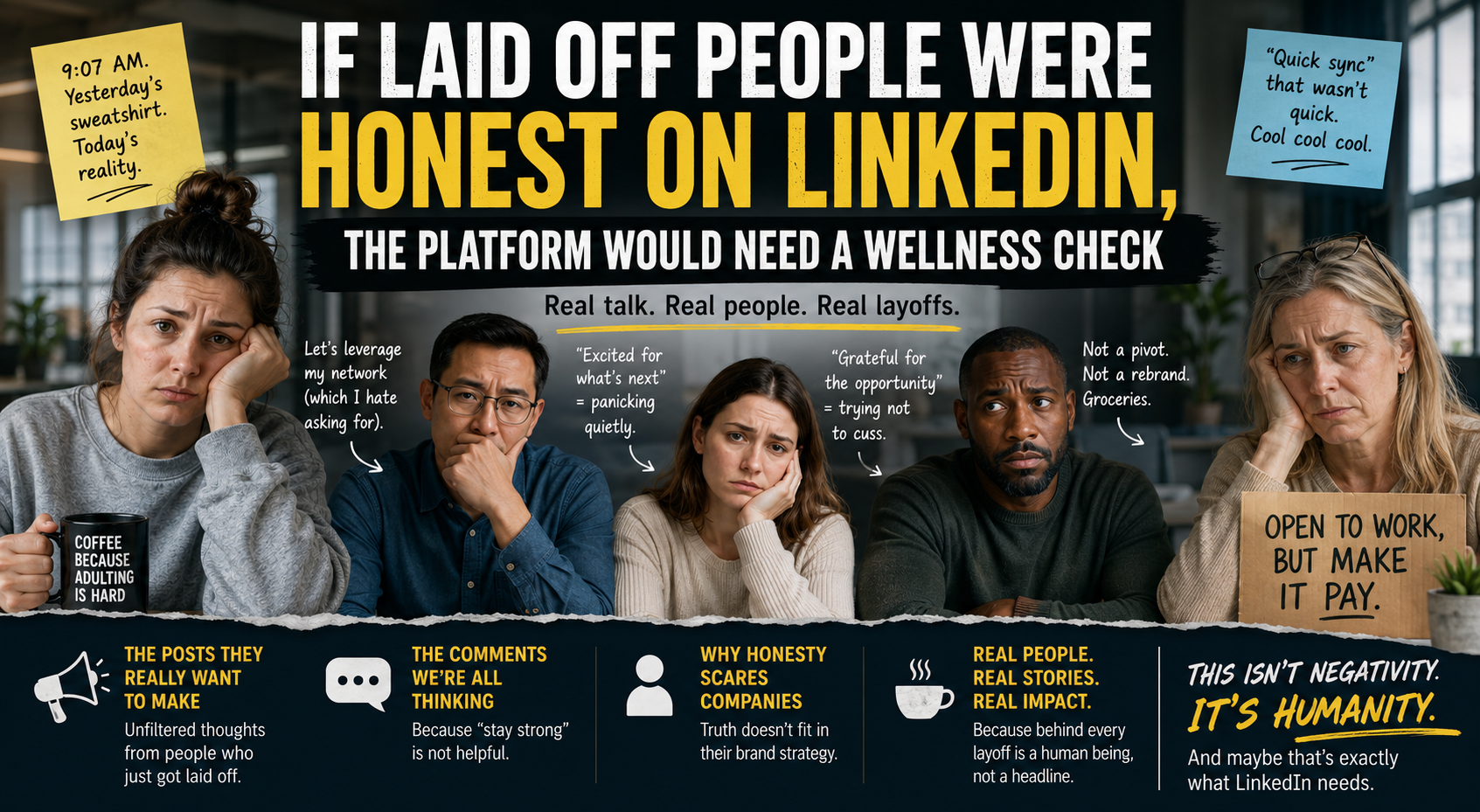
There is a special kind of theater that happens after layoffs, and LinkedIn has somehow become both the stage and the hostage video camera.
A person loses their job, their routine, their benefits, their paycheck, their sense of professional gravity, and occasionally the tiny remaining thread of patience they had with the phrase “business needs,” and within days, sometimes hours, they are expected to appear online looking composed, grateful, optimistic, and legally digestible. They must take the emotional equivalent of being pushed off a corporate balcony and convert it into a tasteful paragraph about growth.
They cannot say, “I am scared.” That sounds negative.
They cannot say, “This company preached family while quietly calculating who could be removed from the spreadsheet.” That sounds risky.
They cannot say, “My manager cried for twelve seconds and then immediately posted about leadership lessons.” That sounds like a screenshot waiting to happen.
So they do what laid off people have been trained to do in the modern workplace. They polish the wound until it looks like a lesson.
They write, “After an amazing journey, my role has been impacted.”
Impacted.
What a beautiful little corporate air freshener of a word. Impacted makes it sound like your job experienced a minor weather event. Like your paycheck got delayed by fog. Like your livelihood was not placed on a PowerPoint slide, sorted by salary, judged by people with matching Patagonia vests, and then quietly removed from the building through a calendar invite called “Quick Sync.”
Nobody ever says, “After an amazing journey, my rent has been emotionally body-slammed by quarterly planning.”
But that would be closer to the truth.
And imagine, just imagine, if one morning laid off people collectively stopped translating their pain into employer-friendly language. Imagine if every person who had ever typed “I am excited for what is next” while staring into the refrigerator like it owed them a severance package simply logged in and told the truth.
LinkedIn would not survive breakfast.
Recruiters would refresh their feeds like they were defusing explosives. HR would assemble emergency meetings with titles like “Truth Containment Strategy.” Executives would begin posting thoughtful reflections on empathy from second homes, where their paychecks continued arriving with the confidence of a sunrise. Corporate communications teams would suddenly discover that “people-first culture” sounds very different when people start responding.
Because real honesty after a layoff would not be rude. It would not be unprofessional. It would not be bitterness wearing a hoodie.
It would be oxygen.
And oxygen is dangerous in rooms that have been professionally decorated with denial.
The Official Layoff Post, Also Known as Emotional Taxidermy
The standard layoff post has become its own literary genre, somewhere between obituary, press release, hostage note, and motivational refrigerator magnet. It begins with a soft announcement, usually something like, “After three incredible years, my role has been impacted due to organizational changes,” which is a very elegant way of saying, “A spreadsheet looked at my mortgage and said, absolutely not.”
Then comes the gratitude section, because apparently when your job disappears, you must immediately become a public relations intern for the company that removed your income.
“I am so grateful for the opportunity.”
Are you?
Or are you grateful because every recruiter, hiring manager, former coworker, future employer, and emotionally distant executive might be watching, and you now have to perform calmness in the middle of financial whiplash?
Nobody wants to admit that the layoff post is not always a post. Sometimes it is a survival document. It is a carefully worded attempt to say, “Please hire me,” without sounding desperate enough to make anyone uncomfortable. It is dignity in a blazer, panic in dress shoes, and hope wearing a company-approved smile.
The real version would be much shorter.
“Today I was laid off. I am not excited for what is next because what is next appears to be refreshing job boards, recalculating groceries, and explaining to my nervous system that LinkedIn Easy Apply is not a valid emergency response system.”
That post would get engagement.
Not the fake kind. Not the “commenting for reach” kind, where someone types “Visibility boost!” and then disappears like a motivational ghost. Real engagement. People would stop scrolling. They would recognize themselves. They would whisper, “Oh no, this person said the indoor thought outdoors.”
And that is why the polished version exists.
Because a polished layoff post lets everyone remain comfortable. The company gets to look human. The former coworkers get to offer support without confronting the system. The executives get to post about courage, resilience, and transformation while nobody asks why courage and resilience are always required from the people who just lost health insurance.
But a truly honest layoff post would ruin the furniture.
It would say, “I gave this company years of loyalty, late nights, weekend replies, emotional flexibility, and a suspicious number of unpaid thoughts in the shower, and in return I received a severance packet written like it had never met a human being.”
That is not negativity.
That is journalism.
The Things People Would Say If Employability Did Not Have a Surveillance Camera
If laid off people were completely honest on LinkedIn, the first thing that would disappear is the phrase “amazing journey,” because no one describes losing their job as an amazing journey unless they are being watched by recruiters or have been trapped inside a TED Talk.
The real post would sound more like this:
“Today I was invited to a meeting titled ‘Quick Sync,’ which should legally be classified as emotional fraud. There was nothing quick about my soul leaving my body, and there was absolutely no syncing except between HR, legal, finance, and whatever haunted spreadsheet decided I was now a cost-saving opportunity.”
That is the post people want to write.
They want to say the manager looked sad but not sad enough to argue. They want to say the company called itself a family right up until family became expensive. They want to say the same leaders who spent all year demanding accountability suddenly transformed into poets when it was time to explain why accountability could not include them.
They want to say, “Please stop telling me to leverage my network like I am a motivational appliance.”
Because that phrase alone deserves consequences.
Leveraging your network after a layoff sounds clean and strategic until you are the person doing it. Then it becomes a strange public ritual where you message people you have not spoken to in years and try to sound confident while quietly wondering whether your resume has been rejected by an algorithm with no face and poor manners.
“Hi Jessica, hope you are doing well,” you type, even though you are not doing well and Jessica has not interacted with you since 2019, when she liked a post about leadership values written by someone later sued for wage theft.
This is the middle part nobody wants to talk about.
The layoff itself is brutal, but the aftermath is its own circus. Suddenly you become a personal brand, a networking project, a resume renovation, a content strategy, a LinkedIn headline, a target candidate, an applicant tracking system sacrifice, and a person expected to remain inspiring while cereal becomes dinner and your inbox fills with automated rejection emails written with the emotional warmth of a parking ticket.
And still, people tell you to stay positive.
Stay positive is easy advice from someone whose direct deposit still has a pulse.
The honest post would say, “I am trying to stay positive, but positivity does not pay Cobra, and my confidence is currently lying face down in the laundry room wearing business casual.”
That is not unprofessional.
That is Tuesday.
Why Companies Fear Honest Laid Off People More Than Bad Quarterly Results
Companies do not fear sadness. Sadness is manageable. Sadness can be redirected into an employee assistance program link, a farewell post, and a tasteful comment from leadership saying, “You will land somewhere amazing.”
Companies fear people naming the thing plainly.
That is dangerous because it does not call layoffs “transitions” when the transition is from stable income to panic math. It does not call job loss “a new chapter” when the person did not agree to end the last one. It does not call the decision “difficult” without asking difficult for whom.
Because let’s be honest. A difficult decision for an executive is not the same thing as a difficult consequence for the person being laid off.
One person has to update a forecast.
The other has to update their entire life.
And yet the language always floats upward, away from the person carrying the actual weight. “Business needs.” “Market conditions.” “Restructuring.” “Realignment.” These words are designed to sound responsible while avoiding eye contact with groceries, rent, insulin, childcare, gas, and the psychological collapse of realizing your company email has already been disabled before you finished processing the sentence.
That is why honest laid off people are treated like a threat.
Not because they are dangerous, but because they make the room human.
They remind everyone that behind every “workforce reduction” is a person sitting at a kitchen table trying to figure out how long severance lasts if nothing goes wrong, which is adorable because everything goes wrong the moment you start calculating money under stress. The car hears you doing math and immediately develops a sound. The dentist appears from the mist. A bill you forgot about rises from the floor like a demon with online payment options.
Meanwhile, leadership posts, “This was a hard day.”
Was it?
Because hard days usually do not come with retained stock options and a communications team.
The honest laid off person would write, “This was not just a hard day. This was the day I learned my loyalty had an expiration date, my performance reviews were decorative, and my value could be deleted by people who still want me to speak highly of the experience.”
That kind of honesty makes people uncomfortable because it refuses to turn pain into company-safe content.
And maybe that is exactly why we need more of it.
Final Thoughts: Maybe Honesty Is Not the Problem. Maybe the Performance Is.
If laid off people were completely honest on LinkedIn, yes, there would be havoc.
Beautiful havoc.
Human havoc.
The kind of havoc that happens when people stop pretending job loss is just another branding opportunity with a ring light. The kind where someone finally says, “I am not grateful yet. I am hurt. I am scared. I am angry. I am trying. I am applying. I am rebuilding. I am not a lesson. I am a person.”
And maybe that would be good for us.
Maybe it would remind everyone that professionalism should not require emotional disguise. Maybe it would teach companies that dignity is not a farewell email. Maybe it would remind leaders that empathy is not a LinkedIn post written after payroll has already been protected at the top. Maybe it would give permission to the next person, and the person after that, to stop turning their pain into polished corporate weather.
Because losing a job is not just a career event.
It is a life event.
It touches everything. Your confidence. Your schedule. Your identity. Your family. Your sleep. Your grocery list. Your ability to answer “How are you?” without accidentally giving a deposition.
So no, laid off people do not owe the internet a beautiful paragraph about transformation five minutes after their badge stops working.
They do not owe the company gratitude wrapped in perfect grammar.
They do not owe recruiters a version of themselves that has been emotionally pressure-washed into marketable optimism.
They are allowed to be honest.
Not reckless. Not cruel. Not destructive.
Honest.
And if that honesty makes the corporate world uncomfortable, maybe the problem is not the person telling the truth.
Maybe the problem is that the truth was sitting there the whole time, wearing yesterday’s sweatshirt, holding coffee like it owed them money, waiting for someone brave enough to post it.