
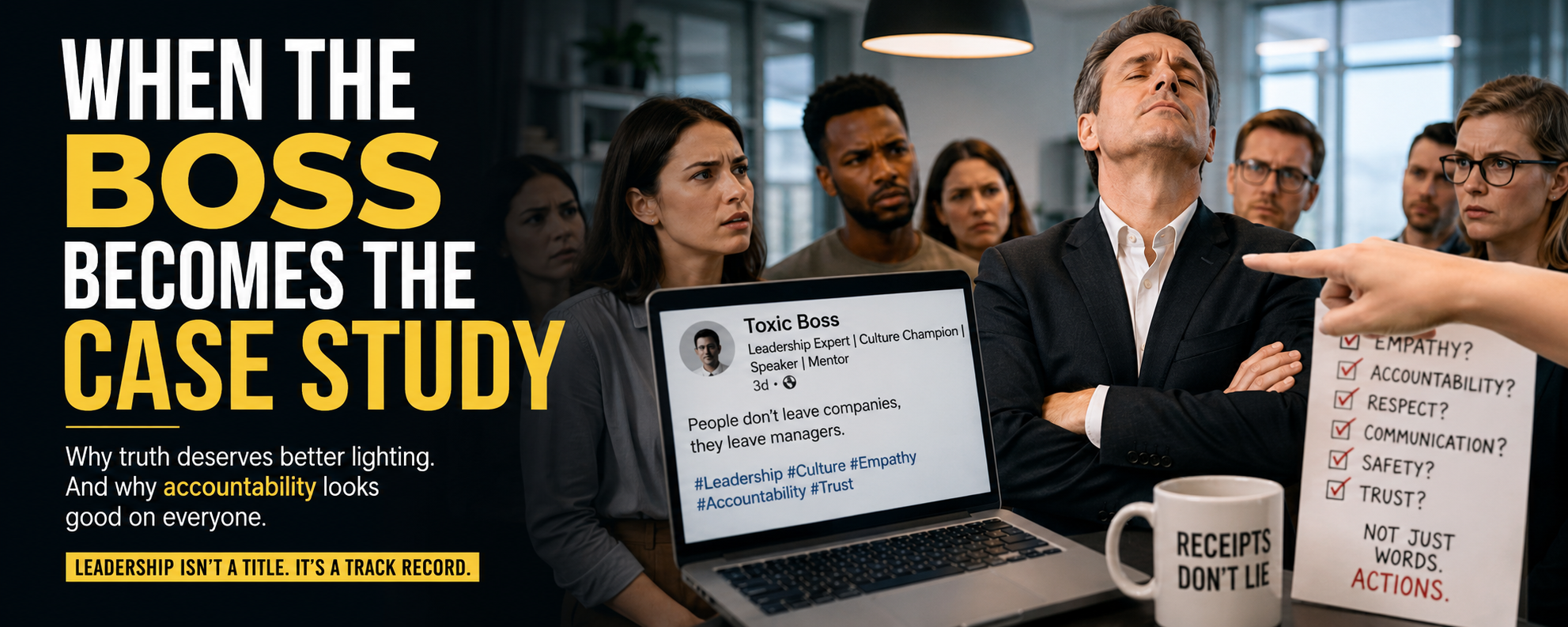
There are moments in adult life when you realize personal growth is not always quiet breathing, drinking more water, forgiving people in silence, or posting a quote about choosing peace while your left eye twitches like it has been summoned by corporate trauma. Sometimes personal growth is simply learning how long you can stare at a toxic former boss’s LinkedIn post about empathy before your thumb starts moving toward the comment box like it has been possessed by the spirit of every exit interview that never mattered. There you are, trying to be normal, trying to scroll responsibly, trying to behave like someone whose nervous system has been approved by HR, and suddenly the person who once made meetings feel like hostage negotiations is online talking about “building trust,” “creating safe spaces,” and “leading with compassion.” And that is when something ancient wakes up inside you. Not rage exactly. Not revenge. Something more professional. Something with receipts.
Because there is a very specific kind of comedy in watching someone who treated people like expired office furniture publicly rebrand themselves as a leadership philosopher with a headshot and hashtags. They write posts about accountability as if accountability is a decorative word they found at HomeGoods and placed gently on the executive bookshelf. They talk about culture like they did not personally turn it into a haunted break room with fluorescent lighting. They say things like “people don’t leave companies, they leave managers,” and every former employee within a thirty-mile emotional radius suddenly sits upright like the universe just opened a courtroom. That sentence alone should come with a comment section waiver, because if you build a public brand around leadership, empathy, and trust, eventually someone who survived your leadership, empathy, and trust may appear with a very reasonable follow-up question and a terrifyingly calm tone.
And that is where the @ symbol enters the story. The @ symbol is not punctuation. It is not technology. It is not a harmless social media feature. The @ symbol, when used on a toxic former boss, is a summoning ritual with Wi-Fi. You type it, their name appears, and suddenly LinkedIn stops being a professional networking platform and becomes a courtroom with profile pictures, endorsements, and people named Linda typing “Wow, this is powerful” while sipping coffee from a mug that says “Be Kind.” I did not wake up choosing chaos. I woke up choosing context. Chaos is throwing a printer out a window because it jammed during payroll. Context is saying, “Since you enjoy posting publicly about leadership, I thought you might enjoy being included in the conversation as a case study.”
And let’s be honest, there is a part of you that knows this may not be your most peaceful decision. This is not the version of you wearing linen, drinking lemon water, and calmly choosing emotional detachment. This is the version of you who has seen one too many “grateful to lead such an amazing team” posts from people who led their teams the way a smoke alarm leads a kitchen fire: loudly, randomly, and after the damage has already started.
So you stare at the name. You stare at the comment box. You feel your soul briefly consult with legal, therapy, and the ghost of every coworker who ever whispered, “Is it just me?” And then you realize something very simple: sometimes the spotlight is not revenge. Sometimes the spotlight is just where the truth finally gets decent lighting.
The Spotlight Looks Different When It Comes With Receipts
Toxic bosses love visibility when visibility is wearing flattering lighting and clapping politely. They love being tagged in posts that say, “So grateful for your mentorship,” even if the mentorship mostly consisted of anxiety, vague instructions, and learning how to interpret a passive-aggressive Teams message like scripture. They love the applause, the professional compliments, the “great leader” comments from people who were never trapped in a conference room while they turned a simple update into a psychological weather event. They love when LinkedIn becomes a stage, because on a stage they can wear the costume. They can be the mentor, the visionary, the culture builder, the calm voice of wisdom who believes in people, even though half the people they believed in now need a full-body reset every time they hear the phrase “circle back.”
But when the spotlight shifts, when the comment section stops functioning as a decorative applause machine and starts behaving like an incident report with witnesses, suddenly everybody gets nervous. Suddenly there are concerns about tone. Suddenly there is a need for nuance. Suddenly people who watched the whole circus happen in silence become deeply passionate about “taking the high road,” which is a fascinating concept because the high road apparently only appears after someone who was mistreated starts telling the truth. When the behavior was private, it was “leadership style.” When the consequences become public, it is “unprofessional.” That is how toxic management survives. It creates damage behind closed doors, then acts offended when someone opens a window.
The funny thing is, most people do not tag a toxic boss because they are bored. Nobody wakes up, stretches, pours coffee, and says, “You know what this Tuesday needs? A professional fireworks display with possible career consequences.” Usually, by the time someone even considers tagging that person, they have already swallowed years of nonsense with a smile so tight it could hold a suspension bridge together. They have tried being patient. They have tried explaining. They have tried documenting. They have tried private conversations that somehow left them feeling more confused, more blamed, and more professionally gaslit than before. So when the former boss starts publicly selling themselves as the ambassador of healthy leadership, the comment is not random. It is not dramatic. It is the invoice finally arriving.
And the invoice has line items. Emotional labor. Unclear expectations. Meetings that could have been emails but became character assassinations with screen sharing. Feedback that changed depending on mood, weather, and whether leadership had recently attended a webinar about “radical candor” and misunderstood the assignment. People act like the truth appears out of nowhere, but most of the time the truth has been sitting quietly in the corner for years, wearing a name badge, holding screenshots, and waiting for someone to stop pretending the room is not on fire.
There is also a special kind of bravery in being the first person to say what everyone else has been carefully not saying. Because once one person speaks, the air changes. Other people start remembering. Other people start nodding. Other people start sending private messages that say, “I wanted to say this for years,” which is both validating and slightly annoying because apparently the revolution had a group chat and nobody invited you until after you posted.
That is the part people miss. The tag is not always revenge. Sometimes it is punctuation. Sometimes it is the period at the end of a sentence that leadership kept interrupting. Sometimes it is one calm little blue hyperlink saying, “Since you brought up accountability, let us all gather around this inspirational campfire and discuss the weather conditions you personally created.” And yes, that makes people uncomfortable, because truth in public has a very different sound than truth whispered in a parking lot after another employee resigns.
“Let’s Not Air This Publicly” Is Usually Said by People Who Privately Installed the Dryer
The moment someone tells the truth publicly, the professional etiquette committee appears out of nowhere with clipboards, concern, and the emotional urgency of people who were mysteriously unavailable when the actual mistreatment was happening. They say, “This should be handled privately,” as if private handling was not already attempted, ignored, minimized, buried, rebranded, and filed under “communication breakdown.” They say, “There are two sides to every story,” which is true, but sometimes one side has screenshots, witnesses, turnover, and a pattern so obvious it could be used in onboarding. They say, “You should not burn bridges,” which is often said by people standing comfortably on bridges other people were pushed from.
And listen, I understand the argument. Not every workplace conflict belongs on LinkedIn. Not every bad boss needs to become a public documentary. Not every painful experience should be turned into content, because life is already exhausting and some people are just trying to survive without turning their professional history into a limited series called “The Manager Who Scheduled My Anxiety.” There are real consequences to speaking publicly. There are recruiters watching. There are future employers judging tone without knowing history. There are references, reputations, bills, and quiet survival calculations happening behind every decision to stay silent. Sometimes silence is not weakness. Sometimes silence is rent.
But there is also something deeply strange about how often the burden of professionalism lands on the person who was harmed rather than the person who created the harm. Employees are expected to be graceful, composed, strategic, polished, and “above it,” even after being managed by someone whose emotional intelligence seemed to be running on trial software. The toxic boss gets to be “direct,” “intense,” “old school,” “results-driven,” and “passionate.” The employee gets to be “difficult” the minute they describe what direct, intense, old school, results-driven passion actually felt like from the receiving end. Corporate language has a magical way of turning bad behavior into leadership texture and honesty into a character flaw.
That is why the phrase “let’s not air dirty laundry publicly” is so funny to me. Because the laundry was dirty when people were wearing it to work every day. It was dirty when employees were crying in their cars, rehearsing basic questions before asking them, decoding mood shifts like storm warnings, and updating resumes after meetings that were somehow both vague and threatening. It was dirty when people left the company and everyone pretended not to know why. It was dirty when HR called it a personality conflict, leadership called it misalignment, and the team group chat called it “Tuesday.” The laundry did not become dirty because someone talked about it. Someone talked about it because it had been dirty for a long time and the entire building smelled like denial.
And let’s talk about “professionalism” for a second, because that word gets dragged into these situations wearing a tiny corporate helmet. Professionalism should mean respect, honesty, accountability, and basic human decency. But too often, professionalism gets weaponized into a muzzle. It becomes a way to tell people, “Please describe your mistreatment in a tone that protects the comfort of the people who allowed it.” That is not professionalism. That is customer service for dysfunction.
The wildest part is how many toxic workplaces do not want healing; they want silence with better formatting. They want people to move on, but not explain what they are moving on from. They want former employees to be “grateful for the experience,” even if the experience was mostly learning how to emotionally brace before a calendar invite. They want closure, but only if closure does not include names, details, witnesses, or the phrase, “Actually, that was not okay.”
And that is the part people forget: accountability does not become cruel just because it becomes visible. Sometimes visibility is the only reason anyone finally pretends to care. Private accountability sounds noble until you realize private accountability often means the same three people having a quiet conversation, writing nothing down, changing nothing meaningful, and hoping the person who raised the issue gets tired enough to call it closure.
So yes, when a toxic boss builds a public brand around emotional intelligence, trust, and culture, it is not unreasonable for someone to say, “Interesting, because here was my experience.” That is not airing dirty laundry. That is customer feedback. That is product review. That is adding sources to the research paper. If you are going to sell leadership in public, you should probably expect the public to compare the marketing material with the lived experience.
Toxic Bosses Love Accountability Until Accountability Learns How to Tag
The great irony of toxic leadership is that it almost always knows the language of healthy leadership. That is what makes it so exhausting. These are rarely people walking around saying, “I enjoy creating confusion and emotional instability.” No, they know the words. They know the phrases. They know how to talk about values, mission, trust, ownership, growth mindset, feedback culture, psychological safety, and servant leadership. They can stand in front of a team and say all the right things while somehow making everyone in the room feel like they should keep their emergency snacks and resume updated. The vocabulary is polished. The behavior is where the wheels come off and roll into the retention report.
That is what makes the public posting so absurd. A toxic boss will write, “My door is always open,” and every former employee remembers that yes, the door was technically open because people were sprinting through it like a fire drill. They will write, “I believe in empowering my team,” and someone remembers being empowered to do three jobs with one salary and a vague promise of future opportunity. They will write, “Culture matters,” and the entire alumni network of their former employees collectively hears a laugh track. They will post about kindness, and somewhere a person who survived their weekly meetings gently closes the laptop before the spirit leaves their body.
And then, if someone finally responds with the truth, the toxic boss often acts shocked, as if the comment fell from the sky with no connection to anything they ever did. “Why would you say this?” they ask, with the wounded tone of someone who believes consequences are a surprise party. Sir, because you did it. This is not creative writing. This is not fan fiction. This is a documentary with better punctuation. If your leadership style left a trail of burned-out people, nervous systems, resignation letters, and group chats named “Are We Okay,” then perhaps the issue is not that someone tagged you. Perhaps the issue is that your leadership brand and your leadership reality are not on speaking terms.
Toxic bosses do not fear drama. They create plenty of it. What they fear is documentation, witnesses, and a comment section that refuses to clap on command. They are comfortable with confusion because confusion gives them room to rewrite the story, but they are far less comfortable when the people who were there begin comparing notes in daylight.
They also fear patterns, because one story can be dismissed as bitterness, but ten stories start looking like a management style with a body count. One person speaking up can be labeled emotional. Two people can be labeled disgruntled. But when the quiet messages start arriving, when people begin saying, “Same thing happened to me,” suddenly the narrative stops being a complaint and starts becoming data. And if corporate America loves anything, it is data, unless the data has feelings and screenshots.
That is why the public comment is so powerful. Not because it destroys anyone. Not because it fixes everything. But because it disrupts the fantasy that the toxic boss gets to write the entire story alone. It says, “Actually, there are other chapters.” It says, “The people you managed remember the plot differently.” It says, “You can keep posting about leadership, but some of us were in the room where your leadership happened, and the reviews are mixed.”
The truth is, toxic bosses have been tagging themselves for years. Every time they post about culture, they invite comparison. Every time they write about empathy, they invite memory. Every time they claim to develop people, they invite the people they developed into job seekers, migraine owners, and amateur labor lawyers to quietly raise an eyebrow. They want the public benefits of leadership branding without the public possibility of leadership review. But that is not how visibility works. If you want the spotlight, you do not get to control every shadow it reveals.
Now, does that mean everyone should start tagging every toxic boss they have ever had? Absolutely not. Some people deserve peace more than a viral comment. Some people deserve sleep more than a debate thread. Some people need to protect their careers from systems that still punish truth more efficiently than they punish misconduct. But when someone does decide to speak, when someone decides the public performance has become too insulting to the private reality, I understand the impulse. Sometimes the truth does not need a megaphone, but it does need better lighting.
The workplace taught people to be quiet for years and called it professionalism. Then social media gave people a microphone, and suddenly everyone who benefited from the silence started calling honesty dangerous. Maybe it is dangerous. But so is letting bad leadership keep wearing a costume labeled “mentor” while the people who survived it are still trying to recover their confidence in the parking lot.
Final Thoughts: Sometimes the Comment Section Becomes the Exit Interview That Actually Gets Read
I am not pretending this is simple. It is not. Calling out a toxic boss publicly can be satisfying for approximately seven glorious seconds and then terrifying for the next several business days. You start imagining who saw it, who screenshotted it, who sent it to whom, whether someone from HR is breathing into a paper bag, and whether your former boss is currently typing a response that begins with “I am disappointed” like they are about to perform Shakespeare in a performance improvement plan. There is risk in telling the truth, especially in a professional world that often prefers polished dishonesty over uncomfortable accuracy.
But there is also a cost to endless silence. There is a cost to watching the same people who created harm get promoted, applauded, celebrated, and reposted as thought leaders. There is a cost to being told to move on while the person who made the environment unbearable gets to move up. There is a cost to seeing leadership theater rewarded while the people who endured the backstage version are expected to smile, clap, and keep their experiences locked in a drawer labeled “Be Professional.” At some point, silence starts to feel less like maturity and more like unpaid reputation management for someone who never earned it.
That is why the question matters. If a toxic boss builds a public brand around leadership while privately treating people like disposable office equipment with Outlook calendars, is it wrong to tag them, or is that just adding footnotes to the autobiography they keep posting one hashtag at a time? Is it dramatic, or is it documentation? Is it unprofessional, or is it simply inconvenient for people who benefited from everyone staying quiet? I do not think there is one clean answer, because real life is messy, careers are fragile, and the truth does not always arrive in a format that LinkedIn’s algorithm finds inspirational.
But I do know this: people are tired of watching bad leaders hide behind good language. They are tired of being told to heal quietly while the person who hurt them publicly collects applause. They are tired of the corporate magic trick where private harm becomes a misunderstanding, public truth becomes aggression, and accountability becomes something everyone supports in theory until it recognizes a name in the comment section.
So yes, maybe tagging a toxic boss is dramatic. Maybe it is spicy. Maybe it is the professional equivalent of setting a PowerPoint on fire while maintaining eye contact. But sometimes the drama did not start with the tag. Sometimes the tag was just the first time the drama had captions. Sometimes the person who always wanted the spotlight finally got it from a different angle, and for once, the lighting was honest.
And if that makes people uncomfortable, maybe that discomfort is not the problem.
Maybe it is the meeting finally starting.