
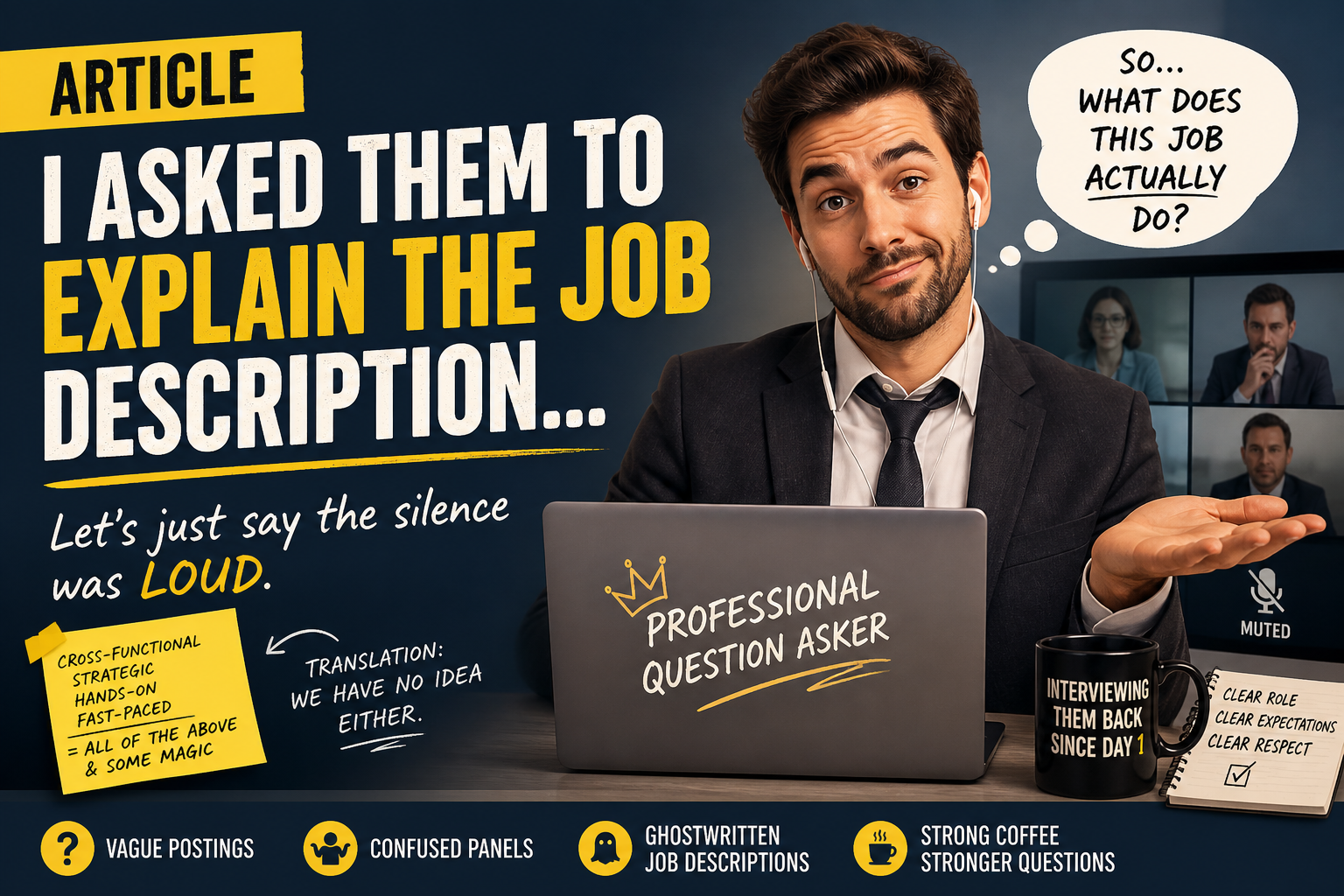
You ever ask a Zoom panel to walk you through the job description before the interview begins?
I did.
Not because I was confused. Not because I forgot what I applied for. Not because my resume had blacked out somewhere between Workday, Taleo, and the emotional DMV known as “Create Candidate Profile,” then wandered into the wrong corporate forest wearing a tiny visitor badge and whispering, “I think we are in marketing now.”
I asked because at some point in modern job hunting, candidates have been trained to treat every job description like sacred literature, as if it descended from Mount LinkedIn carved into two stone tablets by the gods of “fast-paced environments,” when in reality half of these postings read like they were assembled during a smoke alarm by three departments, one consultant, a recruiter who left the company in March, and a hiring manager who believes “wear many hats” is not a warning sign but a leadership philosophy. The title says “Operations Manager,” but the duties include sales, marketing, finance, logistics, account management, customer success, executive reporting, staff training, process improvement, vendor negotiation, social media strategy, emotional support for leadership, emergency printer therapy, and “other duties as assigned,” which is corporate language for “one day you may be asked to personally hold the building together during a thunderstorm while leadership asks if you have bandwidth.”
And yet candidates are supposed to show up glowing with enthusiasm, like we did not just read a job description that appears to be six full-time jobs stacked on top of each other wearing a trench coat and asking for “three to five years of experience.” We are supposed to say, “This role really aligns with my background,” even though the role itself appears to have no fixed address, no adult supervision, and a salary range that looks like a weather forecast. We are supposed to say, “I’m passionate about cross-functional collaboration,” when everyone knows “cross-functional” often means “nobody knows who owns this, but whoever gets hired will be blamed when it catches fire.”
So there I was, sitting in the Zoom waiting room, dressed professionally from the waist up and spiritually lying face down on the floor from the neck down, waiting for the panel to arrive like I had been summoned before the Council of Calendar Fatigue. Then they appeared: HR, the hiring manager, and one mysterious person from another department who had the unmistakable energy of someone added to the invite at the last second and still processing the betrayal. They smiled the corporate smile, the one that says, “We are very excited to meet you,” while also saying, “Nobody has looked at your resume since Tuesday,” and then HR said, “Before we begin, do you have any questions?”
Big mistake.
The Question That Made Wi-Fi Nervous
I said, “Yes, actually. Could you walk me through the job description and explain what this role is responsible for?”
And the room froze.
Not dramatically. Nobody dropped a coffee mug in slow motion while violins played. Nobody gasped like I had revealed a secret twin in a courtroom. It was worse than that. It was the polite, professional, deeply terrifying silence of three employed adults realizing the candidate had just asked them to explain the exact thing they invited him to discuss. It was the kind of silence that makes Wi-Fi nervous, the kind where everyone briefly checks their screen to confirm they are not muted, frozen, or legally protected by a sudden outage.
Everyone looked at everyone else. HR looked at the hiring manager. The hiring manager looked at the mystery panelist. The mystery panelist looked somewhere near their second monitor, possibly searching for the job posting, the meaning of life, or a transfer request. That was the moment I knew nobody had come prepared to explain the job. They had come prepared to evaluate me. They had come prepared to ask about my leadership style, my strengths, my weaknesses, my background, my experience with conflict, my comfort level with ambiguity, and whether I could describe a time I influenced stakeholders without authority, which is corporate for “tell us how you survived people who outranked you but had worse ideas.” But they had not come prepared for the most basic question in the room: what is this job?
HR finally blinked first and said, “Well, it is really a cross-functional role,” which is one of those phrases that sounds polished until you realize it has the nutritional value of printer paper. Everything is cross-functional now. Nobody has normal functions anymore. Jobs do not sit in departments; they float through the organization like haunted office furniture, collecting abandoned responsibilities and unresolved leadership decisions. Cross-functional means you will attend meetings with people who disagree about what you do, report to someone who says “circle back” like a religious chant, and inherit problems created before your laptop was issued.
Then the hiring manager added, “We need someone strategic, but also hands-on,” and there it was, the phrase that should come with a siren, a waiver, and a small HR pamphlet titled “So You Have Been Asked To Be An Executive Thinker With Intern-Level Obedience.” Strategic but hands-on means they want someone who can build the plane, fly the plane, serve snacks on the plane, redesign the boarding process, calm the passengers, create a dashboard about the plane, explain the plane to leadership, and still crawl under seat 14B to restart the router when the plane’s Wi-Fi develops abandonment issues. They want vision, execution, patience, speed, humility, courage, analytics, empathy, and someone who can “jump in where needed,” which is corporate for “there are no boundaries and the floor is lava.”
Then, because the corporate gods had not yet finished seasoning the absurdity, the mystery panelist leaned toward the camera and said, “The role is still evolving.”
Wonderful.
The role was not a job.
It was a weather system.
When the Interview Becomes an Audit
At that point, something shifted. I was no longer just a candidate trying to make a good impression while pretending my laptop camera was not aging me in fluorescent betrayal. I had become an unpaid organizational consultant wearing a button-down shirt and silently inspecting the structural integrity of their hiring process. Because once you ask a panel to explain the job and they respond with fog, vibes, and one phrase from a leadership retreat, the interview becomes less about whether you are qualified and more about whether the company knows what it is hiring for in the first place.
And a lot of companies do not. They know they are overwhelmed. They know something is broken. They know the team is stretched, the process is failing, customers are irritated, reporting is messy, leadership wants answers, and someone somewhere said, “We need to hire someone for this,” as if hiring one human being into an undefined pile of organizational laundry will suddenly restore order to the kingdom. But instead of defining the problem, narrowing the scope, clarifying priorities, setting expectations, and deciding what success actually looks like, they create a job description that reads like a corporate junk drawer with benefits pending.
A little operations. A little sales. A little project management. A little analytics. A little customer service. A little strategy. A little change management. A little “must thrive in ambiguity,” because apparently chaos sounds more executive when you turn it into a competency. Then they invite candidates into interviews and expect them to perform enthusiasm for a role nobody can clearly describe, as if passion alone can compensate for the fact that the job appears to have been written by a committee trapped in a conference room with low blood sugar.
That is the part of modern interviewing that makes it feel like theater, and not normal theater either, but experimental theater, the kind where the audience is not sure if the show started, the actors are making eye contact too aggressively, and someone in black clothing is moving a chair across the stage while whispering about synergy. Candidates are trained to be agreeable. We are told to be positive, curious, flexible, excited, humble, prepared, polished, and grateful for the chance to explain our career journey to people who may or may not have opened the attachment. We are told not to challenge too much too early because we might seem difficult, but we are also told to ask thoughtful questions, which apparently means questions thoughtful enough to flatter the company but not so thoughtful that the panel begins sweating through its branded quarter-zip.
So we ask the safe questions. “What does success look like in the first ninety days?” “How would you describe the team culture?” “What are the biggest priorities for this role?” And those are fine questions, but sometimes we need to ask the question underneath all of them: what am I actually walking into? Because “success in ninety days” does not mean much if the role is secretly three departments and a group chat. “Team culture” does not mean much if the culture is surviving on caffeine, resentment, and a shared Google Sheet named FINAL_FINAL_USE_THIS_ONE_v7. “Biggest priorities” does not mean much if every priority is urgent because leadership ignored it for six months and now wants a new hire to arrive with a mop, a cape, and a clean dashboard.
The panel tried to recover. They started describing pieces of the job, but each person described a different creature. HR described a collaborative partner. The hiring manager described a tactical operator. The mystery panelist described someone who could “drive alignment,” which is one of those phrases that sounds important until you realize it usually means persuading adults to answer emails they have been ignoring since the previous quarter. By the time they finished, the role had transformed from a position into a mythology, something between a senior leader, project manager, analyst, therapist, firefighter, process architect, customer whisperer, and office raccoon with PowerPoint access.
And I nodded. Professionally. Because you cannot just laugh in a Zoom interview, even when the job description has begun multiplying like a gremlin after midnight. But internally, I was standing there with a clipboard, wearing a hard hat, checking for load-bearing nonsense and thinking, “This building may not be up to code.”
The Candidate Is Not the Only One Being Interviewed
Here is the thing companies forget: an interview is not a royal audience. It is not the employer sitting on a velvet throne while candidates arrive one by one to juggle measurable outcomes, emotional intelligence, and STAR-format responses for the privilege of being ghosted by Thursday. It is supposed to be a mutual evaluation, which means the company is interviewing the candidate, yes, but the candidate is also interviewing the company, the process, the leadership, the clarity, the culture, the expectations, and the likelihood that accepting this role will require updating a resume again in six months with the phrase “navigated ambiguity” because “survived chaos with a badge” sounds too honest.
Candidates are paying attention. We notice when the panel is late but still asks about time management. We notice when nobody read the resume but everyone wants us to summarize it like we are doing story time at a professional daycare. We notice when the job description says one thing, HR says another thing, the hiring manager says a third thing, and someone from finance joins halfway through to suggest the role may also own budgeting, vendor contracts, and maybe the holiday party if Carol is still out. We notice when “collaborative culture” sounds suspiciously like “no one makes decisions,” when “high visibility” means “leadership will look at your work only when something goes wrong,” and when “entrepreneurial environment” means “we have no process, but we do have expectations.”
We also notice when companies act surprised that candidates want clarity, as if asking what the job actually does is some kind of radical labor uprising. How dare you ask what you will be responsible for before agreeing to pursue it. How dare you request alignment before entering a building full of meetings called alignment. How dare you want to understand expectations before spending four rounds proving you can meet them. But asking a company to explain the role is not rude. It is responsible. It is not aggressive. It is basic adult due diligence, the professional equivalent of checking whether the bridge exists before agreeing to sprint across it while holding a laptop and a quarterly target.
Good companies do not panic when you ask simple questions. Good hiring managers can explain the role without sounding like they are reading tea leaves over a budget deck. Good teams can say, “Here is why this role exists, here is what is messy, here is what is realistic, here is where we need help, here is what success looks like, and here is what this role does not own.” That last part matters more than people realize because every job description tells you what they want, but very few tell you where the boundaries are, and a role without boundaries becomes a basement where every abandoned task goes to live.
Give me the hiring manager who tells the truth. Give me the person who says, “We have some process gaps, the reporting needs work, the team is stretched, and we need someone who can create structure, but we are not expecting one person to solve ten years of organizational neglect before lunch.” That is useful. That is honest. That is adult. But when the answer is just “dynamic, cross-functional, evolving, strategic, hands-on, fast-paced,” congratulations, you have not described a job. You have described a haunted treadmill with a performance review cycle.
Because after you accept the offer, all those vague phrases become real problems wearing calendar invites. “Still evolving” becomes “your scope has expanded.” “Cross-functional” becomes “everyone needs something from you, but no one agrees on your priorities.” “Strategic but hands-on” becomes “please build a five-year roadmap after you manually fix this spreadsheet from 2018.” “Fast-paced environment” becomes “we confuse poor planning with urgency and call it culture.” And by the time you realize the interview was actually a warning label, your inbox already has sixteen unread messages with the subject line “Quick question.”
Final Thoughts: Ask the Obvious Question
The older I get, and the more interviews I survive, the more I believe candidates should stop saving their best questions for the end like dessert. Ask early. Ask clearly. Ask the obvious question while everyone still has their polite Zoom face on. What is this role actually responsible for? What problem is this hire meant to solve? What are the top three priorities? What would be too much for one person? What changed that made this position necessary? Who owns final decisions? What does this role not own?
Because that last question might be the most powerful one in the entire interview. What does this role not own? A company that can answer that question probably has some level of clarity, structure, and respect for human limits. A company that cannot answer that question may be preparing to hand you a laptop, a badge, a half-broken process, four departments’ worth of anxiety, and a manager who says, “We are still figuring it out,” every time your workload begins violating federal aviation laws.
So yes, I asked the panel to walk me through the job description before the interview began, and no, I do not regret it. Sometimes the most revealing moment in an interview is not when you give the perfect answer; it is when you ask one simple question and watch three people discover, live on camera, that the job description was written by a ghost, approved by a committee, inflated by leadership, polished by HR, sprinkled with buzzwords, uploaded by Chad, and never actually explained to the humans now responsible for defending it.
Candidates are not asking for perfection. We are asking for honesty. We are asking companies to stop posting jobs that look like wish lists from a department that lost its manager, its process, its budget, and its grip on reality. We are asking them to define the job before demanding we prove we are passionate about it, because “Why are you excited about this role?” becomes a very strange question when the role itself is standing in the corner wearing a fake mustache and refusing to identify itself.
So the next time a panel asks, “Before we begin, do you have any questions?” smile, take a breath, and ask them to explain the job. Not aggressively. Not dramatically. Just calmly, professionally, and with the quiet confidence of someone who has read enough job descriptions to know that sometimes the first interview is not about getting hired. Sometimes it is about finding out whether the company is hiring for a real job, a corporate identity crisis, or a weather system with benefits pending.