
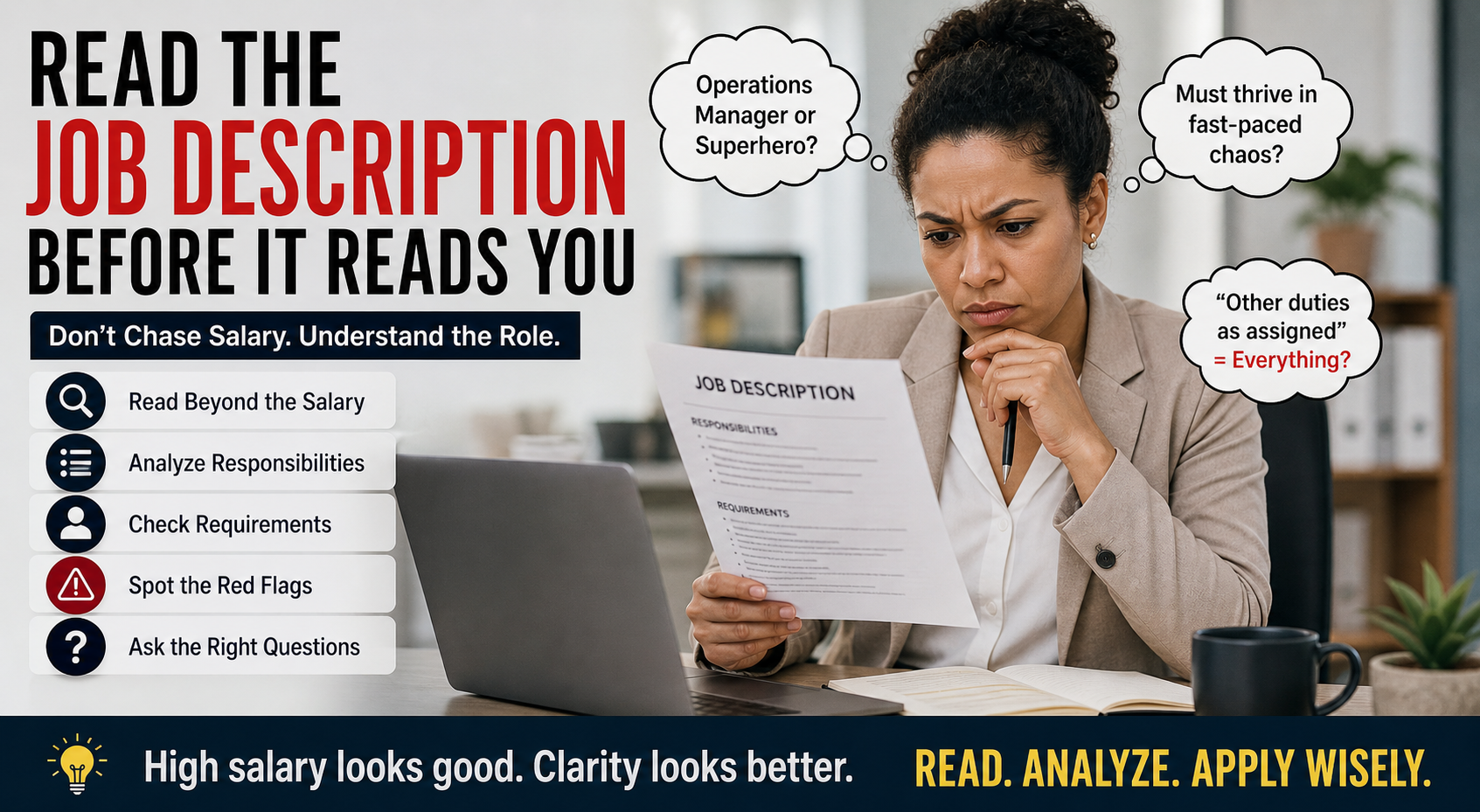
Whenever you apply for a job, read the job description like it owes you money, an explanation, and possibly a written apology from whoever decided one human being should be responsible for strategy, execution, analytics, morale, vendor management, revenue growth, emergency printer repair, and “other duties as assigned,” which is the corporate version of a trapdoor opening beneath your ergonomic chair.
Because we have all been there. You are scrolling through job postings at midnight with one eye open, your laptop glowing like a tiny unemployment campfire, and suddenly you see a salary range that looks like financial oxygen. One hundred forty thousand to one hundred ninety thousand dollars. Benefits. Remote flexibility. Growth opportunities. The posting has just walked into your living room wearing velvet slippers and whispering, “Come here, tired professional. Come live a life where groceries do not require a congressional hearing.”
And for a moment, you believe.
You picture yourself thriving. You picture the nicer apartment, the paid-off credit card, the vacation where you do not check your bank account like it is a horror movie. You imagine telling people, “Yes, I accepted a leadership role,” in that calm tone people use when they have dental insurance, matching retirement contributions, and access to a coffee machine that does not taste like it was filtered through office despair.
Then, if you are wise, you scroll down.
That is where the truth lives.
The salary is the shiny porch light. The job description is the basement.
And sometimes that basement has noises.
The title says “Operations Manager,” which sounds respectable. Reasonable. Adult. The kind of title you can explain at Thanksgiving without your uncle asking whether it is “one of those internet jobs.” But then the responsibilities begin, and suddenly this “Operations Manager” is expected to rebuild the entire company infrastructure, lead cross-functional initiatives, improve employee engagement, train new hires, redesign reporting systems, reduce costs, increase revenue, manage vendors, coach underperforming teams, create dashboards, handle escalations, forecast budgets, develop strategy, support payroll, improve customer retention, and apparently become emotionally available to the supply chain.
At that point, the job is no longer a job. It is a medieval quest with a login.
The problem is not ambition. The problem is that companies have learned to write job descriptions like they are making a wish at a corporate fountain. They throw every problem they have into the posting, slap a title on it, sprinkle in “fast-paced environment,” and hope some exhausted candidate with a strong resume and a temporarily weakened sense of self-preservation clicks apply.
And we do.
Because we are hopeful. Because rent exists. Because LinkedIn keeps sending job alerts with the emotional accuracy of a raccoon operating a dating app. Because after your seventh application of the day, every salary range starts looking less like compensation and more like a rescue helicopter.
But that is exactly why you have to read the whole thing.
Not skim it. Not glance at it. Not let the money hypnotize you while the duties crawl out of the shadows carrying a clipboard.
You have to read it like evidence.
You have to look for what they are saying, what they are not saying, what they are trying to hide under “collaborative culture,” and what kind of organizational weather system you are about to voluntarily walk into while wearing business casual and hope.
Because sometimes a job description is not a description.
Sometimes it is a confession letter with bullet points.
The Salary Range Is the Bait, Not the Biography
The first mistake people make is seeing the salary range and immediately losing all ability to read. A big salary range can make an otherwise intelligent person behave like their mouse is being chased by creditors. Suddenly you are clicking “apply” with the urgency of someone defusing a bomb, even though the job description is quietly telling you this role was last held by three people, two consultants, one burned-out director, and a spreadsheet named Brian.
That salary range is powerful. I understand it. One hundred fifty thousand dollars has a way of making “highly ambiguous environment” sound like “character building.” One hundred seventy thousand dollars can make “must be comfortable wearing many hats” sound almost charming, like maybe the hats are stylish, maybe there is a fedora for strategy, a little baseball cap for data analysis, perhaps a tasteful beret for cross-functional collaboration.
But no.
“Wear many hats” does not mean variety. It means the company has not decided where one job ends and another job begins, so they are handing you the costume rack and calling it leadership development.
This is why you read past the salary. The money tells you what they are willing to pay. The responsibilities tell you what they are trying to survive.
And sometimes those responsibilities are not normal responsibilities. They are a cry for help wearing bullet points.
You will see lines like “own operational excellence across multiple departments,” which sounds fancy until you realize “own” means “inherit every unresolved problem from the last six quarters.” You will see “build scalable processes,” which means the current process is probably one person named Linda, three sticky notes, and a shared spreadsheet that crashes whenever someone adds a border. You will see “drive alignment among stakeholders,” which means no one agrees on anything and you will be hired to stand in the middle of a conference room while people use the word “alignment” as a weapon.
Then there is “hit the ground running,” one of the most dangerous phrases in professional language. Nobody says “hit the ground running” when there is a thoughtful onboarding plan, a supportive manager, a clear training path, and a nicely labeled folder called “Start Here.” No, they say “hit the ground running” when the building is already moving, the ground is on fire, and someone from HR is smiling too hard while saying, “We are so excited to have you jump in.”
Jump in where?
The volcano?
A job description with a high salary and chaotic duties is not automatically bad. Some roles are genuinely complex. Some companies pay well because the role is demanding, important, and visible. That is fair. Adults can handle responsibility. Professionals are not allergic to hard work.
But there is a difference between a challenging role and a corporate junk drawer.
A challenging role has priorities. A chaotic role has adjectives.
A challenging role has goals. A chaotic role has “support various initiatives.”
A challenging role has leadership support. A chaotic role has “self-starter” written four times like a warning label.
That is why you cannot let the number at the top do all the talking. The salary might be beautiful, but beautiful things can still have raccoons in the attic.
Read the responsibilities slowly. Ask yourself whether they describe one role or a small village. Look at the verbs. Are you managing, leading, building, analyzing, training, coaching, selling, forecasting, reporting, repairing, resolving, escalating, presenting, and transforming? Congratulations, you may not be applying for a job. You may be applying to become the company’s emotional support department.
And yes, money matters. Absolutely. We are not pretending salary is decorative. Salary is survival with direct deposit. But when a company offers big money for a job description that sounds like an organizational tornado, you have to ask whether the compensation is pay, bait, or hazard money wearing cologne.
Because sometimes the salary is not saying, “We value this role.”
Sometimes it is saying, “Please enter the haunted house.”
Read the Requirements Like They Were Written During a Panic Attack
The requirements section is where job descriptions stop pretending to be normal and start acting like someone emptied the entire company wish list onto the page during a caffeine emergency.
At first, it is reasonable. Bachelor’s degree preferred. Seven to ten years of experience. Strong communication skills. Ability to manage competing priorities. Fine. Nothing unusual. You are still calm. You are still drinking coffee like a person with hope.
Then the software list appears.
Salesforce. HubSpot. Excel. SQL. Power BI. Tableau. Workday. ADP. Monday. Asana. Jira. SharePoint. QuickBooks. NetSuite. Google Analytics. SAP. Oracle. Slack. Teams. Smartsheet. A CRM you have never heard of. An internal platform that probably looks like it was built in 2008 by someone who hated buttons.
At that point, the job description becomes less of a role and more of a software buffet where every department walked by and added something to the tray.
This is when you pause.
Because sometimes the list is aspirational. Sometimes they are describing the tools they use. Sometimes they do not expect you to be an expert in every single platform. But sometimes, and this is where your professional survival instincts need to stand up and stretch, they absolutely do expect you to know everything because nobody internally knows how anything works anymore.
There is a very special kind of job posting that says “must be proficient in Excel,” but what they mean is “we have a workbook from 2016 with forty-seven tabs, broken formulas, hidden columns, and one pivot table that controls the emotional stability of the finance team.” They say “dashboard experience preferred,” but what they mean is “leadership wants real-time data, but nobody can define the metrics, the data sources disagree with each other, and last month someone manually typed revenue numbers into a slide deck like it was 1997.”
Read carefully.
“Experience working cross-functionally” can mean healthy collaboration. It can also mean you will spend your life chasing people who owe you answers while they hide behind meetings called “syncs.”
“Strong communication skills” can mean you need to present clearly. It can also mean leadership has been avoiding direct conversations and would like you to become the official translator between chaos and accountability.
“Ability to manage ambiguity” can mean innovation. It can also mean no one knows what success looks like, your manager is still “defining the role,” and every week someone will say, “We are building the plane while flying it,” as if that sentence should not trigger federal involvement.
And then there is the phrase that deserves its own candlelight vigil: “Must thrive in a fast-paced environment.”
That sentence is never just a sentence. It is a small red flag wearing sneakers.
Fast-paced can mean exciting. It can mean growth. It can mean the company moves quickly, makes decisions, and empowers people. Wonderful. Love that. Put it on a mug.
But too often, “fast-paced” means understaffed, undertrained, overcommitted, and allergic to documentation. It means the processes are not processes; they are folklore. It means onboarding is someone sharing their screen for twenty minutes while saying, “You’ll pick it up.” It means the last person in the role left suddenly, nobody knows where their files are, and your first week will include someone asking whether you can “take ownership” of a project that has already failed twice and is now standing in the corner smoking.
That is why requirements need to be translated.
Not cynically. Accurately.
When you see “self-starter,” ask whether they mean independent or abandoned.
When you see “entrepreneurial mindset,” ask whether they mean creative or unsupported.
When you see “comfortable with change,” ask whether they mean adaptable or constantly reorganized by people who confuse motion with strategy.
When you see “must be able to influence without authority,” ask whether they mean collaborative leadership or being accountable for people who do not report to you, do not listen to you, and will still blame you when the project stalls.
This is not negativity. This is literacy.
Corporate literacy.
The ability to read a job description and hear the quiet screaming between the bullet points.
Because companies are not always lying. Sometimes they are telling the truth accidentally. They are telling you the role is undefined. They are telling you the team is overwhelmed. They are telling you the tools are scattered, the reporting structure is blurry, the expectations are enormous, and the onboarding plan may involve a chair, a login, and spiritual warfare.
So read the requirements like they matter.
Because they do.
And if the list sounds like they are looking for a senior leader, a data analyst, a therapist, a systems administrator, a project manager, and a magician who can also do payroll, do not ignore that because the salary smiled at you.
The salary is flirting.
The requirements are testifying under oath.
The Missing Information Is Usually Wearing the Loudest Suit
One of the most important parts of reading a job description is studying what is missing, because companies often reveal themselves not only through what they include, but through what they carefully leave standing outside the room with no badge.
No salary range? Suspicious.
No reporting structure? Suspicious.
No clear success metrics? Suspicious.
No explanation of team size, budget ownership, direct reports, travel expectations, remote policy, or what the first ninety days actually look like? Suspicious with a tiny hat.
A job description should give you enough information to understand the role, not just enough adjectives to decorate confusion. If it says “lead strategic initiatives,” what initiatives? If it says “manage a team,” how many people? If it says “support leadership,” doing what? If it says “drive results,” which results? If it says “improve processes,” what processes are currently broken, how broken are they, and will I need gloves?
This is where candidates need to become investigators.
Not hostile. Not rude. Not difficult.
Just awake.
Because a vague job description is often a pre-interview stress test. It sees whether you will accept unclear expectations before the company even has to explain them. It is basically the organization whispering, “Will you walk into this fog if we use enough words like growth, impact, and ownership?”
And many people do, because candidates have been trained to be grateful for access instead of curious about reality.
We are told to be excited. Be positive. Be flexible. Be passionate. Be humble. Be prepared. Be polished. Be grateful for the opportunity to interview for a job that may or may not include the responsibilities of four departed employees and one missing intern.
But being prepared does not mean memorizing corporate values and smiling like a hostage on Zoom. Being prepared means reading the job description deeply enough to ask intelligent questions that protect your time, energy, sanity, and future blood pressure.
Ask what success looks like in the first ninety days. Ask what problem the role was created to solve. Ask whether it is a backfill or a new position. Ask who the role reports to. Ask what resources are already in place. Ask what tools the team actually uses daily versus what appeared in the posting because someone copied and pasted from another department’s wish list. Ask what the biggest challenge is. Ask why the last person left, if appropriate. Watch how they answer.
Because the answer matters, but the reaction matters too.
A healthy company appreciates thoughtful questions. A messy company gets nervous when you read the menu before ordering.
There is also that famous little phrase at the bottom: “Other duties as assigned.”
Now, let us be fair. Every job needs some flexibility. No job description can capture every task, every meeting, every weird Tuesday, every urgent thing that appears because business is business and life is a poorly formatted calendar invite.
But “other duties as assigned” can also be a legal junk drawer where responsibilities go to avoid accountability. It can mean “we reserve the right to keep adding things until your title becomes symbolic.” It can mean “this job may expand faster than your compensation.” It can mean “we are not sure what this role is yet, but we are very confident you will be blamed for it.”
That does not mean you automatically run. It means you ask.
Ask what kind of additional duties typically come up. Ask how priorities are set when everything feels urgent. Ask how workload is balanced. Ask how leadership decides what falls inside the role and what requires additional support.
Because if a company cannot explain the job during the interview process, imagine trying to succeed in it after the welcome email.
And please, for the love of employment, stop assuming the job description is just a formality.
It is not.
It is the first interview.
Before they interview you, you should interview the posting.
Read the title. Read the duties. Read the requirements. Read the benefits. Read the missing pieces. Read the language. Read the tone. Read the desperation. Read the little phrases that sound normal until you realize they are standing near an open manhole.
If the posting says “competitive salary” but does not list one, ask yourself competitive with what? Rent? Inflation? A lemonade stand with venture funding?
If the posting says “family culture,” ask whether that family has boundaries.
If it says “rockstar,” close the tab and drink water.
If it says “ninja,” report the listing to whatever spiritual authority you trust.
If it says “must have a sense of humor,” understand that the humor may be required because the processes are illegal in twelve emotional states.
The missing information is never silent.
It is just waiting for you to notice.
Final Thoughts
Reading a job description is not about being negative. It is about being professionally awake in a job market that keeps asking candidates to bring enthusiasm to situations that look suspiciously like organizational arson.
You can still apply. I still apply. We all still apply, because opportunity sometimes hides inside imperfect postings, and not every awkward job description means the company is a flaming shopping cart rolling downhill toward a quarterly planning meeting.
But apply with your eyes open.
Apply like someone who understands that a salary range is only one part of the story. Apply like someone who knows “fast-paced” can mean exciting or completely feral. Apply like someone who sees “wear many hats” and immediately asks whether the company also provides a neck brace. Apply like someone who knows a job title can say “Manager” while the responsibilities say “please rescue our entire infrastructure before lunch.”
Because job descriptions are not just advertisements. They are clues.
They tell you what the company values, what it fears, what it has not fixed, what it needs, what it expects, and sometimes what it has been pretending is normal.
So read them. Highlight them. Question them. Translate them. Bring notes to the interview. Ask specific questions. Protect your peace like it has a benefits package.
Because the high salary may look exciting, but sometimes that money is hazard pay wearing a blazer.
Sometimes the company is not offering growth. It is offering a folding chair in front of the organizational tornado.
And sometimes, before you ever meet the recruiter, before you ever join the Zoom, before you ever answer why you are interested in the role, the job description has already answered the real question.
No, thank you.
This position has not been selected to move forward.