
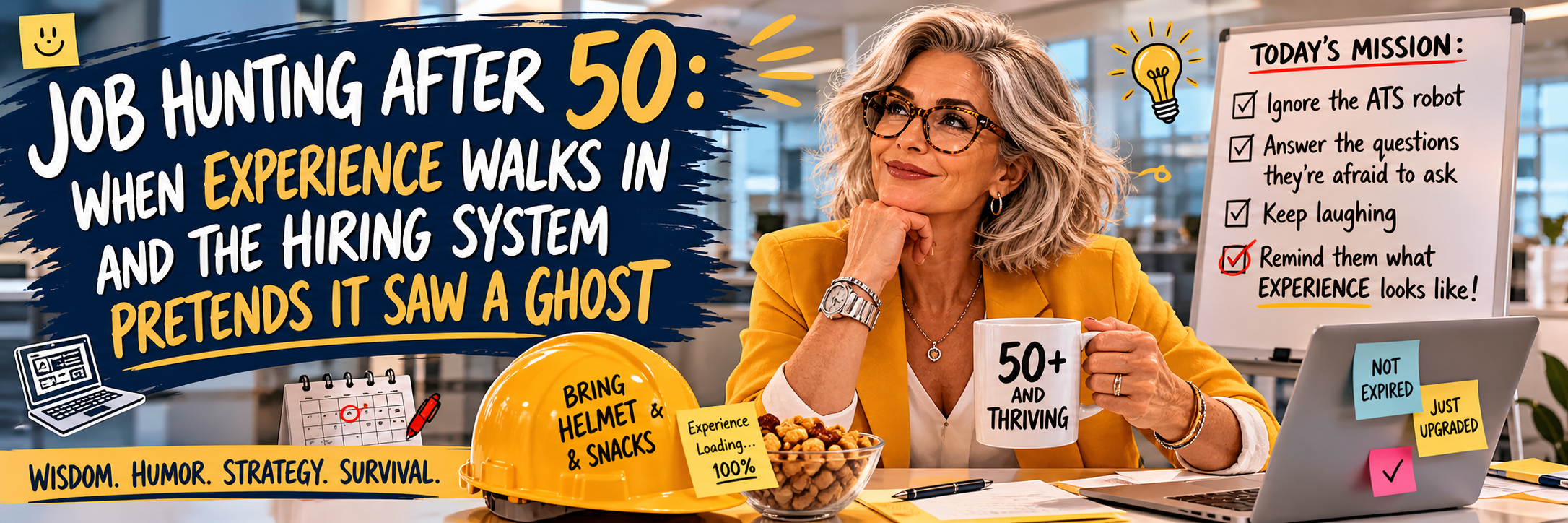
There should be a separate orientation packet for job hunting after 50, and not the fake kind of orientation where someone named Brandon from People Operations tells you the company is “excited to have you here” while nobody has ordered your laptop, your badge opens three doors but not the one with the bathroom, and your manager is still trying to remember whether your role reports to Marketing, Operations, or the haunted folder labeled “Strategic Initiatives.”
No, I mean a real packet.
A survival packet.
A helmet. A snack. A back brace. A password manager. A small emotional support lasagna. A legally binding apology from every company that says it “values experience” right before rejecting someone because they appear to have survived too much of it. Maybe even a laminated card that says, “You are not losing your mind. The job description did, in fact, ask for twenty years of wisdom, then panic when you arrived with actual wisdom.”
Because job hunting after 50 is not simply applying for jobs. It is entering a corporate obstacle course where everyone claims they want leadership, maturity, patience, accountability, mentorship, crisis management, communication skills, strategic thinking, emotional intelligence, and someone who can “hit the ground running,” which sounds beautiful until you realize they only want those things in theory, like how people say they want honesty but then get offended when you explain that the department is being held together by three spreadsheets, one overwhelmed coordinator, and a manager whose main leadership philosophy is forwarding emails with “thoughts?” at the top.
They say they want someone seasoned.
Then someone seasoned applies.
Suddenly the room goes quiet.
Suddenly “experienced” becomes “overqualified.” Suddenly “leadership presence” becomes “might challenge our broken process.” Suddenly “mentor junior employees” becomes “may accidentally expose that we promoted a 27-year-old because he owns a blazer and says ‘alignment’ with confidence.”
And that is where the comedy begins, because “overqualified” may be one of the most ridiculous words in modern hiring. Imagine going to the emergency room and hearing, “We loved your background, doctor, but unfortunately you seem too capable of saving lives, and we were really hoping for someone with three to five years of experience and a stronger willingness to guess.” Imagine hiring a pilot and saying, “You have flown too many planes. We are looking for someone more junior, preferably with enthusiasm, fresh perspective, and no memory of turbulence.”
But in corporate America, somehow competence can walk into the room wearing a cape, holding receipts, carrying decades of results, and the hiring team will whisper, “I do not know. They seem like they might ask follow-up questions.”
That is the real fear.
Not age.
Not salary.
Not culture fit.
Follow-up questions.
Because after 50, you have seen enough workplace theater to know when the set is cardboard. You know when “fast-paced environment” means “nobody planned anything.” You know when “wear many hats” means “we fired four people and replaced them with vibes.” You know when “competitive salary” means “we are competing with your bills and currently losing.” You know when “family culture” means Thanksgiving dinner, but everyone is passive-aggressive and one uncle controls payroll.
And companies know that you know.
That is why they get nervous.
The Job Posting Wants a Grown-Up, Until a Grown-Up Applies
Job postings are where companies write love letters to imaginary employees.
They want a strategic thinker who can execute tactically. A collaborative leader who can work independently. A self-starter who can follow direction. A change agent who respects legacy systems. A mentor, builder, analyst, firefighter, therapist, coach, spreadsheet whisperer, client diplomat, process designer, morale repair technician, and emotional support adult who can calmly walk into chaos and somehow make the dashboard green by Friday.
They want leadership without ego, maturity without salary expectations, experience without boundaries, confidence without memory, and wisdom that somehow has never encountered a bad boss, failed rollout, merger disaster, budget cut, reorganization, or leadership retreat where adults used sticky notes to rediscover common sense.
Then someone over 50 applies and says, “Great, I have done all of that.”
And suddenly the company reacts like experience is a suspicious item left unattended in the lobby.
They read the resume and see decades of results. They see people managed, departments stabilized, crises handled, revenue protected, teams mentored, clients saved, systems improved, fires extinguished, disasters cleaned up, and impossible deadlines met while someone in leadership was still deciding whether the new logo should be blue or slightly more emotionally available blue.
And instead of thinking, “This person could help us,” they think, “This person may know things.”
Terrifying.
Because the modern hiring process does not always want knowledge. Sometimes it wants compliance with a LinkedIn headline. It wants someone hungry enough to accept confusion as culture. It wants someone excited to “build the plane while flying it,” which is corporate language for “we sold tickets before checking whether wings were included.”
People over 50 often hear the coded concerns before anyone says them out loud.
Will they fit in?
Will they be too expensive?
Will they be comfortable reporting to someone younger?
Will they adapt to technology?
Will they have enough energy?
These questions are fascinating because they are almost never asked when a younger candidate has never led a team, never managed a crisis, never owned a budget, never handled a difficult client, never survived a restructuring, and believes workplace conflict can be solved by adding “circle back” to the end of an email.
But someone over 50 has to prove they can still learn software, as if they did not survive fax machines, pagers, dial-up internet, BlackBerry culture, Lotus Notes, Windows updates that sounded like aircraft engines, and every corporate platform ever created by someone who clearly hated humans.
You think someone over 50 cannot learn your project management tool?
Friend, they learned life before buttons explained themselves.
They survived printers that needed negotiation. They survived conference calls where half the meeting was someone yelling, “Can you hear me now?” They survived Excel before it became a personality disorder. They survived managers who printed emails. They survived software rollouts where training consisted of a PDF, a prayer, and one person named Linda who “kind of knew the system.”
They can learn your dashboard.
They just may also notice the dashboard is lying.
And that is the problem.
“Overqualified” Is Corporate for “You Look Like You Have Standards”
The word “overqualified” deserves its own museum exhibit.
It should be displayed under soft lighting beside other corporate phrases that sound professional but mean something else entirely, like “we went in a different direction,” “we will keep your resume on file,” “the position has been paused,” and “we are looking for someone more aligned with the role,” which usually means, “We found someone cheaper, quieter, or related to someone on the leadership team.”
Overqualified is especially funny because it treats competence like a safety hazard.
A candidate walks in with leadership, industry knowledge, emotional maturity, problem-solving ability, and the kind of calm that only comes from surviving three recessions and a boss who once scheduled a meeting to discuss why there were too many meetings, and the company says, “We are concerned you may become bored.”
Bored?
At work?
In this economy?
People are not leaving jobs because they solved capitalism by Thursday. They are leaving because companies keep building roles out of burnout and then acting surprised when employees develop facial expressions during staff meetings.
The “you may become bored” concern is almost never about boredom. It is about fear. They fear you may see the cracks too quickly. They fear you may ask why the role has been open for eight months. They fear you may ask what happened to the last three people. They fear you may ask why the job description has leadership responsibilities but individual contributor pay. They fear you may understand that “growth opportunity” sometimes means “we cannot afford the role we actually need, so we are hoping ambition will cover the invoice.”
And maybe, yes, they fear you may not tolerate nonsense with the same bright-eyed confusion as someone who has not yet learned that “urgent” often means “someone above us forgot.”
After 50, you know things.
You know when a company says “we are like a family,” the follow-up question should be, “Healthy family or group text with unresolved trauma?”
You know when they say “we value transparency,” the salary range is about to enter witness protection.
You know when they say “we move fast,” they may mean no documentation, no training, no process, and one shared login named Admin123 that somehow holds the organization together.
You know when they say “we are looking for a rock star,” they really mean someone willing to perform miracles while being paid in compliments, pizza, and occasional exposure to senior leadership.
You know when a recruiter says, “The team loved you,” silence may still be waiting behind the curtain wearing tap shoes.
That kind of awareness is not negativity. It is pattern recognition.
And pattern recognition is what experience gives you.
It is not that candidates over 50 are cynical. It is that they have watched the same movie with different logos. They have seen the enthusiastic new executive arrive with a five-pillar strategy and leave eighteen months later to “pursue new opportunities.” They have watched companies rename the same initiative five times and call it transformation. They have seen managers create chaos, promote confusion, then ask the team to be more agile, as if agility means sprinting away from consequences.
So when someone over 50 sits in an interview and hears, “We are in a season of change,” they do not hear opportunity.
They hear, “The org chart is currently a crime scene.”
When they hear, “This role requires resilience,” they do not hear inspiration.
They hear, “The last person cried in a supply closet.”
When they hear, “We need someone who can manage ambiguity,” they do not hear challenge.
They hear, “Nobody knows who owns this role, but everyone will blame you by Q2.”
That is not being overqualified.
That is being awake.
The ATS Nightclub and the Bouncer Named Kevin
Applying after 50 can feel like standing outside a nightclub run by an applicant tracking system named Kevin.
Kevin has no face, no mercy, and no understanding of transferable skills. Kevin sees thirty years of experience, leadership progression, measurable achievements, certifications, industry knowledge, and a career full of evidence, then says, “Sorry, we are looking for someone with three to five years of experience and the exact phrase ‘growth mindset’ placed within four inches of ‘stakeholder engagement.’”
Kevin is not impressed that you managed teams through chaos. Kevin does not care that you rescued accounts, trained employees, improved operations, handled budgets, reduced turnover, increased revenue, or solved problems before they became lawsuits. Kevin wants keywords. Kevin wants formatting. Kevin wants your resume to resemble the job description so closely that it feels like plagiarism with benefits.
And this is where the absurdity becomes almost spiritual.
You have survived recessions, layoffs, mergers, acquisitions, leadership changes, office politics, budget freezes, hiring freezes, system migrations, software rollouts, rebrands, restructures, reorganizations, and at least one executive who said “synergy” like he had discovered fire.
You trained people who now have director titles.
You cleaned up messes created by people with larger offices and smaller instincts.
You mentored employees through crises, carried teams through uncertainty, made clients feel heard, made bosses look prepared, and kept departments alive with coffee, judgment, and a calendar that looked like a hostage note.
Then a robot rejects you because your resume said “managed cross-functional teams” instead of “cross-functional leadership enablement.”
This is why job hunting after 50 requires emotional core strength.
You are not only applying for jobs. You are translating your entire professional life into whatever language the algorithm is pretending to understand this week.
You are expected to prove you are experienced but not intimidating, confident but not expensive, adaptable but not desperate, mature but not old, energetic but not fake, strategic but still willing to do the work, and humble enough to be excited about a role that clearly used to be three jobs before someone discovered the phrase “lean team.”
And while you are doing all of that, some hiring manager may still look at your resume and wonder whether you are “too senior,” as if being senior means you arrive at work wearing a judge robe and immediately sentence the interns to process improvement.
The truth is, many workers over 50 are not trying to take over the building.
They are trying to contribute.
They are trying to work somewhere sane.
They are trying to bring value without having to pretend every broken process is an exciting growth journey.
They are trying to use what they have learned, not apologize for having learned it.
And yes, maybe they have standards.
Good.
The workplace could use a few.
Because standards are not a threat unless chaos has been promoted.
Final Thoughts: Experience Is Not Expired Just Because the Hiring System Forgot How to Read
Job hunting after 50 can mess with your head because the market has a way of making accomplished people feel like they need to shrink themselves to fit through a broken doorway.
It makes people soften their experience, trim their timelines, remove graduation dates, rewrite titles, lower expectations, over-explain value, and rehearse answers to questions that should not be traps in the first place. It asks people with decades of results to prove they still have energy to people who cannot return an email after a final interview. It asks professionals who have carried companies through storms to convince a hiring panel they are not too much, too seasoned, too expensive, too established, too direct, too aware, too anything.
But let us be honest.
You are not too much.
Some hiring processes are simply too small.
Too small for perspective. Too small for maturity. Too small for someone who knows the difference between urgency and panic. Too small for someone who can tell when leadership is using “culture” as bubble wrap around dysfunction. Too small for someone who has already survived enough workplace nonsense to know when the building is on fire, even if the all-hands meeting calls it a “heat-forward transformation initiative.”
Experience is not expiration.
Experience is not a liability.
Experience is not a suspicious item left unattended in the lobby.
Experience is what keeps the place from falling apart when the dashboard breaks, the client is furious, the new system crashes, the manager freezes, the team panics, and the person hired for “culture fit” accidentally deletes the shared drive while posting about productivity.
You are not outdated.
You are not done.
You are not a dusty corporate artifact from the museum of common sense.
You are a walking emergency manual with comfortable shoes.
You are receipts in human form.
You are calm with a calendar invite.
You are strategy with reading glasses.
You are the person who knows that not every problem needs a task force, not every meeting needs a pre-meeting, not every initiative needs a rebrand, and not every workplace fire should be solved by asking employees to be more resilient while leadership stands next to the matches.
So keep applying.
Keep networking.
Keep telling the truth.
Keep laughing at the absurdity, because sarcasm may be the only thing standing between you and mailing Workday a casserole with a note that says, “Since you keep rejecting qualified people, I assumed you were hungry.”
Do not let a confused market convince you that your value disappeared because it no longer knows how to recognize depth.
Do not let a lazy hiring process make you apologize for surviving long enough to become good at what you do.
Do not let “overqualified” become a word that makes you smaller.
Sometimes “overqualified” means you are exactly what they need, but not what their chaos can handle.
Sometimes it means you asked one good question and the room realized the furniture was made of cardboard.
Sometimes it means they wanted experience as decoration, not as a functioning adult with standards, boundaries, judgment, and the audacity to notice when a job description is wearing a fake mustache.
And frankly, after watching hiring teams define “culture fit,” after watching companies reject wisdom while begging for leadership, after watching job descriptions ask for maturity and then run from it like it brought receipts, one thing has become very clear.
The workplace does not need fewer experienced people.
The workplace needs more adults in the room.
And if hiring after 50 makes companies nervous, maybe that is not because you are the problem.
Maybe it is because you can read the room before the room is ready to be read.