
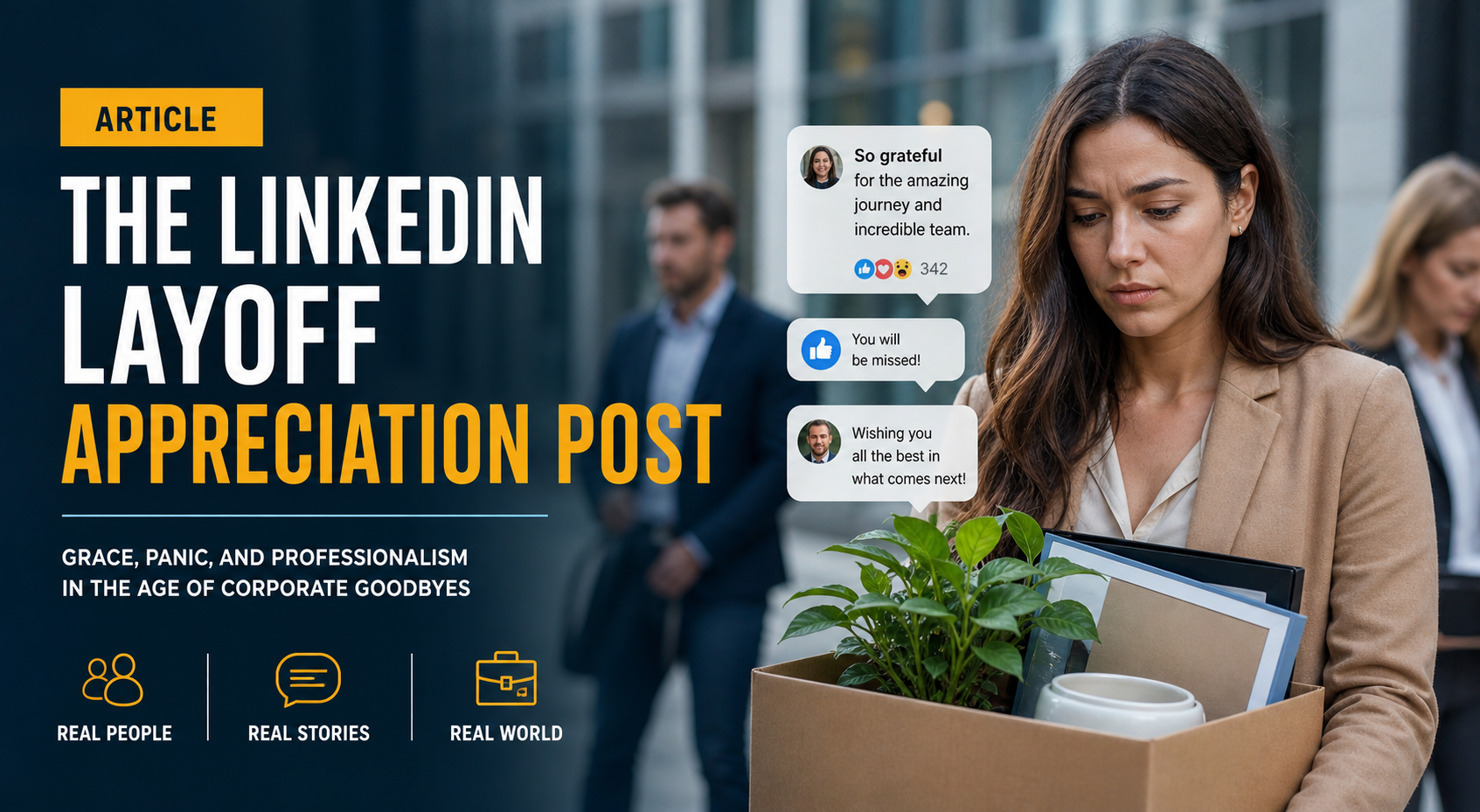
There is a particular kind of emotional theater that happens on LinkedIn after layoffs, and if you have spent more than seven minutes scrolling through your timeline during corporate restructuring season, you already know the genre. It begins with a professional headshot, usually one where the person looks optimistic enough to be trusted with a quarterly initiative, followed by a paragraph that somehow manages to sound grateful, devastated, employable, spiritually evolved, and mildly sedated at the same time. Everyone is posting appreciation posts after getting laid off, and LinkedIn has started to look less like a networking site and more like a corporate funeral home with profile pictures, engagement metrics, and one recruiter in the corner whispering, “Stay positive,” while quietly searching for candidates with fifteen years of experience willing to accept the salary of a haunted internship.
I understand the ritual. I really do. Nobody wants to get laid off and then immediately become the person on the internet screaming into the void while recruiters clutch their pearls and hiring managers quietly move your resume into a folder labeled “emotionally aware but dangerous.” You cannot log onto LinkedIn and write, “Today I was launched into the economy by a leadership team wearing fleece vests and emotional sunscreen,” even though that would be more honest, more accurate, and frankly more useful to society. You cannot say, “I would like to thank my former employer for teaching me that job security is a seasonal decorative item, much like pumpkin spice or corporate values during earnings season.” You have to perform grace. You have to look employable while your nervous system is chewing through drywall. You have to make unemployment sound like a personal brand pivot instead of a financial escape room designed by people who still have company laptops, dental insurance, and calendars full of meetings called “Future State Planning.”
The appreciation post has become the official LinkedIn grief format, a little hostage note dressed in gratitude, wrapped in professionalism, and served on a platter of networking optimism. It says, “After an amazing journey, today marks my last day,” when what it means is, “Yesterday I was in a meeting about Q3 alignment, and today my badge works about as well as a Blockbuster gift card.” It says, “I am so thankful for the lessons,” when the lessons were mostly that family is a word companies use right before layoffs, culture fit does not include surviving the budget cut, and the CFO is basically Thanos with an Excel subscription. And still, people write it with dignity, because dignity is sometimes the only severance package your soul gets when HR sends a life-altering email that sounds like a printer apologizing for low toner.
The Graceful Exit, Sponsored by Panic
The graceful layoff post always begins with a sentence so polished it should be displayed behind glass at the Museum of Corporate Survival. “After an incredible journey with such an amazing team, my role has been impacted.” That sentence is doing the emotional labor of twelve departments. “Incredible journey” is carrying grief. “Amazing team” is carrying trauma bonding. “My role has been impacted” is carrying the fact that the company just tossed your livelihood into a spreadsheet volcano and asked you to remain brand-safe about it online. Nobody says, “My job was deleted.” Nobody says, “Leadership made a budget smoothie and I was one of the ingredients.” Nobody says, “Apparently I was mission critical right up until someone needed the quarterly deck to wear a nicer blazer.”
Instead, we use the language. We say “impacted” because it sounds softer than “unemployed.” We say “transition” because it sounds more elegant than “my access was cut off before I finished my coffee.” We say “next chapter” because “the current chapter was ripped out by a consultant named Brent” feels a little too specific. Corporate America has become very good at building vocabulary that makes human consequences sound like weather patterns. Nobody gets fired anymore. They are affected. Nobody loses income. They enter a workforce transition. Nobody has to sit at the kitchen table refreshing job boards while pretending not to panic. They are exploring new opportunities, which sounds almost adventurous until you remember rent remains aggressively monthly.
And here is the cruel little trick: people have to be graceful because the market demands it. The person who was just laid off has to immediately become their own public relations department. They have to show humility, gratitude, resilience, optimism, and just enough vulnerability to seem human but not so much that anyone thinks they might cry during a phone screen. They have to say, “I am open to new opportunities,” when what they want to say is, “I am open to stability, health insurance, and not having my existence determined by a budget meeting where nobody made eye contact with the word accountability.” They have to write like their future employer is watching, because they are. Somewhere out there, a recruiter is reading the post with binoculars made of keywords, looking for signs that this person can remain enthusiastic after being professionally ejected from a moving vehicle.
That is why I respect the people who write those posts, even when the posts sound like they were drafted by a wellness coach trapped inside Microsoft Outlook. It takes strength to say thank you when you are scared. It takes discipline to turn shock into a networking announcement. It takes a level of emotional control that should qualify as a transferable skill to write, “I am excited for what comes next,” when what comes next is usually a job market that asks you to upload your resume, retype your resume, explain your resume, attach your resume again, then answer whether you have ever operated a forklift in Portuguese.
The Company That Lays You Off Will Still Comment “You Will Be Missed”
The strangest part of the layoff appreciation post is not even the post itself. It is what happens underneath it. The same company that deleted your email before your chair cooled down will sometimes appear in the comments like a ghost wearing a branded quarter-zip and write, “You will be missed!” Missed by who, exactly? The laptop return portal? The access badge that stopped recognizing your face faster than some relatives? The manager who discovered empathy only after legal approved the template? It is one of the greatest acts of corporate performance art currently available without tickets.
“You will be missed” is a fascinating phrase when it comes from an organization that just proved, mathematically and administratively, that you will not be missed enough to remain employed. It is like being pushed off a boat and hearing someone yell, “We loved having you aboard!” as they speed away toward a shareholder update. And yet there it is, sitting under the post like a sympathy casserole made of branding. “Wishing you all the best.” “So grateful for your contributions.” “You made such an impact.” Beautiful. Touching. Inspirational. Also, apparently, not enough impact to survive the spreadsheet.
Then come the coworkers, and that part is different. That part is real. The coworkers usually mean it. They are the people who sat with you through the confusing meetings, the emergency deadlines, the leadership pivots, the projects that changed names six times but never became less broken. They know you were valuable because they watched you quietly hold the system together with duct tape, vibes, and one exhausted project manager named Karen who somehow knew where every file lived, which vendor was lying, which dashboard was fake, and which executive was about to say “synergy” like it was a medical treatment.
Those comments matter because layoffs do not just remove a job. They rearrange people’s sense of belonging. One day you are part of the team, copied on everything, invited to meetings you did not want to attend, asked for input no one planned to use, and then suddenly you are outside the glass looking in, holding a cardboard box and wondering why the company keeps posting about values like it did not just treat payroll like a lifeboat with limited seating. That is the emotional whiplash people do not always talk about. You can hate the bureaucracy and still miss the people. You can be relieved to leave the chaos and still feel rejected by the exit. You can know the layoff was not personal while still experiencing it in the extremely personal location known as your entire life.
And LinkedIn, with all its polished chaos, becomes the place where people try to convert that mess into language. Not because they are fake. Not because they are naive. Not because they actually believe the company deserves a standing ovation for turning their job into a cost savings bullet point. They do it because they need the network. They need visibility. They need someone to see the post and think, “This person handled a terrible moment with grace.” They need the algorithm to become a tiny unemployment flare. They need the little green “Open to Work” circle to glow around their face like a corporate Bat-Signal, calling out into the night for someone, somewhere, with a budget, a role, and enough humanity to reply.
Gratitude Under Duress Is Still Survival
There is a reason these posts feel both inspiring and ridiculous. They are usually written from the most awkward emotional position imaginable: the person has been hurt, but they cannot sound hurt; they are scared, but they cannot sound desperate; they are angry, but they cannot sound angry; they need help, but they have to phrase that help as a confident next step in their exciting professional journey. That is not normal communication. That is emotional gymnastics performed on a balance beam made of economic uncertainty.
The professional world loves resilience because resilience is easier to celebrate than responsibility. Companies love stories about people bouncing back because nobody has to ask who pushed them. LinkedIn loves the comeback arc, the polished announcement, the “I am thrilled to share” after months of rejection, silence, ghosting, and interviews that feel like parole hearings with better lighting. But between the layoff post and the new job post, there is a whole wilderness that rarely gets packaged nicely. There are mornings where people stare at job boards like they are trying to decode ancient curses. There are applications that vanish into portals. There are recruiters who say, “You are a great fit,” then disappear so completely you wonder if they were a hallucination caused by caffeine and hope.
So when someone writes an appreciation post, I no longer roll my eyes the way I used to. I read between the lines. “I am thankful for my time here” might mean, “I am trying very hard not to let bitterness become my only personality today.” “I will miss the people most” might mean, “The coworkers were the reason I survived as long as I did.” “I am excited for what comes next” might mean, “I am terrified, but I refuse to let this moment introduce me as defeated.” There is dignity in that. There is also absurdity, because corporate language has turned human pain into a press release, but dignity and absurdity have always shared an office in modern work culture.
The truth is, layoffs create a strange kind of forced optimism. People have to become marketable while still grieving. They have to update resumes while remembering passwords. They have to write posts while calculating insurance. They have to network while their confidence is still lying on the floor like a printer jam. And somehow, many of them do it with more class than the companies that cut them loose. That is the part worth noticing. The employee who got laid off often shows more emotional intelligence in one LinkedIn post than leadership showed in the entire restructuring announcement.
Because let’s be honest: if companies can call layoffs “strategic optimization,” then workers are allowed to call their survival “an exciting new chapter.” If leadership can read from a script about difficult decisions while remaining safely employed, then the person who got cut can write a grateful post with one hand and quietly scream into a couch cushion with the other. That is not hypocrisy. That is survival in business casual.
Final Thoughts: May Your Next Company Deserve the Post
So to everyone writing those appreciation posts after being laid off, I see you. I see the grace, the panic, the professionalism, the carefully worded gratitude, the restraint it took not to describe the leadership team as a collection of LinkedIn quotes wearing Patagonia vests. I see the little green circle of unemployment glowing around your face like a signal flare in the fog. I see the sentence “open to work” doing the emotional labor of “please help me stay financially alive without making me beg in public.”
And honestly, I respect it. I respect anyone who can take a moment that feels like rejection, fear, embarrassment, anger, and confusion all fighting in the same conference room, and turn it into something readable, hopeful, and useful. I respect the people who thank their teams, even when the company did not deserve the thank-you. I respect the people who stay classy, even when payroll got treated like a clearance rack. I respect the people who are trying to remain kind while quietly wondering if “budget optimization” should be classified as a villain origin story.
May your next company have better leadership, fewer mystery restructures, and an HR department that understands humans are not subscription services. May your next manager know the difference between culture and a slideshow. May your next role come with real stability, real communication, and the kind of respect that does not require a layoff post to prove you mattered.
And may the company that commented “You will be missed” step barefoot on every Lego in the conference room of accountability.