
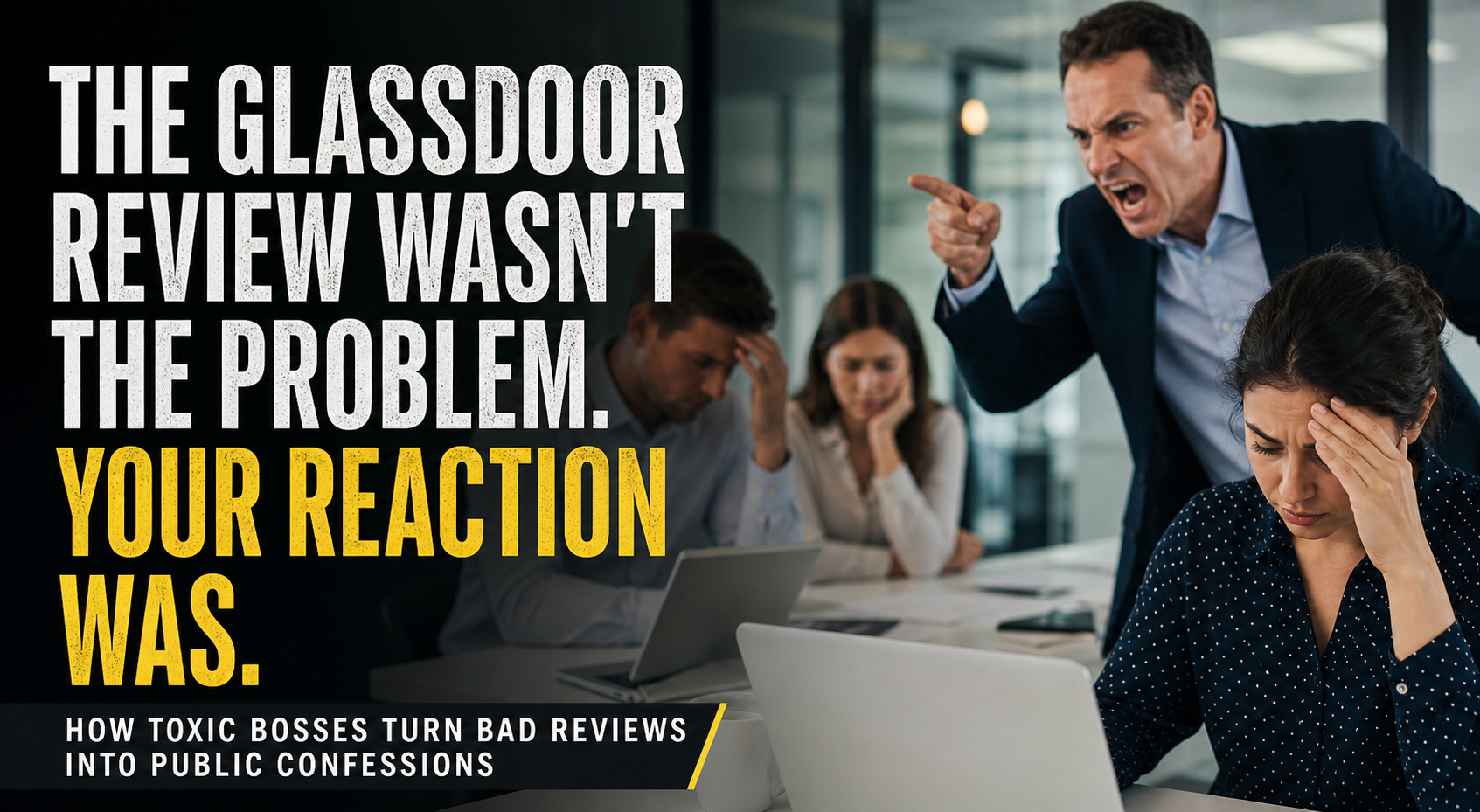
Sometimes the most honest document a company ever produces is not the mission statement, the careers page, the leadership video, the “About Us” section, or that suspiciously cheerful photo of twelve employees standing in a conference room pretending they are not silently calculating how much PTO they have left. Sometimes the most honest thing a company produces is a bad Glassdoor review written by someone who finally escaped with their laptop, their dignity, three screenshots, and a nervous system that now flinches whenever Microsoft Teams makes a sound. That review may be anonymous, but the trauma usually has a font, a timestamp, and the emotional aroma of a break room microwave that has seen things.
And every time a bad review appears, leadership has a choice. They can pause, breathe, behave like adults with direct deposit authority, and ask the one question that actually matters: “How did we get here?” They can look at turnover, management behavior, communication patterns, employee feedback, unrealistic workloads, broken promises, strange owner meltdowns, and the fact that half the staff speaks in survival phrases like “it is what it is” and “just keep your head down.” They can consider the terrifying possibility that maybe, just maybe, the review did not fall out of the sky like a disgruntled pigeon, but grew naturally from the soil they spent years fertilizing with chaos, fear, favoritism, passive aggression, and mandatory fun.
But no. That would require self-awareness, and self-awareness is apparently not included in the executive compensation package.
Instead, some leaders see a bad review and decide the real problem is not the culture. It is not the bullying. It is not the micromanagement. It is not the owner treating every mild inconvenience like a constitutional crisis. The real problem, in their minds, is that employees learned how to type. The keyboard becomes the enemy. The review becomes a criminal act. Suddenly, the boss who never had time to respond to employee concerns has enough time to become a part-time detective, a full-time victim, and a discount courtroom drama villain with access to email.
Someone leaves a review saying, “The owner is a bully,” and instead of proving the review wrong by behaving like a calm, rational, emotionally regulated business leader, the owner allegedly starts threatening former employees, throwing around phrases like “defamation,” “legal action,” and “we know it was you,” as if fear is a management style and not just insecurity wearing cufflinks. That is the part that always amazes me. Nothing says “this review is completely false” like immediately performing the review in real time with bonus material. That is not damage control. That is live theater. That is the extended director’s cut of “Why Everyone Leaves After Two Months.”
Because when a company responds to criticism by intimidating people, it does not erase the criticism. It underlines it. It highlights it. It puts glitter around it and hires a marching band to play it through the town square. If the review said the workplace was toxic and your response is to put on a hazmat suit and start tap dancing in the evidence locker, congratulations, you did not protect the brand. You gave the brand a confession booth with Wi-Fi.
Small Company Kingdoms and the Decorative Fern Known as HR
Small company toxicity is a special flavor because it usually arrives wrapped in warm phrases that sound charming until you realize they are not values, they are warning sirens wearing business casual. “We are like family” is the classic one, and it always sounds beautiful at first, because who does not want a workplace that feels supportive, personal, loyal, and human? Then you get inside and realize the family is not the healthy kind that brings casseroles and remembers birthdays. It is the medieval kingdom kind, where the owner is king, HR is a decorative fern, and everyone else is one misunderstood Slack message away from being accused of treason against the crown.
In these companies, the owner’s mood becomes the weather system. Every morning, employees walk in and silently check the forecast. Is it calm today? Is there a storm warning? Did someone forget to copy the owner on an email and now the entire office has to prepare for emotional hail? Did the printer jam, causing a leadership spiral about loyalty, accountability, and why nobody cares about excellence anymore? You are not just doing your job in these places. You are monitoring facial expressions, decoding silence, measuring hallway footsteps, and deciding whether “Can you come into my office?” means a normal conversation or the beginning of a documentary that will later be called “What Happened to the Accounting Department?”
And because the company is small, there are fewer systems to protect people from the owner’s personality becoming policy. There may not be a real HR department. There may be one person who handles payroll, benefits, birthday cards, printer toner, onboarding paperwork, and emotional hostage negotiation, all while quietly telling employees, “That is just how he is,” which is one of the most dangerous phrases in professional life. “That is just how he is” has excused more workplace nonsense than any policy manual ever written. It is what people say when the problem has been around so long that everyone built furniture around it.
The toxic small company boss usually wants all the benefits of loyalty without offering the safety that makes loyalty possible. They want employees to work late, stay quiet, smile through confusion, absorb chaos, forgive outbursts, accept vague instructions, tolerate shifting expectations, and treat every unreasonable demand like a sacred opportunity. They want people to care like owners while being paid like replaceable office furniture. They want gratitude for the job, silence about the dysfunction, and excitement about “wearing many hats,” even when those hats include firefighter, therapist, janitor, unpaid strategist, crisis manager, and emotional support animal for a grown adult with a title.
Then, when someone finally leaves and a review appears, leadership acts shocked. Shocked. Wounded. Betrayed. They clutch their pearls so hard the pearls file a workers’ comp claim. “How could someone write this?” they ask, as if employees were not sitting in meetings for months watching reality build the review sentence by sentence. People usually do not write bad reviews because one Tuesday was annoying. They write them because Tuesday became a franchise. They write them because nobody listened privately. They write them because every concern was dismissed, every boundary was treated like betrayal, every question was considered disrespect, and every resignation became proof that the employee was never loyal enough to begin with.
A bad Glassdoor review is often not the first complaint. It is the complaint that survived. It is the concern that made it past closed-door meetings, ignored emails, fake check-ins, awkward exit interviews, and leadership speeches about “open communication” delivered by people who punish anyone brave enough to communicate openly. By the time someone takes the nuclear option of writing a public review, the culture has usually been coughing smoke for a long time. The review is not the fire. The review is someone standing outside the building saying, “Hey, maybe do not go in there barefoot.”
Legal Threats Are Not Leadership, They Are Insecurity With Letterhead
There is a special kind of corporate comedy that happens when a toxic boss tries to intimidate former employees over an anonymous review, because the entire performance usually proves more than the review ever could. The review might say, “Management is aggressive and retaliatory,” and within twenty-four hours the owner is sending messages that basically say, “How dare you accuse me of being aggressive and retaliatory, I will now become aggressive and retaliatory until morale improves.” That is not a denial. That is a reenactment.
They always reach for the same dramatic words, too. Defamation. Legal action. Damages. Reputation. Investigation. We know it was you. These words get thrown around with the confidence of someone who watched three minutes of a courtroom scene on YouTube and now believes they are qualified to cross-examine a former receptionist. Suddenly, the boss who could never define your job responsibilities has become extremely precise about “false statements.” The same person who communicated business expectations through vibes, panic, and hallway ambushes now wants documentary-level evidence about who said what, when, where, and why. Fascinating how process becomes important only when leadership feels exposed.
And yes, defamation is a real legal concept. People should not make false factual claims about others. People should be careful, truthful, and responsible. But some bosses treat the word “defamation” like a magic spell that turns every uncomfortable opinion into a punishable crime. They hear “toxic workplace” and act like someone forged a birth certificate. They hear “bully” and react like the United Nations has declared sanctions against their office chair. They forget that people are allowed to describe their experiences, share opinions, and warn others, especially when those experiences were lived with a badge, a desk, a schedule, and a constant sense that one wrong sentence might trigger a leadership volcano.
The funniest part is that these bosses believe intimidation will restore their reputation, when intimidation is usually the reputation problem wearing a hat. They think if they scare enough people, the story disappears. But stories do not disappear anymore. They screenshot. They forward. They sit in inboxes. They live in text threads. They age beautifully. Emails do cardio. Slack messages survive rebrands. Screenshots are basically the cockroaches of accountability. You can change the company logo, rewrite the values page, hire a branding consultant, and make everyone say “people-first culture” in the onboarding video, but somewhere out there, a former employee still has a message that says, “Delete the review or we will take action,” and that message is doing yoga, drinking water, and waiting patiently.
Threatening people after they leave also reveals something deeply important about the culture they left behind. Because if leadership behaves this aggressively when someone is no longer on payroll, imagine what it felt like when that person depended on them for income, benefits, references, and basic workplace peace. If this is how the boss acts when they have less control, what did they do when they had more? That is the question companies never realize they are answering. The reaction becomes evidence. The intimidation becomes marketing. The panic becomes a press release written entirely in red flags.
And let us talk about the phrase, “We know it was you,” because that one deserves its own museum exhibit. First of all, do you? Do you actually know, or are you just standing in the office with a flashlight under your chin accusing everyone who escaped recently? Second, if multiple former employees could plausibly have written the review, that is not a detective breakthrough. That is a culture problem. If you have to narrow down which of the many unhappy people described the workplace as unbearable, maybe the issue is not anonymity. Maybe the issue is inventory.
The Review Was Not the Problem, It Was the Smoke Alarm
A bad review can be painful. I get that. Nobody enjoys reading criticism about something they built, manage, own, or represent. Even strong leaders can feel defensive when feedback shows up publicly, especially if it is sharp, emotional, or embarrassing. But the difference between a mature leader and a toxic one is what happens after the sting. A mature leader eventually asks, “Is there anything here we need to learn from?” A toxic leader asks, “Who did this, and how do I scare them?”
That difference tells you everything.
Because reviews, even messy ones, are data. Not perfect data. Not sacred scripture. Not automatic truth carved into stone by the ghost of workplace justice. But data. They are signals. Patterns matter. If one person says the culture is chaotic, maybe it was a bad fit. If ten people say leadership is abusive, turnover is high, expectations are unclear, and people are afraid to speak up, then maybe the problem is not that ten people are bitter keyboard criminals. Maybe the building is on fire and leadership keeps blaming the smoke detector for being negative.
Companies love feedback when it is flattering, polished, and safe enough to put in a recruiting brochure. They love employee testimonials that say things like, “This company helped me grow,” especially when the employee writing it still works there and would like to continue eating indoors. They love surveys when the numbers are good. They love engagement results when the comments are vague. They love praise when it arrives gift-wrapped in corporate language. But the second feedback becomes honest, specific, public, and inconvenient, suddenly leadership starts acting like free speech broke into the office and stole the Keurig.
The truth is, people read reviews differently than companies think. Most reasonable candidates do not see one bad review and immediately assume the entire company is a haunted swamp. Candidates are used to mixed reviews. They know every workplace has flaws. What scares people is not the existence of criticism. What scares people is the pattern, the tone, and the company’s reaction. If every review mentions fear, turnover, favoritism, yelling, retaliation, and poor leadership, and then the company responds with some robotic paragraph about “We take feedback seriously” while allegedly threatening former employees behind the scenes, candidates can smell the smoke through the screen.
And candidates are paying attention now because the job market has taught them survival. People are tired of walking into workplaces that looked normal online but operated like emotional escape rooms. They are reading reviews, checking LinkedIn turnover, looking at how long employees stay, comparing job postings that keep reappearing every two months, and asking whether “growth opportunity” means development or unpaid damage control. A bad review may not stop everyone from applying, but a company that reacts badly to bad reviews absolutely will.
That is why the smartest companies do not hunt reviewers. They hunt root causes. They ask why people feel that way. They look for patterns. They examine leadership behavior. They train managers. They create safer reporting channels. They stop treating criticism like betrayal and start treating it like a maintenance light on the dashboard. Annoying? Yes. Inconvenient? Absolutely. But useful? Very. Because ignoring the check engine light does not make the engine healthier. It just makes the eventual tow truck more expensive.
Final Thoughts: Read the Warning Label Before You Apply
Sometimes the review is not the problem. Sometimes the review is the warning label. Sometimes the person writing it is not bitter, lazy, dramatic, disloyal, or out for revenge. Sometimes they are just the person who finally said the quiet part out loud after everyone else spent years whispering it in parking lots, bathroom stalls, group chats, and carefully worded resignation letters.
And to the toxic bosses who think legal threats are a substitute for self-awareness, please understand that fear may silence people temporarily, but it does not build respect. It does not fix culture. It does not improve retention. It does not make you a leader. It makes you a person with letterhead and a panic response. If your first instinct after reading criticism is to hunt down the reviewer instead of examining why the review felt believable to so many people, then you are not protecting the company. You are confirming the review with extra steps, background music, and a complimentary tote bag.
To employees and former employees dealing with this kind of nonsense, stay calm. Save everything. Keep records. Do not get pulled into emotional mud wrestling with someone who thinks intimidation is a personality trait. Get real legal advice if needed, especially if threats become specific or serious. Do not assume a loud person is right just because they know how to use scary words. Volume is not authority. Aggression is not proof. A title is not a moral license. And a boss who screams “defamation” every time someone describes their lived experience may not be defending the truth as much as trying to keep the lights off.
And to job seekers, please read the reviews carefully before applying. Not with cynicism, but with pattern recognition. One angry review might be noise. Ten reviews telling the same story in different fonts might be a choir. Watch for repeated mentions of turnover, retaliation, bullying, unclear expectations, unpaid overtime, chaotic leadership, and phrases like “run,” “avoid,” and “I wish I had listened.” Also watch how the company responds, because the response often tells you whether leadership is mature enough to hear feedback or just polished enough to deny it publicly.
A company can survive a bad review. What it may not survive is proving the review right.
Because sometimes the Glassdoor page was not a complaint box.
Sometimes it was the smoke alarm.
And if leadership’s response is to threaten the smoke alarm, blame the smoke, interrogate the people outside, and insist the building is fine while everyone can smell the fire, then maybe the review did exactly what it was supposed to do.
It warned the next person before they walked in.