
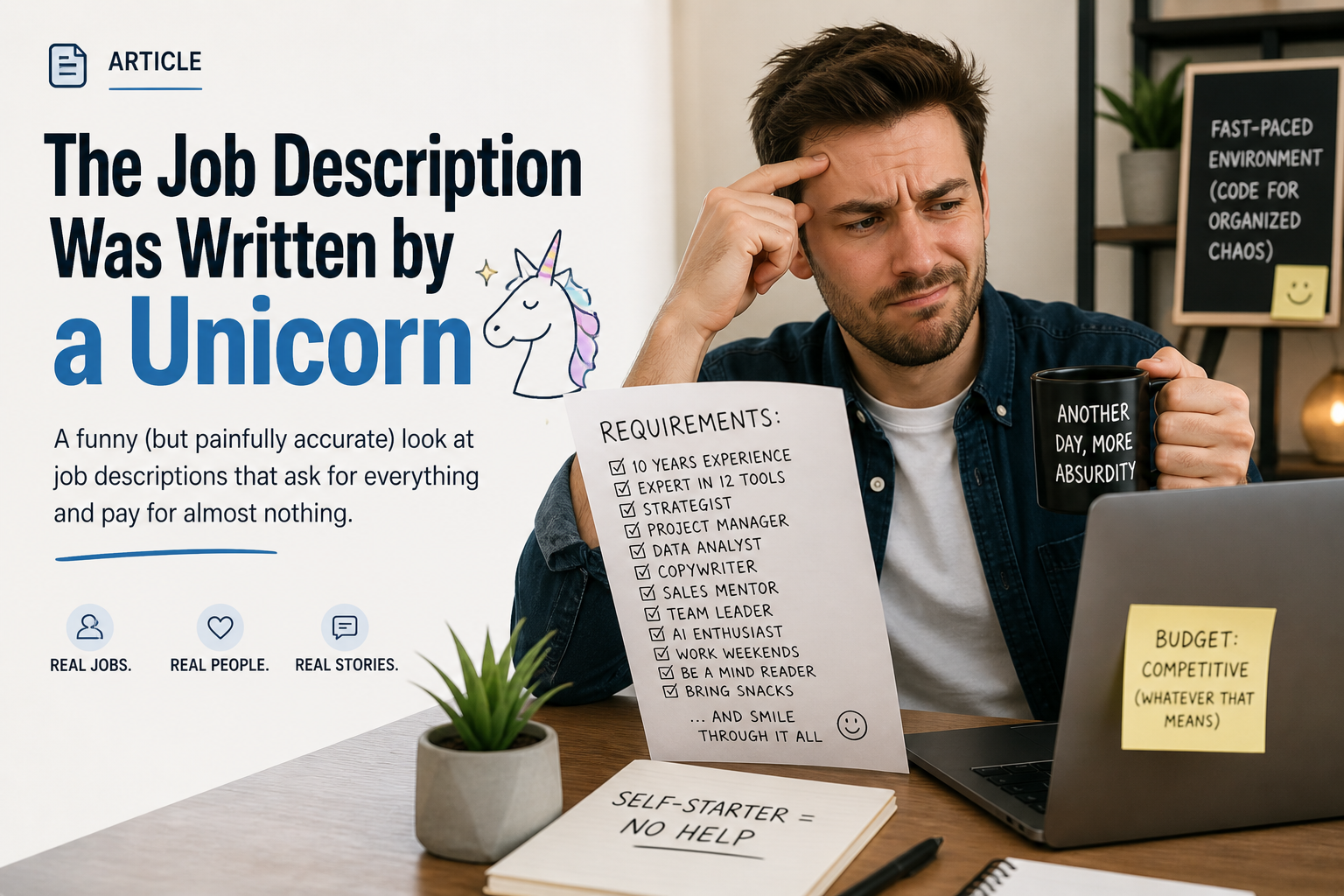
You ever read a job description that starts off sounding normal, reasonable, and almost friendly, like it was written by a company that understands human employment, only for the second paragraph to suddenly reveal that they are not hiring a person, they are attempting to assemble a mythological creature using corporate buzzwords, caffeine, and the emotional remains of six former employees?
Because I have.
The other day, I found one of those job descriptions that looked innocent from a distance, the way a quiet lake looks peaceful until you realize there is a LinkedIn recruiter living underneath it asking if you are open to opportunities that pay in “growth potential.” The title said something ordinary, something you could explain to your parents without needing a whiteboard. Marketing Operations Manager. Customer Success Lead. Business Development Strategist. Senior Coordinator of Something That Sounds Real Until You Read the Responsibilities.
So naturally, I clicked.
That was my first mistake.
The opening paragraph was warm and inviting, which is always how the trap begins. “We are a fast-growing, mission driven company looking for a passionate, hands-on leader to help scale our next phase of growth.” Beautiful. Inspirational. Suspicious. Anytime a company says “next phase of growth,” I immediately picture a conference room full of people staring at a whiteboard where someone has written “do more with less” in dry erase marker while avoiding eye contact with payroll.
Then came the responsibilities.
And suddenly this was no longer a job.
This was a medieval quest with Slack notifications.
They wanted one person who could create strategy, execute strategy, manage people, build dashboards, run campaigns, write copy, analyze performance, own the CRM, fix the CRM, apologize for the CRM, mentor junior staff, lead cross-functional initiatives, manage vendors, forecast budgets, improve retention, increase revenue, reduce churn, optimize workflows, present to executives, support sales, support marketing, support product, support customer success, support finance, support operations, support the fragile ecosystem of leadership feelings, and somehow remain “comfortable in ambiguity.”
Comfortable in ambiguity?
That is not a skill.
That is a trauma response with a LinkedIn endorsement.
And of course, the salary was described as “competitive,” which means the compensation is hiding in a bunker somewhere wearing night vision goggles. They could list seventeen required platforms, twelve preferred certifications, and a complete emotional profile of the person they want, but somehow the pay range has entered witness protection.
At some point, you realize companies are not writing job descriptions anymore. They are writing corporate fan fiction about a person who does not exist, has never existed, and would be too emotionally healthy to apply if they did.
The Unicorn Requirements Department
The first sign you are dealing with a unicorn job description is the way the qualifications slowly detach from reality, like a budget meeting floating into space. It starts politely enough. “Bachelor’s degree preferred.” Fine. Normal. Then it adds “eight to ten years of experience.” Still annoying, but we are in familiar territory. Then suddenly it wants advanced knowledge of Salesforce, HubSpot, SQL, Tableau, Google Analytics, paid media, content strategy, customer lifecycle management, change management, vendor negotiation, team leadership, copywriting, forecasting, automation, AI tools, executive communication, and the ability to thrive in a fast-paced environment.
Thrive.
Not survive.
Not tolerate.
Thrive.
They want you flourishing inside the professional equivalent of a dishwasher full of forks.
And the funniest part is that the role is usually listed as “mid-level,” because companies have discovered that if you call something mid-level, you can describe an entire executive department and still act surprised when applicants ask about money. “We are looking for someone who can own the entire growth engine, lead strategic transformation, implement scalable systems, influence senior leadership, manage competing priorities, and occasionally bend time.” Great. Is this a director role? No. Is there equity? Also no. Is there a team? Funny you should ask. The team is you, a shared inbox, and an intern named Caleb who starts Tuesday and already looks overwhelmed in his profile picture.
Then comes the classic phrase: “wear many hats.”
That sentence alone should legally require hazard pay.
Because “wear many hats” never means you get to develop diverse skills in a supportive environment. It means the company has confused headwear with staffing strategy. It means someone in leadership looked at an org chart, saw several empty boxes, and decided instead of hiring people, they would hire one person with a reinforced spine and a troubling relationship with productivity.
You are not wearing many hats.
You are being asked to dress as an entire department for Halloween.
And somehow, every hat is on fire.
What makes these job descriptions so impressive is the absolute confidence with which they describe nonsense. They do not say, “We know this is a lot.” They say, “The ideal candidate is a strategic thinker and tactical executor.” That sentence should be studied by scientists. It means they want someone who can plan the war, fight the war, order the snacks, design the flag, write the recap email, and thank leadership for the opportunity to be shelled.
Strategic but tactical.
Independent but collaborative.
Humble but confident.
Creative but process-driven.
Flexible but structured.
A visionary who follows instructions.
A leader who does not need authority.
A self-starter who can align with unclear expectations.
At that point, they are not describing a person. They are describing a corporate horoscope.
“Hands-On” Means Congratulations, You Are the System Now
My favorite phrase in any job description is “hands-on role,” because it sounds so harmless, so practical, so grounded in real work, until you realize it is corporate language for “we have no infrastructure and you are now the infrastructure.”
Hands-on means the strategy deck is yours, the execution is yours, the reporting is yours, the errors are yours, the cleanup is yours, and the blame will be distributed generously in your direction during the next leadership meeting. Hands-on means there was once a process, but it left during the pandemic and never updated its LinkedIn. Hands-on means the documentation lives in a Google Drive folder called “Archive,” inside another folder called “Old,” inside another folder called “Use This Maybe,” guarded by a spreadsheet last opened by someone named Melissa in 2019.
And when you ask about training, they say, “We are looking for someone who can hit the ground running,” which is one of the most violent phrases in professional life. Nobody should have to hit the ground running. That is not onboarding. That is being pushed out of a moving van with a laptop and a branded water bottle.
Then comes “must be a self-starter.”
Translation: nobody knows what is happening, but we hope you do.
The boss is in meetings all day. The team is understaffed. The previous employee left abruptly but “on good terms,” which means either they ascended into peace or they now flinch when they hear Microsoft Teams. Their farewell document is twelve bullet points, three broken links, and one sentence that says, “Check with Mark,” but Mark was laid off during a “strategic realignment” and now sells handmade candles on Etsy.
The company will tell you they value initiative, but what they really mean is they value employees who can discover problems, solve problems, absorb problems, emotionally process problems, and never ask why the same problems have been allowed to reproduce like raccoons behind a restaurant dumpster.
Then they say, “You will partner closely with cross-functional teams.”
This sounds collaborative until you learn that cross-functional means every department has a different priority, nobody agrees on who owns what, and every meeting ends with someone saying, “Let’s circle back,” which is corporate for “this issue has escaped into the woods.”
You will partner with sales, who needs everything yesterday.
You will partner with marketing, who needs alignment.
You will partner with product, who needs clarity.
You will partner with finance, who needs justification.
You will partner with leadership, who needs a dashboard.
You will partner with operations, who needs a miracle.
And somehow, when the project gets delayed because six teams gave conflicting direction, someone will ask why you did not communicate more effectively.
Excellent communication skills, apparently, means translating chaos into bullet points while smiling like your soul did not just leave through the nearest exit.
The Salary Is Competitive Because It Is Competing With Rent
The salary section is where the job description usually reaches its final form of comedy.
After asking for a hybrid of strategist, analyst, manager, copywriter, therapist, firefighter, systems administrator, revenue magician, and executive whisperer, they reveal the pay with the mysterious confidence of a magician refusing to show the card.
“Competitive salary.”
Competitive with what?
A grocery receipt?
A haunted internship?
A lemonade stand with dental?
Companies love saying “competitive” because it sounds professional while revealing absolutely nothing. It is the job posting equivalent of putting a sheet over furniture and calling it interior design. Competitive could mean $52,000. Competitive could mean $125,000. Competitive could mean “we checked the market in 2014 and added a pizza party.”
And when candidates ask for the range, companies act like you requested nuclear codes. Suddenly everyone becomes mysterious. “Compensation depends on experience.” Of course it does. Everything depends on experience. That is why you listed enough requirements to qualify someone for a cabinet position.
The real issue is that companies want luxury talent on clearance pricing. They want the unicorn, but they want the unicorn to accept an entry-level salary because “there is room to grow.” Room to grow is a beautiful phrase when you are discussing a garden. It is less inspiring when you are discussing whether someone can afford electricity.
Then comes the benefits section, which is always written like they invented time off.
“We offer paid holidays.”
Thank you for not making employees submit PTO to observe Thanksgiving like it is a side hustle.
“We offer health insurance.”
Amazing. You participate in the basic social contract after extracting forty-five hours a week from adults with lower back pain.
“We offer a collaborative culture.”
That is not a benefit. That is a sentence.
“We offer unlimited PTO.”
Which often means nobody takes it because the workload has been designed by a man who believes burnout is a mindset issue.
And then, after listing a role that sounds like it should come with a horse, a sword, and a therapist covered at one hundred percent, they close with the most incredible sentence in modern recruiting:
“We encourage you to apply even if you do not meet every qualification.”
Oh really?
Because you just described someone who can lead transformation, build systems, run analytics, drive revenue, manage people, influence executives, write content, fix software, negotiate contracts, increase retention, decrease churn, automate workflows, understand AI, speak fluent Salesforce, and remain emotionally radiant while juggling flaming OKRs in a room called “The War Room.”
But sure.
I will apply even if I am only missing the ability to levitate.
That sentence is supposed to sound inclusive, but after a job description that reads like a prophecy, it feels like being invited to a sword fight with a butter knife and a positive attitude.
Final Thoughts: The Unicorn Escaped and Left the Committee Unsupervised
The funniest thing about these job descriptions is that they are not usually written by one person. They are written by committee, which explains why they sound like eight departments trapped in a trench coat. Everyone adds their little wish. Sales wants revenue growth. Marketing wants campaign execution. Finance wants forecasting. Product wants roadmap alignment. Leadership wants innovation. HR wants culture fit. Operations wants process improvement. Someone named Brad wants “AI fluency” because he heard it on a podcast while drinking cold brew near a whiteboard.
Nobody stops and says, “Can one human being do this?”
Nobody asks, “Is this actually three jobs?”
Nobody asks, “Did we accidentally describe the person who should be CEO?”
They just keep adding requirements until the job description becomes a shrine to corporate imagination.
And somewhere out there, the unicorn reads it, closes the laptop, and quietly walks into the forest.
Because even mythical creatures have boundaries.
The unicorn has seen your “fast-paced environment.”
The unicorn has worn many hats.
The unicorn has been hands-on.
The unicorn has hit the ground running.
The unicorn has worked with cross-functional teams, survived unclear priorities, attended meetings that could have been emails, and received feedback from a VP who used the word “synergy” like a smoke bomb.
The unicorn is done.
So yes, I applied anyway.
Not because I believed I was the perfect candidate.
Not because the role made sense.
Not because I wanted to become a department with a badge.
I applied because after reading that job description, I needed closure. I needed to know whether a human recruiter would actually call me, ask if I had experience being both a visionary leader and a tactical spreadsheet goblin, then tell me the salary was competitive with a straight face.
And maybe, just maybe, I wanted to see if the unicorn would be on the panel interview.
Though knowing corporate America, the unicorn would probably be late, apologize because its last meeting ran over, ask me where I see myself in five years, and then reject me for not having enough experience in unicorn operations.