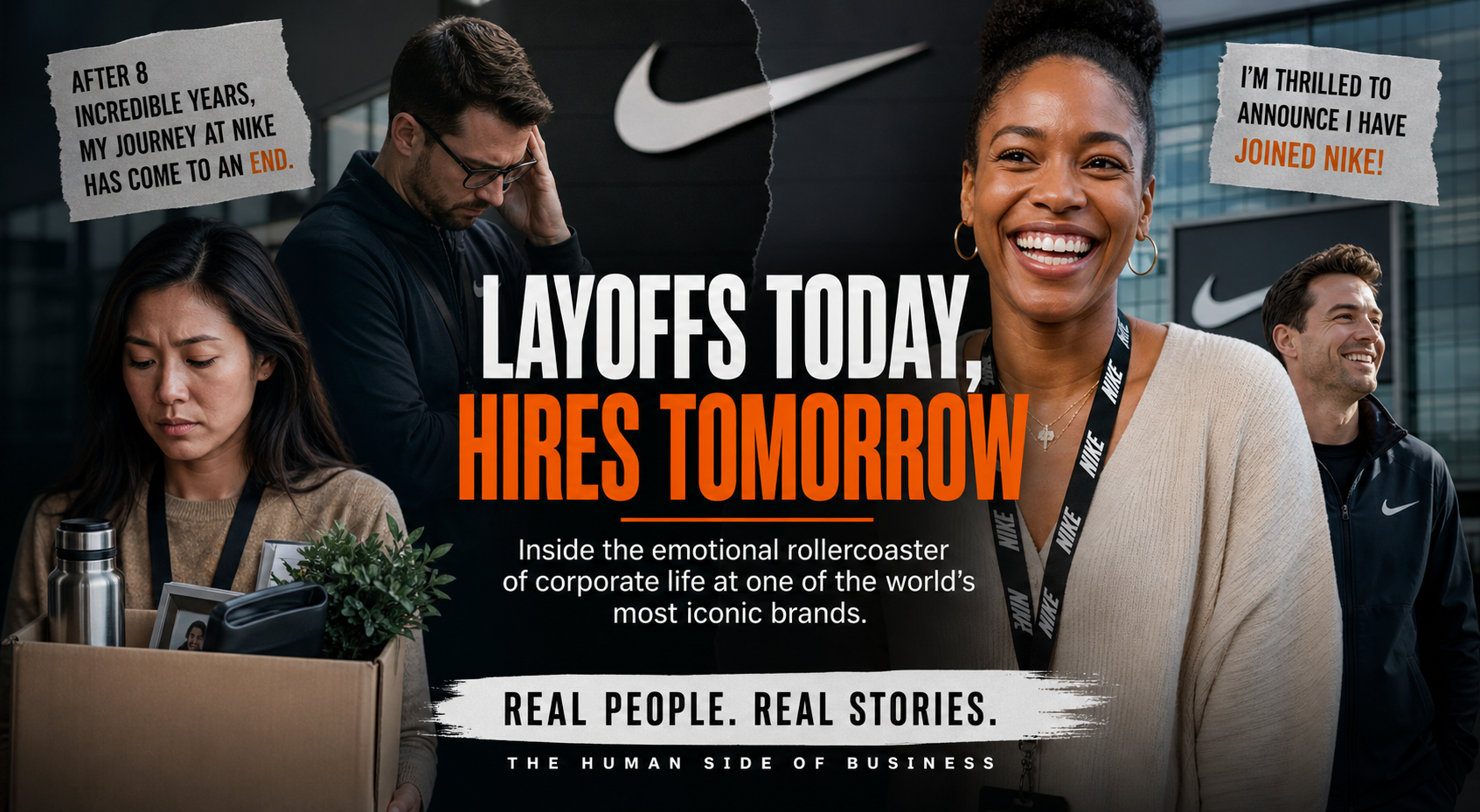
There is a very specific kind of emotional vertigo that happens when you open LinkedIn in the evening, expecting maybe one humblebrag, two motivational quotes, and a recruiter explaining why candidates should be grateful for being ignored, only to find your entire timeline split between people leaving Nike with beautiful goodbye posts and people joining Nike with professional headshots glowing like they just got drafted into the corporate Olympics.
It is not a feed anymore. It is a revolving door wearing sneakers.
One post says, “After eight unforgettable years at Nike, my journey has come to an end,” and before your heart even has time to sit down, the next post says, “I am beyond excited to announce I have joined Nike,” complete with the logo, the badge photo, the obligatory gratitude paragraph, and seventeen comments saying “well deserved” from people who have not texted them since 2019.
That is emotional whiplash in performance fleece.
LinkedIn has turned into an airport terminal during a thunderstorm, except instead of people holding boarding passes, everyone is holding employment trauma. Some people are arriving. Some people are departing. Some people are pretending they are fine while their internal organs are filing for unemployment. The Nike logo is glowing behind one person like the gates of heaven, while another person is trying to summarize a layoff with the kind of emotional restraint usually reserved for hostage negotiations.
And the weirdest part is that both realities are true at the same time.
Someone is celebrating the job they prayed for, fought for, interviewed for, and probably refreshed their inbox sixty-four times for. Someone else is grieving the job they gave years to, built relationships in, sacrificed evenings for, defended in meetings, survived reorgs inside, and then lost through a paragraph that somehow used the words “valued” and “transition” while removing their access badge.
Corporate America has mastered the art of making joy and grief share the same lobby.
Welcome to the Swoosh Terminal, Please Keep Your Severance Under the Seat in Front of You
The LinkedIn timeline has become the only place where you can watch someone get hired and laid off from the same company before your coffee gets cold. It is like scrolling through two different movies edited by a consultant with no emotional awareness. In one scene, someone is standing proudly in front of the logo, talking about dreams, purpose, culture, and how excited they are to contribute to the mission. In the very next scene, someone else is saying goodbye to that same mission after eight years, two reorganizations, six leadership changes, one “all hands” call that had the energy of a funeral with Wi-Fi, and enough vague corporate language to legally qualify as fog.
And nobody knows how to react because both posts deserve compassion, but LinkedIn was not designed for emotional complexity. LinkedIn was designed for people to say “humbled” while posting achievements that required three lighting attempts and a ring light named Patricia.
So you scroll carefully.
You want to like the new hire post because getting a job right now is not a small thing. It is not “good news.” It is survival with a start date. It means they made it through the application portal, the resume scanner, the recruiter screen, the panel interview, the “we just need one more conversation,” the mysterious silence, the sudden urgency, the background check, and that final week where everyone acts like a signed offer letter is being transported across the country by horse.
Getting hired in this market deserves applause.
But then you see the layoff post, and your whole spirit takes off its sneakers and sits down.
Because getting laid off is not just losing a job. It is losing structure, income, identity, routine, coworkers, benefits, the fake little confidence you get from having calendar invites, and the ability to answer “What do you do?” without briefly staring into the middle distance like a Civil War widow.
And companies always find a way to say it like they are writing a condolence card using leftover consulting words.
“You are a valued member of the team.”
Beautiful.
“Your contributions have made a lasting impact.”
Lovely.
“Unfortunately, your role has been impacted.”
There it is. The corporate trapdoor under the inspirational quote.
One minute you are part of the future. The next minute the future has apparently moved your department to a spreadsheet called “cost savings final FINAL revised copy 3.”
And now the person has to write the classy LinkedIn post, because apparently society has decided that even after losing your job, you still need to perform emotional professionalism for an audience that includes former bosses, recruiters, coworkers, and Brenda from HR who once said “we are family” during a budget freeze.
So the post says, “I am grateful for my time at Nike.”
Translation: I am trying not to scream into a company hoodie.
It says, “I will always cherish the people and memories.”
Translation: My coworkers were amazing, but the org chart was assembled by a raccoon with a laminator.
It says, “I am excited for what comes next.”
Translation: What comes next better include rent money, dental coverage, and a hiring manager who does not say “we are moving quickly” before disappearing into a cave for eleven business days.
Just Do It, Unless “It” Is Job Stability
There is something uniquely strange about watching a brand known for motivation, courage, grit, movement, and overcoming adversity become the backdrop for people experiencing corporate adversity in real time.
Nike tells the world to run faster, push harder, rise above, chase greatness, and believe in the impossible. Then corporate America walks in holding a spreadsheet and says, “Great energy, but have you considered being impacted?”
That is the comedy and tragedy of modern work. The brand can be inspiring, the people can be talented, the teams can be passionate, and the system can still look at human beings like they are adjustable columns in a budget workbook.
One person is joining the dream.
Another person is waking up from it.
And somewhere, a brand video is playing slow-motion footage of an athlete overcoming obstacles while an employee is reading an email that basically says, “Your obstacle is payroll.”
You almost have to admire the absurdity, because corporate America has perfected the emotional split screen. On one side, there are polished posts about growth, innovation, purpose, and bold new chapters. On the other side, there are people privately wondering how long their insurance lasts, whether they should update their resume tonight or tomorrow morning, and how to explain to their family that “restructuring” is not something you can fix by working harder.
That is what layoffs do. They turn loyal employees into philosophers against their will.
You start asking questions nobody asked during the town hall. Was I really valued, or was I valued until the quarterly numbers needed a dramatic haircut? Was my work meaningful, or was it meaningful until leadership found a cheaper way to describe it? Was this a community, or was this a business that used community language until the math got uncomfortable?
And none of that means the people joining should feel guilty. They should not. A new job is a blessing, especially in a market where getting hired sometimes feels like trying to enter a nightclub guarded by an algorithm with unresolved childhood issues. If someone got the offer, celebrate them. Let them have the announcement. Let them enjoy the badge photo, the welcome box, the new laptop smell, and the tiny moment of peace before onboarding introduces them to fourteen systems with passwords that expire emotionally.
But also, read the room.
Because while one person is saying, “I am so excited to join this incredible company,” someone else is trying to figure out whether “incredible company” is still allowed to be listed on their resume without making their eye twitch.
LinkedIn forces all these moments into the same emotional blender. Celebration, grief, ambition, disappointment, gratitude, panic, networking, inspirational hashtags, and one executive posting about resilience from a conference stage while people refresh job boards in sweatpants.
And somehow, everyone is supposed to comment professionally.
“Congratulations!”
“So sorry to hear this.”
“Excited for you!”
“Thinking of you.”
“Big things ahead.”
“Please let me know how I can support.”
That last one is always interesting because sometimes people mean it, and sometimes it means, “I have fulfilled my public compassion requirement and will now vanish like a recruiter after asking for your availability.”
The Classy Layoff Post Is the Strongest Athletic Performance
People talk about elite athletic endurance, but I have seen no greater display of discipline than someone writing a respectful layoff post five minutes after corporate America handed them a digital cardboard box.
That is not professionalism. That is Olympic restraint.
Because the real post in their heart probably sounds very different.
The real post says, “After years of giving this company my talent, weekends, ideas, calm replies, emergency fixes, skipped lunches, and the emotional labor of pretending every reorg was a growth opportunity, I have been released into the wilderness by people who used the word ‘family’ until the family budget needed fewer children.”
But that is not what gets written.
Instead, people write, “I am grateful.”
They write, “I learned so much.”
They write, “I am open to new opportunities.”
They write, “Please keep me in mind.”
They write, “I am taking time to reflect.”
Meanwhile, their bills are standing in the corner wearing sunglasses, asking when reflection starts paying utilities.
That is the part people who have not been laid off do not always understand. A layoff is not just a career event. It is a logistical ambush. It is your calendar clearing itself without asking. It is your inbox becoming quiet in a way that does not feel peaceful. It is your identity suddenly standing in the hallway with a box of office supplies, asking where everyone went.
And it is especially weird when the company keeps moving like nothing happened.
The brand continues.
The campaigns continue.
The posts continue.
The inspirational language continues.
The leadership updates continue.
The hiring posts continue.
The “we are thrilled to welcome” announcements continue.
And the people who were let go are expected to handle it gracefully, because apparently the final responsibility of the employee is to make the company’s decision look emotionally tidy.
That is why these timelines feel so heavy. They are not just posts. They are evidence of the strange bargain workers are forced to make. Give your energy. Build the mission. Believe in the culture. Wear the logo. Defend the brand. Sacrifice when needed. Smile through ambiguity. Stay agile. Be resilient. And then, if the numbers shift, please write something gracious on your way out so nobody feels uncomfortable.
That is not a workplace. That is a breakup where the person dumping you asks you to leave them a five-star review.
Final Thoughts: The Swoosh Goes Both Ways
So yes, congratulations to the people joining Nike. Truly. In this market, getting hired is a victory worth celebrating, and nobody should have to shrink their joy because corporate America has terrible timing and the emotional sensitivity of a printer jam.
Celebrate the offer. Take the picture. Post the update. Enjoy the moment. You earned it.
But to the people leaving Nike, or any company, after being told that your role was impacted, eliminated, restructured, optimized, realigned, sunset, or whatever new word the corporate thesaurus coughed up after lunch, please know this: you are not the paragraph they gave you.
You are not a budget line.
You are not a headcount reduction.
You are not an impacted employee.
You are not a business decision wrapped in empathy font.
You are a person who gave time, skill, patience, effort, creativity, leadership, loyalty, and probably hundreds of calm Teams messages when the correct emotional response would have required a dramatic soundtrack and a folding chair.
Your work mattered even if the company decided the role did not.
Your talent still counts even if a spreadsheet pretended otherwise.
Your value did not disappear because your access badge stopped working.
And if your timeline looks like mine, half celebration and half corporate memorial service, just remember that LinkedIn has become a sneaker-shaped emotional obstacle course where one person is sprinting toward a dream job while another is limping away from a layoff with their dignity, their resume, and a desk plant that has survived more restructures than most executives.
Some people are getting hired.
Some people are getting laid off.
Some people are posting gratitude while quietly Googling “how long does COBRA last.”
Some people are saying “dreams come true” while others are wondering why dreams keep requiring severance paperwork.
That is corporate America in one scroll: one door opens, another door closes, and HR stands nearby holding a clipboard like this was all part of the wellness strategy.
And somewhere in the middle of it, the rest of us are watching, cheering for the people who made it in, grieving with the people pushed out, and wondering how a country with this many leadership books still cannot figure out how to treat workers like human beings.
Because at the end of the day, the swoosh can mean a lot of things.
For one person, it means a new beginning.
For another, it means the end of a chapter.
And for everyone watching from the timeline, it means one more reminder that in corporate America, even the finish line has been reorganized.