
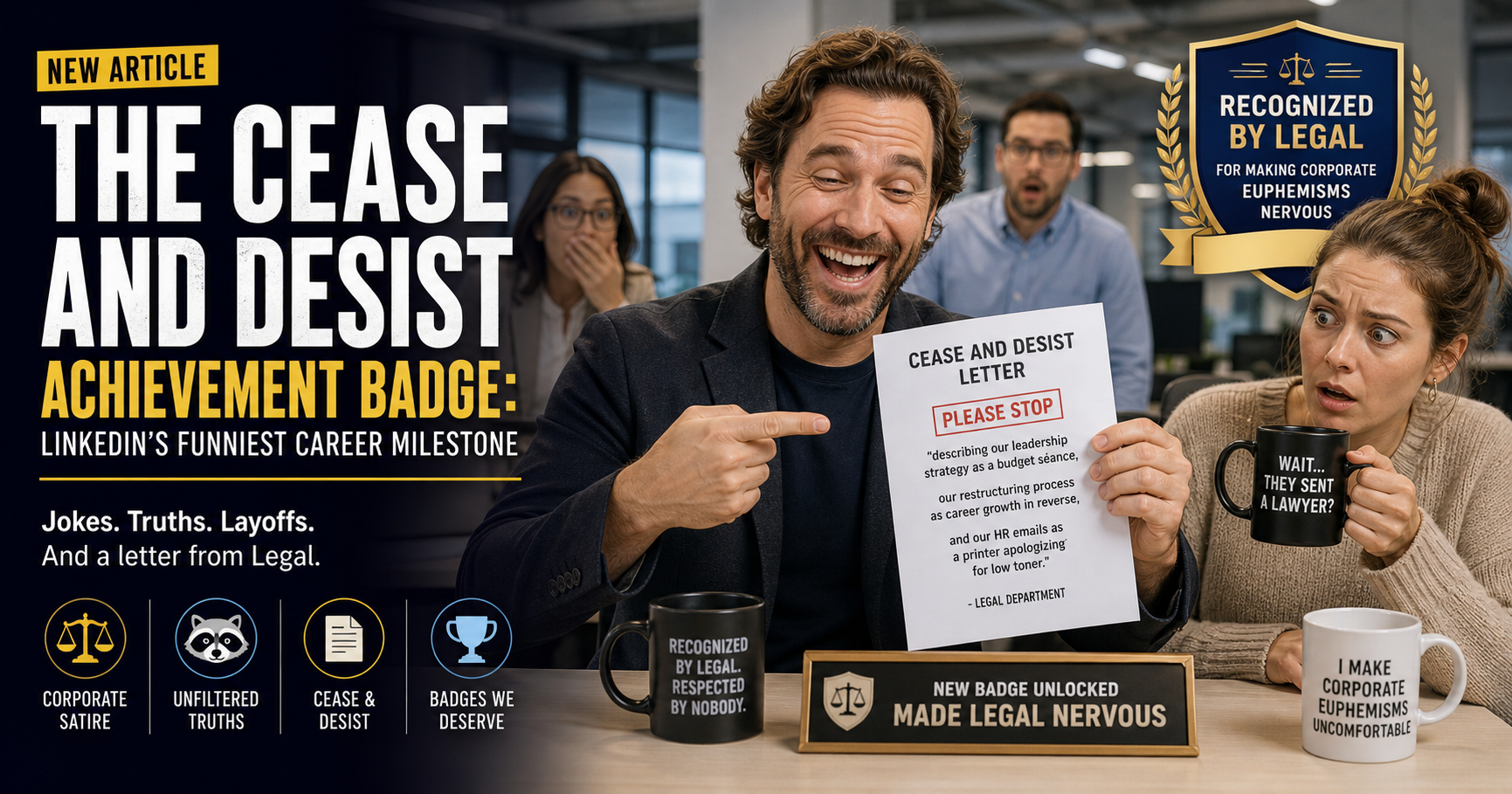
There are certain career achievements nobody puts on the five-year plan because polite society has not yet figured out how to include them between “promotion,” “professional development,” and “learned Excel well enough to stop crying in front of pivot tables.” Nobody sits in a career coaching session and says, “My goal this quarter is to write something so painfully accurate about corporate behavior that a legal department gathers in a conference room, lowers the blinds, and begins reading my jokes out loud like classified intelligence.” And yet, here we are, living in an economy where the most honest performance review you may ever receive is a cease and desist letter arriving because your LinkedIn post made leadership feel seen in a way their employee engagement survey never could.
A cease and desist letter would be the funniest LinkedIn achievement badge ever created because it sits at the perfect intersection of professional recognition, corporate panic, and comedy becoming too accurate for comfort. Some people get badges for completing leadership courses. Some people get endorsed for project management, strategic thinking, or knowing how to say “circle back” without visibly losing part of their soul. But a cease and desist letter? That is an elite badge. That is the black belt of workplace satire. That is corporate America accidentally admitting, in writing, that your post did not just land. It parked in the executive lot, took a badge photo, made itself coffee, and asked why the company keeps calling layoffs “transformation” like the affected employees turned into butterflies instead of unemployed adults refreshing job boards at midnight.
The funniest part is that companies never seem upset because someone lied. They seem upset because someone described the thing too clearly. There is a massive difference. If you invent a wild story, they can dismiss it. If you exaggerate beyond recognition, they can call it nonsense. But when you take their own behavior, remove the scented candle of corporate language, and say, “So basically you told people they were family until the budget got seasonal depression,” suddenly Legal appears from the ceiling tiles like Batman with a billable hour problem. Nobody panics faster than a corporation that realizes the employee they underestimated can write complete sentences with punchlines and receipts.
That is why the cease and desist letter deserves its own LinkedIn badge. Not because lawsuits are fun, not because anyone wants to spend their afternoon decoding the emotional temperature of a paragraph that begins with “It has come to our attention,” but because there is something magnificently absurd about a company deciding the best response to a joke is a formal letter from someone whose signature looks like it bills in six-minute increments. It is corporate fan mail with legal formatting. It says, “Dear Alex, your post reached the executive floor, caused discomfort near the catered sandwiches, made three vice presidents say reputational risk before lunch, and forced People Operations to remember that people can describe their lived experiences in public.” That is not a threat. That is a standing ovation wearing Times New Roman.
When Legal Accidentally Confirms the Bit
The true magic of a cease and desist letter is that it often does the exact opposite of what it was supposed to do. It arrives pretending to silence the joke, but instead it becomes the sequel. It is like watching a company step on a rake, then send a notarized letter demanding the rake apologize. The whole point of satire is to expose the absurdity already happening in the room, and when a company responds to the satire by behaving exactly like the satire predicted, the joke grows legs, gets promoted, receives a company laptop, and starts attending leadership meetings under the title “Director of Uncomfortable Accuracy.”
Imagine writing a post about layoffs being wrapped in language so soft it sounds like a yoga instructor reading bad news from a spreadsheet. You mention how nobody gets fired anymore, they get “impacted.” Nobody loses income, health insurance, structure, and sleep; they are “invited to explore external opportunities,” which sounds less like losing a job and more like winning a haunted corporate vacation package. Nobody gets told the company miscalculated growth, overhired, panicked, and then shoved employees into the job market like luggage falling off a conveyor belt. Instead, everyone receives a polished statement about realignment, optimization, restructuring, or some other word that sounds like it was generated by a consultant trapped inside a printer.
Then the company reads the post and thinks, “This is damaging.” Not inaccurate, necessarily. Not false. Just damaging. And that is where the comedy becomes high art, because the damage was not caused by the person pointing at the fire. The damage was caused by the building being on fire while leadership asked everyone to remain committed to the smoke experience. But instead of addressing the flames, they send a letter to the person who said, “Hey, this room smells like burning trust and unpaid severance.” That is when Legal walks in wearing polished shoes and a paragraph full of warnings, somehow convinced that intimidation will do what internal culture could not: make reality less shareable.
A cease and desist letter in that situation is basically the company saying, “We would prefer you not describe the consequences of our decisions in language that people understand.” Because corporate language thrives on fog. It needs fog. Fog is where euphemisms go to breed. “Right sizing” sounds strategic. “Optimization” sounds clean. “Role elimination” sounds administrative. But “you told people they were family and then let a spreadsheet evict them from the org chart” sounds like what happened, and that is the kind of sentence that makes executives grip their branded water bottles with ancestral fear.
The best part is how serious the letter always tries to sound. It never says, “Please stop hurting our feelings with metaphors.” It says things like, “We demand that you immediately cease making false, misleading, and defamatory statements.” Translation: “Your post has escaped containment, and now employees are reading it in group chats with the kind of silence usually reserved for discovering their bonus was replaced by a wellness webinar.” It says, “Failure to comply may result in further action.” Translation: “We have run out of emotional vocabulary and are now outsourcing our discomfort to counsel.” It says, “This matter is serious.” Translation: “The raccoon has entered the boardroom and appears to understand employment law.”
And maybe that is why the badge would be so beautiful. It would not say “Certified Professional.” It would say “Recognized by Legal for Making Corporate Euphemisms Nervous.” Underneath, in tiny LinkedIn font, it would say, “Awarded for outstanding achievement in turning leadership’s preferred language into plain English.” People would add it proudly under Licenses and Certifications, somewhere between “Google Analytics Fundamentals” and “Survived a Panel Interview Where Everyone Asked the Same Question Differently.” Endorsements would come pouring in. Skills: satire, emotional damage, workforce translation, spotting layoffs disguised as journeys, making HR say brand reputation without blinking.
And corporate America would hate it because the badge would reveal something deeply true: sometimes the people being silenced are not dangerous because they are wrong. They are dangerous because they are readable.
Corporate America Loves Transparency Until Someone Uses It
Corporate America has spent years asking employees to be authentic, vulnerable, engaged, passionate, transparent, resilient, innovative, collaborative, emotionally intelligent, customer obsessed, mission aligned, feedback friendly, and willing to bring their whole selves to work, provided their whole self does not contain opinions, memories, screenshots, pattern recognition, or the ability to explain why the culture video and the layoff email appear to have been written by two completely different civilizations.
That is the great contradiction. Companies want authenticity the way hotels want decorative towels: visible, folded correctly, and never actually used. They want employees to share stories about growth, teamwork, gratitude, mentorship, overcoming adversity, and how the company changed their life, preferably with a smiling photo taken near a glass wall. But when someone shares a different kind of story, the kind involving ghosted internal concerns, chaotic leadership, layoffs with theatrical language, fake family culture, or the strange way companies can host mental health seminars while quietly deleting entire departments, suddenly authenticity becomes a compliance issue.
This is where LinkedIn becomes the world’s strangest stage play. Every day, companies publish posts about purpose, belonging, and courage. Leaders write long reflections about empathy while approving decisions that make empathy clock out early and sit in the parking lot. HR departments celebrate “people-first culture” in the morning and send emails in the afternoon that read like a toaster received an MBA during a thunderstorm. Employees are encouraged to be brand ambassadors, but only if the brand is doing well, behaving nicely, and not currently dragging morale through a reorganization named something inspirational like “Project Horizon,” because apparently every corporate reduction needs to sound like a NASA mission instead of a budget panic with catered sandwiches.
And then someone posts the truth in a way people understand. Not even the whole truth, usually. Just a slice. A paragraph. A joke. A metaphor about a leadership strategy that felt like a budget séance. A line about restructuring being career growth in reverse. A sentence about HR emails sounding like a printer apologizing for low toner. And the post spreads because people recognize it. That recognition is what scares companies. They are not afraid of one person’s opinion. They are afraid of everyone else saying, “Wait, that happened to me too.” That is the moment a joke becomes a mirror, and corporations hate mirrors unless they are in recruitment videos reflecting diverse employees laughing near a ficus.
The cease and desist letter exists because corporations have confused reputation with silence. They think the problem is the post, not the behavior that made the post believable. They think the danger is the person describing the smell, not the fact that the building has been microwaving fish in the break room of public trust for years. They think if they can pressure one person into deleting a sentence, then the underlying issue will vanish like an internal complaint routed to an inbox nobody checks after Rebecca moved departments in 2021.
But reputations are not protected by legal threats. They are protected by behavior. If a company treats people well, people usually say that. If a company handles layoffs with dignity, people remember that too. If leadership communicates honestly, takes accountability, and avoids stuffing human pain into a blender full of consultant language, then employees do not need to become freelance historians of corporate nonsense. But when companies wrap pain in branding, demand gratitude from the people affected, and then act shocked when those people process the experience publicly, the problem is not the storyteller. The problem is that the story has witnesses.
That is why the cease and desist badge would be so powerful on LinkedIn. It would expose the difference between the corporate version of transparency and the human version. Corporate transparency is “We are excited to announce a bold new chapter.” Human transparency is “My team vanished on Tuesday, my access was shut off before my manager finished reading the script, and the severance FAQ had the warmth of a vending machine denying my dollar.” Corporate transparency is “We are optimizing for future growth.” Human transparency is “The company overcorrected, and now hundreds of people are trying to explain a layoff in interviews without sounding bitter while the executives post about courage.” Corporate transparency is a press release. Human transparency is what happens after the press release lands in someone’s kitchen while their kids are asking why Dad is home early.
The badge would not glorify conflict. It would honor clarity. It would say, “This person translated corporate nonsense into human language and survived the consequences.” And honestly, in today’s job market, that might be more valuable than half the leadership certificates floating around LinkedIn like participation trophies from a workshop called “Empathy at Scale.”
The Badge We Deserve but LinkedIn Will Never Approve
LinkedIn already gives us plenty of strange little symbols of professional existence. We have skill endorsements from people who have never seen us perform the skill. We have recommendations written like eulogies for people who are very much alive but between opportunities. We have badges for learning courses, profile completion, creator mode, hiring frames, open-to-work frames, and the sacred green halo that tells recruiters, “Please approach gently; this person has been through Workday.” But what we do not have is a badge for surviving the real workplace Olympics: getting ghosted after four interviews, being told the company went with an internal candidate they probably knew about before scheduling your panel, receiving rejection emails at 2:13 a.m. from systems that have more emotional consistency than the hiring team, and, finally, writing something so accurate that a company calls its lawyer instead of its conscience.
The cease and desist badge would need to look official, but slightly unhinged. Maybe a tiny gold envelope with a raccoon paw print on the seal. Maybe a little courthouse icon wearing sunglasses. Maybe a blue ribbon that says, “Legal Reviewed My Punchline.” When people hovered over it, the badge description would read: “Awarded to creators whose workplace commentary achieved measurable executive discomfort and triggered formal written panic from a department that definitely said this was not personal.” Under prerequisites, it would list: “Must have survived at least one corporate euphemism, one leadership email beginning with ‘difficult decision,’ one HR template with no human fingerprints, and one person in the comments saying, ‘Be careful, companies are watching.’”
Of course companies would hate this badge, which is exactly how we know it belongs on LinkedIn. They would immediately release statements about professionalism, respect, brand integrity, and maintaining constructive dialogue, which is corporate for “Please only discuss your trauma in private, preferably with someone who signed an NDA and has no audience.” Someone from HR thought leadership would post, “There is a right way to give feedback,” and that right way would mysteriously involve never making leadership uncomfortable, never naming patterns, never using humor sharp enough to cut through a quarterly earnings statement, and never posting during business hours because apparently public accountability should submit a calendar invite.
Recruiters would have complicated feelings. On one hand, they might admire the engagement. On the other hand, they would message you with, “Love your content, but I worry hiring managers may see you as a risk.” And that is when you realize the modern job market does not just evaluate your skills. It evaluates your willingness to pretend absurdity is normal. You can lead teams, grow revenue, fix broken systems, train managers, handle chaos, build strategy, and survive a workplace that communicates like a haunted intranet, but if you publicly say, “Maybe treating candidates and employees like disposable office furniture is bad,” suddenly you are a culture fit concern.
The badge would become a secret signal between people who have seen behind the curtain and realized the wizard is just a vice president with a slide deck titled “People Strategy Q3.” Job seekers would see it and nod. Laid-off employees would understand. Burned-out managers would whisper, “That person knows.” HR professionals with souls still intact would quietly like the post and then unlike it because their director might notice. Legal teams would pretend not to care while screenshots of the badge circulate in private chats labeled “Potential Issue.” Executives would ask whether the badge can be removed, which would only make people want it more, because nothing increases the value of a joke faster than leadership trying to confiscate it.
And the badge would become a more honest achievement than half the things we currently celebrate. Because surviving corporate retaliation, legal intimidation, or professional side-eye for telling the truth with humor requires something companies claim to value but rarely reward: courage. Not the polished kind that appears in annual reports under stock photography of people pointing at glass walls, but the messy, expensive, inconvenient kind that says, “I know this might cost me something, but silence has already been charging interest.” That kind of courage does not always look like a speech. Sometimes it looks like a post written after another layoff announcement, another friend crying in your inbox, another candidate being ghosted after giving a company their time, energy, preparation, and hope.
The cease and desist badge would be funny because it is ridiculous. It would be meaningful because it is ridiculous for a reason. It would remind everyone that satire is not the enemy of professionalism. Sometimes satire is what happens when professionalism has been abused so long that plain honesty needs a costume, a spotlight, and a raccoon with a law degree from the University of Garbage Can.
Final Thoughts: That Is Not Cease and Desist. That Is Reach and Engagement.
At the end of the day, a cease and desist letter is supposed to scare you into silence, but in the strange theater of modern work, it can also become the loudest confirmation that your words reached the room they were meant to reach. Not because conflict is the goal, not because anyone wants to spend their life arguing with corporate attorneys over metaphors, but because sometimes the letter proves the point better than the post ever could. If a company reads a joke about leadership, layoffs, HR language, or workplace hypocrisy and immediately thinks, “We need legal intervention,” then maybe the joke was not the unstable part of the story.
The unstable part is a corporate culture that wants praise without accountability, loyalty without reciprocity, authenticity without honesty, employees without opinions, candidates without boundaries, and public image without public memory. The unstable part is calling people family until the budget gets moody, then acting offended when the family group chat starts comparing notes. The unstable part is spending millions on employer branding while treating basic human decency like an optional benefit available after ninety days.
So yes, if that cease and desist letter ever arrives, frame it. Put it next to the rejection emails, the ghosted interview follow-ups, the fake “we were impressed” messages, and the imaginary certificate awarded for surviving panel interviews where everyone joined late and still judged your communication skills. Add it to LinkedIn under Honors and Awards. Write: “Recognized by Legal for Excellence in Making Corporate Euphemisms Nervous.” Let the endorsement section fill up with skills like “truth telling,” “satirical risk management,” “executive discomfort,” and “advanced raccoon jurisprudence.”
Because when your jokes make it to the attorneys, congratulations to the post. It passed the recruiter screen, survived the panel, cleared background checks, dodged the ATS, made it through leadership alignment, and reached decision-makers faster than most internal complaints.
That is not cease and desist.
That is reach and engagement.