
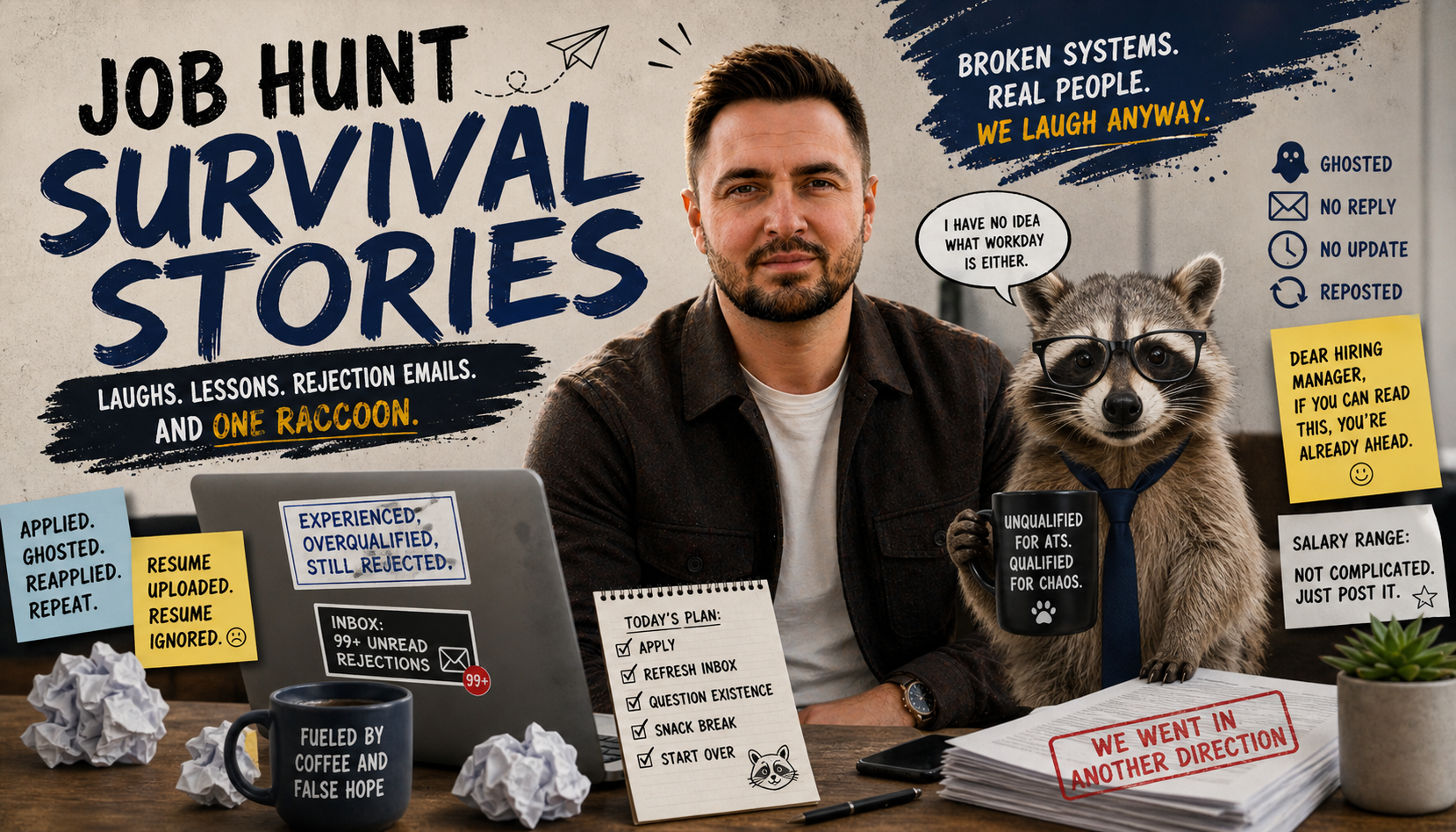
I never planned to become the narrator of job search survival stories, but somewhere between the first ghosted application, the twelfth rejection email written with all the emotional warmth of a parking ticket, and the moment I realized that modern hiring had somehow become a competitive endurance sport sponsored by caffeine, confusion, and applicant tracking systems nobody fully understands, the universe handed me a microphone, a coffee mug, and a slightly unstable raccoon who, despite lacking formal HR certification, still manages to understand candidate experience better than half the companies currently using the phrase “people-first culture” in their job postings.
Nobody warned us adulthood would include turning unemployment trauma into group therapy with punchlines, but here we are anyway, standing in the emotional clearance aisle of corporate America with one hand holding a resume we have rewritten so many times it now qualifies as historical fiction, the other hand refreshing an inbox that has become less of a communication tool and more of a haunted waiting room where hope goes to stretch, sweat, and question its life choices.
They told us to network, stay positive, tailor every resume, send thoughtful follow-ups, believe in ourselves, and treat every rejection as redirection, which sounds beautiful in a motivational quote posted over a sunrise, but becomes slightly less inspiring when the redirection keeps taking us back to the same application portal where we are asked to upload our resume, retype our resume, summarize our resume, explain our resume, attach our resume again, and then answer whether we have ever worked with Microsoft Excel as if the last twenty years of professional life were conducted using stone tablets and emotional guessing.
And yet, somehow, we keep doing it, because job seekers have developed a level of endurance usually reserved for marathon runners, substitute teachers, airport customer service agents during weather delays, and anyone who has ever tried to reset a Workday password while already emotionally unstable.
We keep applying to roles that were posted three hours ago and already have six hundred applicants, we keep joining Zoom interviews early because apparently we were raised by people who believed clocks were real and not decorative circles companies hang on walls before ignoring them, we keep smiling at recruiters who say, “We loved your background,” right before disappearing into the corporate fog like a LinkedIn ghost wearing a Patagonia vest and carrying our salary expectations into the afterlife.
We keep answering “Why do you want to work here?” without saying, “Because your company appears to exchange labor for money and I have developed an aggressive emotional attachment to groceries, rent, electricity, and the possibility of going to the dentist without needing a payment plan approved by three departments and a raccoon.”
That alone deserves recognition, because job hunting today is not simply looking for work; it is emotional CrossFit, psychological customer service, unpaid administrative labor, and a daily reminder that somewhere in a building with exposed brick and mission statements on the wall, a company is claiming to value communication while ignoring every candidate who made it past round four.
And somewhere in the middle of all that chaos, sarcasm becomes survival, jokes become oxygen, and community becomes the thing that keeps people from believing the silence is personal when, in reality, the silence is often just another broken process wearing business casual.
The Resume Portal Was Built by Someone Who Hates Eye Contact
There is no greater test of human patience than applying for a job online through a portal that asks you to upload your resume, pauses dramatically as if it is carefully analyzing your entire professional history with the seriousness of a Supreme Court clerk reviewing constitutional law, and then immediately opens a blank form that suggests the document you uploaded was not read, scanned, processed, respected, acknowledged, or even emotionally received by the machine.
You upload the resume with hope still in your system, which is already dangerous, and then the spinning wheel appears, circling slowly like a tiny digital raccoon trying to remember where it buried your employment history, before the page reloads and asks you to manually enter your name, address, phone number, email, job history, education, skills, references, certifications, preferred work environment, legal eligibility, and possibly the emotional reason you once left a company in 2014.
The resume you uploaded, it turns out, was not actually used to populate the application, because apparently its only purpose was to be sacrificed at the altar of corporate software before you were forced to rebuild your professional identity one tiny required field at a time.
Then comes the employment history section, which is where the portal takes your perfectly formatted experience and turns it into a hostage negotiation between you, autofill, and a dropdown calendar that refuses to believe anyone worked before 2007.
You try to paste “Regional Operations Manager,” and the system somehow breaks it into three separate careers called “Regional,” “Operations,” and “Manager,” each requiring a start date, an end date, a supervisor name, a reason for leaving, a salary history, and a brief explanation of whether you left voluntarily, involuntarily, spiritually, financially, or because leadership discovered restructuring sounds better than chaos.
Then comes the employment gap question, floating there with the confidence of a form field that has never paid rent during a recession, asking you to explain any gap in employment as if life is supposed to unfold in one seamless professional spreadsheet with no layoffs, no caregiving, no burnout, no pandemics, no company closures, no toxic managers, no economic downturns, no family emergencies, and no months where the job market behaved like a raccoon trapped in a conference room full of keyboards.
You want to write, “I was surviving,” but the character limit says 250, the tone must remain positive, and somewhere in the background a recruiter will later say they appreciate authenticity while rejecting anyone whose life does not look like it was assembled by a corporate brochure.
So you type something professional, clean, graceful, and emotionally restrained, because candidates are expected to summarize complicated life events with the same calm language companies use when announcing layoffs they caused.
Then, just as your patience begins packing a bag and looking for another place to live, the application asks you to create an account with a password containing one uppercase letter, one lowercase letter, one number, one symbol, one ancient rune, one childhood memory, and enough resilience to receive no response after submission.
You create the password, the system rejects it, you create another password, the system rejects that too, and eventually you type something so unhinged and secure it could protect military secrets, only for the portal to say it cannot contain your name even though your name is nowhere inside it, unless the software has now begun detecting emotional distress as a personal identifier.
Finally, after forty-seven minutes of typing information that was already on the resume you uploaded at the beginning like a hopeful fool with a functioning belief in technology, you submit the application and receive the most beautifully meaningless sentence in modern professional life: “Thank you for applying. We will review your qualifications and contact you if your experience matches our needs.”
And then nothing happens.
The role stays online.
Then it gets reposted.
Then it gets reposted again with a slightly different title, a slightly worse salary range, and the same requirement for excellent communication skills, which feels bold coming from a company that communicates exclusively through abandoned portals, vague automation, and the spiritual equivalent of a locked door with a motivational poster on it.
Recruiters, Ghosts, and the Sacred Art of “We’ll Be in Touch”
Recruiters have mastered a very specific style of communication where every message sounds urgent until you respond, at which point the urgency evaporates, the warmth disappears, the conversation enters a witness protection program, and you are left staring at your inbox like you just imagined an entire professional relationship with someone who may have been a staffing agency, a bot, or a Victorian ghost with access to LinkedIn Premium.
It always starts with energy, because the recruiter message must arrive wearing confidence, exclamation points, and the phrase “your background is impressive,” which is flattering until you realize your background was impressive enough to trigger outreach but apparently not impressive enough to receive follow-up communication after you rearranged your schedule, took the call, explained your experience, shared your salary range, and politely pretended the job description made sense.
They say the role is exciting, which usually means confidential, underexplained, urgently hiring, vaguely remote, possibly hybrid, definitely fast-paced, and written in language that suggests three employees quit, one person is doing the work of a department, and leadership has decided the solution is to hire a “rockstar” instead of addressing the flaming wagon rolling downhill through operations.
Still, you respond, because hope is not logical, hope is a raccoon with Wi-Fi chewing through your common sense while whispering, “Maybe this one is real.”
Then comes the quick call, which is never really a quick call but rather a ceremonial reenactment of your resume, during which someone asks you to walk them through your background as if your background is not sitting directly in front of them in bullet-point form, wearing dates, metrics, accomplishments, and enough formatting trauma to deserve its own benefits package.
You walk them through it anyway, because you are professional, because you still believe in being gracious, and because some part of you thinks that maybe if you explain your experience clearly enough, the hiring process will behave like a rational system instead of a corporate escape room designed by people who think “touch base” is a strategy.
The recruiter says, “This sounds like a strong fit,” and that phrase, dangerous little sentence that it is, walks directly into your nervous system wearing dress shoes, sits down at the kitchen table of your hope, and starts rearranging your future without permission.
Suddenly you are imagining what it would feel like to have an offer, to update your LinkedIn without needing sarcasm as a flotation device, to stop translating rejection emails into emotional weather reports, to finally breathe in a way that does not sound like a printer trying to survive a tax deadline.
Then the recruiter disappears.
Not gradually, not apologetically, not after a thoughtful update explaining where things stand, but completely, dramatically, spiritually, as if someone opened a trapdoor beneath the conversation and dropped the entire opportunity into a basement labeled “Candidate Experience.”
You follow up politely after a few days, because candidates must remain calm even when basic communication has apparently been outsourced to a fog machine.
Nothing.
You follow up after a week, still professional, still friendly, still pretending this is normal because somewhere along the way job seekers were taught that asking for updates after being asked for their time might look desperate, while vanishing after requesting someone’s availability somehow still qualifies as talent acquisition.
Still nothing.
Then, three weeks later, the recruiter posts online about the importance of communication, transparency, and building meaningful relationships, and that is when the raccoon has to be physically removed from the room before he starts drafting a compliance complaint in all caps.
Ghosting candidates has become so normalized that people will conduct phone screens, schedule interviews, request references, ask for salary expectations, collect work samples, promise updates, and then vanish like a corporate magician performing the world’s least impressive trick: turning hope into resentment without leaving a forwarding address.
The worst part is not even rejection, because rejection at least has the decency to arrive with a shape, a subject line, and a closing sentence pretending to wish you success in your future endeavors.
Ghosting is different.
Ghosting says, “You may continue waiting indefinitely in the lobby of uncertainty while we go update the job posting and pretend none of this happened.”
And that is why the community matters, because every time someone tells one of these stories, another person realizes they are not crazy, they are not imagining the absurdity, and they are not alone in wondering how a process built around evaluating professionalism can be so wildly unprofessional toward the people trying to enter it.
The Interview Games and the Emotional Damage Olympics
The modern interview process has evolved far beyond a simple conversation between a candidate and a company, because apparently that would be too efficient, too humane, too respectful of everyone’s calendar, and dangerously close to making a hiring decision before the entire organization gets a chance to ask the same question in slightly different fonts.
Now interviewing feels like being invited into a corporate obstacle course where every round is described as “just one more conversation,” even though by the time you reach the final stage you have met the recruiter, the hiring manager, the senior manager, the peer team, the cross-functional partner, the cultural ambassador, someone from leadership who did not read your resume, and one mystery panelist who joins late, keeps the camera off, asks the hardest question, and then disappears like a government witness.
First comes the phone screen, which exists mostly so someone can confirm that the resume they already received belongs to a living person who can speak in complete sentences, tolerate ambiguity, and pretend salary range conversations are not the professional version of two raccoons slowly circling the same sandwich.
Then comes the hiring manager interview, where you are expected to be strategic but hands-on, confident but humble, experienced but not threatening, ambitious but not expensive, flexible but not boundaryless, enthusiastic but not desperate, polished but authentic, and somehow relaxed while being evaluated by someone who may or may not have remembered the meeting was scheduled before the calendar reminder shouted at them.
Then comes the panel interview, which is where companies gather several adults into a virtual room so they can collectively determine whether you are a culture fit, a technical fit, a leadership fit, a communication fit, a personality fit, a values fit, a vibes fit, and perhaps, if there is still time, whether you can actually do the job.
You answer the questions with the emotional precision of a person defusing a bomb made of buzzwords.
Tell me about yourself.
Tell me about a time you overcame adversity.
Tell me about a time you handled conflict.
Tell me about a time you failed.
Tell me about a time you influenced without authority.
Tell me about a time you managed ambiguity.
Tell me about a time you wanted to stand up in the middle of a sixth interview and ask whether anyone here has the authority to make a decision or whether we are all trapped inside a leadership development exercise with dental pending.
You give them stories.
You give them examples.
You give them metrics.
You give them emotional intelligence wrapped in polished business language, because saying “I kept the wheels from falling off while leadership communicated exclusively through vibes and calendar changes” must be translated into “I maintained operational stability during periods of rapid organizational change.”
Everyone nods.
Someone says, “That’s a great answer.”
Someone else says, “That really resonates.”
The hiring manager smiles with the kind of smile that could mean you are the top candidate, the backup candidate, the fifth candidate, or simply a person they will compliment warmly before rejecting with a template.
Then they say they will be in touch soon, and there it is again, the word “soon,” stretching across the conversation like a bridge made of wet cardboard and vague intentions.
Soon could mean tomorrow.
Soon could mean next week.
Soon could mean after the budget meeting, after the internal candidate declines, after leadership returns from PTO, after the role changes, after the team realigns, after Mercury leaves retrograde, or after the company reposts the job under a slightly different title and pretends the last three weeks were a rehearsal.
You wait.
You replay every answer.
You wonder if you talked too much, not enough, too confidently, too honestly, too warmly, too directly, too strategically, or if your Wi-Fi froze at the exact moment your face looked employable.
Then the rejection arrives, dressed in polite language and carrying absolutely no useful feedback.
“While we were impressed with your background, we have decided to move forward with another candidate.”
Another candidate, the mysterious final boss of every hiring process, floating somewhere in the corporate mist, allegedly better aligned with the role, the team, the culture, the budget, the hidden expectations, the unspoken politics, and whatever secret spreadsheet determines whether you receive health insurance or another character-building moment.
And still, even after all of that, you survive.
You close the laptop.
You breathe.
You remind yourself that being rejected by a process does not mean you were not qualified, valuable, capable, talented, experienced, or worthy, because sometimes the process is too broken, too slow, too biased, too confused, or too busy searching for a unicorn ninja purple squirrel who can rebuild a department, repair morale, analyze data, lead strategy, take notes, run reports, mentor the team, make coffee, and accept below-market pay because the office has snacks.
Final Thoughts
The job hunt can make even the strongest person feel like their career was accidentally routed to spam, forwarded to a committee, buried inside a portal, reviewed by an algorithm, ignored by a recruiter, discussed by a panel, rejected by a template, and then reposted online with the same responsibilities and a worse salary range.
It can make you question your value, your timing, your experience, your age, your resume, your confidence, your employment gap, your industry, your background, your interview answers, your LinkedIn headline, your cover letter, your follow-up email, and whether the “easy apply” button is actually just a tiny trapdoor beneath your self-esteem.
But getting rejected by broken systems does not make you broken.
Getting ghosted by people who requested your time does not make your time worthless.
Having an employment gap does not erase your talent, your work ethic, your intelligence, your leadership, your resilience, or the fact that you have survived things no cover letter could possibly explain without becoming either too honest or too long for the portal to accept.
You are not your rejection email.
You are not your application status.
You are not the silence after the final interview.
You are not the “we went in another direction” message written by someone who could not even be bothered to explain whether that direction included accountability, communication, or a hiring manager who knows how calendars work.
You are a human being trying to survive a hiring system that has made finding work feel like competing in a reality show designed by confused raccoons with access to Workday, Outlook, and just enough authority to schedule seven interviews without making a decision.
And that is why we laugh, not because all of this is funny, because it is not, and anyone who has priced COBRA while unemployed knows there are moments in adulthood when the only thing standing between you and a full spiritual collapse is caffeine, community, and one joke sharp enough to cut through the fog.
We laugh because the absurdity deserves witnesses.
We laugh because the silence gets smaller when people tell the truth.
We laugh because someone out there is sitting in front of a laptop right now, staring at another rejection email, wondering if they are the only one exhausted by a process that keeps demanding professionalism while offering very little in return.
They are not.
We are here.
We are tired, funny, caffeinated, mildly suspicious, emotionally overqualified, and still standing.
And if the job market insists on acting like a circus, then fine.
We will bring the raccoon.
But this time, he is running talent acquisition.