There was a time, not that long ago, when applying for a job at least carried the illusion of dignity. A fragile, theatrical, heavily caffeinated illusion, yes, but an illusion nonetheless. You submitted your resume, wrote your cover letter, adjusted your entire personality to fit the phrase “fast-paced environment,” and told yourself that somewhere on the other side of that portal was a hiring manager with reading comprehension, a pulse, and perhaps even a modest respect for human effort. It was a fantasy, of course, but it was a comforting one, like believing your dentist is proud of you or that customer service surveys are actually reviewed by anyone not currently dead inside.
Now, however, we have entered a more evolved stage of the hiring apocalypse, a stage so polished in its absurdity, so casually insulting in its execution, that it deserves to be studied by future historians under a chapter titled: The Collapse of Meaning, But With Branding.
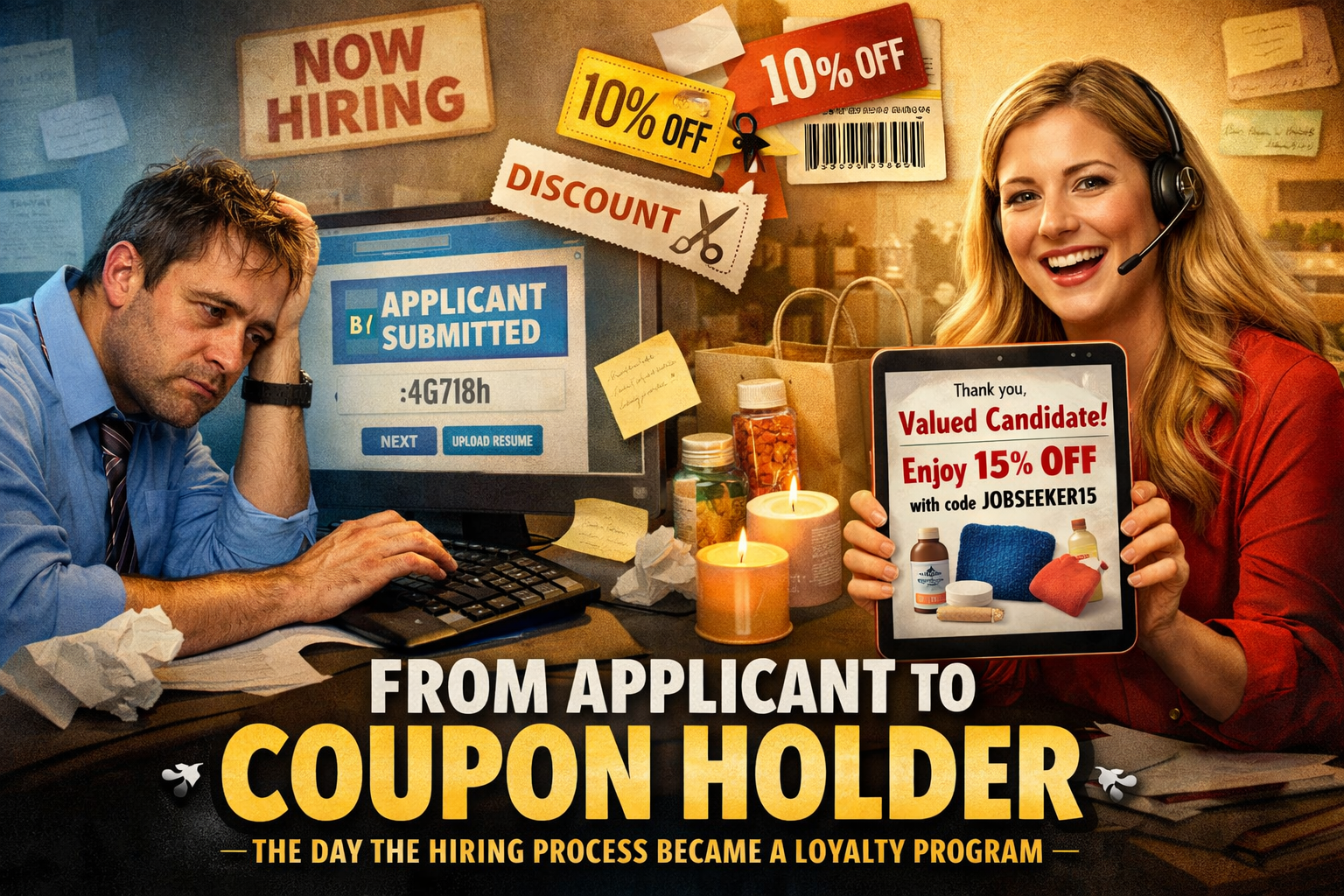
Because nothing, and I mean nothing, captures the precise emotional collapse of modern job hunting quite like spending forty-five minutes applying for a role you are fully qualified for, only to receive an email that appears at first glance to be important, hopeful, maybe even life-changing, and turns out instead to contain a promotional code for muscle cream, vitamins, or free shipping on wellness accessories.
That is not satire. That is not a joke someone made up while rage-eating crackers in a parking lot. That is the actual shape of the economy now. We are living in a society where you can present your education, your years of experience, your professional accomplishments, your references, your carefully tailored resume, and the company’s response is essentially, “Beautiful. Inspiring. Anyway, here is ten percent off knee support.”
There is something so spiritually disrespectful about that exchange that it almost loops back around into performance art. You arrive as a candidate and leave as a potential shopper. Not a colleague. Not a serious professional. Not even a properly rejected person. Just a lead in another funnel. A warm body with an inbox. A citizen of the great modern workforce carnival, where every broken ride is sponsored by a subscription service and every disappointment comes with a promo code attached.
And what makes it even funnier, in the bleakest and most professionally deranged way possible, is that the entire thing is wrapped in language that suggests someone believes this is a kindness. “Thank you for your interest.” “We value your time.” “We are excited to stay connected.” Stay connected to what, exactly? The job I do not have? The team I will never meet? The company that looked at my professional aspirations and decided the strongest next step was to offer me discounted calcium gummies?
Somewhere along the way, the hiring process stopped being a bridge between people and became a cross-promotional hostage situation. The interview never happened, but the marketing department arrived early, hair done, smiling too hard, asking whether you would also like to sign up for texts. You are not being assessed anymore. You are being harvested. Your ambition has been strip-mined for engagement. Your resume is not a document of experience; it is a receipt for future spam.
And this is what makes job hunting in the modern era feel less like career development and more like wandering through a haunted mall where every storefront is either closed, fake, or trying to sell you socks after asking about your leadership style. The systems are broken, the portals are cursed, the ghost jobs are multiplying in the dark, and now even the confirmation emails have started behaving like coupon mailers with self-esteem issues.
Which brings us to the central absurdity of our time: the modern applicant is no longer merely unemployed, underemployed, or professionally exhausted. No. The modern applicant is something much more insulting.
The modern applicant is a pre-customer.
Welcome to the Portal, Where Hope Goes to Be Reformatted
Every modern job application begins the same way: with optimism so fragile it should be transported in bubble wrap.
You see a position that sounds promising. The title is reasonable. The requirements are not completely unhinged. They are only asking for seven years of experience in a tool that was invented during the second Obama administration, which, by current standards, counts as refreshingly grounded. You think to yourself, perhaps unwisely, that this might be worth your time. You update your resume. You rewrite your summary. You swap out verbs like a corporate poet in witness protection. You tailor. You optimize. You align. You perform this little ritual of professional self-translation where your real life gets converted into the specific dialect of people who use words like “stakeholder” without trembling.
Then you click Apply, and the portal reveals itself.
It is always the same visual experience. A website that appears to have been designed by someone who lost a personal battle with joy. Beige fields. Tiny fonts. Broken spacing. A login page with the energy of a DMV basement. You upload your resume, and the system immediately punishes you by extracting your information with the accuracy of a head injury. Your name is now in the last-name field. Your current title has been assigned to your street address. Your city is somehow listed as Microsoft Excel. Your degree has vanished completely, which is actually impressive considering how much debt was involved in obtaining it.
So you begin retyping your entire work history manually, line by line, like a Victorian orphan entering census data by candlelight. There is something almost biblical about it. You upload the document. You re-enter the document. Then, just for spice, the system asks you to describe why you are a strong fit for the role, which is an elegant way of saying, “We noticed you have already provided evidence. We would now like you to beg in paragraph form.”
And you do it. Of course you do it. Because job hunting has trained people to accept indignities the way survival training teaches people to purify swamp water. You do not ask why the process is this bad. You just keep moving. You create the required password, which must contain one uppercase letter, one lowercase letter, one number, one special character, one ancient rune, and the memory of your first professional disappointment. You verify your email. You complete the captcha, proving once again that the only creature regularly required to prove its humanity in this economy is the applicant.
Then come the questions. Are you legally authorized to work here. Will you require sponsorship. Are you willing to relocate. Are you a veteran. Do you have a disability. Are you over eighteen. Under pressure. Comfortable with ambiguity. Available weekends. Open to being perceived as enthusiastic while dying quietly inside. It is a fascinating exercise because the portal manages to ask everything except the one question that might actually speed things up, which is: can you do the job.
By the time you reach the final screen, you have already invested enough emotional energy to deserve either an interview or light sedation. You click submit with the solemn exhaustion of a person mailing their soul into a volcano. And then, for one brief moment, the silence feels meaningful. The process is over. The application is in. The future remains uncertain, yes, but at least you have done your part.
Then the email arrives.
And instead of opportunity, it contains a discount code for seasonal wellness products.
That is when the spirit leaves the body.
Because rejection is one thing. Silence is another. But to turn a job application into the opening move of a retail campaign is such an aggressively modern insult that it deserves its own museum wing. It says, with breathtaking corporate confidence, “Thank you for expressing interest in supporting yourself financially. In return, we would like to offer you fifteen percent off items you may need while stress-crying in your car.”
You are not being hired. You are being converted. Not into an employee, but into a monetizable demographic. The portal was never a door. It was a trapdoor into marketing.
The Candidate Experience Has Been Outsourced to Sales
There is something almost admirable about the efficiency of the insult.
A company can look at an applicant, absorb their data, collect their labor, skim their experience, ignore their humanity, and still find time to say, before we go, would you like to buy something. That is not just bad taste. That is operational excellence in the field of emotional disrespect.
Because let us really sit with the choreography here. A person applies for a job because they need income. That is the central theme. Money. Survival. Rent. Groceries. Insurance. The deeply glamorous dream of continuing to exist indoors. They are not casually browsing. They are not wandering into a digital boutique with a smoothie and a sense of curiosity. They are trying to secure employment. They are trying to participate in society without being tackled by their utility bills.
And the company’s response is not, “We appreciate your interest and will review your qualifications.” No. The company slides across the table like a mall kiosk employee sensing eye contact and says, “Before you go, here is a code for ten percent off orthopedic slippers.”
It is such a perfect expression of the modern economy that it almost deserves applause. Not because it is good, but because it is honest in a way the rest of corporate language never is. At least the coupon tells the truth. It says, clearly and without shame, that the line between worker and consumer has completely collapsed. You are not here to build a career. You are here to generate activity. Clicks. Opens. Funnel movement. Brand interaction. Your dreams have been fed into a CRM.
This is how thoroughly the hiring process has been colonized by marketing brain. Even disappointment must now contain engagement value. Even rejection must be leveraged into a lifestyle opportunity. They cannot simply ignore you. They must monetize the moment. Your failed attempt at stability has become a chance to move inventory.
And the language, always the language, arrives dressed like it is doing you a favor.
“Because you are a valued candidate…”
Valued where. By whom. In what department. Because I assure you it is not the department handing out salaries.
It is such a slippery little phrase, “valued candidate,” because it performs warmth without having to deliver any substance. It is the professional equivalent of being patted on the shoulder by someone stealing your wallet. You are valued just enough to receive branded outreach. Not enough for transparency. Not enough for a timeline. Not enough for human review. Certainly not enough for a recruiter to send an email that does not read like it was assembled by a committee of scented candle merchants and legal interns.
What we are witnessing is the complete retailification of professional aspiration. Careers are now marketed the way protein bars are marketed. Everything is sleek, automated, impersonal, and weirdly upbeat. The job post invites you to “join our family.” The portal asks you to “tell us about yourself.” The confirmation email thanks you for your “passion.” Then a few beats later the brand pivots hard into, “Use code WELCOME10 for a magnesium bundle.”
At this point, there is no meaningful difference between applying for a job and accidentally subscribing to a skincare newsletter. Both begin with hope. Both end with emails you did not ask for. Both somehow involve the word journey.
And the psychological damage is so specific. Because a job application email does not arrive neutrally. It arrives carrying possibility. It arrives with that tiny electrical charge in your chest, that foolish little drumroll of maybe. Maybe they saw something. Maybe they liked your background. Maybe the hours spent tailoring your resume were not, in fact, an offering thrown into the sea. Then you open it and realize the only thing they are prepared to move forward with is your eligibility for discounted compression socks.
That emotional whiplash should qualify a person for hazard pay.
Imagine any other setting where this would be considered normal. Imagine proposing marriage and receiving a response that says, “Thank you for your interest in forever. While we review your compatibility, enjoy free monogramming on select towels.” Imagine auditioning for a play and getting, “The director appreciates your energy. Here is twenty percent off throat lozenges.” Imagine filing taxes and the IRS replying, “We have received your forms. Since you seem financially vulnerable, may we interest you in a branded mug.”
It is madness. Organized, polished, professionally proofread madness.
And yet it continues because somewhere in a conference room, someone called this synergy. Someone with a title like Customer Lifecycle Experience Strategist looked at unemployed people and saw an untapped conversion channel. Someone built a slide deck explaining that applicants exhibit high-intent engagement behaviors and may be receptive to targeted promotional messaging during transitional career moments. Which is a very elegant way of saying, “They are desperate and checking email constantly. Let’s sell them knee braces.”
Late-Stage Capitalism Has Entered the Interview Wearing a Name Tag
The genius of late-stage capitalism is not merely that it exploits people. It is that it insists on doing so cheerfully.
It does not kick down the door in a villain cape and announce itself. It arrives smiling, with rounded buttons, brand-approved empathy, and a follow-up email sequence. It tells you your experience matters. It thanks you for your vulnerability. It invites you to bring your whole self to work, then asks whether your whole self would also like fifteen percent off wellness bundles and expedited shipping.
That is why the promo-code-after-applying phenomenon feels so strangely intimate in its insult. It is not just that it is crass. It is that it reveals the entire architecture. It lets you see the gears. You realize, in one hideously efficient email, that the company may not know your worth, may not care about your qualifications, may never contact you again as a professional, but it absolutely knows how to slot you into a revenue stream by category.
This is no longer a labor market. This is a cross-sell ecosystem with occasional interviews.
The candidate used to occupy a sacred space in the fantasy of capitalism. The ambitious worker. The self-starter. The professional on the rise. The person willing to apply, strive, network, adapt, improve, and keep showing up in polished shoes while the economy performed acrobatics on their ribcage. That figure, at least in theory, was supposed to be respected. Maybe not rewarded adequately, obviously, but respected enough to preserve the illusion.
Now even that has been stripped for parts.
You are no longer the aspiring professional. You are the post-click audience segment. You are no longer a possible teammate. You are an email-open rate with student loans. The same system that demands endless personalization from applicants offers absolutely none in return. It wants your cover letter to sound human, heartfelt, specific, and sincere. Its own response sounds like a coupon fell in love with an autoresponder.
And what makes it worse is the forced optimism of the entire exchange. Everything has to be bright. Encouraging. Upbeat. “We know job searching can be stressful.” Do you. Do you know that. Is that why you followed my application with ten percent off pain relief patches, like a hospital gift shop hovering outside the emergency room. “We are honored you considered us.” Beautiful. Then why am I being treated like I entered a sweepstakes for discounted electrolyte powder.
There is a special cruelty in being acknowledged only as a buyer when what you wanted was a chance to be useful. That is the quiet humiliation underneath the joke. People are not applying for jobs because they are bored. They are applying because they want to work, contribute, stabilize their lives, support families, preserve health insurance, stop waking up at three in the morning trying to calculate whether they can survive another month of uncertainty. They are bringing skill, effort, vulnerability, and hope to the table.
And the table keeps turning into a checkout counter.
That is why these moments land so hard. Not because the coupon itself matters. It is not about the ten percent. It is about the conversion of a deeply human act into a branded transaction. The reduction of aspiration into market behavior. The way every system now seems unable to encounter a person without immediately asking how that encounter can be monetized.
At some point you stop feeling like an applicant and start feeling like a guy who wandered into a networking event only to discover it was secretly an airport kiosk trying to sell moisturizer. Every “career opportunity” starts to feel like one of those websites where the ad for the thing is larger than the thing itself. The role may not be real. The recruiter may not respond. The process may take four months and end in silence. But the promo code, somehow, is always ready. Prompt. cheerful. deeply committed.
That is the part that should concern us all. The machinery of actual hiring is unreliable, delayed, evasive, and opaque. The machinery of selling you something after failing to hire you is immediate, polished, and frighteningly competent. They cannot coordinate an interview timeline, but by God they can get a coupon into your inbox before your application confirmation page finishes loading.
That is not an accident. That is a priority list.
Final Thoughts: We Did Not Lose the Plot, We Put It Behind a Paywall
There is a reason this kind of thing makes people laugh and then stare into the middle distance like they have just seen the ghost of every bad decision ever made in a boardroom. It is because the absurdity is too complete to dismiss. The coupon is funny, yes. It is ridiculous. It is meme-worthy. It is so aggressively unserious that it practically writes its own punchlines. But it is also a tiny crystal-clear symbol of something much bigger and uglier.
It tells you exactly what this era thinks a person is.
Not a worker first. Not a citizen. Not a mind, a talent, a future teammate, a contributor, or even a properly disappointed candidate. A consumer. Always and immediately a consumer. Before your resume is read, before your qualifications are considered, before your interview is scheduled or your rejection is drafted, your inbox has already been measured for sales potential.
That is bleak enough on its own, but it becomes almost majestic when paired with the level of effort expected from applicants. Because this is not a low-investment process. People are not tossing their names into a fishbowl for a chance to win a blender. They are laboring. They are researching companies, tailoring resumes, drafting cover letters, preparing work samples, completing assessments, recording one-way interviews, following up professionally, monitoring email like emergency dispatch operators, and trying to remain optimistic in a system that treats optimism like a resource to be extracted.
And after all that, the reward is often not clarity, not momentum, not even closure, but a discount code for sleep aids.
It would be funnier if it were less precise. But it is precise. That is what gives it power. It is the perfect emblem of an economy that keeps asking people to perform dignity while offering them less and less of it in return. It says: present yourself as accomplished, polished, emotionally intelligent, and eager, and in exchange we may someday circle back. Until then, enjoy ten percent off products designed to soothe the symptoms we helped create.
Magnificent. Deranged. Entirely on brand.
So yes, laugh at it. You have to. Laughter is one of the last remaining free services in this economy, and even that feels vulnerable. Laugh at the coupon. Laugh at the phrase valued candidate. Laugh at the fact that the path from applicant to shopper now takes less time than the average recruiter callback. Laugh because the alternative is flipping over a folding table in a lobby while shouting about workflow dehumanization.
But also notice what it reveals. Notice how quickly every human interaction is being flattened into monetizable behavior. Notice how little effort some organizations put into the actual candidate experience compared with the suspiciously polished effort they put into branding, funnels, engagement, and transactional follow-up. Notice how often people seeking stability are met not with opportunity, but with a sales sequence.
Because once you see it, you cannot unsee it. The whole thing changes shape. The portal is not a doorway. The confirmation email is not reassurance. The professional language is not always respect. Sometimes it is just a velvet curtain hanging in front of a gift shop.
And maybe that is the truest description of modern job hunting now. Not a pathway. Not a process. Not even a fair contest.
A gift shop.
You arrive carrying your resume, your experience, your hope, and your last functioning ounce of self-belief. You think you are there to build a future. Then the cashier smiles, hands you a coupon, and asks whether you would also like to sign up for rewards.






https://shorturl.fm/HY6B3