
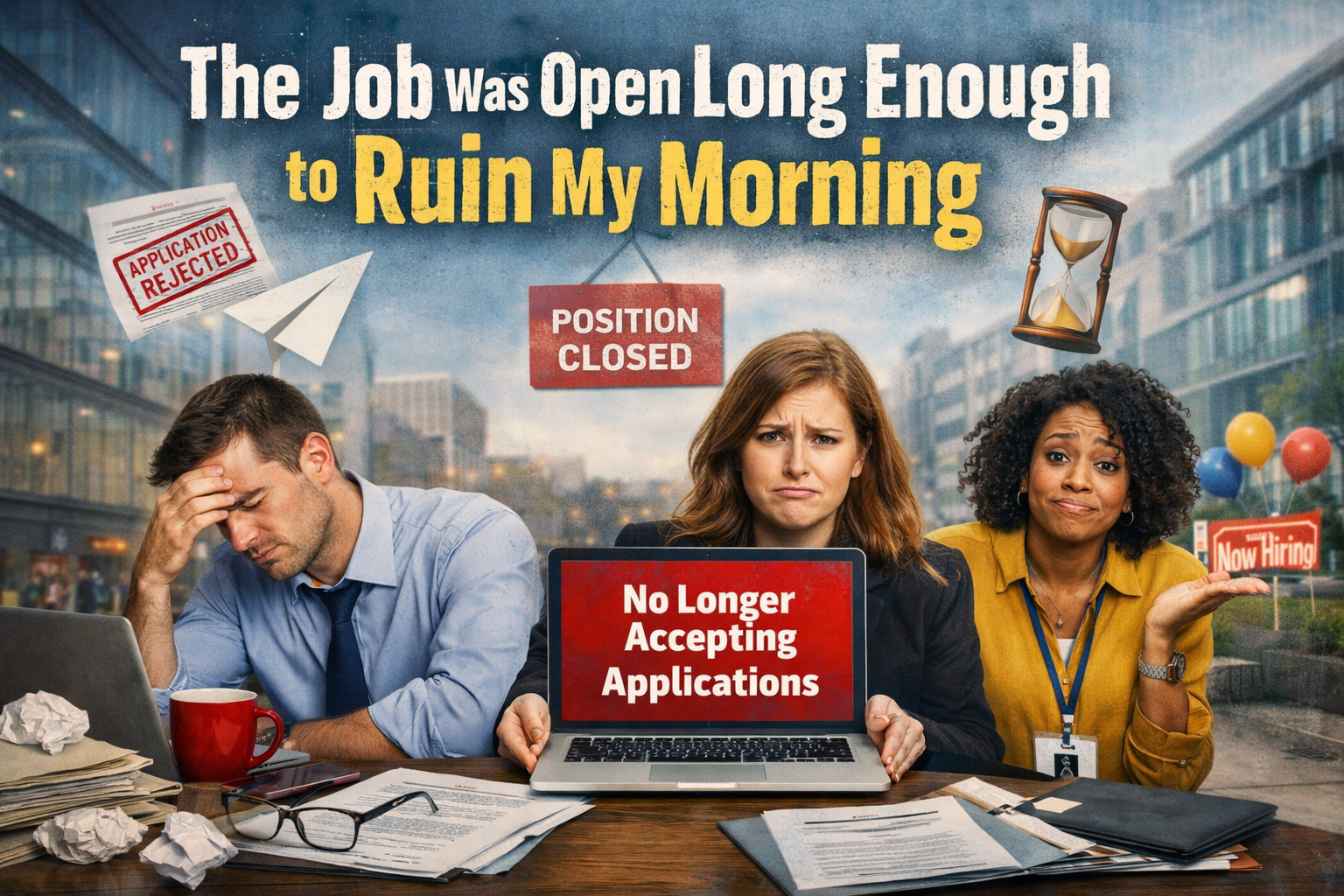
There should be a clinical term for the exact emotional collapse that happens when you spend two and a half deeply committed hours tailoring your resume for a role you could do with one hand on the keyboard, one eye half open, and the other eye rolling at the company’s mission statement, only to discover at the very end that the position is no longer accepting applications. Not filled, not gracefully closed, not even dressed up in one of those fake warm little corporate lines about how they were “fortunate to receive an overwhelming number of applicants.” No. Just dead. A flat little digital tombstone sitting where your future briefly pretended to live.
And that particular rage is unlike other rage, because it is not loud at first. It begins in silence. In optimism. In the deeply embarrassing sincerity of a person who still, against all available evidence, believes effort might matter. You wake up with purpose. You open the job description like it is a sacred text that must be interpreted with the seriousness of a constitutional scholar and the paranoia of a hostage negotiator. You read every line as though hidden between “must be a team player” and “thrives in a fast-paced environment” is the secret code that will unlock human recognition. You do not merely apply. You prepare. You revise. You curate. You perform literary surgery on your entire professional history until every bullet point glistens with strategic intent.
You turn ordinary words into elite words. “Helped” becomes “supported.” “Supported” becomes “facilitated.” “Facilitated” becomes “drove cross-functional outcomes,” which means absolutely nothing and yet somehow sounds like it should come with stock options. You rewrite your resume with the focus of a battlefield medic. You customize your cover letter until it sounds like you have been in a committed emotional relationship with the company’s values for six years. You mention the team. You mention the mission. You mention the role in a tone that says, I understand your needs, your pain points, your quarterly objectives, and your fragile little preference for people who say “stakeholders” without gagging.
You do all of this because every piece of advice ever thrown at candidates says this is what serious professionals do. Research the company. Show initiative. Be specific. Demonstrate enthusiasm. Leverage your network. Use the exact posting. Follow the process. Tailor your materials. Respect the system. Present yourself as polished but authentic, accomplished but humble, confident but not threatening, experienced but somehow still “eager to learn.” So you obey. You kneel before the gods of modern hiring and build your offering with trembling hands and a decent serif font.
Then, after all that effort, after the tailoring and formatting and keyword choreography, after you have emotionally dry-cleaned your entire career into something acceptable to strangers, you click the application link and discover that the posting has already closed.
That is not a hiring process. That is a prank with health insurance implications.
Because now your morning is gone. Not in the abstract “time is precious” sense people write in inspirational calendars, but in the very real sense that you have burned your best mental energy on a role that was never even available to you by the time you reached the front door. It is the professional version of getting dressed for a first date, driving across town, parking in a paid garage, rehearsing your smile in the rearview mirror, and then finding a handwritten sign on the restaurant that says, “Actually this ended yesterday.” No apology. No explanation. Just vibes and debris.
And what makes it even more insulting is that the system still expects you to internalize this as a personal growth opportunity. Somewhere, right now, a recruiter is posting on LinkedIn that candidates need to be more resilient, more proactive, more strategic, as though job seekers are not already out here performing unpaid thesis projects for portals run by software that looks like it was developed during a hostage situation in 2007. People are not tired because they lack initiative. They are tired because every application now requires the emotional stamina of a triathlon and the outcome reliability of a carnival claw machine.
So yes, let us talk about the modern job hunt, that dazzling pageant of administrative humiliation where a person can be extremely qualified, internally referred, thoroughly prepared, and still get taken out by a hyperlink with bad timing. Let us speak of the theater. Let us document the absurdity. Let us drag a folding chair into the middle of this nonsense and finally admit that half the exhaustion of job hunting is not rejection. It is the relentless insult of being asked to perform sincerity for systems that cannot even manage the decency of being open when they say they are open.
Because if the job market insists on behaving like a haunted escape room designed by passive-aggressive bureaucrats, then the least we can do is laugh while the walls move.
The Holy Ritual of Tailoring a Resume for People Who Do Not Deserve That Level of Effort
There is something almost noble, in a tragic pioneer-walking-into-a-blizzard kind of way, about the mindset a person enters when they decide to tailor a resume for a job they actually want. The hope is so pure in the beginning. So stupid. So radiant. It is the optimism of a man ironing a shirt for a meeting with destiny while destiny is already in sweatpants ignoring calls.
You start strong. Maybe even a little smug. This one fits, you think. This one is in your lane. This is not one of those deranged postings asking for ten years of experience in software released last Tuesday, or a “junior” role requiring executive presence, coding fluency, bilingual negotiation skills, and the willingness to relocate to a city where rent now behaves like an organized crime operation. No, this job is different. This one actually makes sense. Your background lines up. Your experience matches. Your internal referral says you would be perfect. There is a glimmer in the air. You begin to imagine a recruiter seeing your materials and physically sitting up straighter.
So naturally you begin the ritual.
You do not simply send your resume. You enter into a relationship with the posting. You study its language with the alertness of someone trying to decode a ransom letter. Every phrase becomes an instruction. Every repeated term becomes a clue. “Project management” appears three times, so now you are looking back through your life, wondering whether the time you coordinated a broken rollout, a stressed manager, and a spreadsheet on the verge of collapse counts as “enterprise-level cross-functional execution.” Suddenly your past is not your past anymore. It is a quarry. You are mining it for keywords.
Then comes the conversion process, which is less writing and more witness protection for your work history. The things you actually did are not enough. They have to be translated into the official dialect of corporate theater. You did not solve problems; you drove operational efficiencies. You did not train people; you developed scalable talent strategies. You did not fix a disaster held together by string and prayer; you stabilized business-critical workflows during a period of rapid change. The modern resume is not a record of reality. It is a glamour shot of labor wearing contour.
And the cover letter, Lord help us, the cover letter. That is where the real emotional delusion sets in. Because now you are not just listing your qualifications. Now you are serenading a company that might not even know how to update its own application status. You are writing with warmth and intelligence and intentionality, crafting paragraphs that say, in elegant prose, “I have taken the time to understand your organization and would like to contribute meaningfully to its success,” when what your spirit is really saying is, “Please let one person in this building be awake.”
You tailor everything. You strip out the generic language. You replace it with custom references to their priorities, their culture, their needs. You make it specific because they said generic applications are obvious. You make it polished because they said attention to detail matters. You make it concise because apparently nobody can read more than five paragraphs anymore without needing a hydration break. You reread it. You trim a sentence. You swap a word. You change “excited” to “energized” because “excited” suddenly feels too desperate, and in the modern hiring market desperation must be present but never visible, like plumbing.
This is unpaid work, of course, but we are all expected to pretend it is not. We are expected to behave as though pouring specialized labor into a company’s selection process is just part of being professional, not a bizarre little performance in which candidates provide free samples of effort for organizations that cannot always be bothered to send a rejection email before the next fiscal quarter. And still we do it, because what is the alternative? Sending one generic resume into the void and being lectured by strangers online that you need to “put in the work”? Apparently job seekers are now expected to be part applicant, part marketer, part copywriter, part psychic, and part archaeologist sifting through a company’s website for clues about what personality type gets past the gate.
So you tailor and tailor and tailor, like a costume designer sewing sequins onto a gown for a premiere that may or may not exist. And the whole time there is this quiet faith beneath the frustration. A belief that maybe, just maybe, the extra effort will matter. That maybe the recruiter will see the specificity and think, here is someone serious. Here is someone thoughtful. Here is someone who did not just spray-and-pray their way through LinkedIn during a lunch break while eating dry almonds over a keyboard.
What you do not realize, because hope is a known hallucinogen, is that the posting may already be in the process of dying while you are still revising line three.
That is the genius of this entire broken circus. It tells candidates to invest more while investing almost nothing in return. It demands a handcrafted application experience from people on their fifth month of uncertainty and then places that effort into systems so unstable they can vanish mid-sentence. Job seekers are out here tailoring resumes like couture designers for a runway show that gets canceled while they are still hemming the sleeve.
And yet every week some thought leader appears online to explain that the real problem is candidate laziness. Not the labyrinthine portals. Not the expired postings. Not the ghosting. Not the endless rounds, the contradictory feedback, the salary games, the fake urgency, the delayed decisions, the internal hires dressed up as open searches, or the AI filters trained by a machine that clearly once got dumped by a humanities major. No. According to those people, applicants simply need to show more initiative.
At this point, if candidates show any more initiative, they are going to start laying the office flooring themselves before the interview.
When the Link Says No Longer Accepting Applications and You Briefly Leave Your Body
The click is always innocent. That is what makes it cruel.
After all that work, after the tailoring and the polishing and the strategic self-merchandising, there is still that final little moment of optimism where you believe the application part is about to begin. You are ready now. You have assembled your documents. Your file names are respectable. Your coffee has gone cold in solidarity. You crack your knuckles, open the job link, and prepare to enter the portal, that familiar digital sewer where hope goes to update profile fields it already submitted on the previous screen.
And instead of an application form, you get the sentence.
No longer accepting applications for this role.
That is it. No flowers at the funeral. No padded language. No “thank you for your interest.” No false warmth generated by legal. Just a blunt little dismissal sitting on the screen like it has no idea it just ruined a citizen’s entire emotional weather pattern. The role has evaporated. The door is shut. The altar is empty. The sacrifice was for nothing.
This is the moment when you do not immediately get angry. First comes disbelief. You refresh the page, because surely this is a glitch. Surely the internet, that deeply stable and trustworthy institution, is merely having a moment. Maybe the browser cached something weird. Maybe the link is stale. Maybe the universe is testing your patience before rewarding your character. So you refresh once. Twice. Three times, like a pilgrim tapping on the gate of a temple that has clearly closed but might still respond to persistence.
It does not.
Then comes the silence. The kind where you just stare at the screen and feel your soul slowly remove its blazer, loosen its tie, and walk barefoot into traffic. Because the insult here is not simply that the job is closed. The insult is timing. The insult is that it was open long enough to lure you in, occupy your mind, consume your labor, and then disappear before you could cross the threshold. It is bait with a mission statement. It is corporate catfishing with applicant tracking software.
You start replaying the morning like a detective in a crime drama, except the victim is your confidence. Should you have clicked first and tailored later? But everyone says not to do that, because serious candidates customize. Should you have saved a draft cover letter instead of writing a new one? But everyone says personalization matters. Should you have applied last night instead of this morning? Perhaps, but you are not an emergency response unit. You are a human being trying to assemble a future, not a firefighter battling a rapidly spreading outbreak of hiring incompetence.
And still, because job hunting has taught everyone to internalize structural nonsense as a personal failing, your mind begins searching for the version of this that is somehow your fault. Maybe you were too slow. Maybe real professionals move faster. Maybe someone hungrier would have gotten there in time. Maybe the market only rewards the swift and the spiritually dehydrated. This is how broken systems survive, by making reasonable people feel individually inadequate for not anticipating chaos.
But let us pause here and honor the absurdity properly. You had an internal referral. A living, breathing person inside the company was effectively saying, this is a real opportunity, and you would be great for it. That should mean something. In a sane world, it would mean the path is at least functional. Instead, the referral becomes just another prop in the show. Another candle lit at the altar of false momentum. Nothing says modern hiring quite like a real employee encouraging you to apply while the website has already entered its villain era.
That is where the theater becomes beautiful in the darkest possible way. Because now everyone is involved in a process nobody controls. The employee refers. The candidate prepares. The portal shrugs. The recruiter posts a thread next week about candidate quality. Somewhere in the background, a hiring manager says they need more urgency from applicants while the company’s own systems are out here acting like a haunted vending machine that occasionally eats dollar bills and flashes error codes in Latin.
This is why job seekers are exhausted in ways that do not always make sense to people who have not done this recently. It is not just the rejection. Rejection at least acknowledges your existence. It says, we saw you and decided no. There is closure in that, however rude. What destroys people is the pre-rejection nonsense. The wasted effort. The vanished openings. The dead links. The broken portals. The postings that remain public after decisions are already made. The roles that say remote but aren’t. The positions labeled urgent that sit untouched for six weeks like an abandoned shopping cart in a storm drain.
The closed-posting ambush is especially vicious because it robs you of the one thing job searching already steals in large amounts: emotional energy. By the time you discover the role is gone, you have already spent the valuable part of yourself. Not just time, but concentration. Hope. Precision. The mental effort required to narrate your own worth in terms that strangers might deem acceptable. That labor is not nothing. It drains people. It leaves a residue. It makes the next application harder because now you are carrying not only fatigue, but humiliation. You were not even rejected by a person. You were clotheslined by timing and code.
And the platforms themselves do not help. Taleo, Workday, Greenhouse, all these systems with names that sound like either boutique salad restaurants or low-budget sci-fi villains, each offering a slightly different flavor of administrative despair. One wants your resume uploaded and then asks you to manually retype every line into tiny boxes like a scribe in a medieval basement. Another makes you create an account so intimate it feels like joint tax filing. Another lets you get all the way to the final step before collapsing under the weight of its own haunted architecture. We are told technology streamlines hiring, but from where applicants are sitting, it mostly appears to have digitized disrespect and given it twelve password requirements.
And yet, despite all of this, there remains a strange pressure to stay gracious. To remain “professional.” To accept every absurdity with the calm smile of a spa receptionist. Heaven forbid a candidate express frustration, because then suddenly the discourse turns to resilience and emotional maturity, as if watching your labor be casually wasted by lazy systems is supposed to build character instead of blood pressure.
No wonder people are tired. They are not just applying. They are surviving a rolling series of tiny procedural betrayals. They are trying to stay hopeful while being heckled by infrastructure. They are trying to believe in possibility while hyperlinks behave like trapdoors.
At some point you stop feeling like a candidate and start feeling like an extra in a bureaucratic horror film where every hallway leads to a printer from 2009 and a woman named Cheryl keeps saying your paperwork cannot be processed because Mercury is in retrograde.
The Recruiter Will Still Say Candidates Need More Initiative, Which Is a Level of Audacity That Should Require Permits
What makes all of this truly majestic, in the same way a flaming shopping cart rolling downhill is majestic, is that after job seekers navigate this obstacle course of expired postings, broken links, vanished opportunities, and unpaid customization labor, someone in hiring will still find the upper-body confidence to get online and announce that candidates need to try harder.
This is the part that deserves its own museum wing.
Because there is no delusion quite like professional delusion wrapped in leadership language. Somewhere, right now, a recruiter is posting a solemn little monologue about the importance of follow-through, intentionality, and standing out in a competitive market. They will write this from a laptop powered by systems that cannot keep a job posting open through the lifespan of a cover letter. They will say candidates need to be more invested, as though applicants are not already out here acting like unpaid graduate students majoring in Corporate Guessing.
What exactly would “more initiative” even look like at this point?
Should applicants call the company switchboard and ask whether the role is still alive before opening Microsoft Word? Should they send a carrier pigeon to confirm the posting has not entered hospice? Should they maintain a rotating war room with hourly updates, three browser tabs, and a whiteboard labeled “Operational Status of Jobs I Am Emotionally Attached To”? Are we expected to monitor company websites with the vigilance of air traffic controllers because apparently nobody on the employer side can handle the breathtaking administrative burden of removing a dead listing before people waste half a day courting it?
The modern candidate is already performing enough initiative to qualify for sainthood. They network with strangers. They research executives. They tailor resumes. They write custom cover letters. They attend screenings, panels, one-way video interviews, personality assessments, unpaid projects, follow-up calls, final rounds, and “casual chats” that carry the emotional stakes of a hostage exchange. They prepare salary ranges that are somehow both honest and non-threatening. They send thank-you emails like Victorian diplomats. They navigate job descriptions written by committee and compensation ranges that look like somebody accidentally included both annual salary and the GDP of a medium-sized nation.
And after all that, if the process breaks on the company’s side, the candidate is still the one expected to absorb it elegantly.
This is perhaps the central con of modern hiring: the institution can be disorganized, delayed, opaque, inconsistent, and technologically incompetent, but the applicant must remain polished at all times. The company can take six weeks to respond after describing the role as urgent. The interviewer can show up late. The application portal can malfunction. The posting can expire mid-morning. The salary can be wildly below market. The job can quietly go internal after a public listing. The feedback can contradict itself like two raccoons fighting in a trench coat. None of this is seen as a serious indictment of the process. But let the candidate sound even slightly frustrated, and suddenly every pearl in corporate America is being clutched with both hands.
The asymmetry is breathtaking.
Candidates are expected to show gratitude for opportunities that are not opportunities, patience for delays that would get them labeled unreliable, and enthusiasm for organizations that often communicate with the emotional warmth of an automated parking ticket. They are told to be human, but only in the approved directions. Show passion, but not anger. Show personality, but not too much. Show resilience, but never let anyone see what you are surviving. It is less a hiring process and more a pageant for people who can smile while being lightly electrocuted by systems.
And then there is the LinkedIn performance of it all, that glittering open-air asylum where every structural failure gets repackaged as a motivational lesson. A recruiter will witness candidates drowning in broken processes and somehow post, “Top applicants always find a way.” Find a way through what, Deborah? A portal that closed the role after inviting people to apply? A workflow held together with expired links and HR folklore? This is not a test of grit. It is a scavenger hunt designed by cowards.
That is why people feel crazy job hunting. Because they are constantly being told to interpret dysfunction as opportunity. When the posting is dead, be faster next time. When the recruiter ghosts, keep networking. When the portal crashes, re-enter your information. When the salary is insulting, be grateful for the conversation. When the feedback is nonsense, treat it as growth. When the role disappears while you are still tailoring your materials, perhaps consider what this teaches you about agility.
No. What it teaches is that a lot of modern hiring is held together by magical thinking, fragile systems, and an almost athletic refusal to respect applicant time.
And yet the applicants endure. That may be the funniest part of all. People keep going. Bruised, irritated, under-caffeinated, spiritually side-eyed by Workday, and still they keep applying. They update the resume again. They save another version. They write another cover letter. They pretend, for one more morning, that this next posting might remain alive long enough to receive their interest. There is something both heroic and deeply deranged about that persistence.
Maybe that is why job hunting produces such a unique exhaustion. It is not only labor. It is labor performed in the presence of indifference. It is effort continually offered to a process that often seems insulted by effort. It is trying to create momentum in systems designed like abandoned malls. You are not simply pursuing work. You are making repeated emotional deposits into institutions with a long and storied history of acting like your time was printed on the back of a coupon.
So yes, by all means, let us hear one more lecture about initiative from people whose platforms still send applicants into expired listings like a carnival ride with missing bolts. Let us all gather around the glowing remains of basic common sense and nod thoughtfully while somebody with “talent strategist” in their bio explains that the true differentiator is hustle.
At this point, candidates are not lacking hustle. They are lacking a process that does not behave like it was assembled from cursed software and old receipts.
Final Thoughts: Applicants Are Not Fragile, They Are Just Tired of Being Asked to Perform Miracles for Broken Machinery
There comes a point in every prolonged job search where a person starts to understand that the fatigue is not weakness. It is not a mindset problem. It is not a failure of optimism, strategy, grit, manifestation, morning routines, networking habits, or personal branding. It is the perfectly rational exhaustion that develops when you are repeatedly asked to produce gold-standard effort for systems that cannot consistently manage bronze-level functionality.
That is what the dead-posting experience reveals so clearly. It strips away all the fake language and exposes the arrangement underneath. Applicants are expected to bring care, urgency, adaptability, intelligence, customization, and emotional discipline. Employers, meanwhile, are often allowed to bring stale links, vague timelines, contradictory expectations, and software that behaves like it should be studied by paranormal investigators. One side is told to be exceptional. The other side is often permitted to be operationally mediocre in broad daylight.
And still people blame applicants for being discouraged.
Of course they are discouraged. They are spending real thought on imaginary access. They are pouring time into doors that lock after inviting them over. They are being told to “put themselves out there” by people who would collapse into a decorative faint if their own internal systems were subjected to the standards they impose on candidates. Imagine if applicants behaved the way hiring processes behave. Imagine showing up to an interview forty minutes late, offering no explanation, changing the requirements mid-conversation, and disappearing for three weeks before sending a vague note that says, “We’ve decided to move in a different direction, but please continue to admire us.” Society would not call that strategic. It would call security.
The modern application process has managed to become both deeply personal and aggressively impersonal at the same time. It asks candidates to reveal ambition, competence, values, communication style, work history, aspirations, and often their tolerance for humiliation, while offering almost nothing reliable in return except the possibility of being processed. That is why the tiniest administrative indignities hit so hard. A dead posting is not just a dead posting. It is another reminder that the burden of sincerity is one-sided. You were meant to care. The system was only meant to function occasionally.
And maybe that is why humor survives in this space. Because when a process becomes this absurd, laughter is not a distraction from reality. It is a form of documentation. A witness statement. A way of preserving your dignity while the machinery tries to sand it down into compliance. If you cannot laugh at the fact that you spent your morning tailoring a cover letter for a role that had already left the building, then the only remaining option is to lie face down on the floor and let Taleo finish the job.
So no, applicants are not lazy. They are not entitled. They are not weak for feeling worn down. They are participating in a process that keeps demanding handcrafted devotion while operating like a haunted office park held together by forgotten passwords and mild contempt. They are climbing mountains in dress shoes because a portal asked them to. They are performing Olympic-level effort in exchange for outcomes that often resemble an escape room designed by a committee that hates closure.
That is the truth sitting underneath the jokes. People are tired because they keep showing up. Tired because they keep trying. Tired because every application asks them to package their worth in exactly the right language, in exactly the right format, at exactly the right time, and even then the outcome can still be determined by whether the posting expired while they were adjusting the third paragraph. That is not a meritocracy. That is a slot machine wearing a blazer.
And yet tomorrow, or the day after, or after one good walk and one dramatic conversation with a friend, they will probably do it again. Open the laptop. Read the posting. Tailor the resume. Draft the letter. Try to sound accomplished without sounding expensive. Try to sound eager without sounding desperate. Try to believe one more time that this next door might still be open by the time they arrive.
Which, frankly, may be the most qualified anyone has ever been for anything: the ability to remain hopeful inside a process this ridiculous and still somehow produce a polished PDF.






https://shorturl.fm/yQo1g