
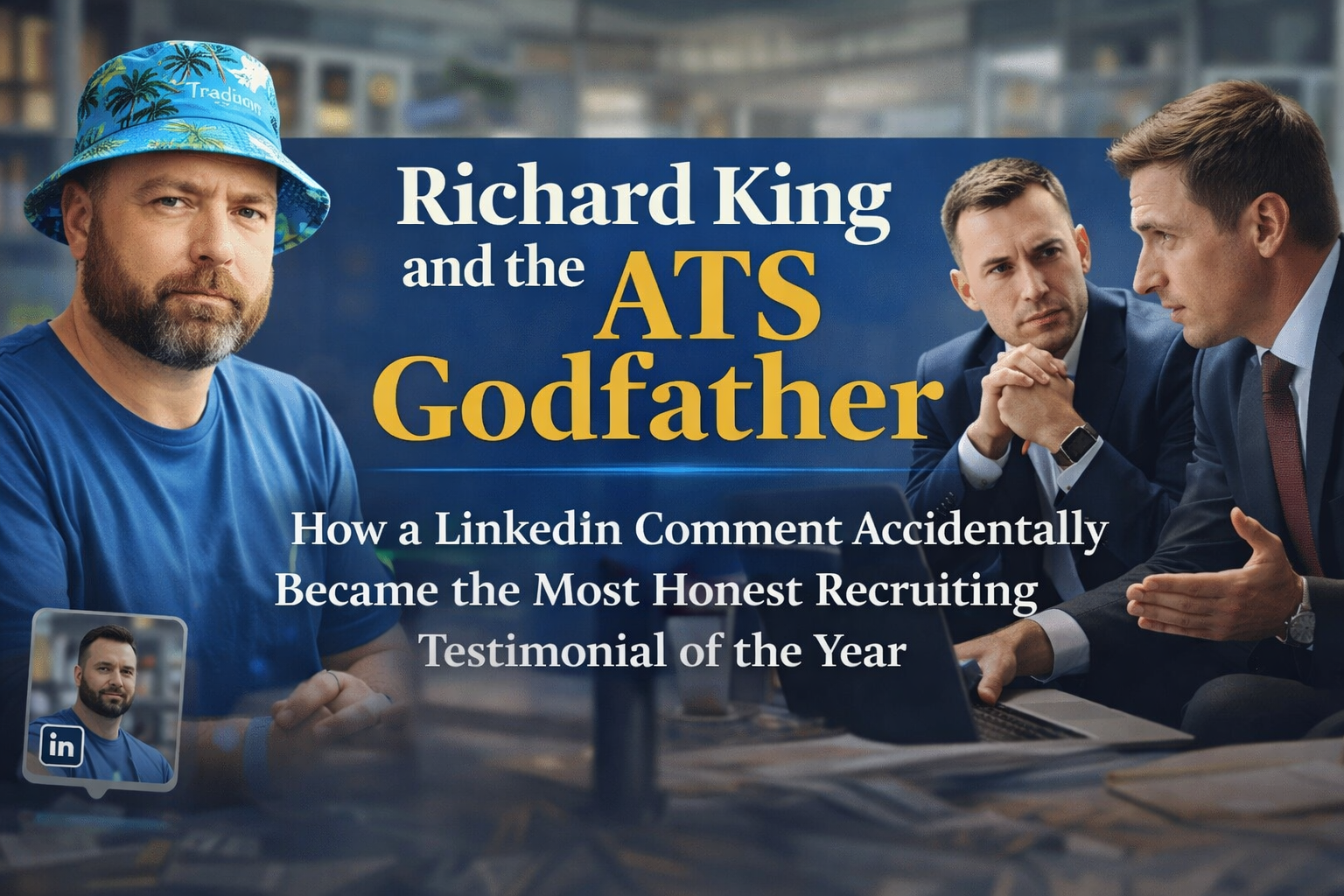
There is something deeply magical about LinkedIn when it stops pretending to be a professional networking platform and finally reveals its true identity, which is a dinner theater production where everyone is dressed like a leadership podcast and one man in a bucket hat suddenly stands up to deliver a threat disguised as mentorship.
That is the energy Richard King brought to the stage.
Not feedback. Not discussion. Not disagreement. A warning. A beautifully seasoned, lightly passive-aggressive, confidently theatrical warning delivered with the grave seriousness of a man who wanted everyone in the room to understand that the hiring machine has rules, and one of those rules is that candidates are allowed to be processed, delayed, assessed, filtered, ignored, rerouted, emotionally tenderized, and quietly discarded, but under no circumstances should they ever narrate the experience in public with accurate details and a functioning memory.
Because that, apparently, is where professionalism ends.
And I have to say, I admire the accidental honesty of it all. I really do. Most people spend years trying to describe what feels broken about hiring culture. They write thoughtful posts. They share examples. They explain the imbalance. They talk about ghosting, lateness, marathon interview processes, and the strange expectation that job seekers should remain gracious while being treated like software under beta testing. Then every so often, like a gift from the algorithm gods, somebody arrives in the comments and explains the whole thing with the efficiency of a villain monologue.
That is what happened here.
Richard King, recruiter, stepped into the conversation and essentially said the quiet part with indoor volume. He warned that I had probably been flagged in an ATS. He explained that he would never book an interview for me with one of his clients because the risk was too great. He added that many of the people high-fiving me had zero experience in the hiring process, which is one of those unintentionally hilarious lines that collapses the second it touches oxygen, because candidates may not have twenty years of recruiter experience, but they do have the absolutely deranged privilege of living through the process itself, which is a bit like saying diners have no experience with restaurant operations while they are actively chewing on undercooked chicken.
It was exquisite.
Because when someone responds to criticism of bad hiring behavior by confirming that yes, speaking openly may lead to punishment, yes, recruiters do see honesty as risk, and yes, silence is preferred, they are no longer defending the system. They are testifying against it. They are not correcting the narrative. They are illustrating it in real time, with props.
And what makes it even better is the tone. That faintly paternal, vaguely threatening, “best wishes to you” tone. The conversational equivalent of a man patting you on the shoulder while slipping a marked playing card into your jacket pocket. It had all the ingredients of classic LinkedIn melodrama: authority, condescension, imaginary danger, and the irresistible assumption that candidates should tremble at the possibility of becoming less attractive to employers who already behave like delayed flights with branding guidelines.
That is what makes moments like this so valuable. They stop the debate from being theoretical. They turn abstraction into dialogue. Suddenly nobody has to wonder whether there is a culture problem when a public comment arrives to explain, in plain language, that candidates who tell the truth may be treated as radioactive.
You do not have to write satire at that point. Satire has already clocked in.
So let us honor the moment properly, because Richard King did not simply leave a comment. He gifted the internet a case study. He gave us a live demonstration of how fragile parts of the recruiting world become when candidates stop whispering and start describing. He gave us a bucket-hatted dispatch from the front lines of recruiter ego, ATS mythology, and that deeply corporate belief that transparency is fine as long as it never inconveniences the people who benefit from opacity.
And for that, truly, I am grateful.
The Warning From the Department of Recruiter Homeland Security
The first thing that made the comment so funny was the structure. It did not arrive like a normal disagreement. It arrived like a man leaning across a poker table in a smoky movie and saying, very calmly, that I seemed like a nice kid and it would be unfortunate if my candidate profile developed a permanent administrative limp.
“I guarantee you have been flagged in their ATS.”
I want to pause and appreciate the elegance of that sentence, because it is one of the most unintentionally revealing lines a recruiter can say in public. It is trying to function as a caution. It wants to sound informed, experienced, and perhaps even helpful in a stern uncle sort of way. But what it actually sounds like is this: be careful, the system remembers when applicants are insufficiently obedient.
That is not wisdom. That is organized bureaucracy with a grievance.
And look at what has to be true beneath that sentence for it to work as intended. First, we must accept that an applicant describing a real experience is enough to trigger reputational consequences. Second, we must accept that this is normal enough to cite casually. Third, we must accept that candidates are supposed to hear that and think, yes, of course, the invisible software should absolutely punish me for possessing both standards and a LinkedIn account.
That is insane. Not dramatically insane. Quietly insane. Corporate insane. The kind of insane that gets put in a spreadsheet and called best practice.
Because imagine applying this logic anywhere else. Imagine a restaurant reviewer being told, “I guarantee you’ve been flagged in OpenTable.” Imagine a passenger saying an airline lost their bag and someone replying, “Careful, Delta remembers who complains.” Imagine a patient saying their doctor was two hours late and being warned that the hospital may never schedule them again because they seem risky. Everywhere else, we would recognize this immediately as absurd, manipulative, and deeply unwell behavior. But in hiring culture, certain people have spent so long marinating in the dysfunction that they now present it like weather.
No, sir. That is not weather. That is mold.
And what makes Richard King’s comment so strangely useful is that it confirmed the emotional architecture of the system better than any critic could. So many job seekers feel this exact pressure but struggle to articulate it. They sense that the process is not merely flawed but disciplinary. That there is an unwritten expectation to absorb bad treatment gracefully. That if a company ghosts you, wastes your time, shows up late, drags you through seven rounds, changes the role halfway through, or performs “candidate experience” like a hostage negotiator reading from a script, you are still expected to smile softly, thank them for the opportunity, and vanish like a well-trained Victorian orphan.
And then along comes Richard King to say, essentially, yes, that pressure is real, and yes, public honesty may be treated as dangerous.
Phenomenal. Stunning. A confession wrapped in career advice.
The Terrifying Threat of a Candidate With Memory, WiFi, and Pattern Recognition
Then came the next masterpiece: “I would never book an interview for you with one of my clients. The risk is too great.”
The risk.
That word deserves a leather chair and low lighting.
Because we need to ask, with full dramatic seriousness, what exactly is the risk here? Is the risk fraud? No. Is the risk that the candidate lies, behaves erratically, harasses staff, misses meetings, or lacks qualifications? Apparently not. Is the risk that the candidate may commit the unspeakable professional crime of accurately recounting what happened if your client behaves like an escape room run by people with Outlook access and emotional detachment? Yes. That seems to be the catastrophic scenario.
A candidate with recall.
A candidate who notices.
A candidate who does not participate in the ancient corporate ritual of pretending everything is fine while the process catches fire behind a branded careers page.
That is the risk.
And once you realize that, the whole performance becomes extraordinary. Because this is no longer about “professionalism.” It is about control. It is about the comfort of institutions that rely on an imbalance so normal that they forget how bizarre it sounds when spoken plainly. They can delay interviews, alter timelines, lose resumes, reschedule calls, stack panels like a surprise jury duty summons, and tell applicants to complete unpaid projects that feel suspiciously like deliverables, but the moment a candidate says, “This was ridiculous,” suddenly the concern is tone.
Tone is always the emergency when power dislikes mirrors.
That is why these conversations fascinate me. So much of the hiring world is built on a one-way morality. Candidates are expected to be prompt, polished, grateful, patient, enthusiastic, prepared, coachable, humble, self-aware, strategic, pleasant, low-maintenance, high-energy, and emotionally waterproof. Meanwhile, employers and recruiters are often granted the majestic freedom to be late, vague, inconsistent, bloated, disorganized, and occasionally possessed by seven-round demons. Then if anyone points this out, here comes the pearl-clutching chorus to explain that honesty might harm your chances.
With whom?
That is always my favorite hidden question.
With whom exactly am I supposed to mourn the loss of opportunity? The clients who need candidates to behave like mute support animals while enduring nonsense? The companies so fragile that a public description of their own conduct is considered reputational violence? The decision-makers who hear “someone criticized lateness and chaos” and think, absolutely not, this person sounds difficult?
My brother in quarter-zips, that is not a lost opportunity. That is quality control.
And the line gets even funnier when you picture it coming from the lofty castle of recruiting authority, because the implied threat is meant to carry weight: I would never book an interview for you. But if the interview being withheld is another emotionally overengineered obstacle course hosted by people who think urgency is decorative, then this is less an intimidation tactic and more a premium cancellation service.
It is the professional equivalent of someone saying, “Careful, or I’ll make sure you never get invited back to this haunted escape room where the clues are contradictory and the staff blame you for not enjoying the ambience.”
Thank you. I will survive the loss.
When Recruiters Mistake the Candidate Experience for Irrelevant Fan Fiction
My other favorite detail in Richard King’s comment was the line about supporters having “ZERO experience in the hiring process,” because it captures a very specific kind of recruiter worldview: the belief that process ownership grants moral authority, while process exposure somehow does not count.
Which is incredible logic.
It is like saying passengers have zero experience with air travel because they have never flown the plane. It is like saying patients have zero experience with hospitals because they have never run the MRI machine. It is like saying employees have zero experience with payroll because they have never personally built the software that delayed their direct deposit.
Candidates may not sit behind the recruiter desk, but they absolutely experience the recruiting process. Intensely. Repeatedly. Often involuntarily. They know what it feels like to have interviews moved three times and still be expected to show up radiant and grateful. They know what it feels like to be told a role is urgent, only to watch the company disappear into a six-week coma. They know what it feels like to hear “we value transparency” from people who communicate like Cold War diplomats with scheduling links.
So when Richard King dismissed commenters as lacking experience, he accidentally revealed one of the oldest professional delusions in existence: confusing proximity to the machinery with immunity from criticism about what the machinery does to people.
No, the crowd may not have insider recruiting experience. What they have is survivor testimony.
And that is what unnerves certain professionals more than any criticism from peers. Not experts. Not consultants. Not industry analysts. Candidates. Actual human beings who went through the conveyor belt, got bumped by the gears, and then had the nerve to compare notes in public. Because once that happens, the mythology gets harder to maintain. It becomes more difficult to act as though every complaint is an isolated misunderstanding when the comments section looks like a support group sponsored by expired calendar invites.
That is why these reactions are so telling. They are rarely about the specific post. They are about the threat of shared pattern recognition. Once candidates begin recognizing common behavior across companies and recruiters, the old gaslighting routine loses some of its magic. Suddenly “you’re overreacting” starts sounding weak when fifty people say, no, actually, that exact thing happened to me too, right down to the fake urgency, the lateness, the bloated interview sequence, and the final rejection email written like a hostage negotiator discovered empathy through templates.
Which brings us back to the comment itself. Richard King did not defend excellence. He defended opacity. He did not elevate standards. He reinforced the idea that the standard is silence. He did not refute the criticism. He illustrated the culture behind it so cleanly that he may as well have arrived with a flip chart titled Why Candidates No Longer Trust Us.
And let me say this with warmth: that is why the bucket hat matters.
Because the bucket hat transforms the whole moment from ordinary LinkedIn tension into visual literature. It adds just enough accidental flair to make the exchange feel less like a disagreement and more like a scene from a prestige dramedy called The ATS Remembers. You cannot issue soft blacklisting warnings in public while wearing the energy of a man about to review bait options at a marina and not become part of the theater. It is art at that point. Disturbing art, yes, but art.
Final Thoughts: Best Wishes, Warm Regards, and Other Elegant Threats
What I keep coming back to is how useful moments like this are, because they strip the issue down to its skeleton. All the polished language falls away. All the corporate phrasing about candidate care, stakeholder alignment, employer brand, and talent strategy starts dissolving like a cheap stage set in the rain. And what remains is the simple truth that too many people inside the hiring world still believe candidates should tolerate poor treatment quietly if they want continued access to opportunity.
That is the culture problem in one sentence.
Not that every recruiter is bad. Not that every company is malicious. Not that every process is broken beyond repair. But that there remains a stubborn pocket of professional culture where power expects discretion from the powerless and calls that professionalism. Where speaking plainly about lateness, chaos, bloated processes, or disrespect is treated not as feedback but as betrayal. Where the greater offense is not behaving badly, but embarrassing the people who behaved badly by describing it accurately.
And once you see that, the whole thing becomes impossible to unsee.
Because good systems do not fear honest reviews. Healthy professionals do not threaten people with database folklore because they told the truth online. Strong hiring cultures do not rely on whispered warnings about being flagged, marked, remembered, or quietly sidelined. Only insecure systems need secrecy to preserve dignity they did not earn.
That is why Richard King’s comment landed the way it did. Not because it was intimidating, but because it was clarifying. It was one of those rare moments when somebody climbs into the comments to challenge the criticism and accidentally confirms every underlying concern with the precision of a self-own engineered by fate. It was not a rebuttal. It was supporting evidence wearing confidence.
And honestly, that is the part I appreciate most.
Because if a candidate saying, “Show up on time, respect people’s time, and stop turning hiring into an emotional obstacle course,” is enough to make certain corners of the industry clutch the ATS like a sacred text, then we are no longer discussing personality differences. We are looking at a system so accustomed to asymmetry that basic accountability feels threatening.
That is not on the candidate.
That is on the culture.
So yes, best wishes to Richard King. Truly. Thank you for the warning. Thank you for the theater. Thank you for stepping so boldly into the conversation and demonstrating, in one compact LinkedIn comment, exactly why so many candidates feel like they are not navigating a hiring process so much as negotiating with a polite, database-driven protection racket.
And thank you, above all, for proving the post.
Because sometimes the most devastating critique of a profession is not written by its critics.
Sometimes it arrives from inside the house, wearing a bucket hat, talking about risk.