There is a special kind of silence that only exists in modern professional life, and it is not the peaceful kind. It is not the silence of a quiet morning, a sleeping house, or a calm walk before the day starts swinging its fists. It is the silence that follows a perfectly normal, perfectly polite, professionally moisturized LinkedIn message sent to someone whose entire public brand appears to be built around helping humans not perish in the labor market.
That silence is not empty.
It is crowded.
It is crowded with your optimism at 9:14 a.m. when you hit send. It is crowded with your little internal pep talk about being proactive, building relationships, putting yourself out there, and refusing to let unemployment turn you into a Victorian widow staring out a rain-soaked window whispering, “Perhaps tomorrow.” It is crowded with every article ever written about networking, every motivational post about “closed mouths don’t get fed,” every recruiter who has ever said candidates should feel empowered to reach out, and every chirpy LinkedIn prophet who types the phrase “my inbox is always open” like they are operating a community soup kitchen for the professionally displaced.
And then, after all that, nothing.
Not even a “Thanks for reaching out.”
Not even a thumbs-up emoji from the corporate underworld.
Not even one of those thin, bloodless replies that somehow manages to contain both words and spiritual absence, like: “Thanks, please apply online.”
No. Just silence. Flat, elegant, fully curated silence.
Which would be easier to accept if Linda were not visibly alive online.
That is the twist that turns ordinary disappointment into premium psychological theater. Because if Linda had simply disappeared from the platform, you could invent noble explanations. Perhaps she is on vacation. Perhaps she is tending to a personal emergency. Perhaps she has fled civilization and now lives in a candlelit cottage where no Wi-Fi signal can penetrate. But when Linda is posting, liking, commenting, clapping, celebrating, and publicly discussing the transformative beauty of professional connection while your message sits unanswered like a body in a locked room, the silence becomes less administrative and more artistic.
It becomes performance.
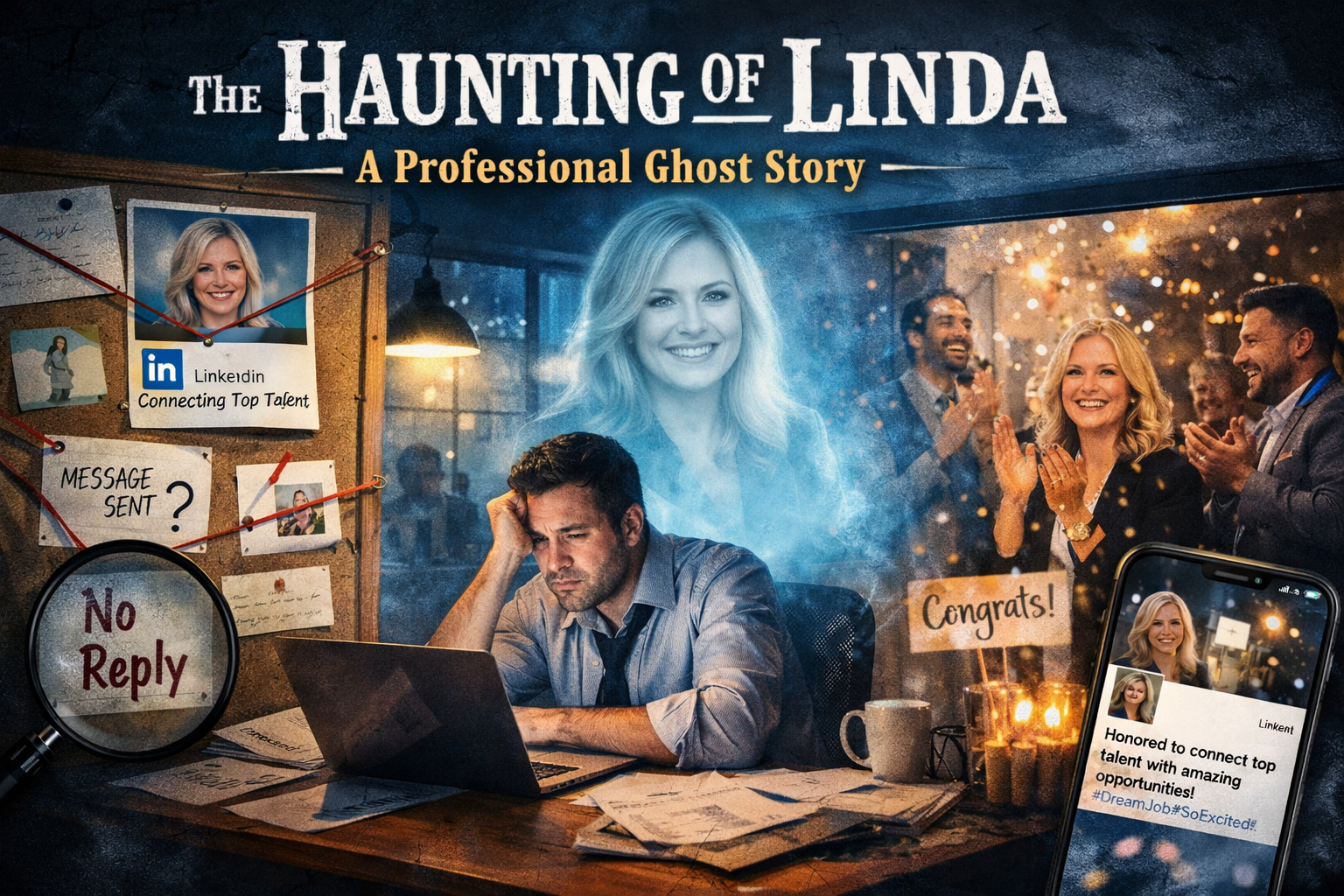
And that is when the imagination gets involved, which is never good. Because the unemployed mind is not a calm and rational machine. It is a Broadway production with no adult supervision. It does not merely observe ghosting. It scores it with dramatic music. It adds narration. It zooms in on timestamps. It turns ordinary LinkedIn activity into suspicious evidence. Suddenly you are not just a job seeker. You are a detective in a prestige streaming series called Inbox Unit: Special Abandonment Victims.
You begin with innocence. “Maybe she missed it.”
Then concern. “Maybe the platform glitched.”
Then analysis. “Interesting. She posted twice, changed her headline, and congratulated a man named Trevor on his seventh work anniversary at a cloud infrastructure startup, yet my respectful message remains untouched.”
Then madness. “I need a corkboard, red string, and an intern.”
Because recruiter ghosting is not merely frustrating. It is destabilizing in a uniquely modern way. It asks you to accept that someone can build an entire professional identity around communication, access, relationships, talent, humanity, and opportunity, while treating your existence like spam from a haunted printer. It asks you to watch polished adults use the language of care with the consistency of a wellness retreat and the follow-through of a magician fleeing the scene. It asks you to remain gracious while being professionally evaporated by someone with “People First” in their banner.
And that is why Linda matters.
Not because Linda is uniquely terrible. Linda is not the villain. Linda is the museum docent. Linda is simply guiding us through the larger exhibit. She is the friendly face at the entrance of a much bigger institution: the astonishingly normal modern system in which everyone talks about connection and almost nobody behaves like they have met another human being before.
So let us discuss Linda properly.
Let us honor the silence.
Let us explore the beautiful absurdity of sending one normal message and somehow ending up emotionally cast as the cold open in a true crime documentary narrated by a man with a velvet voice and deep concerns about digital etiquette.
The Message Was Fine, Which Somehow Makes It Worse
The first insult of recruiter ghosting is that it almost never follows chaos. It follows effort. Civilized effort. Controlled effort. You did not send Linda a manifesto. You did not write fourteen paragraphs about your childhood, your grit, your ability to thrive in fast-paced environments, or the spiritual lessons you learned from using Excel under fluorescent lighting. You did not attach a blood sample and a recommendation letter from a former manager named Greg who once described you as “surprisingly resilient during a printer outage.”
You sent a normal message.
That is what makes it sting with such exquisite precision.
It was likely one of those beautifully restrained notes that took far longer to write than any sane person would admit. The kind where every sentence is weighed like it might be reviewed by a panel of Swiss diplomats. Friendly but not overeager. Confident but not arrogant. Interested but not creepy. Professional but not robotic. Just enough personality to suggest you are, in fact, alive, but not enough to make anyone clutch their pearls and whisper, “This candidate seems to possess thoughts.”
You probably read it three times before sending. Adjusted one adjective. Removed one exclamation mark because nothing says “desperate” like punctuation with hope in it. Maybe you changed “I’d love to connect” to “I’d welcome the opportunity to connect” because unemployment teaches you that even warmth needs tailoring. You hit send not like a wild gambler but like a responsible adult placing one carefully chosen chip on the table.
And Linda, patron saint of curated professionalism, received that message and treated it like a Victorian child treated a strange berry in the woods: by not touching it and hoping it would go away on its own.
Now, in a healthy society, there would be something mildly embarrassing about this and then life would continue. A reply would arrive. Maybe not the reply you wanted, but a reply. A simple, humane sentence. “Thanks for reaching out, but I don’t currently have anything aligned.” That is all. Seven seconds. Twelve words. One tiny act of civilized acknowledgment, the professional equivalent of holding the door open for someone instead of staring at them while they walk into the glass.
But this is not a healthy society. This is LinkedIn, where every profile reads like a TED Talk and every actual interaction has the emotional reliability of cable service during a storm.
So instead of a response, you get emptiness. And because human beings are not built to sit in ambiguity without generating folklore, your brain starts making content. It becomes a full-time writer’s room dedicated exclusively to explaining why Linda has not answered. Maybe she is overwhelmed. Maybe she meant to respond and got pulled into meetings. Maybe your message landed in some algorithmic basement where the platform stores hope, nuance, and everyone who clicked “Open to Work.” Maybe she saw it and thought, “I should reply later,” which is the adult professional version of placing a leaf over a problem and walking away.
This is the point where ghosting stops being a simple absence and becomes an active event. Because unanswered communication is never truly passive. It is labor transferred. Linda has done nothing, and now you are doing all the work. You are interpreting silence, generating mercy, building explanations, buffering the awkwardness she created with your own empathy. It is one of the most elegant little scams in the modern workplace: one person avoids fifteen seconds of discomfort, and the other person spends a week doing forensic emotional accounting.
And what a miracle that is.
Because there is something darkly impressive about a system in which the candidate must remain endlessly professional, endlessly patient, endlessly polished, endlessly understanding, while being treated with the administrative tenderness normally reserved for junk mail.
The message was fine. That is what haunts you.
If you had sent something bizarre, you could blame yourself. If you had written, “Dear Linda, I feel we are cosmically aligned and would be a beautiful partnership in talent acquisition,” then yes, silence would be both expected and medicinal. But that is not what happened. The message was good. Reasonable. Competent. Human. Which means the silence does not feel corrective. It feels revealing.
It reveals that sometimes the issue is not tone, or timing, or wording, or strategy. Sometimes the issue is that people who talk for a living do not want the inconvenience of talking to the wrong person at the wrong moment in a way that offers them no immediate professional dopamine.
And that realization lands with all the joy of a folding chair to the back.
Because now it is not just about Linda. Now it is about the architecture. Now it is about the fact that entire industries have learned to outsource basic decency to branding. They do not have to practice responsiveness if they can just post about empathy. They do not have to communicate clearly if they can repost a quote card about authenticity. They do not have to behave like grown adults if their headline says “relationship builder.”
The message was fine. Linda was polished. The silence was real.
And with that, the haunting began.
Once You See Them Active, the Ghosting Becomes Theater
There is ignoring someone, and then there is ignoring someone while visibly thriving in the same digital room. That is not mere silence. That is stagecraft.
Because the moment you return to LinkedIn and see Linda active, cheerful, and publicly engaged in the business of professional encouragement, the whole thing changes texture. Before, the unanswered message existed in a realm of plausible uncertainty. It could still be an accident, a delay, a backlog, a harmless oversight. But the second you see Linda liking posts about leadership, commenting “Love this!” under somebody’s announcement, and congratulating a stranger on joining a mid-level strategy role in Denver, your private disappointment graduates into a public farce.
Now there are witnesses.
Now you are being ghosted under chandelier lighting.
And there is something uniquely disrespectful about being professionally ignored by a person who continues to broadcast their accessibility like a luxury fragrance campaign. Linda’s page is still there, smiling softly with recruiter confidence, dressed in the visual language of support, growth, opportunity, and connection. Her banner likely contains a phrase so uplifting it should be stitched onto a throw pillow. Her headline probably suggests that she exists to bridge talent and possibility, to build futures, to elevate careers, to champion human potential in all its glorious forms.
Meanwhile one actual human reached out, and Linda handled that event the way aristocrats handled plague carts: by closing the curtains and pretending the street was not there.
That contrast is what makes LinkedIn such a masterpiece of accidental satire. It is not merely that hypocrisy exists there. Hypocrisy is everywhere. But LinkedIn has industrialized it into a user experience. It has created a professional carnival where everyone publicly performs values that private behavior then drop-kicks into a decorative shrub. It is less a network and more a large, well-lit museum dedicated to aspirational self-fiction.
And when you are the one sitting unanswered, you start to notice every detail with the sharpened sensitivity of a man who has accidentally become emotionally available to injustice.
You notice that Linda has updated her profile photo.
You notice that she has commented on a leadership post with the phrase “So important.”
You notice that she has reposted an article on candidate experience, which at that point is no longer content but taunting.
You notice that she is “honored” by things at a volume that begins to feel chemically suspicious.
You notice, above all, that none of this requires responding to you.
That is the part that drives a person gently insane. Not the rejection. Not even the silence itself. It is the visibility of the silence. It is seeing someone remain vibrantly present to the world while remaining selectively absent to you. That is what turns recruiter ghosting into emotional community theater. Linda is not offstage. Linda is center stage, spotlighted, delivering a monologue about connection while your message decomposes in the orchestra pit.
At this point the candidate mind, already fragile from too much hope and not enough payroll, evolves. It becomes investigative. The same person who once approached LinkedIn with optimism now opens the app with the posture of a divorced detective reexamining old receipts. You are no longer checking in casually. You are reviewing developments. “Interesting. Linda appears to have endorsed twelve people for communication skills in the last forty-eight hours, yet remains physically unable to type six words acknowledging my existence. Curious.”
You become absurdly fluent in meaningless digital evidence. Active green dot? Noted. New banner? Suspicious. Fresh post at 8:06 a.m. about empowering careers? Deeply disrespectful. Suddenly every banal platform movement becomes part of an emotional case file. You do not want to care, but you do, because ghosting creates the kind of low-grade humiliation that makes the brain hunt for narrative. Human beings can survive bad news. What we cannot survive gracefully is ambiguity with Wi-Fi.
And that is where the comedy becomes almost too elegant. Because Linda, in all likelihood, is not cackling maniacally while ignoring you. She is probably just moving through her day, triaging, prioritizing, selecting. That is almost worse. Because it means the injury is not malicious. It is casual. Administrative. Ambient. You were not dramatically rejected. You were quietly categorized as a task too easy to avoid and too inconvenient to honor. There is something profoundly bleak about realizing that in the marketplace of modern professionalism, a human being can become not an obstacle, not a threat, not even a problem, but a minor notification someone will always plan to handle later and never actually will.
This is what transforms the whole experience from disappointment into satire. Because the platform keeps insisting it is about people while repeatedly demonstrating it is mostly about optics. Real connection would require risk, clarity, and brief moments of discomfort. Branding requires none of that. Branding only asks that you look like the sort of person who values communication. It does not require you to communicate. That is the genius of it. You can become a public ambassador for relationships while privately treating one as expired produce.
Once you see them active, the illusion dies.
Not all at once. Quietly. Elegantly. Like a chandelier unscrewing itself from the ceiling while the violin music continues.
And there you are, still dressed for professionalism, standing beneath it.
LinkedIn Is Not a Networking Platform, It Is a Beautifully Managed Haunted House
After enough experiences like this, a terrible thought arrives with the calm authority of a priest entering a ruined chapel: maybe LinkedIn is not what it says it is.
Maybe it is not a networking platform in the warm, practical, human sense of the word. Maybe it is not a place where relationships are built, opportunity flows, conversations happen, and careers are advanced through mutual professional regard. Maybe that is just the wallpaper. Maybe the actual structure underneath is something far stranger.
Because once you have been ghosted by enough polished adults with “human-centered leader” in their headline, the entire site starts to feel less like a professional ecosystem and more like a haunted property that has been aggressively staged for resale.
Everything looks beautiful at first glance. The lighting is flattering. The slogans are expensive. The language is buffed until it gleams. Everyone appears deeply committed to growth, purpose, innovation, empathy, excellence, resilience, authenticity, leadership, transformation, and whatever other nouns are currently being dry-cleaned for executive use. But then you start opening doors.
And behind one door is a recruiter who says “my inbox is always open” and treats messages like suspicious packages.
Behind another is a company preaching culture while asking candidates to complete six rounds, a timed personality assessment, a take-home project, and what appears to be a minor oral exam before anyone can access a salary range.
Behind another is a hiring manager demanding initiative but panicking when candidates show signs of independent thought.
Behind another is a thought leader discussing vulnerability in the workplace while privately behaving like a Victorian landlord with a Wi-Fi plan.
Every room is decorated. Every room is eerie.
That is the genius of the platform. It has managed to transform ordinary workplace dysfunction into lifestyle content. Ghosting is not just tolerated; it is floating through the hallways in tasteful business casual. Contradictions are not hidden; they are monetized. You can be ignored by the exact same people who spend all day publicly evangelizing responsiveness. You can be rejected by organizations whose entire content strategy revolves around “putting people first.” You can watch adults produce daily sermons on trust, connection, and transparency while practicing communication like it might trigger an allergic reaction.
At some point, after enough of this, the platform no longer feels deceptive in a simple way. It feels supernatural.
You log in, and there are the smiling faces. The leadership photos. The sleek banners. The declarations of gratitude. The promotions. The “thrilled to announce.” The “honored to share.” The “excited for this next chapter.” The entire place vibrates with ceremonial positivity. And yet underneath it all is the low moan of a thousand ignored messages, abandoned applications, vague rejections, vanished interview processes, and candidates left standing in digital hallways wondering if anyone can still hear them.
That is haunted house behavior.
And like any haunted house, it depends on two things: appearance and selective invisibility. The front-facing version must remain gorgeous. The uncomfortable truths must remain half-seen, glimpsed only by the people living inside the nightmare. The public story is aspiration. The private experience is often confusion wearing loafers.
Which is why experiences like Linda’s silence become oddly clarifying. Not because they are rare, but because they are ordinary. They reveal the gap between the platform’s self-image and its daily habits. They expose how much of modern professionalism is performed rather than practiced. They remind you that an ecosystem can become so fluent in talking about values that it forgets values are supposed to show up in small behaviors, not just polished captions written between webinars.
And yet, somehow, there is comedy in that realization too.
Because once the illusion breaks, the whole thing becomes unintentionally hilarious. Every inspirational post starts sounding like it was written by the concierge of a luxury ghost hotel. “We believe in bringing out the best in people,” says the caption, moments after ignoring six candidates and rescheduling a screening call into the next presidential administration. “Relationships matter,” says the comment from someone who has not answered a message since the previous equinox. “Candidate experience is everything,” says a company still using an application portal designed by medieval architects and emotional sadists.
That is the secret gift of disappointment: eventually, it teaches you how to see the set design.
And once you see the set design, you stop blaming yourself for not being fully embraced by a building whose walls are mostly painted foam. You stop treating every silence like a referendum on your worth. You start recognizing the more likely truth, which is both funnier and more pathetic: a great many professional adults are performing sincerity while being operationally allergic to minor acts of actual humanity.
Linda is not the whole story. Linda is just one of the chandeliers in the haunted house.
But what a chandelier she is.
Final Thoughts: The Problem Was Never the Message, It Was the Performance
In the end, I never heard back from Linda, which is fitting, because ghost stories are rarely resolved with paperwork. They end with an open question, a creak in the hallway, a cold draft under the door, and a survivor staring into the distance realizing the house was never normal to begin with.
And maybe that is the real lesson.
Not that Linda is evil. Not that recruiters are villains. Not even that every unanswered message is proof of hypocrisy, malice, or moral failure. The truth is less cinematic and therefore somehow more insulting. A lot of people in professional spaces have simply become too comfortable with low-grade disregard. They have normalized it. Systematized it. Decorated it with branding. They have wrapped indifference in polished language and convinced themselves that sounding thoughtful is close enough to being thoughtful.
It is not.
A platform can talk about connection all day, but connection is not a slogan. It is behavior. It is reply or no reply, clarity or vagueness, acknowledgment or disappearance. It is made visible in tiny moments, not giant banners. A person’s real professional values are not hiding in their headline like a secret code. They are usually in the boring stuff: whether they answer, whether they follow up, whether they say no cleanly, whether they treat another person as a living being instead of an inconvenient notification with shoes.
That is why ghosting stings so much. It is not just silence. It is contradiction. It is the collision between what modern work culture says it believes and what it repeatedly permits in practice. It is the emotional whiplash of watching people speak fluent empathy and behave in expired mayonnaise.
And for candidates, that contradiction is exhausting. Because job seekers are asked to be so relentlessly polished. Tailor the resume. Write the cover letter. Research the company. Practice the interview answers. Follow up professionally. Be enthusiastic but not desperate. Be memorable but not annoying. Be confident but humble. Be human, but only in ways the algorithm can digest. All of that labor, all of that calibration, all of that emotional choreography, and then sometimes the outcome is still just Linda, active online, liking a post about authenticity while your message fossilizes quietly in her inbox.
If you do not laugh, you will have to buy a monocle and begin speaking only in courtroom monologues.
So yes, laugh.
Laugh because the absurdity deserves witnesses.
Laugh because there is something wonderfully deranged about being ignored by people whose profiles read like brochures for connection.
Laugh because at some point the only sane response to a deeply unserious system is a serious commitment to noticing how unserious it is.
And then, after the laughter, keep your dignity.
That part matters most.
Because ghosting has a sneaky way of trying to rewrite the story in your head. It wants you to think the silence means something definitive about you. That you were not interesting enough, useful enough, polished enough, timely enough, strategic enough, worthy enough. But most of the time, silence tells you far more about the architecture than the visitor. A house with bad wiring is not proof that you failed to enter correctly.
So let Linda post.
Let Linda celebrate.
Let Linda continue building her museum of polished professional enthusiasm under flattering lighting and carefully selected verbs.
And let the unanswered message remain what it actually is: not a verdict on your value, but an artifact from a strange era of work in which branding learned to cosplay as character.
If nothing else, Linda gave us that.
She gave us the truth by refusing to type it.
And in that silence, loud as a cathedral, the whole haunted house lit up.