A Corporate Safari Through the Modern Hiring Process
There are questions people ask casually that should, in truth, require waivers, emotional preparation, and at least one licensed therapist standing nearby with a clipboard and low expectations. One of those questions is this: “What’s the wildest interview you’ve ever had?”
That is not a conversation starter. That is a trap disguised as curiosity. That is the professional equivalent of asking a war veteran if anything “funny” ever happened overseas and then being surprised when the answer includes fire, betrayal, and a man named Todd from Talent Acquisition who spoke exclusively in calendar invites and broken promises.
Because once you have spent enough time in the modern job market, especially as an adult with actual experience, bills, self-awareness, and the fading but still technically legal ability to hope, you stop thinking of interviews as normal career moments and start recognizing them for what they really are: immersive theater performed by organizations that would like your loyalty before they have even demonstrated competence.
At first, of course, everyone enters the process with innocence. You see a job description. You think, perhaps foolishly, perhaps beautifully, that this might be a straightforward exchange between grown people. They have a role. You have a skill set. There will be a conversation, perhaps two, and then some kind of decision based on logic, merit, and whether anyone involved can operate a calendar without turning it into an instrument of emotional abuse.
But that is not the world we live in anymore.
We live in a world where a thirty-minute interview can require two weeks of scheduling, three confirmations, one personality test, a panel discussion, a project, a follow-up with a senior leader, a culture conversation, and at least one recruiter who says, “We move very quickly here,” with the haunted confidence of someone actively standing in wet cement.
We live in a world where job descriptions read like ransom notes written by people who want a strategic leader, a tactical executor, a culture builder, a process architect, a data storyteller, a player-coach, a visionary, a firefighter, and occasionally someone who can also “jump in where needed,” which is corporate dialect for please save this dysfunctional department with your nervous system.
And so when someone asks me what the wildest interview I ever had was, I never know where to begin, because the true issue is not that there was one particularly outrageous interview. The true issue is that absurdity has become the default setting. The bizarre is now standard operating procedure. The outlandish has put on a blazer, learned how to say “alignment,” and now schedules itself through Microsoft Teams.
What used to be a red flag is now called process. What used to be disrespect is now called bandwidth. What used to be disorganization is now somehow framed as a sign that the company is “moving through some exciting changes,” which is a sentence that should legally require subtitles reading: nobody knows what is happening here.
And the candidate, that fragile little creature still clinging to a résumé and a prayer, is expected to absorb all of it with grace.
You are expected to smile through lateness. Smile through confusion. Smile through contradictions. Smile through panel interviews that feel less like professional evaluation and more like being cross-examined by a committee of emotionally underfunded raccoons who all believe they invented leadership. You are expected to research the company, tailor your answers, show personality but not too much personality, demonstrate confidence but not enough confidence to frighten anyone insecure in middle management, and behave as though every part of the process is reasonable even when it has begun to resemble a church pageant directed by LinkedIn.
And let me be clear: the humor here is not theoretical. It is survival-based. If you do not laugh, you will start saying things out loud in interviews that will make HR summon legal like a medieval priest calling for backup.
So yes, I have had wild interviews. I have had interviews that felt like loyalty tests, game shows, hostage situations, and mildly spiritual crises. I have had interviews where the recruiter arrived late and still spoke with the commanding energy of a person who believed they were doing me a favor by attending their own appointment. I have had interviews for remote jobs that turned out to be remote only in the sense that prison yards technically contain outdoor space. I have met digital interview bots with the emotional warmth of expired yogurt. I have sat before panel interviews so overcrowded they looked like a school board meeting convened to discuss my tone.
And after all of it, what fascinates me most is not just the chaos itself, but the confidence with which the chaos is presented.
Nobody in these processes ever behaves like this is strange.
That is the masterpiece.
The recruiter who is late acts like time is a collaborative suggestion. The hiring manager who wants seven rounds acts like discernment is impossible without a pilgrimage. The company that mislabels hybrid as remote behaves as though truth itself is just a branding choice. The AI asks increasingly stupid questions with the calm authority of a toaster that got promoted too quickly. And the candidate is somehow supposed to walk away thinking, “Yes. This feels like a serious institution.”
It does not.
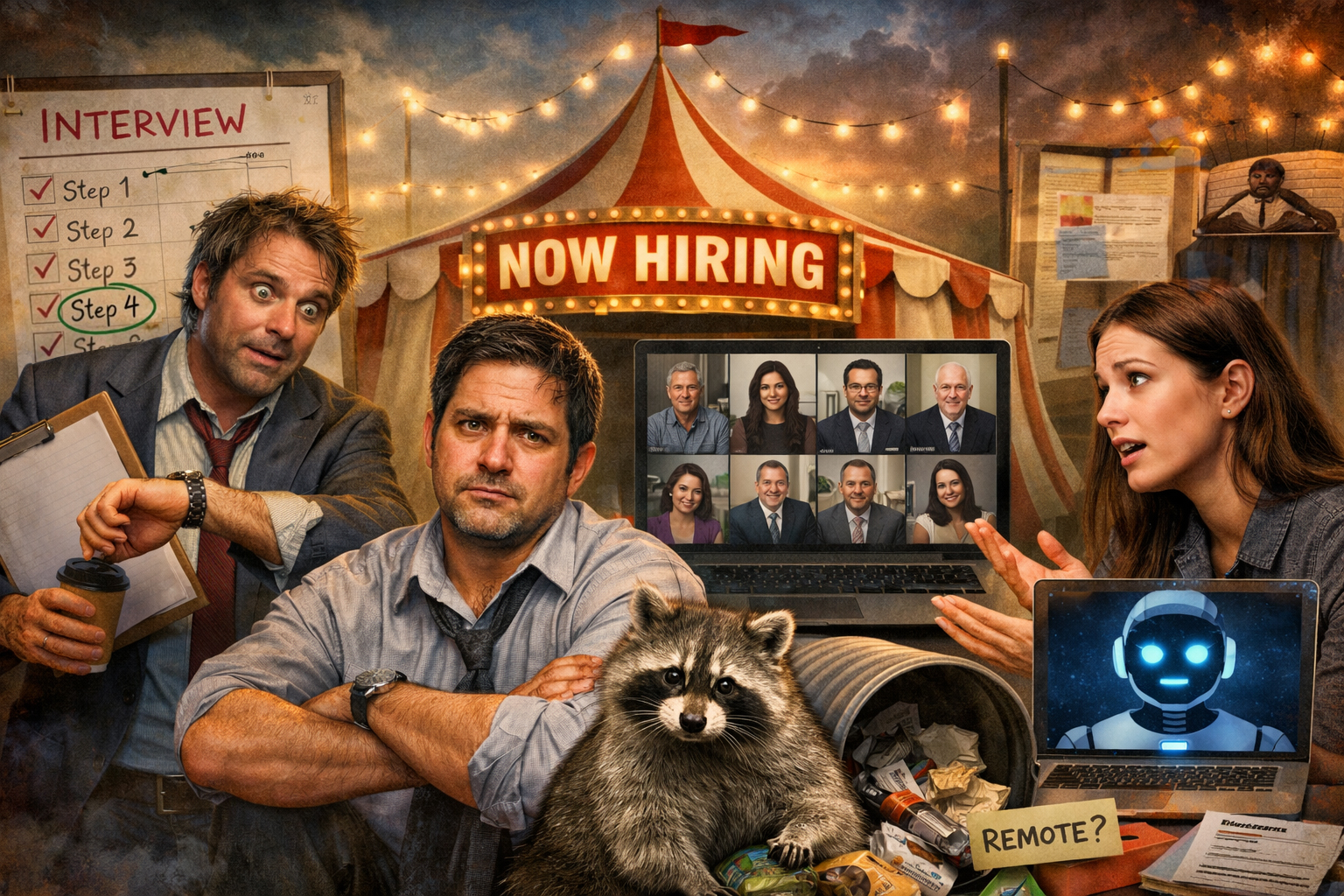
It feels like a raccoon-led circus where everyone has access to Outlook and none of them should.
And still we go. We put on the shirt. We adjust the camera. We practice our answers. We introduce ourselves to strangers who say they are excited to connect and then proceed to interrogate us like we are applying to manage oxygen. We pretend not to notice the contradictions. We ignore the little spiritual bruises. We take notes. We send thank-you emails. We continue participating in the hiring economy’s longest-running improv show because somewhere deep inside us is a feral little optimist whispering that maybe this one will be normal.
It never is.
And that is where the story begins.
The Seven-Step Courtship of Delusion
There is something deeply inspiring about a recruiter being thirty minutes late to a meeting and then using the remaining time to explain that the company values excellence, discipline, and strong communication.
That kind of confidence cannot be taught. That is not professionalism. That is performance art. That is a person standing knee deep in their own contradiction and still delivering the message like they are unveiling the Ten Commandments of Talent Acquisition.
One of the wildest interviews I ever experienced began this exact way. The recruiter scheduled the call. The confirmation came through. The time was agreed upon by all civilized parties. I appeared promptly, because unlike some organizations, I was still operating under the outdated belief that clocks were real and commitments meant something. Then I waited. And waited. And kept waiting long enough to complete the emotional arc from optimism to irritation to anthropological curiosity.
By minute twenty, you are no longer “being patient.” You are observing a species. You are studying behavior. You are making mental notes like a researcher in the field: fascinating, the recruiter appears to be native to a region where apology is considered ornamental.
Then, at last, they arrived. Not in panic. Not in shame. Not with the frantic energy of someone aware that another human being has been professionally marinating in silence for half an hour. No. They arrived with serenity. With calm. With the elegant indifference of a person who had clearly decided that punctuality was a burden for smaller minds.
And then they explained the process.
Seven steps.
Seven.
I want to pause here because numbers matter. Three steps is a process. Four is annoying. Five is excessive unless you are selecting a neurosurgeon or a national security advisor. Seven is not a hiring process. Seven is a pilgrimage. Seven is a mythological trial. Seven is what happens when a company confuses indecision with rigor and bureaucracy with wisdom.
There would be an initial recruiter screen, naturally, because no absurdist theater production begins without someone asking you to “walk them through your background” as though your résumé had arrived from another planet and needed live narration. Then a hiring manager conversation. Then a panel. Then a project. Then a deeper dive. Then an executive discussion. Then, presumably, a ceremonial swim across a river of fire while reciting the company values in reverse chronological order.
And all of this, mind you, for a job that did not involve governing a country, restructuring global debt markets, or selecting the next pope.
This was not the Vatican.
This was payroll with branding.
What always amazes me in moments like these is the majestic absence of self-awareness. Somewhere inside that organization, several adults gathered in a room and decided that seven separate evaluations were not a symptom of fear, dysfunction, or chronic managerial insecurity, but instead a sign of excellence. They probably used phrases like thorough, intentional, and high-bar talent. They probably congratulated themselves for being selective. They probably genuinely believed they were building a process that would attract the best candidates.
What they were actually building was a decorative maze for people with bills.
Because here is the truth no one in those meetings seems willing to admit: a wildly overbuilt hiring process does not make a company look elite. It makes a company look scared. Scared to decide. Scared to trust judgment. Scared to let one conversation carry any actual weight. Scared, above all, that if they hire a human being without first subjecting them to a corporate decathlon, some middle manager might someday have to live with uncertainty.
And that is unbearable, apparently.
So the candidate becomes the sacrifice.
You must perform your competence in phases. You must prove the same facts repeatedly to different people who all ask variations of the exact same question but with increasingly decorative phrasing. Tell us about a challenge. Tell us about a time you influenced stakeholders. Tell us how you navigate ambiguity. Tell us what kind of tree you would be if cross-functional collaboration depended on root systems.
By round four, your answers are no longer improving. They are decaying. You are not presenting your authentic self. You are rendering a copy of a copy of a copy, like a faxed personality handed around an office that does not know when to stop touching things.
And still the organization says it needs more data.
More data for what? The role has not changed. The candidate has not changed. Gravity is still functioning. At some point, the issue is not insufficient information. The issue is that nobody with authority wants to own a decision. Everyone would prefer one more meeting, one more perspective, one more round of mutual professional sniffing before anyone has to say yes or no like an adult.
This is how companies accidentally transform a job interview into a failed courtship ritual. They stretch it out until the original energy dies. They turn interest into fatigue, fatigue into suspicion, and suspicion into story material. What began as a potential opportunity becomes an anecdote told later at dinner, in group chats, or online, where the only thing still moving quickly is other people’s disbelief.
And what makes it truly funny is that these same companies often complain that they “struggle to find great talent.”
Of course you do.
You built an escape room and called it recruiting.
Remote, But Only If Your Soul Never Leaves the Building
There are few phrases in modern work more spiritually dishonest than fully remote.
It has become one of corporate America’s favorite little costume pieces, right up there with competitive salary and collaborative culture. It arrives in job descriptions with a kind of innocent sparkle, as though it means freedom, flexibility, autonomy, and the deeply erotic possibility of not having to wear hard pants before sunrise. But increasingly, fully remote turns out to mean something far more poetic: we would like you to work from home while still being monitored like a Victorian orphan in a pencil factory.
One interview in particular stands out because the role was advertised with all the familiar language. Remote. Flexible. Trust-based environment. Strong outcomes culture. Beautiful, elegant lies laid across the page like rose petals leading to a trap door.
Naturally, the scheduling was messy from the beginning. The interview got moved once, then again, then again, in a sequence so repetitive I began to feel less like a candidate and more like an ignored software update. Each time came a fresh note full of gratitude for my flexibility, which is one of those phrases companies use when they have mistaken your patience for infinite emotional inventory.
I accepted the changes because that is what candidates do. We accept. We accommodate. We bend ourselves into increasingly elaborate shapes because the labor market has taught adults with mortgages to behave like camp counselors trying not to upset the horse.
Finally, the interview happened, and within minutes the remote reality began to emerge like a body in shallow water.
There was, it turned out, an expectation of constant availability. There were scheduled check-ins upon scheduled check-ins, all delivered with the soft smile of people who describe surveillance as support. The role would require being online at very specific hours, naturally, and also flexible outside those hours, naturally, and occasionally traveling into the office for key collaboration moments, naturally, and maintaining visible responsiveness throughout the day, naturally, because trust apparently works best when laminated, timestamped, and observed from several angles.
In other words, this role was remote in the same way a dog on a retractable leash has freedom.
Yes, there is movement.
No, that is not independence.
It is astonishing how often organizations describe control using the language of empowerment. They do it with such confidence that for a moment you start to question your own understanding of words. They say things like autonomy while outlining a daily routine that would make a Victorian governess blush. They say flexibility while describing coverage windows broad enough to consume most of the daylight. They say work-life balance while quietly implying that Slack replies should travel at the speed of panic.
And you sit there nodding because the candidate’s primary task in any interview is to behave as though the strange thing being described is not, in fact, strange.
This is one of the most exhausting parts of the whole performance. It is not merely that companies misrepresent roles. It is that they often present those misrepresentations with the glowing sincerity of a nonprofit volunteer. They genuinely seem to believe that if they frame control in sufficiently friendly language, it stops being control.
It does not.
A leash with a wellness webinar is still a leash.
And what makes it funnier is how offended some organizations become when candidates notice. If you ask a careful question about expectations, responsiveness, travel frequency, after-hours communication, or decision rights, the room temperature changes. Suddenly curiosity is interpreted as resistance. Clarification becomes attitude. A grown adult trying to understand the actual shape of a job is treated like a difficult child who has rudely interrupted story time by asking where the exits are.
Because many companies do not actually want an informed candidate. They want an enchanted one. They want someone who hears remote and fills in the rest with hope. They want a person willing to confuse ambiguity for possibility until the offer letter arrives and the truth starts dripping out in calendar invites.
And let us not ignore the rescheduling itself, because that too is part of the theology.
A company will reschedule an interview three times, show up scattered, struggle to communicate clearly, and still somehow position the candidate as the party under evaluation for professionalism and reliability. This is like a man showing up late to his own wedding in swim trunks and then asking whether the bride is truly committed to the process.
The asymmetry is breathtaking.
Candidates are expected to have researched the company, rehearsed examples, tested the camera, adjusted the lighting, chosen the right shirt, prepared questions, and entered the meeting with enough charm to suggest executive presence but not enough to trigger insecurity. Meanwhile the company may arrive late, confused, distracted, underprepared, or apparently reading the résumé for the first time like it was slipped under the door by an accomplice.
And somehow the formal judgment still flows one direction.
That is why these interviews become stories. Not because any one contradiction is especially new, but because the cumulative effect is so absurd. Each tiny act of dishonesty, disorganization, or image management adds another clown to the car until eventually the whole thing stops feeling like a business and starts feeling like a touring deception ministry.
The modern remote interview is especially rich territory because it so often reveals the deeper truth of the company. Not whether they use Zoom. Not whether they allow home offices. Not whether they mail you a laptop. But whether they can psychologically tolerate adult autonomy. Whether they believe productivity requires trust or whether they still worship at the altar of visibility, where work only counts if someone can feel you typing through the wall.
And many, many of them still do.
They want independent thinkers who are permanently reachable. Strategic minds who never question the frame. Self-starters who await permission with enthusiasm. Leaders who can own outcomes while somehow remaining politely supervised to death.
They want contradiction in business casual.
And that is how fully remote becomes one of the funniest phrases in the corporate language. Not because it is always false, but because when it is false, it is false in such a specific and controlling way that all you can do is admire the craftsmanship. It is not a simple lie. It is a curated experience. It is deception with onboarding.
The Panel, the Robot, and the Death of Dignified Absurdity
There comes a point in the modern interview journey when you stop being surprised and start simply taking notes for later.
That point usually arrives during the panel interview.
I once joined what I believed would be a normal conversation with one hiring manager. Already, that sentence sounds naïve, like something said by a man who still believes in fax machines, pensions, and ethical printers. But I truly did think it would be one person. One conversation. One reasonably contained exchange of professional facts.
Then the Zoom room began populating.
Another face appeared. Then another. Then another. Then another. It kept happening with the steady menace of a horror film where the doors are locking one by one. Each new square on the screen brought a fresh layer of departmental concern, until suddenly I was no longer in an interview. I was in a televised hearing about my existence.
Six people.
Six.
There is something magnificently disrespectful about surprising a candidate with a panel interview. Not because panels are always wrong, but because ambush is not a scheduling strategy. It is a psychological event. Had they wanted to recreate the sensation of being questioned by a bipartisan committee investigating a national outage, they succeeded beautifully.
And every panelist had their specialty. Operations wanted one thing. Strategy wanted another. Leadership wanted another. Culture wanted another. Someone else seemed to want a therapist. One of them asked about metrics. One asked about conflict. One asked about vision. One asked a question so broad and abstract it felt like I was being invited to summarize capitalism while maintaining eye contact.
This is the hidden comedy of the panel interview: six people all arrive hoping you will somehow become exactly the version of competence they personally find comforting. What they rarely appreciate is that their preferences may not align. One wants concise. Another wants detailed. One wants executive brevity. Another wants storytelling. One wants boldness. Another wants warmth. So the candidate has to perform a kind of conversational trapeze act, adjusting tone, depth, pace, and posture midair while everyone silently scores the landing against a different rubric they never bothered to share.
And then, sometimes, after all of that, you receive feedback that your answers lacked depth.
That might be my favorite corporate sentence of all time.
Lacked depth.
After six people asked six different categories of questions in a time window apparently designed by airport security.
There is no feedback more revealing. It tells you immediately that the organization does not understand its own role in communication. It assumes quality exists independently of environment, as though depth is something a candidate can simply pour out at will while being peppered from six directions like a business piñata. It never occurs to them that maybe thoughtful answers require structure, pacing, follow-up, and something even rarer: evidence that the people asking the questions know what they are looking for.
But the panel is merely one branch of the circus.
The AI interview, however, deserves a monument.
I logged into one of these once expecting a human conversation and instead found myself face to face with the future, if the future were built by people who deeply hated nuance. There I sat, dressed for professionalism, speaking into a machine that asked questions with the charisma of an unplugged blender. Every answer I gave was met with the same blank digital appetite, like I was feeding expensive gravel into a slot.
You try, at first, to answer like a real person. You use context. You explain trade-offs. You speak in complete thoughts because you are under the adorable impression that communication is still about meaning.
The machine does not care.
The machine wants keywords. The machine wants pattern simplicity. The machine wants your career reduced into a format that could be appreciated by a suspicious microwave. I would offer a layered answer and the robot would essentially respond with some variation of: fascinating, now please remove every trace of humanity from that and return with something a spreadsheet can emotionally tolerate.
So you start translating yourself downward.
Leadership becomes managed team. Transformation becomes improved process. Stakeholder complexity becomes talked to people. Strategic results become money good.
By the end, you are no longer being evaluated for thought. You are being optimized for digestion. You are chewing your own experience into machine-safe paste and hoping some algorithm somewhere concludes you are adequately employable to deserve contact with a living mammal.
That is what makes these experiences so spiritually bizarre. Interviews used to at least pretend to be about mutual understanding. Now many of them feel like endurance tests designed by people who have never had to sit through their own systems. Surprise panels. AI screens. reschedules. assignments. personality quizzes. culture rounds. values checks. presentations. unpaid strategy samples politely disguised as opportunities to showcase thinking. All of it carried forward by the organization’s sincere belief that this is just what serious hiring looks like now.
But serious hiring should not feel like a cursed board game.
It should not require six stakeholders, two bots, three reschedules, and a side quest. It should not leave competent adults feeling as though they have survived a low-budget corporate escape room whose only prize is the right to maybe have another meeting later.
And yet that is precisely what has happened. The process has drifted so far from proportion that candidates now swap interview stories the way previous generations swapped weather complaints. We no longer say, “I had a strange experience.” We say, “You will not believe what this company made me do,” and the listener nods with the somber recognition of a fellow traveler.
Because they will believe it.
They have seen things too.
The six-person panel. The fake remote role. The recruiter who vanishes and returns like a seasonal illness. The AI that asks you to explain your own résumé as though it has just discovered language. The hiring manager who wants someone entrepreneurial but also deeply obedient. The executive who says they value transparency and then ghosts with the elegance of a Victorian widow.
At some point, all you can do is laugh.
Not because it is fine, but because it is ridiculous, and ridicule is often the last functioning response to a process that has become too bloated to fear and too common to shock.
Final Thoughts: I No Longer Prepare for Interviews. I Prepare for Folklore
The older I get, and the more interviews I survive, the less I think of the hiring process as a professional gateway and the more I see it for what it has become: a strange modern pageant where companies audition their dysfunction and candidates politely pretend not to notice until the parking lot, the group chat, or the internet.
That is the real reversal nobody talks about.
Organizations believe they are evaluating candidates, and of course they are, in the most technical sense. They are assessing communication, capability, background, and fit. But the candidate is also watching. The candidate is noticing who is late, who is prepared, who listens, who interrupts, who understands the role, who contradicts the job description, who romanticizes chaos, who confuses control for culture, who uses the phrase fast-paced like it is not simply a decorative way of saying we are understaffed and allergic to planning.
Every interview is reciprocal whether the company likes it or not.
And what many companies have accidentally done is reveal far more about themselves than they intended. Not through mission statements or employer brand videos or those glossy LinkedIn posts featuring suspiciously joyful employees standing near whiteboards. No. They reveal themselves through process. Through delay. Through disorganization. Through excess. Through the little moments when respect should appear naturally and instead arrives wheezing, forty minutes late, with a coffee and a PowerPoint about excellence.
That is why the wildest interview is so often the most recent one. Not because the individual people are always malicious, though sometimes they absolutely are, but because the overall system has become detached from proportion. It no longer understands scale. It no longer recognizes that candidates are human beings rather than renewable resources for process design. It no longer distinguishes between thoughtful evaluation and ceremonial overcomplication.
Everything is too much.
Too many rounds. Too many stakeholders. Too many performative steps. Too many companies trying to hire like they are casting the final lead in a prestige drama when in reality they need someone competent who can do the work, collaborate well, and refrain from setting anything important on fire.
And somewhere inside this bloated machinery, the candidate keeps showing up.
That remains the most human part of all.
We still show up after being ghosted before. We still prepare after being disappointed before. We still press our shirts, charge the laptop, test the microphone, rehearse the stories, and log in with that battered little sliver of optimism that has survived layoffs, auto-rejections, broken ATS logic, and hiring managers who say they want honesty right before punishing it.
That is not weakness.
That is resilience dressed as professionalism.
But resilience should not be endlessly exploited. Hope should not be treated like free labor. There is something profoundly absurd about how much emotional regulation candidates are expected to contribute to processes that often cannot manage basic adult courtesy in return. We are expected to absorb lateness gracefully, decode contradictions generously, and continue performing competence while the company itself sometimes stumbles through its own process like a man assembling furniture in the dark with a hammer and unresolved childhood issues.
So yes, I have had wild interviews.
I have had meetings that felt like loyalty tests, scheduling chains that resembled spiritual warfare, and digital screens so dehumanizing I briefly considered introducing myself as a barcode just to speed things along. I have seen recruiters treat punctuality like fan fiction. I have watched companies sell flexibility while clutching the leash. I have joined “casual conversations” that turned out to include enough panelists to repopulate a small parliament.
But if there is one thing all of these stories have given me, beyond material and high blood pressure, it is clarity.
A bad interview is information.
A chaotic process is information.
A disrespectful recruiter is information.
A vague role, a bloated sequence, a bait-and-switch schedule, a robot asking you to compress your humanity into searchable fragments, all of it is information.
Not just about whether you want the job, but about what kind of world you would be entering if they gave it to you.
That does not mean every strange interview should be dismissed immediately. Some good roles live inside messy organizations. Some decent people work within bad systems. Some flawed processes are the result of fear, not cruelty. But it does mean candidates should stop acting as though the company’s behavior is sacred simply because it comes with a logo and a headcount.
If the process is absurd, it is absurd.
If the treatment is disrespectful, it is disrespectful.
If the story sounds insane when you tell it out loud afterward, that may be because it was.
And maybe that is the healthiest thing a candidate can remember in this era of professional nonsense: you are not crazy for noticing the circus. You are not dramatic for feeling the whiplash. You are not ungrateful for expecting basic coherence from people who claim to be evaluating excellence.
Sometimes the process really is ridiculous.
Sometimes the recruiter really is late and arrogant.
Sometimes the role really is fake-remote.
Sometimes the panel really does look like a hostage documentary.
Sometimes the AI really does seem offended by complete sentences.
And sometimes the only thing you get from the experience is a story.
But stories matter.
Stories are how we remind one another that the madness is shared. Stories are how candidates compare notes, recover perspective, and resist the gaslighting language of modern hiring culture. Stories are how one person says, “This happened to me,” and another says, “Dear God, me too,” and suddenly what felt like a private humiliation becomes a public pattern.
That pattern deserves to be named.
And laughed at.
Aggressively.
Because if modern hiring is going to keep operating like a traveling circus for overqualified adults, then the least we can do is stop pretending the clown car is a leadership pipeline.
At this point, I do not enter interviews with innocence. I do not enter with blind trust or cinematic optimism or the belief that professionalism will naturally be mutual. I enter like a raccoon near a casino dumpster: alert, suspicious, oddly experienced, and absolutely prepared for the possibility that what looks like opportunity may actually just be fluorescent chaos in a nicer font.
And if nothing else, I know this much now:
Even when the offer does not come, the material usually does.