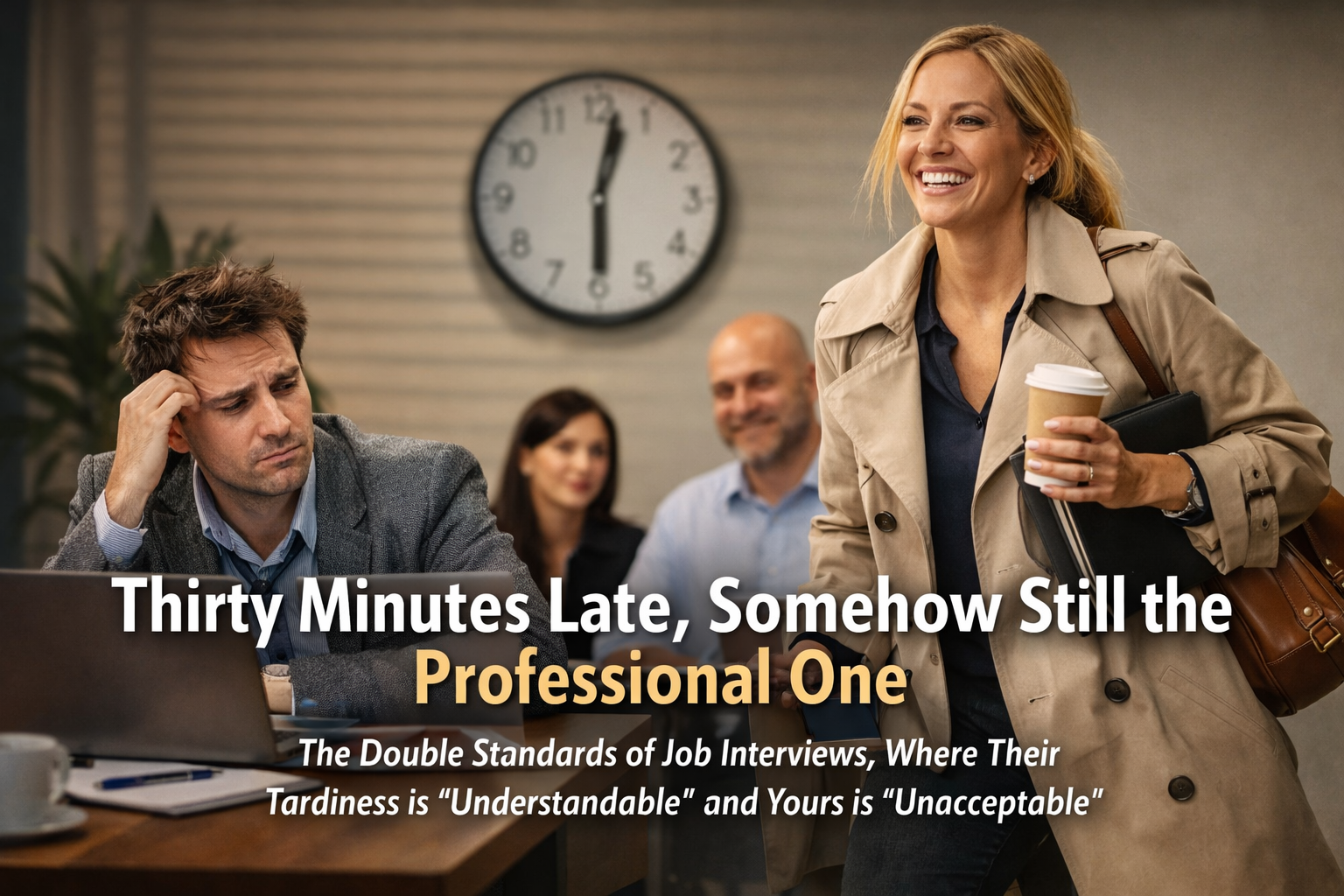
There is a very specific kind of insult that arrives wearing business casual and pretending to be normal, and one of its favorite disguises is the late interviewer who enters the call with the breezy confidence of a person who has never once in their adult life been held to the same standards they enforce on others. It is one of the great modern rituals of professional life, this strange little theater production where the candidate is expected to prepare like they are defending a doctoral thesis before Congress while the company is permitted to behave like a dinner guest who texted “on my way” from the shower.
You know the scene. The laptop is open early because of course it is. The lighting has been adjusted with the intensity of a low-budget documentary crew. The camera angle has been tested. The tabs are lined up. The fake calm has been applied. There is a glass of water nearby that no human being has ever actually wanted but every interview candidate keeps close as if hydration might somehow compensate for institutional nonsense. Your face is arranged into that special expression professionals wear during interviews, which is equal parts confidence, humility, warmth, competence, curiosity, and the desperate hope that nobody asks where you see yourself in five years because the honest answer is “not doing this.”
And then the meeting time arrives.
And then it leaves.
Five minutes goes by, and you do what every candidate does. You become generous. Maybe there was a technical issue. Maybe the platform glitched. Maybe they got pulled into something important. Maybe this is one of those rare, understandable, human moments we are all supposed to pretend happens equally across all levels of the professional food chain.
Ten minutes passes and the optimism starts to thin out. You check the invite. You check the email. You check the time zone even though you already checked the time zone because modern job hunting has turned everyone into part-time air traffic controllers trying to prevent disasters between Outlook, Zoom, Teams, and the emotional instability of strangers.
Fifteen minutes in, you begin having the kinds of thoughts that never appear in employer branding materials. Thoughts like, “Am I being ghosted live?” Thoughts like, “Is this still an interview or have I accidentally subscribed to a humiliation demo?” Thoughts like, “If I leave now, will they reappear the second I stand up and later describe me as impatient?”
By twenty minutes, you are no longer waiting for an interview. You are participating in an endurance event. Your own face on the screen begins to feel accusatory. The room gets quieter in a way that feels personal. Time itself becomes rude. Every passing minute begins to sound less like a scheduling issue and more like a small executive whispering, “Your time matters, just not in a way anyone here intends to honor.”
And then, because the universe loves structure, because hypocrisy loves routine, because corporate absurdity is nothing if not consistent, they finally arrive.
No smoke. No apology worthy of the delay. No sense that the laws of time applied in any meaningful way. Just a calm little smile, maybe a quick “Thanks for your patience,” delivered with the emotional investment of someone acknowledging light drizzle, and then right into the interview as if the previous thirty minutes were not real human life but merely a buffering period designed to test whether you were obedient enough to remain seated.
And that is when the thought appears, every single time, in full ceremonial dress:
Can you imagine if I had done that?
Because that is where the comedy stops being subtle and starts walking around the room in expensive shoes. If I had shown up thirty minutes late, there would not have been an interview. There would have been an assessment. There would have been concern. There would have been a post-call debrief in which adults used the words professionalism, readiness, reliability, and executive presence as though I had not missed half an hour but had instead been caught trying to sell catalytic converters in the parking lot.
The genius of the hiring process is that it has turned identical behavior into completely different moral events depending on who commits it. When they do it, it is context. When you do it, it is character. When they are late, the schedule was demanding. When you are late, society is collapsing through your torso. Their delay is logistical. Yours is spiritual. Their chaos is understandable. Yours is documentation.
This is why interviewing often feels less like a mutual evaluation and more like a hostage negotiation moderated by etiquette. You are expected to be flawless in a process that rarely extends the same courtesy back. You must be timely, polished, researched, grateful, flexible, charismatic, strategic, self-aware, and somehow still humble enough to pretend that being treated like a calendar accessory is a privilege.
And that, more than anything, is what makes these moments so funny. Not funny in the cheerful sense. Funny in the deeply professional, spiritually exhausted sense. Funny in the way a flaming printer is funny when someone from leadership walks in and says, “Let us use this as a learning opportunity.”
Because nothing reveals the architecture of modern interviewing faster than a late recruiter acting normal about it. That is the whole system in miniature. A clock on the wall. A double standard in a blazer. And a candidate smiling politely through an experience that would absolutely disqualify them if the roles were reversed.
So let us talk about that sacred little imbalance, because it deserves more than a passing sigh. It deserves analysis. It deserves ridicule. It deserves to be studied with the seriousness of a national emergency and the tone of a man who has stared too long into the glowing aquarium of professional networking and lived to narrate the wildlife.
The Candidate Must Be Perfect, the Process Merely Existing
There is no creature in the corporate ecosystem more heavily evaluated than the job candidate, which is fascinating when you consider how little evidence exists that the process itself has ever once been evaluated by anyone with both authority and a functioning sense of shame. Candidates are examined like suspicious luggage. We are reviewed for tone, timing, grammar, eye contact, energy, wardrobe, follow-up speed, keyword usage, handshake pressure, camera presence, and whether our answer to “Tell me about yourself” struck the exact right balance between confidence and not terrifying the panel.
The process, meanwhile, can arrive half-dressed and coughing.
That is the first joke no one says out loud. Interviews are marketed as professional conversations, but they are actually moral obstacle courses built almost entirely for one participant. The candidate is expected to demonstrate punctuality because punctuality signals discipline. The candidate is expected to be prepared because preparation signals seriousness. The candidate is expected to respect everyone’s time because respect signals maturity. The candidate is expected to adapt quickly to surprises because agility signals resilience.
That all sounds reasonable until you notice the same standards suddenly become optional when the delay is happening from the side with the corporate email signatures.
Because let a candidate be five minutes late and watch how swiftly routine becomes diagnosis. Suddenly the lateness is not late. It is information. It is evidence. It is a glimpse into future performance. It is an omen. Somewhere, someone writes a note so grim it sounds like the opening paragraph of a parole denial. Candidate arrived late. May indicate organizational challenges. Potential concern around prioritization. Lacked urgency. Did not demonstrate respect for scheduled time.
You can practically hear the violin.
But when the interviewer is late, all language changes. We become diplomats. We become historians. We become theologians explaining the mysteries of executive delay. Perhaps there was a conflict. Perhaps an internal matter came up. Perhaps leadership needed them urgently. Perhaps they were navigating a very full day. The story bends itself into a softer shape because power always enjoys better lighting.
And what makes it even funnier is that candidates are then expected to absorb the delay gracefully and continue performing at full emotional wattage. No adjustment period. No recognition that sitting alone in a video call for thirty minutes does something strange to the human spirit. You are still expected to pop right into your “great question, thanks for asking” voice as if your nervous system had not just completed a small private war.
This is one of the secret requirements of interviewing: you must not merely endure disrespect. You must metabolize it instantly into enthusiasm.
That is art.
That is performance.
That is a level of emotional labor so advanced it should qualify for continuing education credit.
Because by the time they arrive, you are already managing several invisible tasks at once. You are suppressing irritation because irritation reads poorly. You are suppressing confusion because confusion can look needy. You are suppressing the entirely reasonable impulse to ask whether this is how the company treats time generally, because curiosity is only charming when it flows upward in flattering directions.
Instead you smile. You joke lightly. You say, “No problem at all,” which is one of the great lies of professional civilization, right up there with “circle back” and “we’re like family here.” You pretend your time had no shape. You pretend your afternoon was an empty field waiting to be developed into their delay.
And the saddest part is that most candidates do this instinctively, because we understand the unwritten rule: interviews are not just tests of skill. They are tests of tolerance. Companies are often assessing not only whether you can do the job, but whether you can absorb asymmetry without making it visible. Can you remain charming while being inconvenienced? Can you stay grateful while being disrespected just enough to keep you off balance? Can you continue selling yourself under conditions that would be considered absurd in any context where both parties were treated as equal adults?
This is why the late recruiter is such a perfect symbol. They are not merely delayed. They are demonstrating the architecture of the relationship before it even begins. They are showing you, in real time, who is expected to accommodate whom. And if you are sharp enough to notice it, you then face the second test: can you notice the imbalance without reacting in a way that becomes the imbalance’s favorite new victim?
Because the system does not merely reward compliance. It often pathologizes awareness.
A candidate who says, “I understand things happen, but I did wait thirty minutes and would appreciate us acknowledging that,” is suddenly not professional. Suddenly they are intense. Suddenly they are rigid. Suddenly they may not be a culture fit, which remains one of the most elegant euphemisms ever invented for “we prefer people who smile while swallowing nonsense.”
And so the dance continues. Candidates must be pristine. The process must merely occur. Candidates must treat the interview as sacred. The company may treat it as movable furniture. Candidates must arrive polished, alert, punctual, and emotionally aerodynamic. The process itself can trip over its own shoes, spill coffee on the carpet, forget your name, and still expect a thank-you note by sunset.
That is not a mutual professional standard. That is a monarchy with calendar invites.
When Their Mistake Becomes Your Personality
One of the most remarkable features of modern hiring is the speed with which an external inconvenience can be converted into an internal flaw once the candidate is the one experiencing it. This is where corporate logic becomes less a system of evaluation and more a supernatural phenomenon. Their lateness is temporary. Your reaction to it is permanent. Their behavior is an event. Your response is an identity.
That is an incredible scam.
Because the truth is, being kept waiting changes the emotional chemistry of an interview. Of course it does. Human beings are not decorative plants. You cannot marinate in uncertainty for half an hour and emerge untouched, smiling with the radiant freshness of a morning talk show host. Waiting has texture. Waiting has heat. Waiting has a way of making a person feel both foolish and trapped at the same time, which is a difficult mood to convert into polished executive rapport.
And yet that is exactly what candidates are expected to do.
The minute the late interviewer arrives, the burden quietly shifts. It is no longer about their delay. It is about your recovery. Can you transition fast enough? Can you conceal annoyance well enough? Can you answer with warmth despite having just spent thirty minutes wondering whether the meeting still existed? Can you snap back into performance mode without any visible emotional residue, like a Broadway understudy being shoved onstage after a small kitchen fire?
If not, the story changes immediately.
Now you were “a little off.”
Now your energy “felt slightly tense.”
Now you did not “build rapport naturally.”
Now you maybe lacked flexibility.
This is how nonsense reproduces. The original offense is barely discussed, but the candidate’s emotional afterimage becomes data.
It is one of my favorite corporate magic tricks. You get inconvenienced, then graded on how elegantly you carried the inconvenience on your head through a maze while making direct eye contact and discussing your greatest strengths. By the end of it, the very person who created the disruption may leave with the impression that you somehow underperformed.
There is comedy in that so rich it ought to be taxable.
Imagine any other arena working like this. A restaurant keeps you waiting forty minutes past your reservation, then rates you on how enthusiastically you enjoyed the appetizer. A mechanic loses your car for an hour and later notes that your tone during pickup lacked optimism. A dentist leaves you in the chair staring at the ceiling tiles so long you invent religion, then remarks that you seemed a little guarded during the cleaning.
We would call that ridiculous, because it is. But in interviews, ridiculousness becomes etiquette if enough people put it on a slide deck.
And this is where candidates get trapped in the most exhausting way, because they know the asymmetry is real and yet also know that saying so can cost them. The hiring process teaches adults to distrust their own calibration. It tells them that obvious disrespect might still need to be treated as neutral if they want a chance at employment. It teaches them to perform emotional leniency toward people who would absolutely not return the favor. It trains them to ask not, “Was this acceptable?” but, “Can I survive pretending it was?”
That is not confidence building. That is professional gaslighting with branded templates.
You can feel it in the way candidates talk after these experiences. They do not say, “That was disrespectful.” They say, “I know things happen.” They do not say, “That process was sloppy.” They say, “I’m trying to be understanding.” They do not say, “This already feels like a warning.” They say, “Maybe I’m overthinking it.”
No, my friend. You are not overthinking it. You are simply living in a culture that has spent years teaching workers to undername what they feel.
And because the candidate is almost always the more vulnerable party, the whole interaction takes on the emotional shape of diplomacy under occupation. You must continue smiling. You must continue answering. You must remain composed, because one visible crack becomes the real story. Not that they mishandled the meeting. Not that your time was treated as expendable. Not that the opening move of this professional relationship involved you sitting alone in silence like a museum exhibit titled Hope Under Fluorescent Light.
No. The story becomes whether you handled it with enough grace.
Grace, in this context, is often just a prettier word for unpaid damage control.
The company makes the mess. You are asked to be elegant around it. And if you are not elegant enough, somehow the mess becomes your mirror.
That is why late interviewers are so educational. They teach you, within minutes, whether the organization sees professionalism as a shared standard or a one-way performance. They reveal whether accountability flows in all directions or only downhill. They show you whether the company believes respect is mutual or merely something candidates are expected to bring as a gift basket.
And perhaps the bleakest joke of all is that many candidates still feel pressure to send a warm thank-you note afterward. Thank you for your time, they write, even though a measurable portion of that time was spent alone, blinking at their own reflection, aging in real time. Thank you for the conversation, they say, after surviving a delay that would have ended the process instantly had the roles been reversed. Thank you for learning more about the opportunity, as though the opportunity had not already introduced itself quite clearly by arriving late and acting like clocks are mostly for interns.
But that is the modern candidate. Resilient. Adaptable. Capable of turning disrespect into follow-up language polished enough to eat off.
And somewhere, the system mistakes that endurance for health.
The Interview as Emotional Escape Room
The reason these moments linger is not just because they are rude. Plenty of rude things happen every day and disappear by dinner. No, what makes absurd interview moments memorable is that they reveal the hidden logic of the whole enterprise. They expose that interviewing is often less about assessing capability and more about observing how gracefully a person navigates asymmetrical pressure without naming it too directly.
That is why it feels like an emotional escape room.
Every interview contains puzzles that are not printed anywhere. How honest can you be without sounding difficult? How warm can you be without sounding unserious? How confident can you be without triggering insecurity? How flexible can you appear without looking desperate? How do you answer absurd questions seriously enough to seem cooperative while still preserving enough dignity to recognize that “What animal best represents your leadership style?” is not a sentence healthy civilizations produce on purpose?
Now add lateness to that environment and the whole thing becomes performance art.
Because once they arrive late, the room changes. The air changes. You are no longer just interviewing. You are recovering in public. You are solving a psychological puzzle while pretending it is a networking opportunity. Do you address the delay? Do you ignore it? Do you make a joke? Do you act especially pleasant so no one can accuse you of being rattled? Do you ask whether there is still enough time, or does that sound combative? Do you subtly reclaim your dignity, or do you temporarily lease it back to the process for strategic reasons?
This is not a conversation. This is hostage etiquette with icebreakers.
The candidate has to make dozens of tiny calculations in real time, and none of them are about the actual work they would be doing in the role. That is the most absurd part. We pretend interviews identify job performance, but so much of the experience is really measuring one’s ability to survive ceremonial weirdness without developing a visible pulse.
Can you answer canned questions in a spontaneous tone? Can you remain enthusiastic after hearing the role described in terms so vague they could also apply to an assistant cruise director? Can you nod thoughtfully when someone says they are looking for a self-starter who thrives in ambiguity, which is corporate dialect for “we have no onboarding and our best people quit”?
And perhaps most importantly, can you absorb little insults without naming them as insults?
That is where the late interviewer becomes the patron saint of the entire process. Their lateness is not just lateness. It is a compressed demonstration of the whole hiring worldview. We can inconvenience you. You must remain aspirational. We can create uncertainty. You must remain emotionally tidy. We can shift the dynamic. You must continue treating the moment like a privilege.
If that sounds dramatic, good. Interviewing is dramatic. It is full of adults pretending ordinary power imbalances are neutral administrative facts. It is full of polite language stapled over deeply impolite experiences. It is full of phrases like “moving quickly” from organizations that need three weeks to answer one email, and “we value transparency” from people who still have not explained why six rounds were necessary to determine whether you know how to send a spreadsheet.
So when a recruiter arrives thirty minutes late and continues like nothing happened, they are not committing an isolated offense. They are reciting the creed. They are performing the gospel according to modern professional life: your time is important, but ours is important-er; your composure is required, ours is optional; your mistakes are data, ours are circumstances.
And the candidate, because they need work and understand risk and have bills and groceries and adult responsibilities and maybe a fading sense of wonder, is expected to meet this entire circus with the expression of someone attending a wine tasting.
That is why people leave interviews exhausted in ways they struggle to explain. It is not only the questions. It is not only the stakes. It is the constant self-management required to remain legible inside a process that keeps changing its own rules while insisting it is fair. It is the emotional tax of pretending mutuality where hierarchy is openly running around without pants.
By the end, many candidates are not asking, “Do I want this job?” They are asking, “Did I successfully perform an acceptable reaction to their behavior?” They are replaying tone, facial expressions, pauses, and whether their brief flicker of human irritation accidentally translated as attitude. They are analyzing themselves because the process trained them to do so, while often spending far less time analyzing whether the company behaved like adults.
And that, to me, is the darkest little joke under all of this. The candidate, who showed up prepared and on time, leaves wondering if they did enough. The company, which treated punctuality like a folklore concept, moves on without ever confronting the possibility that their own conduct communicated more than any culture slide ever could.
It is a brilliant system if your goal is to make the more vulnerable party carry both the pressure and the reflection.
It is a terrible system if your goal is dignity.
Final Thoughts
So yes, some interview moments are so absurd they stop feeling like professional experiences and start feeling like deleted scenes from a workplace satire no one wanted to admit was documentary. A recruiter showing up thirty minutes late and continuing with complete serenity is one of those moments, because it takes the hidden contract of interviewing and reads it aloud in a perfectly calm voice.
The contract is simple. The candidate must arrive as a finished product. The company may arrive as weather.
And once you see that clearly, it becomes impossible not to laugh, because the alternative is probably screaming into a ring light.
The comedy is not merely in the lateness. It is in the choreography around it. It is in the expectation that the delayed candidate must become instantly gracious. It is in the fiction that professionalism is being preserved when in fact it is being applied with all the consistency of a horoscope. It is in the way identical behavior becomes a moral flaw in one direction and an understandable hiccup in the other. It is in the breathtaking confidence of systems that demand emotional excellence from applicants while offering process quality somewhere between improvised and legally interesting.
Most of all, it is funny because everyone knows the truth.
Everyone knows if the candidate had done the same thing, the consequences would have been immediate and severe. There would be concerns about judgment. There would be questions about reliability. There would be notes in systems. There would be phrases like not aligned with expectations and showed limited respect for the interviewer’s time. There would be no philosophical generosity extended to the person with less power. There rarely is.
And yet candidates are expected to navigate all of this with a smile so polished it could serve appetizers.
That is why these moments stick with people. They are not just inconvenient. They are clarifying. They reveal that many hiring processes are not designed to model the professionalism they claim to value. They are designed to evaluate how much asymmetry a candidate can endure before their humanity becomes visible. They reward people who can remain composed in lopsided conditions, who can translate disrespect into charm, who can continue pitching themselves while the process quietly demonstrates exactly how uneven the relationship may become.
Maybe that is why so many people come out of interviews feeling tired in their bones. Not because talking about their experience was hard, but because pretending not to notice the imbalance was harder. Because sitting politely through small indignities requires a kind of internal editing that wears people down over time. Because modern professionalism often asks workers to be less offended by things that should offend any healthy adult.
So when I picture the late recruiter strolling in with the calm energy of someone entering brunch rather than a delayed interview, I do laugh. I laugh because the scene is ridiculous. I laugh because the double standard is so obvious it almost feels lazy. I laugh because corporate life has a way of creating the exact satire it would later claim is unprofessional to mention.
But underneath the humor is something sharper. A simple, stubborn truth.
Respect is not real if it only travels downward.
Professionalism is not meaningful if it is only demanded from the person with less power.
And time is not valuable if the process keeps proving it only values one side’s.
That is the part worth remembering long after the meeting ends and the thank-you notes are sent and the status updates vanish into the digital swamp. Every absurd interview moment is data, not just about the candidate, but about the company. Every unexplained delay, every casual disregard, every little ritual of asymmetry tells a story. The candidate is not the only one being interviewed, no matter how hard the process tries to pretend otherwise.
And perhaps that is the healthiest thought available in a process built on so much one-sided performance.
Yes, they were late.
Yes, they acted like it was normal.
Yes, if you had done the same thing, your candidacy would have been folded neatly into a rejection email before your apology reached the second sentence.
That contradiction is not in your head. That tension is not you being difficult. That discomfort is not a flaw in your professionalism. It is simply what happens when an unreasonable system briefly forgets to hide its reflection.
And when that happens, sometimes the only sensible response is to take notes, laugh hard, and remember that a process capable of mistaking your patience for infinite supply was never evaluating professionalism quite as fairly as it claimed.