There is a very specific kind of comedy that cannot be written, only witnessed, and it usually appears in professional settings where people have spent years polishing their personal brand into something sleek, competent, and aspirational, only to have reality kick open the conference room door holding a folding chair.
That is the category we are dealing with here.
Because there is ordinary hypocrisy, the kind people expect from modern work the way they expect stale coffee and one person on every Zoom call to say, “Can you see my screen?” And then there is deluxe hypocrisy, the artisanal kind, the small-batch contradiction aged in oak barrels and served with a LinkedIn headshot. The sort of contradiction that arrives not as a rumor, not as a suspicion, but as a fully visible line item on a profile, staring at the public like it wants applause.
Time Management.
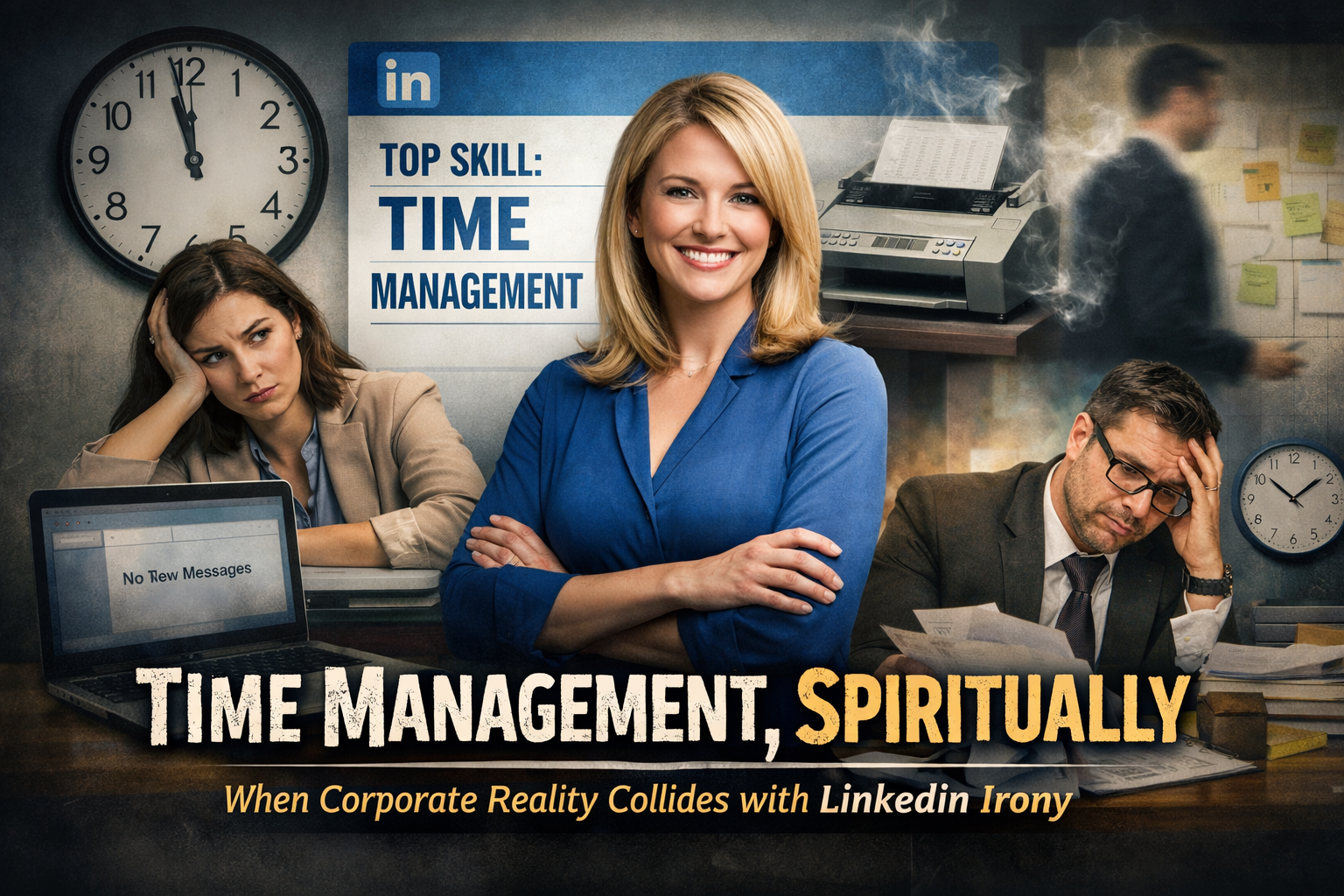
Not hidden. Not buried. Not quietly implied through vague references to being organized and results-driven. No, this thing was listed with the confidence of a person who believed clocks themselves would stand up in court and testify on her behalf. It sat there in bold blue text, glowing with the certainty of a lighthouse, while somewhere out in the distance an actual human candidate drifted alone in the fog, refreshing their inbox like a Victorian widow awaiting word from a ship that had clearly sunk.
And that is where the poetry begins.
Because the corporate world has become a place where branding and behavior are no longer cousins. They are estranged relatives who only see each other at holidays and spend the entire meal pretending not to remember why they stopped speaking. A recruiter can speak passionately about communication while ghosting with the elegance of a stage magician. A company can announce a commitment to transparency while communicating in fragments that read like ransom notes assembled from conference swag. A hiring manager can talk about respect for people’s time with the sort of straight face usually reserved for hostage negotiators and weather forecasters.
But there is something uniquely breathtaking about a person who lets a candidate marinate in silence so long the process begins to qualify for carbon dating, while simultaneously presenting themselves online as a kind of horological superhero. That is not just irony. That is corporate taxidermy. That is taking a dead truth, stuffing it, posing it under fluorescent lighting, and asking the public to admire the craftsmanship.
I think that is why LinkedIn has become less a professional network and more a museum of accidental stand-up comedy. Every profile is a curated exhibit of hopes, half-truths, strategic adjectives, and endorsements granted by former coworkers who may or may not have actually met the person they were praising. It is a place where everyone is excellent at leadership, passionate about synergy, and deeply committed to innovation, even if they have not led anything, synergized with anyone, or innovated outside of finding new ways to reschedule a thirty-minute call.
So when you stumble onto one of these perfect collisions between self-presentation and actual conduct, it feels almost sacred. You do not want to interrupt it. You do not want to improve it. You simply want to stand there, hands folded, and admire the splendor of a joke so complete that reality itself delivered the punchline before any writer had the chance.
And that, truly, is what happened here.
A recruiter delayed, disappeared, drifted through the process with all the momentum of a haunted fax machine trying to remember who it used to be, and above it all, floating like a ceremonial banner in the wind, was the declaration that her top skill was Time Management. Not survival. Not communication. Not candidate experience. Time Management. Which is a little like watching a man set his own kitchen on fire while wearing a shirt that says Fire Safety Champion.
Corporate life keeps producing these moments because corporate life is fundamentally built on the hope that nobody will compare the brochure to the building. That nobody will ask whether the values page has ever met the calendar. That nobody will notice the person posting thought leadership about efficiency is somehow responding to an email chain like each message must first travel by horseback through the mountains.
But people do notice. Candidates notice. Employees notice. The public notices. And increasingly, the only sane response is laughter, because the alternative is to accept that all of this is normal, and frankly that is a level of spiritual surrender I am not prepared to recommend.
So let us not treat this as a minor scheduling issue. Let us honor it properly. Let us examine it with the seriousness of scholars and the pettiness of people who have absolutely had enough. Because buried inside this tiny contradiction is the whole modern hiring experience: the branding, the waiting, the performative professionalism, the disrespect wrapped in polished language, and the astonishing confidence of people who continue to describe themselves in ways reality has already formally disputed.
Welcome, then, to the grand cathedral of office absurdity, where Time Management is a listed skill, silence is a workflow, and the candidate is expected to remain grateful for the privilege of being ignored in an orderly fashion.
The Sacred Delay
There is no delay quite like the professional delay, because an ordinary delay is just lateness, while a professional delay is theater. It comes with language. It comes with framing. It comes with the faint perfume of self-importance. In regular life, if someone keeps you waiting too long, we call that what it is. They are late, careless, disorganized, inconsiderate, or perhaps all four standing on each other’s shoulders in a trench coat. But in corporate life, we do not speak that plainly. We wrap lateness in vocabulary until it sounds strategic.
Suddenly the meeting is not late. It is being moved. The process is not stalled. It is evolving. The silence is not neglect. It is thoughtful consideration. The ghosting is not ghosting. It is an internal alignment period, which sounds less like hiring and more like a moon ritual performed by middle management around an empty budget.
And the candidate, poor exhausted saint that they are, is expected to absorb this nonsense with grace. They are expected to understand. To remain flexible. To appreciate that everyone is busy. As though busyness is a moral exemption card that allows adults to mishandle other adults while still thinking of themselves as polished professionals. It is one of the great scams of modern work, this idea that being busy cancels out the effect of being inconsiderate. It does not. If anything, it just means your chaos has a calendar invite.
The beauty of the sacred delay is that it is almost always one-sided. The candidate is expected to arrive on time, prepared, camera-ready, emotionally balanced, professionally dressed, technically stable, and carrying the full burden of enthusiasm. The candidate must confirm availability, respect the schedule, reply promptly, send thank-you notes, monitor spam folders, check time zones, smile through confusion, and remain alert for changes delivered at the last possible moment by someone who apparently regards clocks as decorative coasters.
But the recruiter? The recruiter can drift in thirty minutes late like a cruise ship approaching port through fog and still speak with the calm authority of a person who believes they are doing everyone a favor by appearing at all.
That is the imbalance nobody talks about enough.
Hiring is framed as mutual evaluation, but too often it functions like aristocracy. One party is expected to perform professionalism, while the other merely claims it. One side must demonstrate respect. The other side gets to mention respect on LinkedIn and call it even. One side is punished for the tiniest deviation, while the other can vanish into administrative mist and reemerge with a casual “Thanks for your patience,” as though patience were an inexhaustible natural resource growing wild behind every job seeker’s apartment.
And let us pause on that phrase, because “Thanks for your patience” might be one of the most manipulative little bits of corporate pickpocketing ever invented. It politely informs you that your time has already been taken and simultaneously drafts you into pretending you donated it willingly. It is the scheduling equivalent of someone stepping on your foot and thanking you for supporting their balance.
But delays become transcendent when paired with self-branding. That is when they stop being frustrating and start becoming literary. Because if a late recruiter had no public persona, we would merely be annoyed. We would sigh, roll our eyes, maybe tell a friend, and move on. But when that same recruiter publicly advertises Time Management as a defining strength, the whole thing upgrades from inconvenience to performance art.
Now the delay has symbolism.
Now the silence has texture.
Now the missed appointments and slow responses are no longer isolated acts of disorder. They are brushstrokes on a mural of accidental satire.
It becomes impossible not to picture the candidate waiting by the inbox like a Victorian child listening for carriage wheels, while somewhere in the digital clouds this endorsement hovers overhead, smug and untouched, like a pageant sash pinned to a scarecrow. Time Management. An extraordinary claim, especially from someone treating the calendar like optional fan fiction.
This is what the corporate world forgets: the public record exists. The candidate sees the profile. The employee sees the values statement. The audience sees the contradiction. And once that contradiction is visible, all the polished language in the world cannot save it. In fact, the polish makes it worse. Because nothing amplifies absurdity like confidence. A person who is quietly disorganized is just a mess. A person who is loudly branded as organized while visibly causing delay becomes a landmark.
A tourist attraction.
A case study.
A cautionary tale with premium headshots.
And so the sacred delay continues, drifting through hiring processes everywhere, defended by jargon, padded by assumptions, and sanctified by the expectation that candidates should simply be grateful someone eventually remembered they existed. But every so often the universe slips, the curtain opens, and we are allowed to see the thing in full: the lateness, the branding, the contradiction, the accidental joke standing there in business casual asking if next Tuesday still works.
That is not a scheduling issue.
That is art.
LinkedIn, the Museum of Office Fiction
LinkedIn is perhaps the greatest unintentional comedy venue ever created, because it is a place where adults gather daily to present the most flattering possible interpretation of themselves while surrounded by evidence that reality had other plans.
It is magnificent.
Every platform has its own form of dishonesty, of course. Instagram has lighting. Facebook has nostalgia. Dating apps have photography from three governments ago. But LinkedIn has something far more ambitious: narrative architecture. It does not merely let people share what they did. It invites them to construct a moral identity out of buzzwords, endorsements, and stories that somehow always end with leadership, growth, resilience, or coffee. It is less a networking platform and more a giant interactive brochure where everyone is both a thought leader and an active witness to their own excellence.
That is why contradictions hit so hard there.
Because LinkedIn is not casual. It is ceremonial. Every line is chosen with the care of a lawyer reviewing a prenup. People do not just mention skills. They curate them. They pin them to the top like medals. They present them as artifacts of who they are, what they value, and why the market should approach with reverence. To list Time Management is not simply to say, “I can use a calendar.” It is to claim fluency in discipline, reliability, prioritization, and the deeply erotic adult concept of showing up when you said you would.
So when someone with that skill endorsement conducts a hiring process like a raccoon sorting receipts in a thunderstorm, the result is breathtaking.
Because then LinkedIn stops being a platform and becomes a museum.
There, preserved behind glass, is the skill itself. Time Management. Carefully labeled. Nicely lit. Publicly visible. And just three feet away, in the next exhibit, is the actual behavior: delays, reschedules, silence, drift, vague follow-ups, and the unmistakable energy of a person treating another human being’s time like it came free with a software subscription.
What a pairing.
What curation.
What a devastating commitment to irony.
And the funniest part is that no one on LinkedIn ever seems to notice how often their branding sounds like parody when compared with their conduct. The person who champions open communication writes emails like they are leaving clues in a hostage situation. The executive who posts about servant leadership cannot remember the names of the people doing the actual work. The organization that celebrates authenticity has approved exactly three facial expressions and all of them look expensive. The recruiter who lists Time Management appears to schedule conversations using weather patterns and spiritual intuition.
This is why the platform fascinates people who have spent any real time in the working world. Because it claims to document professionalism, but what it often documents instead is aspiration wearing makeup. It is not a map of how things are. It is a diorama of how people would prefer to be perceived while the office behind them burns quietly off-camera.
And to be fair, everyone participates in some version of this. That is part of what makes the whole thing so human. People want to be seen generously. They want their profile to represent the polished thesis of themselves, not the daily draft. They want to lead with intention, not the afternoon they forgot to answer twelve emails because life was chaos and their coffee tasted like conflict. I understand that. We all do it to some degree.
But there is a difference between polishing and fiction.
There is a difference between highlighting strengths and installing decorative lies.
And LinkedIn becomes absurd when it drifts too far from biography into mythology. That is when a profile no longer feels like a summary of work and starts reading like a church pamphlet for a saint who once missed four deadlines and cried in the supply closet.
Time Management, in this case, is not funny merely because the recruiter was late. It is funny because it perfectly captures the platform’s whole ecosystem of self-certification. Someone, somewhere, either selected that skill, endorsed that skill, or allowed it to remain on display while living in open conflict with it. And none of those steps were interrupted by a single inner voice whispering, “Perhaps not this one.”
That is astonishing confidence.
That is the same confidence that fuels corporate mission statements promising empowerment in buildings where half the staff cannot get approval to order pens. It is the same confidence behind public posts celebrating culture while employees quietly update resumes in the bathroom. It is the same confidence required to write “people-first organization” on a website and then design an interview process that makes applicants feel like unloved contestants in a budget game show.
LinkedIn does not create these contradictions. It illuminates them. It puts them in one place, labels them with tasteful typography, and lets the public do the rest. Which is why it so often becomes a source of comedy more precise than anything a writer could fabricate. Fiction needs restraint. Reality, especially corporate reality, has no such burden.
And maybe that is why people keep coming back to the platform despite the nausea. Because hidden beneath the motivational sludge and strategic gratitude posts is a kind of accidental truth. Not the truth people intended to tell, but the truth that leaks through anyway when their claims rub against observable behavior. The platform may aspire to be a hall of excellence, but in practice it often functions as a living archive of tiny collisions between who people say they are and who the calendar says they became.
A museum of office fiction.
A gallery of professional self-portraits painted from memory, hope, and moderate delusion.
And in one especially beautiful wing, under perfect lighting, sits an endorsement for Time Management beside the smoking ruins of an actual schedule.
The Candidate as Emotional Support Furniture
There is something deeply revealing about the way hiring systems treat candidates, and it is this: the candidate is almost never treated like a person moving through a life. They are treated like a paused tab.
Always there. Quietly waiting. Conveniently reloadable.
That is why these delays sting in ways people inside the system often fail to understand. It is not just that time passes. Time always passes. It is that candidates are expected to keep their emotional availability suspended during that passage. To remain hopeful, responsive, and professionally composed while the process mutates around them like weather. The candidate cannot fully move on, cannot fully settle in, cannot fully detach, because at any moment the inbox might light up with another message asking whether they are still available for an opportunity that has so far treated their time like compost.
This is not a small thing.
It is not a harmless inconvenience.
It is a psychological tax levied on people who are already spending enormous effort trying to remain employable in a system built increasingly like an escape room designed by cowards.
Candidates prepare for interviews as if each one could matter, because sometimes they do. They research the company, study the job description, rehearse stories, adjust schedules, manage childcare, borrow confidence, iron shirts, troubleshoot microphones, test cameras, and step into these conversations carrying a version of themselves polished just enough to survive scrutiny. It takes energy. It takes vulnerability. It takes hope, which is frankly one of the most expensive fuels on earth when the job market starts behaving like a carnival game with HR software.
So when a recruiter drifts, delays, disappears, or moves with the organizational rhythm of a dryer full of forks, the damage is not just logistical. It is emotional. The candidate has already paid something to participate. They have invested attention, preparation, and the small but meaningful act of taking this seriously. When that seriousness is not returned, even minimally, it communicates something ugly: your time is not real here. Your waiting is invisible. Your humanity is an administrative detail.
And because professional culture is addicted to politeness theater, the candidate is often forced to process that message with grace. They must not appear frustrated. They must not ask too directly. They must not seem impatient, difficult, or insufficiently thrilled to remain on layaway. They are expected to be understanding in situations specifically designed to be inconsiderate.
In other words, they become emotional support furniture.
Present, useful, silent, and not allowed to have needs.
Set them in the waiting room of possibility. Lean process confusion on them. Rest scheduling failures against their backs. Thank them vaguely for their flexibility and move on. They will still be there, apparently, because the system has trained them to believe that objecting to mistreatment might cost them the very opportunity already treating them poorly.
This is why the public contradiction of Time Management lands with such force. Because it is not just funny. It is insulting in a way only polished incompetence can be. A delayed recruiter is frustrating. A delayed recruiter branding themselves as a master of time becomes a symbol of the whole imbalance: the system markets itself as professional while feeding on the patience of people it refuses to treat professionally.
And let us be honest, the candidate experience has become one of the most absurdly one-sided customer service interactions in modern life. Imagine a restaurant where you make the reservation, arrive early, dress appropriately, review the menu in advance, and then sit for three hours while the server occasionally reappears to ask whether you are still excited to dine there. No food. No explanation. Just periodic contact designed to keep you from leaving. Eventually the manager emerges, thanks you for your interest in the establishment, and lets you know they have decided to go with another eater whose chewing more closely aligns with company values.
That restaurant would be on fire by sunrise.
But in hiring, this kind of process is normalized so completely that the burden of emotional maturity falls almost entirely on the applicant. The person being ignored must remain kind. The person being delayed must remain enthusiastic. The person being treated as disposable must continue projecting gratitude. It is deranged.
And maybe the most corrosive part is how often the system treats candidate frustration as the actual problem. Not the inefficiency. Not the lack of communication. Not the calendar disorder dressed up like strategy. No, the real issue, apparently, is that someone noticed the joke. Someone looked at the recruiter who had slow-roasted a candidate in uncertainty and then saw the skill endorsement for Time Management shining like a cursed heirloom and thought, surely we are all seeing this.
Yes. We are.
That is the thing about public contradictions. Once seen, they cannot be unseen. And once named, they become contagious. Other candidates recognize them. Other workers recognize them. Everyone who has ever been trapped in a process that ran on delay, ego, and administrative incense sees themselves in it instantly. The experience becomes communal. The laughter becomes a form of witness.
Because beneath the humor is a very old, very human request: if you are going to ask people to give you their time, please behave like you know it belongs to them.
Not your process.
Not your convenience.
Not your calendar.
Theirs.
And if you cannot manage that, perhaps remove Time Management from the profile before the public starts mistaking your endorsements for satire.
Final Thoughts
What makes all of this linger is not merely the lateness, or the contradiction, or even the polished absurdity of a recruiter publicly cosplaying as a clock enthusiast while moving through a hiring process like wet laundry in low gravity. What makes it linger is that it captures the emotional architecture of modern professional life so perfectly that you almost have to admire the efficiency of the metaphor, even if the actual process itself displayed none.
Because this is where we are now.
We live in an era where systems insist on being praised for values they do not practice, where people market qualities they do not reliably demonstrate, and where the public is constantly asked to confuse presentation with substance. We are told to trust the mission statement, the profile, the value proposition, the skill list, the smiling leadership post, the polished explanation, the casual “just circling back,” the breezy assurance that everything is moving along. Meanwhile, candidates are out here aging visibly between interview rounds, learning to interpret inbox silence like Cold War analysts reading intercepted code.
And yet, through all of this, the funniest thing remains the confidence.
The absolute titanium-plated confidence of professional culture.
The confidence to delay and still describe oneself as timely. The confidence to communicate badly while championing communication. The confidence to mishandle people while publishing reflections about people-first leadership. The confidence to turn contradiction into branding and trust that no one will hold the brochure next to the building long enough to notice the missing wall.
That confidence is almost impressive.
Not morally. Not operationally. But artistically.
Because it takes a special kind of nerve to build a digital identity around virtues your conduct keeps mugging in broad daylight.
And maybe that is why humor has become such an essential survival skill for anyone trying to remain psychologically intact in the modern world of work. Without humor, these moments are just disrespectful. Just draining. Just another example of adults using polished language to disguise preventable carelessness. But with humor, the whole thing shifts. The contradiction becomes visible. The power imbalance gets named. The absurdity is dragged into the light where it belongs, blinking and overdressed.
Laughter, in this context, is not trivial. It is diagnostic.
It says, I see what happened here, and I refuse to let your corporate vocabulary make it sound normal.
It says, you do not get to mishandle time and still own the language of discipline uncontested.
It says, if you are going to turn professional life into improv theater, at least understand that the audience is taking notes.
And perhaps that is the real gift of LinkedIn, against all odds. Not the networking. Not the personal branding. Not the inspirational sludge poured daily into the feed like warm soup from a very optimistic can. The real gift is exposure. It creates a public archive where performance and reality occasionally collide hard enough to produce truth. Messy truth. Funny truth. Truth that arrives wearing business casual and carrying a contradiction so obvious it practically introduces itself.
Time Management.
Still one of the finest accidental punchlines ever left unattended on a profile.
Because that is what this really was in the end: not just a delay, but a perfect tiny opera of modern work. A candidate waiting. A recruiter drifting. A platform preserving the contradiction in high definition. And everyone else standing around the scene like museum guests, reading the placard and trying not to laugh too loudly in the gift shop.
Maybe that is all any of us can do now. Observe carefully. Name things honestly. Laugh when the irony becomes too large to carry quietly. Refuse to be gaslit by polished incompetence. Refuse to treat preventable disrespect like a feature of professionalism. Refuse, above all, to pretend that a person can set your time on fire and still be admired publicly as a guardian of clocks.
Because once you see it, you really do see the whole machine.
The endless branding. The brittle scripts. The fake urgency. The selective courtesy. The expectation that candidates remain infinitely patient while everyone else enjoys the freedom of consequence-free disorder. It is all there in one glowing little endorsement, sitting smugly on a profile like a decorative plaque in a collapsing building.
And honestly, that may be the single most honest thing LinkedIn has ever shown us.
Not because it meant to.
But because irony, unlike recruiters, always shows up right on time.