
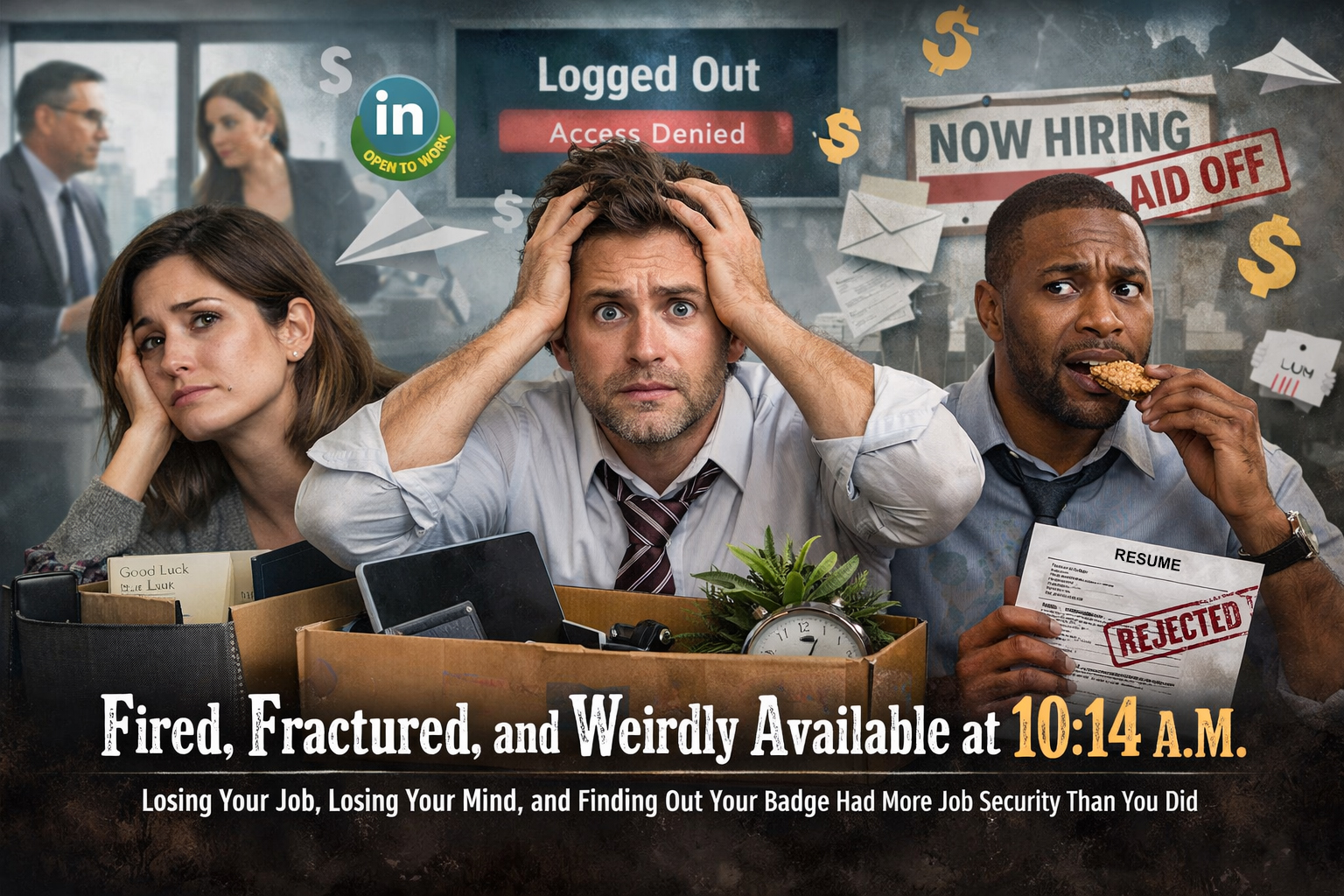
A Funny Article About Losing a Job, Losing Your Mind, and Finding Out Your Badge Had More Job Security Than You Did
There is a very particular kind of emotional whiplash that comes with losing a job, and what makes it so special, so memorable, so beautifully deranged, is that it almost never arrives with the cinematic decency of an actual disaster. There is no thunderclap. No alarm. No kind intern running through the hallway yelling, “Everyone out, they’ve chosen Gary from accounts payable.” Nothing dramatic happens on the outside, which is almost insulting when you think about it, because internally your soul is performing a full evacuation while your face is still trying to maintain the polite expression of someone who has been told the brunch reservation is delayed by twenty minutes. One minute you are doing perfectly ordinary workplace nonsense, answering emails nobody should have sent in the first place, sitting in meetings where three adults use the phrase “going forward” as if it were a religious doctrine, pretending that “touching base” is both a reasonable sentence and a thing any emotionally healthy person has ever wanted to do, and the next minute you are in a calendar invite with a title so vague it might as well say, “Please report to the digital parking lot for consequences.”
And from there, the corporate theater begins.
The voices are always gentle in a way that makes you instantly suspicious, like you are being broken up with by a hostage negotiator. They say things like “organizational restructuring,” “unforeseen market realities,” and “this decision was not made lightly,” which is the business world’s way of laying a silk pillow under your head before kicking your life down a staircase. You nod. They nod. Everyone is using their softest voice. You are trying to remain composed while your brain, which just ten seconds earlier was wondering whether you should reorder printer toner, is now sprinting barefoot through the fields of your financial future screaming, “WHAT DO YOU MEAN MY ACCESS HAS BEEN REVOKED.”
What follows is one of the strangest emotional experiences known to modern adulthood, because losing a job is not just losing income. That would almost be simpler. It is losing routine, rhythm, identity, petty complaints, preferred coffee mug territory, the little walk you took at 2:17 p.m. when Keith started talking too loudly on speakerphone, the comfort of knowing exactly where you were supposed to be on a Tuesday morning and exactly which coworkers to avoid when Mercury was in retrograde or payroll was late. It is not only practical loss. It is emotional dislocation. It is grief in business casual. It is heartbreak with login credentials.
And yet, because human beings are apparently built to survive even the most ridiculous forms of modern humiliation, the experience eventually becomes funny. Not immediately, of course. In the beginning, it is mostly panic wrapped in disbelief and lightly seasoned with rage. But later, when the smoke clears and you have had time to stare into the middle distance, consume a medically irresponsible amount of snacks, and explain to seventeen people that no, it was not performance-related even though the wording of that sentence feels like you are defending yourself in a court case nobody asked to attend, the absurdity of it all begins to reveal itself. You remember the exit survey. You remember the manager who ignored you for nine months suddenly saying, “We value everything you’ve done.” You remember being locked out of your own email before the meeting had even ended, as if the company had trained for this like a tactical operation. You remember how fast you went from “team member” to “potential cybersecurity threat,” and somewhere in the middle of that memory, against all odds, you laugh.
Because losing a job is awful, yes. It is destabilizing and painful and deeply personal in ways companies are forever pretending it is not. But it is also, in many cases, unintentionally hilarious. It exposes the ridiculous machinery of professional life in a way few other experiences can. It reveals how much of corporate culture is just expensive wallpaper over chaos. It forces you to look directly at the strange religion of productivity and realize that a badge, a title, and an email signature were never the full measure of a human life, no matter how many LinkedIn posts insist otherwise.
So let us talk about it properly. Let us give it the dramatic treatment it deserves. Let us honor the chaos, the sadness, the fury, the emotional indigestion, and the absurdity of suddenly becoming “open to work” by circumstances you did not, in fact, open yourself to. Let us walk through the experience from the first suspicious meeting to the later-stage recovery, when you are somehow still wounded, still funny, and just unstable enough to become interesting again.
The Meeting Where Your Tuesday Died
It always starts with a meeting that feels wrong in the way a restaurant feels wrong when there are no cars outside at dinnertime. Something about it is off. The title is suspiciously neutral. “Quick Touch Base.” “Business Update.” “Check-In.” No one in corporate history has ever scheduled a meeting called “Quick Touch Base” to improve another person’s day. Those words are an administrative trench coat hiding a knife.
You join the call already uneasy, because adult intuition is basically just trauma with pattern recognition. And there they are: your manager, suddenly solemn, and an HR representative whose expression suggests she has delivered this speech enough times to know exactly when your face will go blank. The energy in the room is immaculate in the worst possible way. It is calm. Too calm. It is the calm of people who already know how the story ends while you are still under the impression you are on page three.
Then the phrases begin to drop like tiny, polished grenades.
“Due to recent changes…”
“After careful consideration…”
“This is not a reflection of your performance…”
That last one always deserves an award for excellence in emotional gaslighting, because if it is not a reflection of your performance, then why does it still feel like I am being dumped by my own life. Companies love to insist that these decisions are impersonal, which is a fascinating angle considering they tend to arrive directly into your personal bloodstream. They say the role is being eliminated, as though your job was a weak kingdom and they simply had no choice but to send in the cavalry. They thank you for your contributions, your flexibility, your professionalism, your dedication, your work during a difficult season, your leadership, your positive attitude, and any other beautiful qualities they could have mentioned sooner while you were still employed.
And in that moment, your body does the most fascinating thing. It remains physically seated while your consciousness leaves to file a complaint with the universe.
You nod at things you are not hearing. You say phrases like “I understand” and “thank you for letting me know,” which is extraordinary because what you actually understand is nothing, and what you would like to say would get you removed from several professional networks. Your brain begins taking screenshots of details that no longer matter. The pattern on someone’s shirt. The weird lag in the audio. The fact that a person who once took six days to approve a stapler reimbursement has managed to arrange your professional extinction in under twelve minutes. Remarkable efficiency when properly motivated.
Then comes the logistical phase, which is somehow even more insulting because it attempts to domesticate catastrophe. They start discussing severance, timelines, benefits, next steps, equipment return, access revocation, and whether you have any questions. Any questions. As if your life has not just been gently shoved off a dock. As if there is a follow-up question elegant enough to cover, “Excuse me, what exactly am I supposed to do with the version of myself that believed next quarter’s strategy mattered?”
The greatest insult, however, is the speed of deactivation. Companies that could not figure out how to reset a password for three years will somehow disable your access with the coordination of an elite military unit. Your email vanishes. Your Slack dies. Your calendar becomes a museum of meetings you will never attend. Your badge stops working with such immediate conviction that it becomes clear the organization was never actually understaffed; it was just saving all of its competence for the day it needed to erase you.
And afterward, the silence is shocking.
No more messages. No more fake urgency. No more “just bumping this to the top of your inbox.” It is just you, your thoughts, your laptop if they have not already arranged its ceremonial extraction, and the surreal realization that the thing consuming most of your life has ended in a tone best described as professional condolences. You are not merely sad. You are disoriented. You have been removed from a machine while the gears are still spinning, and now you are standing there with all the momentum and none of the map.
It is devastating, yes, but also deeply absurd. Because only modern work could take an event this destabilizing and package it in such emotionally upholstered language. Only corporate culture could turn heartbreak into a scripted interaction followed by a PDF.
The Emotional Support Spiral and Other Side Effects of Professional Rejection
Once the meeting ends, your nervous system begins improvising.
This is where the real show starts, because losing a job does not arrive as one clean emotion. It is not sadness, full stop. That would be manageable. No, it arrives like an uninvited family reunion of every feeling you were hoping not to host. Shock shows up first, pale and blinking. Then panic kicks down the door with a calculator. Shame wanders in wearing one of your old accomplishments like a trench coat. Anger arrives loudly, carrying a box of every dumb thing leadership ever said in a town hall. Embarrassment slips in through the side entrance, already drafting imaginary conversations with people who are absolutely going to ask what happened. And then, just when you think the room could not possibly hold one more feeling, there is grief, unfolding a chair in the middle of the kitchen like it plans to stay.
The first day is especially lawless. Time loses all structure. You are technically free, but in the least luxurious way possible. This is not vacation freedom. This is “I have become unexpectedly available against my will” freedom. The clock hits 10:14 a.m. and instead of being in your normal meeting pretending to care about dashboard alignment, you are in sweatpants staring at a bowl of cereal like it contains strategic guidance. It is one of the most intimate forms of disorientation: being absent from a place where you were so recently expected.
Then comes the mental replay. Every conversation. Every performance review. Every weird interaction with leadership. Every moment a manager said, “Great work,” with the vacant eyes of a man already planning a reorganization. You review your history like a detective assigned to your own unraveling. Was it that project? That email? That meeting where you politely challenged an idea everyone now agrees was bad? Did I miss signs? Were there clues? Could I have prevented this by smiling more, speaking less, being louder, being quieter, reading minds, performing miracles, or pretending enthusiasm during that team-building scavenger hunt?
And of course, because humans are tragically gifted at self-torture, you begin comparing yourself to the people who are still there. That is always a dark hobby. You start thinking about Trevor, who contributed nothing except Bluetooth issues and still somehow survived. You remember Linda, who once replied all to a confidential thread and remained fully employed for years. You remember people with less experience, less effort, less competence, and apparently stronger astrological protection. The mind, in crisis, becomes a terrible little courtroom where the evidence is incomplete and the verdict is always somehow your fault.
But perhaps the cruelest part is the outside commentary.
This is when relatives, acquaintances, and motivational hobbyists emerge from the shadows to offer the exact wrong sentence with dazzling confidence. “Everything happens for a reason.” Fascinating. Please let me know when the reason arrives, because at the moment it appears to be rent. Someone says, “This might be a blessing in disguise,” which is a beautiful thing to say when the disguise is six layers of panic and your health insurance expires on Thursday. Another person tells you, “Take this time to rest,” as if rest is an activity the human nervous system can access when future income has become theoretical.
And then there is LinkedIn, that glittering amphitheater of professional delusion, where nothing makes sense and everyone is either “thrilled to announce” something or “humbled to share” a career update that clearly required twenty-seven drafts and a candlelit crisis. Losing a job in the age of LinkedIn is like having your personal heartbreak take place next to a parade. You are out here recalculating your self-worth while someone from your old industry posts, “Honored to have been recognized as a top visionary in scalable transformation leadership.” Sir, read the room. Some of us are trying not to dissolve in broad daylight.
You update your profile. You make the banner prettier than your mental state. You consider the green ring. You hate the green ring. You briefly become a branding expert against your will. You are suddenly expected to transform fresh grief into a marketable narrative. Not only must you survive the loss, you must package it attractively. You must become resilient in public. Optimistic, but not desperate. Honest, but not too honest. Strong, but somehow still approachable. It is like being told to crawl out of a wreckage site and immediately curate the photos.
Still, amid all this, the absurdity keeps showing up in little flashes.
The exit survey that asks you to rate communication. The manager who ignored your recommendations for a year suddenly writing, “Please stay in touch.” The company laptop box arriving with the tenderness of a ransom exchange. The realization that a corporation capable of losing your expense report for four months managed to shut down your access before your tea got cold. You laugh, not because it is fine, but because laughter is sometimes the only surviving form of dignity available on short notice.
And perhaps that is the hidden genius of humor in these moments. It does not erase pain, but it makes the pain hold still long enough to examine. It lets you tell the truth without collapsing under it. It turns chaos into narrative. It gives you something besides despair to hold in your hands. When life becomes absurd, humor is often the only response that feels proportionate.
So yes, cry in the shower. Rage-clean the kitchen. Eat something that looks like it was invented by a stressed college student with access to melted cheese. Lie on the couch in complete silence like a Victorian widow whose beloved perished in a factory accident. Feel everything. But also notice the comedy. Because if you can laugh, even briefly, at the ridiculous machinery that tried to reduce your humanity to a budget line, then something vital in you is still gloriously, stubbornly alive.
Rebuilding Your Life While Slightly More Unhinged and Significantly Less Gullible
Eventually, the smoke begins to thin.
Not all at once, and certainly not in the tidy, cinematic way motivational speakers describe while standing in front of a ring light, but slowly, unevenly, like your sanity returning from a long walk and refusing to explain where it has been. The panic does not vanish so much as evolve. It becomes more practical. Less wildfire, more electrical hum. You begin doing things again. Updating the resume. Reaching out to people. Searching jobs with the haunted concentration of someone browsing online dating after a spectacularly humiliating breakup. You are cautious now. You have seen too much. Words like “family culture” make your eye twitch. Phrases like “wear many hats” feel like legal evidence.
This is the stage where you begin to understand a difficult but strangely liberating truth: the job ended, but you did not.
That may sound obvious, but it does not feel obvious when you are first thrown out of routine and into uncertainty. In the beginning, work and identity tend to be tangled together like old Christmas lights. You do not just lose a paycheck; you lose a title, a context, a place where your effort used to go. And because modern life is weirdly structured around introducing ourselves by what we do, losing that answer can make you feel briefly invisible. Who are you when you are no longer “Senior Director of Strategic Whatever” or “Operations Manager, Regional Something” or “Professional Apologizer for Leadership’s Bad Decisions”? It is a disturbingly intimate question.
But rebuilding has a way of revealing what was yours and what was merely borrowed.
Your discipline was yours. Your intelligence was yours. Your humor, your instincts, your ability to survive meetings that should have been emails and email chains that should have been crimes, all yours. The company never owned your talent. It rented your time. That is different. Important difference. One is a transaction. The other is your life.
And once that starts to sink in, something changes.
You become more selective, or at least more suspicious in useful ways. You read job descriptions like a forensic linguist. You spot nonsense faster. “Fast-paced environment” now translates to “our planning is terrible.” “Self-starter” means “nobody is training you.” “Rockstar” means “we cannot legally ask one person to do five jobs, so we have chosen whimsy.” “Resilient” means “people cry here.” You are no longer dazzled by ping-pong tables, mission statements, or headshots of executives with rolled-up sleeves pretending they invented empathy. You have been inside the machine. You know the wallpaper peels.
And there is power in that.
Not bitterness, exactly, though a little bitterness can add texture. More like clarity. You begin to see how often companies confuse access with worth, title with identity, employment with value. You realize how much of corporate culture is theater performed under fluorescent lighting for an audience too exhausted to challenge the script. You stop romanticizing the office. You stop assuming loyalty flows both ways. You stop believing that a company saying “we care about people” is meaningful unless it has behaved that way when it was expensive and inconvenient.
This does not make you cynical. It makes you literate.
And from that literacy, a different kind of confidence grows. Not the flimsy confidence of performance reviews and leadership competencies, but the real kind, the kind built from surviving disappointment without turning to stone. You begin to trust yourself again. You remember projects you led, problems you solved, people you helped, impossible weeks you carried without applause. You remember that you were doing hard things before this company found you, and you will be doing hard things long after it becomes one line on your resume and a story you tell with better timing.
Sometimes the next opportunity is better. Sometimes it is only different. Sometimes it takes longer than anyone with functioning compassion would consider acceptable. The in-between can be brutal, and it would be dishonest to pretend otherwise. But even in that uncertainty, there is a strange unfolding. You are no longer asleep inside someone else’s structure. You are paying attention. You are asking harder questions. You are less willing to shrink yourself to fit a conference room. You are discovering, in the most inconvenient way possible, that your life was never meant to be measured only by the system that processed your payroll.
And yes, you may come out of it slightly more unhinged. That is fine. Frankly, some hinging was doing too much anyway. A little instability can be the birthplace of honesty. You become funnier. Sharper. Less impressed by nonsense. More protective of your energy. More aware of how quickly institutions can speak in platitudes while rearranging human lives like office furniture.
That awareness is painful, but it is also freedom.
Because once you see the game clearly, you stop mistaking it for the whole world.
Final Thoughts: The Badge Stopped Working, But You Still Do
Losing a job hurts in a way that is both deeply modern and embarrassingly ancient. It wounds the practical parts of life first, the schedule, the income, the routines, the familiar irritations, but it also reaches into the older places, the part of a person that wants to belong somewhere, to contribute, to be recognized, to have a role in the village beyond “currently refreshing the job board in elastic-waist pants.” It is not dramatic to say it can break your heart a little. It can. Not because a corporation deserves that kind of emotional power, but because human beings naturally pour themselves into the structures that shape their days. We build habits around work. We build identities around competence. We build tiny private rituals around places we do not even fully like. Then one meeting happens, one decision gets made in a room where no one has your rent due date memorized, and suddenly you are left holding the emotional debris of a life that looked stable on Monday.
That is real. The grief is real. The anger is real. The embarrassment, the confusion, the quiet fear at 2:00 a.m. when the house is still and your future feels loud, all real. Anyone who tries to fast-forward you straight into gratitude or brand-safe resilience is skipping the most human part of the story. Some endings deserve to be mourned even when the thing ending was flawed. You are allowed to miss what was familiar even if it was not perfect. You are allowed to feel betrayed even when they call it strategy. You are allowed to be devastated by something that other people reduce to “just business,” because “just business” has an incredible tendency to take place directly inside someone else’s actual life.
But here is the part worth holding onto with both hands: the end of a job is not evidence of the end of your usefulness, your intelligence, your creativity, your discipline, your sense of humor, or your capacity to build something meaningful next. The company may have decided it was done with your role. That is not the same as the universe deciding it is done with you. Those are wildly different institutions with very different authority.
And in time, one of the strangest gifts of job loss begins to reveal itself, though usually only after it has thoroughly ruined a few weeks or months first. It separates you from illusions. It teaches you what parts of your identity were strapped to a title and what parts were actually anchored in character. It shows you which relationships were real and which ones were just proximity with access badges. It strips away some of the professional costume and leaves you staring at the person underneath, frightened maybe, exhausted definitely, but also far more substantial than the role ever captured.
That person is still there.
The person who solves problems. The person who notices what others miss. The person who can carry a team through nonsense and still crack a joke at the exact right moment. The person who survived impossible managers, broken systems, fake urgency, pointless jargon, and meetings that should have been prosecuted. The person who kept showing up. The person who learned. The person who adapted. The person who can begin again, not because beginning again is glamorous, but because life keeps moving and somewhere underneath the disappointment there is still a pulse of defiance saying, very quietly at first, “This is not where I end.”
So mourn it. Curse dramatically in the grocery store parking lot. Delete nothing from your Notes app because some of those observations may become comedy later. Let yourself be angry that your access disappeared faster than any recognition ever arrived. Let yourself laugh at the absurdity of being asked for feedback by the same institution that just escorted your future out through a side door. Let yourself be messy in the aftermath. People talk a great deal about grace under pressure, but honestly, some of life’s best recoveries begin with a slightly feral energy and a sandwich eaten directly over the sink.
Then, when you are ready, stand back up.
Not because a motivational quote told you to. Not because adversity is secretly a gift wrapped in unpaid bills. Not because everything happens for a reason and certainly not because some executive once said change creates opportunity while safely employed behind twelve layers of compensation. Stand back up because you are still here. Stand back up because your story is larger than the company that fumbled you. Stand back up because the chapter was cruel, ridiculous, and inconvenient, but it was still only a chapter.
A job can end. A title can disappear. A badge can stop working with insulting speed.
But your value does not evaporate just because a system failed to budget for it properly.
Most of the time, losing a job feels like the end of the story only because it is the chapter where the main character is forced to stop mistaking the office for the entire plot.