
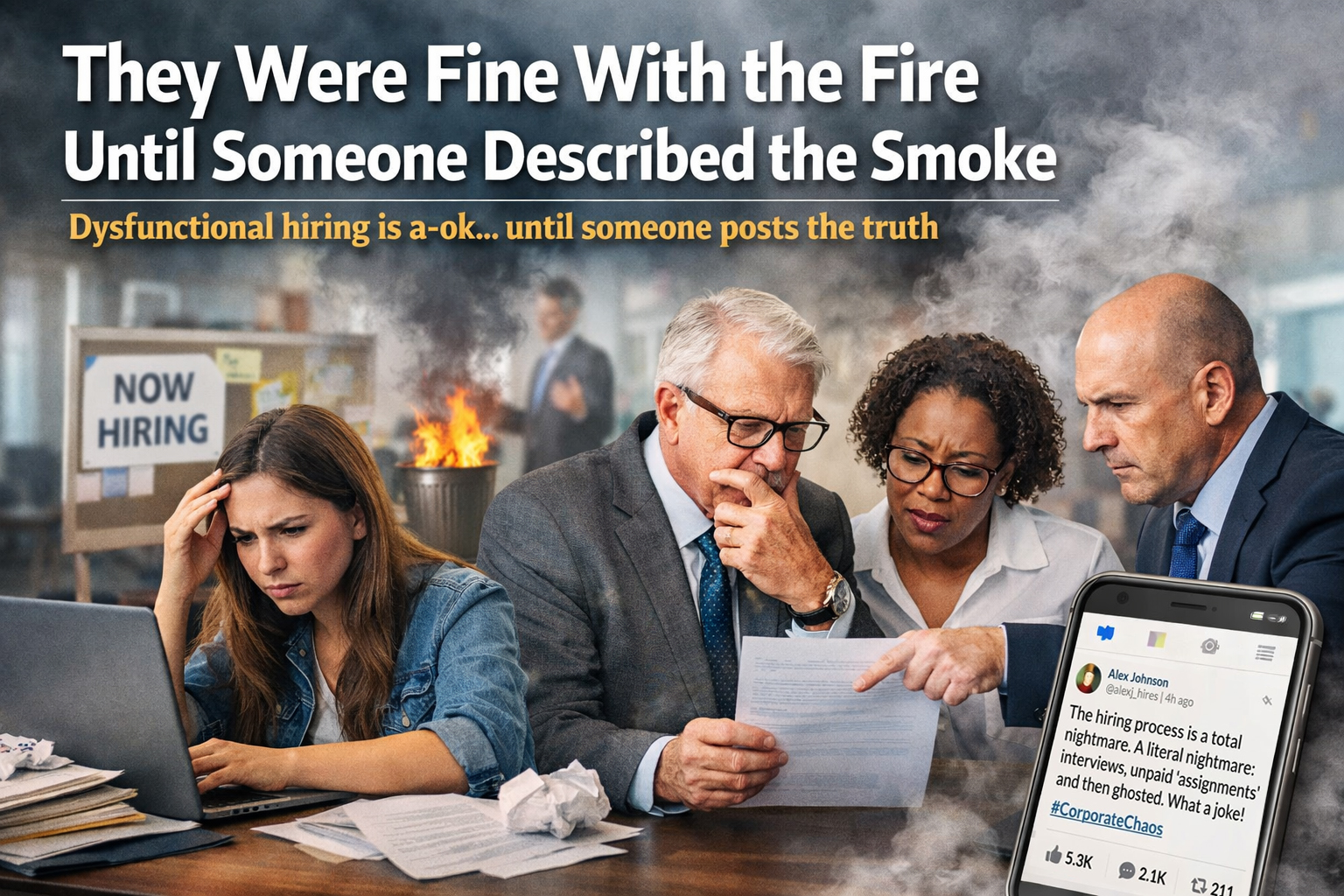
There is a very specific moment in modern corporate life when an organization that has ignored dysfunction with Olympic discipline suddenly rediscovers urgency, posture, and the English language, and that moment is not when candidates are being ghosted, not when hiring managers are asking for five interviews, two assessments, an unpaid project, and the blood oath of eternal enthusiasm for a role that pays in gratitude and cafeteria coupons, and not when applicants are being bounced through a hiring process designed like a medieval obstacle course by people who think “candidate experience” means making the rejection email slightly more decorative. No. The moment a company truly comes alive is when someone tells the truth about it in public and, far worse, does so in a way that other people recognize immediately.
That is when the inbox begins to twitch.
That is when the polished titles materialize like spirits summoned by embarrassment.
That is when a company that could not find thirty seconds to update a rejected candidate somehow finds an entire afternoon to write a message containing the phrases “concerned by the characterization,” “would welcome a private conversation,” and “feel this does not accurately reflect our values,” which is corporate poetry for, “We are less upset that this happened than we are that someone described it with rhythm.”
Because that is the thing corporations rarely admit out loud: dysfunction is manageable, cruelty is survivable, incompetence is recyclable, but accurate public description is intolerable. A broken process can limp for years. A miserable candidate experience can be normalized, templated, and transformed into a workflow. But the second someone captures it in a sentence that makes other people laugh, nod, and send it to three friends with, “This was literally my interview last week,” suddenly the institution starts behaving like a Victorian duke whose family scandal has been printed in the morning paper.
And I understand the panic.
Nothing terrifies the professional class like plain language with witnesses.
A bad hiring process can hide behind jargon. It can sit comfortably under terms like alignment, calibration, selectivity, rigor, stakeholder review, and culture fit, all of which sound wonderful until you realize they are often just decorative ribbons tied around confusion, delay, and the inability to make a decision without consulting seventeen people and a moon phase chart. But honesty strips the velvet off the machinery. Honesty points at the six-round interview for a coordinator role and says, “This is ridiculous.” Honesty looks at the unpaid project, the personality assessment, the panel interview, the executive interview, and the follow-up call that leads nowhere and says, “This is not thoughtful. This is panic wearing a blazer.”
And that is when the messages arrive.
Not to fix it, of course. Never to fix it.
To discuss it privately.
Which brings us to one of the great comic masterpieces of the modern workplace: the corporate instinct to treat public truth as the problem and private discomfort as the emergency.
The Strange and Beautiful Speed of Selective Outrage
One of the most fascinating performances in professional America is watching how slowly institutions move when actual people are struggling and how quickly they sprint when the narrative gets loose. It is like observing a zoo animal discover that the fence has developed opinions.
A candidate can be ignored for three weeks after a final interview and nobody in leadership experiences a muscular response. A recruiter can post a role requiring seven software systems, executive presence, startup agility, enterprise maturity, and the psychic ability to predict stakeholder mood swings, all for the compensation package of “competitive,” which in this economy usually means “technically money,” and no alarms go off in the executive suite. Applicants can be asked to build free strategy decks, produce mock campaigns, complete projects suspiciously similar to actual client deliverables, and then receive a note that says the company has “decided to move in another direction,” which is a lovely phrase because it implies there was once a direction, and still no one at the top feels compelled to intervene.
But let one person describe that process accurately online.
Now suddenly everyone is hydrated, available, and deeply committed to nuance.
Now the people who could not coordinate a hiring timeline can organize concern with military precision. Now the company that once needed twelve business days to locate feedback can draft a five-paragraph email in under an hour explaining that your post paints an incomplete picture. Incomplete is one of my favorite corporate adjectives because it usually means, “Yes, that happened, but we would prefer if it sounded more accidental.”
The truth is that most organizations do not reserve their strongest response for the greatest harm. They reserve it for the greatest visibility. Harm can be absorbed quietly. Harm can be filed away, rationalized, routed through process, buried under language, and eventually recategorized as a learning opportunity. Visibility is different. Visibility threatens the story. Visibility invites comparison. Visibility creates the horrifying possibility that dozens, hundreds, or thousands of people might realize they are not individually unlucky but collectively being processed through the same carnival ride operated by adults with matching lanyards and no brakes.
And that is when selective outrage bursts through the conference room wall like a motivational speaker covered in legal disclaimers.
The funniest part is how often this outrage arrives dressed as professionalism. Nobody ever writes and says, “Please stop exposing the nonsense.” That would be refreshingly honest and, therefore, completely off-brand. Instead, the message arrives in silk gloves. They are “disappointed.” They are “surprised.” They are “hopeful for a constructive dialogue.” They “would appreciate additional context.” Which is marvelous, because companies that showed no appetite whatsoever for context when rejecting a candidate after five interviews become scholars of nuance the moment their own reputation feels a draft.
It is not that they hate unfairness. It is that unfairness, until publicly narrated, remains an internal decorative feature.
They do not hate dishonesty. They hate unauthorized honesty.
Important Titles and the High Church of Brand Protection
There is an entire species of professional whose natural habitat is not problem solving but atmospheric control. These are the people who emerge whenever embarrassment breaches containment. You know them by the elegance of their titles and the fragility of their tone. Senior Director of People Strategy. Vice President of Employer Narrative. Head of Talent Experience and Reputation Architecture. Titles so ornate they sound less like jobs and more like side quests in a fantasy novel.
Their purpose is rarely to ask, “Did this happen, and if so, why are people experiencing us this way?” Their purpose is to stand between the institution and the consequences of being described too plainly.
They are not mechanics. They are museum curators for a collapsing exhibit.
And I do not say that without admiration, because there is something almost athletic about the way these people can witness a story about candidate mistreatment and focus with laser intensity on the tone in which it was reported. A person can write, “I was ghosted after six rounds, asked to do unpaid work, then rejected by an automated email that called me impressive,” and somewhere in a glass office a brand custodian will adjust their eyewear and say, “Our concern is that this framing may not fully reflect our values.”
Your values.
A phrase that has rescued more nonsense than airport neck pillows.
Every company has values. They are usually framed in a lobby, printed on a website, or carved into a slide deck with the seriousness of ancient scripture. Integrity. Respect. Transparency. Courage. Collaboration. Meanwhile the actual hiring process has the emotional texture of being evaluated by a vending machine. The values are the stained-glass windows of corporate religion: lovely in the light, largely uninvolved in the plumbing.
So when someone with an Important Title reaches out, what they are usually protecting is not truth, fairness, or reform. They are protecting the staging. They are making sure the curtains remain closed while the set catches fire. They do not want to discuss the wiring. They want to know why the audience can smell smoke.
And this is where corporate language becomes a kind of interpretive dance. Notice how the messages are never direct. They do not say, “Your description is uncomfortably accurate and several people on our leadership team sent it around with the expression one makes when discovering their own home on Zillow.” Instead they say they are interested in “aligning on concerns.” Aligning is one of those words that means absolutely nothing and therefore travels beautifully through executive email. It is the verbal equivalent of expensive wallpaper: elegant, unobjectionable, and hiding structural damage.
What these messages always reveal, despite their efforts, is recognition. Nobody rushes to correct a story that does not resemble them. Nobody experiences brand distress over satire that misses the mark. The angry private email is one of the sincerest forms of corporate self-identification ever invented. It is the organizational version of hearing a joke about terrible drivers and immediately shouting, “That is offensive to me specifically.”
And that is why these notes are not intimidating. They are evidence. Evidence that the truth did not float harmlessly over the building but struck the glass directly. Evidence that somebody in authority saw the description and experienced the rare and humbling sensation of being unable to hide behind a mission statement. Evidence that satire, when accurate enough, becomes a mirror, and people who have spent years arranging the lighting do not always enjoy their first look in daylight.
They Would Rather Silence the Witness Than Repair the Machine
The saddest joke in all of this is that fixing the underlying problem is usually less complicated than the performance required to avoid fixing it.
Most candidates are not asking for miracles. They are not demanding a parade, a trust fund, and a handwritten sonnet from the hiring committee. They want the basics. Honest job descriptions. Timely communication. Interviews that are proportional to the role. Respect for their labor. Feedback when possible. A process that does not feel like a fraternity hazing ritual designed by spreadsheet enthusiasts. These are not revolutionary demands. This is entry-level decency with a calendar invite.
But decency is operational. Decency requires ownership. Decency needs someone to say, “This process is absurd, we are wasting people’s time, and from now on we are going to conduct ourselves like adults.” That kind of sentence is expensive because it requires leaders to inconvenience themselves. It requires them to edit expectations, reduce vanity rounds, empower recruiters, train managers, reject free-work fishing expeditions, and accept that not every hiring decision needs the ceremonial blessing of a regional oracle and three vice presidents who wandered in from unrelated departments.
Silencing a witness, however, is emotionally cheaper.
It is far easier to write a wounded email than to redesign a broken process. Easier to mention brand impact than to admit operational failure. Easier to ask for privacy than to earn trust. Easier to treat the description as the offense than to confront the conduct being described. This is why so many institutions become fierce only when the truth acquires an audience. They are not built for accountability nearly as much as they are built for containment.
That is the heartbreak under the humor.
Behind every absurd hiring story is usually a real person who needed that job. Someone with rent due, children to support, health insurance to keep, confidence already bruised by a market that treats human beings like raffle entries. The candidate is not experiencing the hiring maze as content. They are living inside it. They are doing their best to remain upbeat while being filtered through systems that confuse exhaustion with selectivity. And while all of that is happening, the machine keeps spinning because enough people inside it are paid to protect its appearance rather than challenge its appetite.
So when one honest post makes the important people nervous, that nervousness says more than any official statement ever could. It tells you they know the gap between the brochure and the experience. It tells you the institution is not confused by the criticism, only inconvenienced by its visibility. It tells you the truth did not feel unfair to them. It felt familiar.
That is why public honesty matters so much.
Not because one post changes everything overnight. It does not. Corporate dysfunction is a sturdy weed. But each honest account chips away at the mythology that candidates are isolated complainers, that bad experiences are rare misunderstandings, that every ridiculous process is an unfortunate one-off. Every truthful description lights up the pattern. Every witness makes the machine a little less magical. Every joke about the absurdity pulls a little more oxygen away from the gaslighting.
And that is the point where the institution, having ignored every quieter signal, finally jolts awake and says, “We should talk.”
Of course you should.
You had your chance to talk when people were asking for fairness.
Final Thoughts
In the end, the flood of Important People into your inbox is not a warning. It is a confession in business casual.
It means the truth traveled farther than the talking points.
It means someone recognized their own company in the description before the logo ever arrived.
It means that after years of tolerating confusion, delay, arrogance, performative selectivity, and all the little indignities of a hiring culture that too often mistakes cruelty for rigor, what finally commanded attention was not the suffering itself but the possibility that suffering might become legible.
That is bleak. It is also hilarious in the way only corporate behavior can be: a giant machine perfectly comfortable chewing through human energy until someone stands outside and accurately narrates the sound.
So no, I am not especially rattled when the polished titles start reaching out with their professionally moisturized concern and their urgent desire to “connect offline.” I take it as confirmation. I take it as the organizational equivalent of hearing footsteps upstairs after you mentioned the haunting out loud.
Because companies can ignore broken systems for years.
But embarrassment enters the room, and suddenly everyone is free Tuesday at two.