
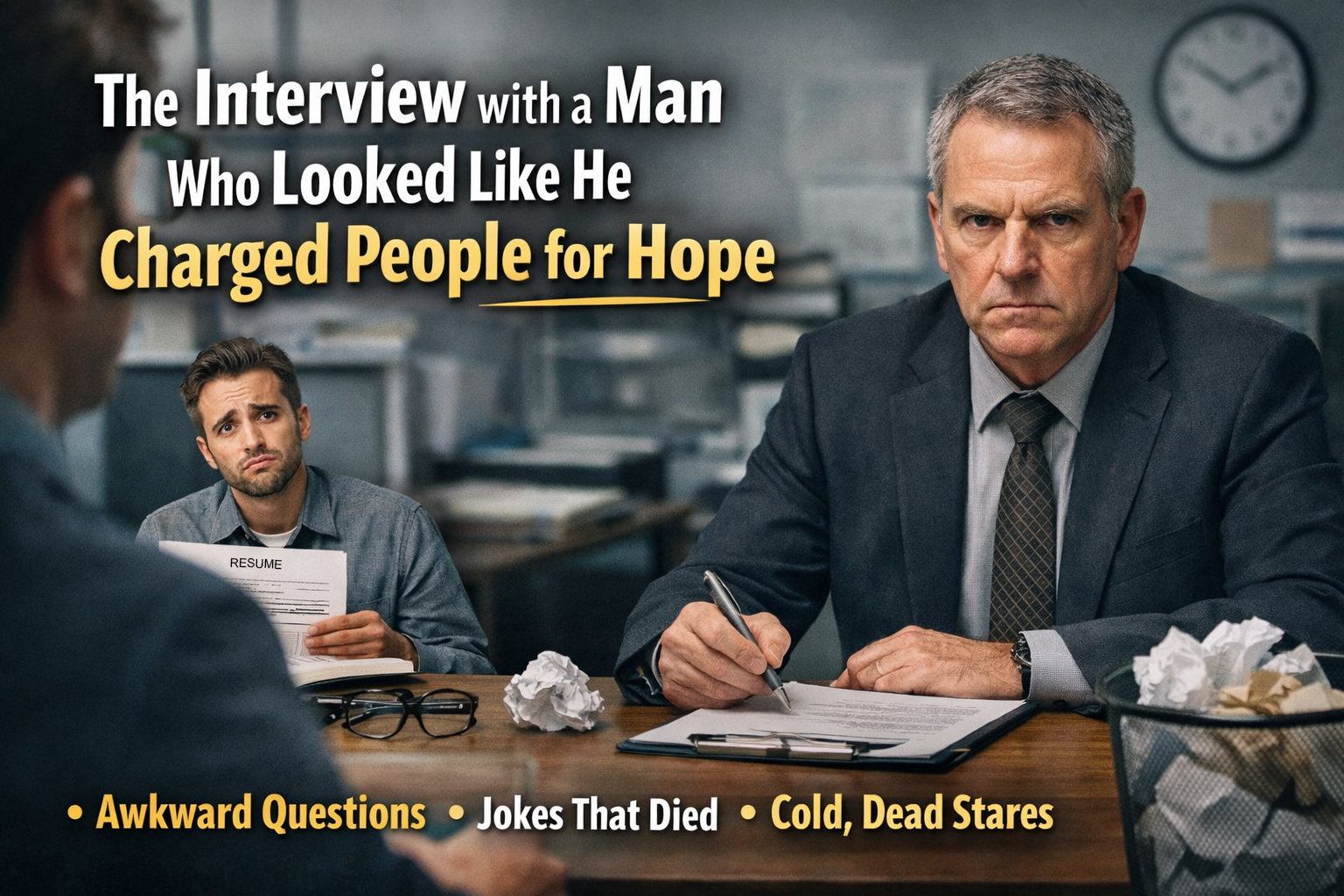
There are bad interviews, there are awkward interviews, and then there are interviews so spiritually hostile they feel less like professional conversations and more like a surprise visit to a government basement where somebody stamps your personality “pending review” and slides it back under the glass without eye contact. Most job seekers have experienced this species of corporate encounter at least once: the interview where you arrive with your resume polished, your stories rehearsed, your face arranged into what you hope is “confident but approachable,” and then you sit down across from a hiring manager whose expression suggests that delight, humor, and even the concept of breathable air were all cut from the budget during the last restructuring.
It is a deeply specific kind of suffering, because interviews already ask you to do something profoundly unnatural. They ask you to enter a room and perform the most flattering, coherent, well-moisturized version of yourself while pretending this is a normal human interaction and not a highly choreographed pageant where one person asks, “What is your greatest weakness?” and the other person must somehow answer without saying, “At the moment, reading the emotional climate in this room.” You are expected to be warm but not too warm, polished but not robotic, funny but not distracting, ambitious but not threatening, and above all capable of pretending that this process does not occasionally resemble speed dating arranged by a tax consultancy.
And every now and then, the universe introduces a hiring manager who seems personally committed to making the entire ritual feel like a hostage video with parking validation. Not openly rude. That would almost be refreshing. Not chaotic. Chaos at least has movement. No, these people bring something much darker to the table: stillness. A chilling, administrative stillness. The kind of stillness usually associated with museum security guards, expensive reptiles, and men who begin sentences with “per my last email” before sunrise.
I met one of those men a while back, and from the second the interview began, I knew I was not speaking to a person so much as a tax-season gargoyle in business casual. He had the facial warmth of a courthouse vending machine, the emotional availability of a padlocked filing cabinet, and the kind of silence that made every answer feel less like a response and more like testimony. The entire experience lodged itself in my brain because it was so spectacularly joyless that it crossed over from uncomfortable into performance art. By the end, I was no longer trying to get hired. I was simply trying to confirm whether the man had ever once, in the history of his adult life, laughed at anything that was not an accounting error later corrected in his favor.
This article is for everyone who has ever walked into an interview hopeful and walked out feeling like they had just done community theater in front of an unplugged fax machine. It is for everyone who has tried a polite joke to break the tension and watched it die on impact like a bird flying into a mirrored office park. It is for every candidate who realized, halfway through a perfectly reasonable answer, that they were speaking to someone whose face had not only filed a complaint against joy, but had apparently hired outside counsel.
Because if we are going to survive modern hiring, we must at least document the wildlife.
First Contact With the Human Paperweight
The first few seconds of an interview tell you almost everything, in the same way the first few seconds of a plane ride tell you whether you are going to have a peaceful trip or spend two hours trapped beside a man eating tuna salad like it is an act of revenge. There is a rhythm to human warmth. A nod. A smile. A handshake with a pulse in it. Some small visual confirmation that the person across from you understands that this is not merely a transaction between two LinkedIn profiles, but a conversation involving actual mammals.
This man bypassed all of that.
He entered the room with the energy of someone arriving to verify flood damage. No smile, no softening around the eyes, no moment of transition from professional seriousness into basic human acknowledgment. Just a flat, expressionless stare that suggested he had been informed shortly before my arrival that fun was once again attempting to breach the perimeter. If a granite bust of an 1840s railroad tycoon had been granted temporary middle-management authority, it would have had more sparkle.
And that is the thing about certain hiring managers: they do not simply fail to create warmth. They actively vacuum it out of the space. You walk in with confidence and leave wondering whether you have done something morally wrong by possessing eyebrows capable of movement. The fluorescent lights feel harsher. The chair suddenly seems accusatory. Your portfolio starts to feel less like a useful professional asset and more like a folder of personal confessions.
I sat down and immediately understood that this was not going to be a conversation. This was going to be an evaluation conducted by a man whose soul had been outsourced. He looked at me with the expression of someone who had just been told his lunch would be delayed because a candidate had the audacity to exist at 2:00 p.m. on his calendar. Not rage. Not annoyance. Something more refined. The kind of low, bureaucratic displeasure that says, “I would never make a scene, but I do want history to record that I objected to your presence.”
Naturally, because the human brain is a prankster with no respect for self-preservation, mine decided this was the perfect setting for charm.
Not excessive charm. Not stand-up comedy. Just a small, tasteful joke. A harmless, professional little remark designed to establish that I was capable, personable, and aware that interviews are strange social theater. The kind of joke normal people receive with a smile, a small chuckle, or at minimum that gracious half-laugh people do in professional settings where everyone is pretending not to be exhausted.
He gave me nothing.
Not even a courtesy puff of air through the nose. Not a smirk. Not an eyebrow trying its best. My joke landed in the room and died there, alone and unclaimed, like luggage at a regional airport. He received it the way a courthouse receives a leaf. Without interest. Without movement. Possibly with paperwork.
The silence that followed was not ordinary silence. Ordinary silence can still belong to humans. This was premium silence. Executive silence. Silence with an expense account. The kind of silence that arrives fully dressed and sits at the head of the table. I could hear the air conditioning judging me. Somewhere deep in my DNA, my ancestors lit a warning fire and begged me to abandon humor forever.
But because interviews are bizarre endurance rituals invented by people who think “Tell me about yourself” is a normal opening line, I continued.
That is the cruel elegance of this kind of encounter. You cannot respond honestly. You cannot say, “Sir, your face currently looks like it was designed by a committee opposed to festivals.” You must keep going. You must answer questions. You must enthusiastically discuss stakeholder alignment while your spirit slowly backs away from your body and applies for remote work elsewhere.
And all the while, some part of your brain starts narrating the scene like a nature documentary.
Here we observe the mid-career candidate in a hostile environment. Note the fixed smile. Note the careful eye contact. Note the increasingly elaborate examples of leadership under pressure, all delivered in hopes of provoking a sign of life from the senior male across the table. The creature remains motionless. This may continue for hours.
By minute twelve, I was no longer interviewing for a role. I was trying to solve a mystery. Had this man ever enjoyed anything? Had he once, in college perhaps, laughed at a sitcom and then sworn never to let it happen again? Did he come home after work and unwind by alphabetizing tax forms? Was there a family somewhere accustomed to seeing him stare at birthday cake like it had submitted an inappropriate request?
I do not know. But I do know that by the time he asked his second question, I had already begun grieving the version of myself who entered that room believing personality might be an asset.
The Joke That Hit the Floor and Died Between the Chairs
There is no loneliness in corporate life quite like the loneliness of making a perfectly decent joke in an interview and watching it bounce off a hiring manager’s face like a Nerf ball thrown at a mausoleum. It is one of the purest forms of social humiliation because it is so clean, so immediate, so free of ambiguity. A joke either creates a tiny bridge between two people, or it lies there twitching while everybody pretends a bridge was never proposed.
Mine died instantly.
And the worst part is that when a joke fails in normal life, there are escape routes. Friends can rescue you. A lively room can absorb the damage. At a party, someone else can jump in, redirect the energy, or say, “That was terrible,” with enough warmth to make failure communal and therefore survivable. But in an interview, there are no emotional paramedics. There is no crowd. There is only you, your own voice, and the face of a man who seems to regard wit as a compliance issue.
So after my little opening joke collapsed face-first onto the carpet, I had two options. I could retreat into total sterile professionalism and become a beige speaking appliance, or I could continue being a person and accept that this man might treat every ounce of humanity I offered like an unapproved attachment. I chose the second option, mainly because by then I was too stunned to reinvent myself.
That is when the surreal quality of the interview really set in. Because once you have failed to make a statue laugh, every subsequent moment becomes absurdly high stakes. Every sentence feels loaded. Every attempt at natural cadence feels dangerous. You start editing yourself in real time. Too upbeat? He will hate that. Too serious? Now I sound like him. Too detailed? I am rambling. Too concise? I seem evasive. Somewhere between answering a question about cross-functional collaboration and describing a challenge I overcame, I became hyperaware of every muscle in my face, as if smiling too broadly in front of this man might count as insubordination.
And the questions always get funnier when delivered by someone who sounds like they are reading ingredient labels at a deposition.
“What motivates you?”
It is such an innocent question in theory, but coming from him it sounded less like curiosity and more like an accusation. What motivates you. As if he had recently discovered motivation itself in the office and was trying to determine who had brought it in without authorization. I wanted to answer honestly. Food. Shelter. The satisfaction of meaningful work. The dream of one day spending fewer afternoons in rooms like this. Instead I reached for the usual elegant language about impact, growth, and solving complex problems, while he watched me with the expression of a man reviewing evidence.
“Tell me about a challenge you overcame.”
Again, in a better room, this is a normal question. In that room it became slapstick. Because the challenge I was currently overcoming was the interview itself. I was actively managing composure in front of someone whose entire presence felt like a customer satisfaction survey gone sentient. I wanted to say, “Well, moments ago I watched a harmless joke die in front of me and still found the strength to continue discussing leadership frameworks, so I would say resilience remains one of my core competencies.”
Instead, I told a polished story about navigating change, aligning teams, and driving results under pressure. The pressure, notably, was now live and seated three feet away.
That is another cruelty of joyless interviewers: they make your best material sound suspicious. You can have an excellent answer, a sharp example, a thoughtful takeaway, and somehow their face will make you question whether you have accidentally confessed to embezzlement. Every story starts to feel too long. Every achievement sounds braggy. Every pause feels incriminating. It is like trying to perform a monologue for a man whose primary hobby is denying permits.
At one point I caught myself trying extra hard to seem likable, which is a dangerous instinct because it quickly leads to over-correction. Suddenly your laugh is too eager. Your transitions are too polished. Your level of eye contact could qualify as a hostage signal. You are no longer naturally demonstrating fit; you are pitching your own humanity like a startup with poor cash flow.
And all the while, he remained still. Chillingly, impressively still. No visible reaction to humor, sincerity, or evidence of competence. If I had announced, halfway through the interview, that I once saved a school bus from rolling into a lake using only strategic planning and upper-body strength, I suspect he would have written “team player” in his notes and moved on.
By the midpoint, I was no longer sure whether I wanted the job or simply wanted closure. I wanted him to give me one sign, just one, that the conversation existed in the same universe for both of us. Blink warmly. Mispronounce a word and smile about it. Drop the mask for half a second and reveal a hobby. Anything. Show me that somewhere beneath that tax-audit expression lived a man who had once seen a dog in a raincoat and felt something.
Nothing.
It was extraordinary. Not in the good sense. In the sense that rare weather events are extraordinary. You do not enjoy them, but you cannot deny the scale.
By the end of that section of the interview, I felt like I had attempted stand-up comedy inside a mausoleum, followed by a TED Talk on my qualifications, followed by a hostage negotiation in which I was both the negotiator and the hostage. I had become deeply aware that the modern job interview is sometimes not an assessment of skill but a stress test designed by people who confuse emotional frostbite with professionalism.
And yet candidates are the ones later described as “not engaging enough,” which is remarkable when you consider how often we are expected to bring sparkle into rooms lit entirely by managerial grief.
When the Candidate Must Generate All the Oxygen in the Room
One of the least discussed absurdities in the hiring process is the way candidates are expected to carry the entire emotional burden of the meeting while also being evaluated for composure, authenticity, and executive presence. You are meant to be the one who energizes the room, keeps the conversation moving, projects confidence, demonstrates curiosity, asks thoughtful questions, and somehow radiates enthusiasm even when seated across from a man who looks like he sends calendar invites as punishment.
The candidate must generate all the oxygen.
That was the sensation by the back half of this interview. I felt like a one-person life support system attached to a meeting that had flatlined emotionally before I arrived. Every answer I gave had to do two jobs: prove I was qualified and compensate for the fact that the hiring manager appeared to have outsourced all facial movement to a third-party vendor. I was not simply discussing my experience. I was trying to keep morale alive in a room where morale had clearly submitted its resignation.
And there is something uniquely insulting about that dynamic because later, somewhere behind closed doors, those same people often describe candidates with language that would be hilarious if it were not so common. Did not seem enthusiastic enough. Did not connect strongly. Felt a little flat. Lacked energy. Sir, with respect, the room had the emotional climate of a storage unit. I brought enough energy for two people, a ficus, and a medium-sized team retreat. At some point this becomes less an interview and more a public utility issue.
As the meeting dragged on, I started studying him the way historians study ruins. I became fascinated by the engineering. How does a person maintain that level of unreadability for an entire hour? That is not ordinary stoicism. That is elite training. That is a level of emotional opacity usually achieved only by luxury watch salesmen and men testifying before Congress. There were moments when I genuinely wondered whether smiling was prohibited by company policy, perhaps buried somewhere in the employee handbook between dress code and expense reimbursement.
Managers are prohibited from displaying visible delight during candidate interactions, as this may create false hope, distort compensation expectations, or result in accidental rapport.
Because that is what made the whole experience feel theatrical. The contrast. I was there, trying to strike the appropriate balance between qualified and personable, while he sat there with the facial ambience of a courtroom sketch. He asked questions about collaboration as if human chemistry were a rumor. He asked about leadership while embodying the interpersonal charm of a malfunctioning badge scanner. It was like being interviewed about hospitality by a drawbridge.
And of course, toward the end of these interviews comes the inevitable question: “Do you have any questions for me?”
It is one of the great traps of corporate civilization because the candidate must now perform curiosity toward a man who has spent the last forty-five minutes acting like joy once keyed his car. You cannot say what you want to say.
Yes, actually. I have several questions. Have you always looked like this, or was there a specific merger that did this to you? Are employees here allowed to laugh privately, or does legal need to be present? When new hires join, do you welcome them, or just hand them a badge and let the atmosphere do the orientation?
Instead, I asked intelligent things about team priorities, success in the role, and current challenges facing the department, because I am a professional and because the human instinct to survive humiliation is stronger than most religions.
His answers were technically fine, which almost made it funnier. Because that is another twist in these encounters: the hiring manager is not always objectively bad. Sometimes they are competent, informed, even reasonably clear. But the delivery is so devoid of human warmth that the whole interaction feels like being briefed on your own replacement by a glacier. You leave with useful information and minor soul damage.
When it was finally over, I stood, thanked him, and walked out with the strange, dissociative calm of someone leaving a room where nothing illegal happened but something definitely took place. I had not bombed. I had not embarrassed myself beyond the manageable levels already required by interviews. I had answered thoughtfully, kept my composure, and even survived the death of an opening joke without visibly folding into a decorative napkin.
But I also had the unmistakable feeling of having done a guest set at a funeral home.
That is the phrase that stayed with me, because it captures the exact imbalance of it. I had arrived ready for dialogue and wound up performing liveliness in a room committed to grief. My qualifications may or may not have been the issue. My answers may or may not have landed. But I knew one thing with clarity: if I did not get the job, I would almost certainly be told I lacked some mysterious spark. And that remains one of my favorite hypocrisies in modern hiring, the idea that candidates must radiate charisma on demand while certain interviewers are allowed to sit there like expired toner given managerial authority.
Somewhere out there, that man is probably still interviewing people. Still sitting in a conference room with the expression of an unsent invoice. Still listening to candidates describe their strengths while his face remains locked in tax season. Still making ambitious, qualified adults wonder whether they have accidentally committed a social crime by trying to be personable before 3:00 p.m.
And afterward, I imagine he sends feedback to HR in phrases like “solid background, but didn’t quite connect,” which is breathtaking, really, coming from a man whose bedside manner suggested he had recently been divorced by sunlight.
Final Thoughts
I think about that interview sometimes because it represents something bigger than one joyless man in one conference room. It captures the peculiar insanity of a hiring culture that demands emotional intelligence from candidates while excusing emotional frostbite from the people evaluating them. We tell job seekers to bring authenticity, personality, confidence, energy, and warmth, then sit them across from people who behave like smiling would compromise internal controls.
And candidates still try. That is the miracle. We still show up. We still rehearse. We still steam the shirt, print the resume, calm the nerves, and enter these rooms hoping, despite all available evidence, to meet someone interested in a genuine exchange. We still toss out the occasional polite joke like diplomats trying to establish relations with a country made entirely of laminated policy documents.
Sometimes it works. Sometimes you meet thoughtful, warm, emotionally literate people who understand that interviewing is already stressful and do their best not to make it feel like a parole hearing. But other times you meet a man with the facial warmth of a courthouse vending machine, and all you can do is survive the weather, leave with dignity, and later turn the whole experience into literature so the rest of us feel less alone.
Because if nothing else, these interviews give us stories.
And frankly, if a hiring manager can sit through an entire conversation looking like he was assembled from expired toner, unresolved resentment, and a lifetime ban from delight, the least the rest of us can do is document the event like witnesses to a rare and hostile climate pattern.