If you ever want to understand modern hiring, don’t study labor economics. Just open LinkedIn, take a deep breath like you’re about to walk into a performance review with no agenda attached, and watch a single job post refuse to die in real time.
It’s not “reposted.” It’s resurrected.
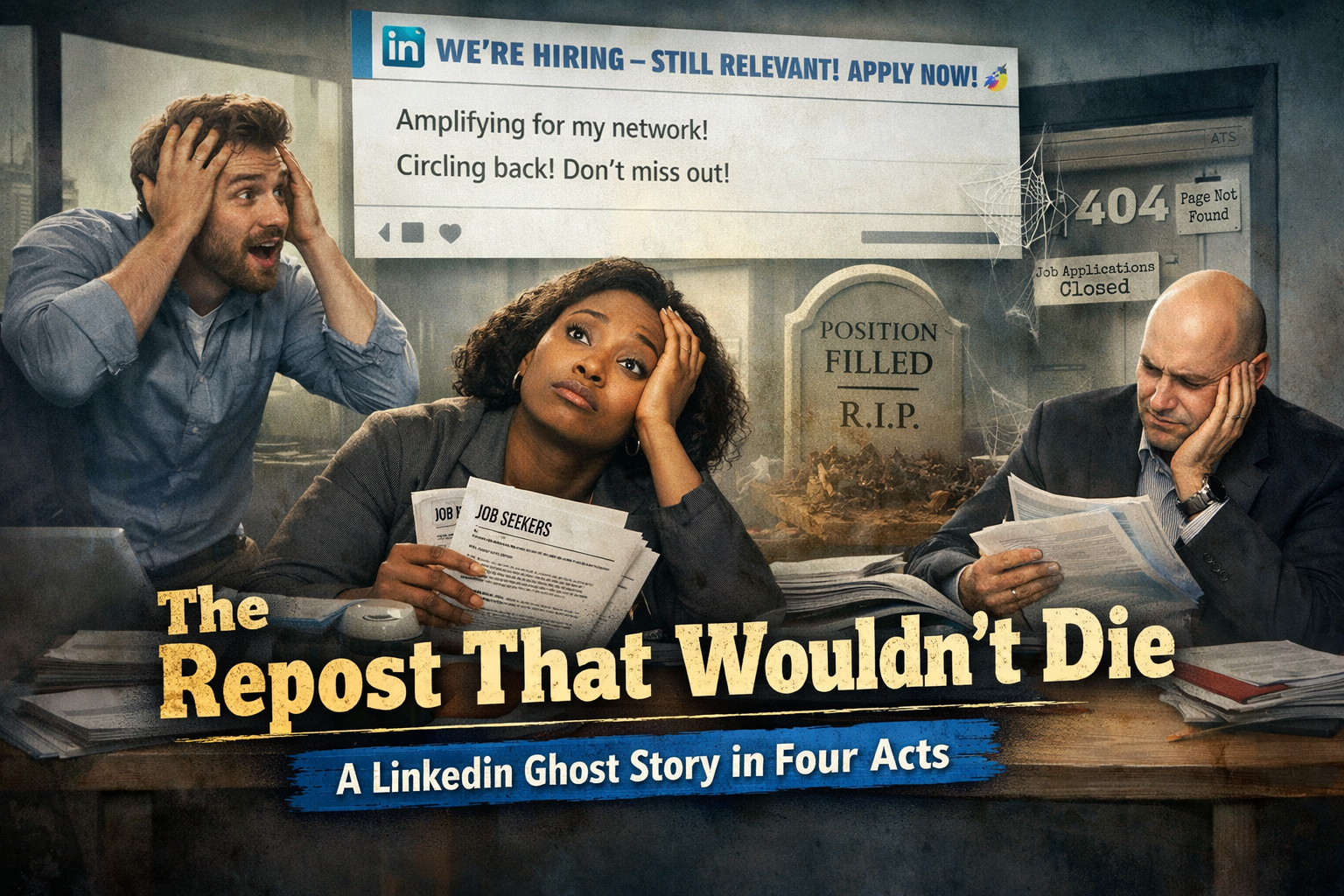
The same “We’re hiring!” graphic returns every morning wearing a fresh little caption like it just got out of witness protection: “Bumping for visibility.” “Still looking!” “Amplifying for my network.” “Circling back.” “Re-sharing because this is an incredible opportunity.” At this point, the post has been revived so many times it should come with a punch card. Ten reposts and you get a free emotional breakdown.
And the wild part is the confidence. The post floats back into your feed like it pays rent there, perched between someone announcing their “new journey” (same job, different company-branded mug) and someone else warning you that “quiet quitting” is when employees stop doing unpaid labor with a smile. The job post is always urgent. Always “Apply now.” Always “hiring immediately.” Meanwhile the actual listing is either closed, broken, paused, “evergreen,” or trapped behind an ATS portal that looks like it was coded on a fax machine by someone who hates fonts and joy.
You click because you are a hopeful adult who has bills and a brain that still believes in cause-and-effect. You land on a page that says: This role is no longer available. And you just stare at it, blinking, like you’ve been pranked by a toaster.
Then comes the tone. The tone is what makes it art.
Every resurrection is framed like community service. Like the reposter is out here in a reflective vest directing traffic for the unemployed. “We care about job seekers.” “Helping great talent find great companies.” “Sharing for my network.” And you want to say, politely, with the gentle calm of someone gripping a steering wheel in a parking lot: if you care about job seekers, could you possibly care in a way that includes accuracy?
Because right now, the post updates more than the job status. The company page is silent. The hiring manager has moved on to a new personality. And yet a stranger with “People Connector” in their headline is out here doing CPR on a requisition that died three quarters ago, whispering, “Come on, buddy,” and pounding on the chest of a role that has already been memorialized.
This is not recruiting anymore. This is engagement farming with a side of hope. This is a loop. A ritual. A modern parable about the human need to believe the “Apply” button still leads somewhere.
So yes. Let’s talk about it. Let’s make it funny, because if we don’t, we will start replying to job posts like they’re sentient beings and demanding they show us their birth certificate.
The Undead Requisition and the People Connector Who Raised It
Somewhere in an office, a job requisition is created. It is given a number. A title. A pay range that may or may not exist in the physical world. It is introduced to the ATS, which immediately begins chewing on it like a goat eating a sweater. The requisition is posted. HR declares victory. Everyone claps. A calendar invite is sent for a “Hiring Sync” that will be rescheduled nine times until it expires naturally like fruit in a break room.
And then something happens that no one is prepared to admit out loud: the role stops being real.
It is filled internally. It is paused for budget. The hiring manager gets distracted by a new org chart. The company decides to “rethink the structure.” The department is merged with another department for reasons that sound strategic but feel like astrology. The role becomes theoretical. Conceptual. A job posting in the same way a cartoon anvil is an anvil: it exists until you look directly at it.
But LinkedIn does not care about reality. LinkedIn cares about motion.
So the post lives on.
Not because the job is open, but because the algorithm has needs, and the algorithm is always hungry. And into this hunger steps the LinkedIn Hero: the People Connector. The Talent Whisperer. The Networking Enthusiast. The person who has never met a closed role they didn’t think could benefit from “one more share.”
They post it again with that unmistakable tone of forced optimism that feels like a motivational quote taped to a broken vending machine: “Sharing this amazing opportunity again—please apply!”
Apply where? To what? To whom? Into the void?
They tag three people they haven’t spoken to since 2018. They add a rocket emoji like the role is about to launch instead of quietly rot. Comments flood in. “Interested!” “Following!” “DM sent!” People throw their resumes into the air like confetti at a parade, and the post absorbs them like a black hole with an “Apply Now” button.
Meanwhile, the actual experience on the other side of the link is an obstacle course designed by someone who considers the phrase “candidate experience” to be decorative. You click. You are asked to create an account. You create an account you already created two months ago. The system says your password is wrong. You reset it. It tells you the new password is the same as your old password. You try a new one. It says it must include a symbol, a number, an uppercase letter, a lowercase letter, the blood of a unicorn, and a memorable childhood regret.
You finally get in. You upload your resume. The ATS immediately asks you to retype the resume. You comply because rent is a powerful motivator. Then it asks you: “Do you have experience with X?” Yes. It’s on the resume. It asks: “Describe your experience with X.” It’s on the resume. It asks: “Why do you want to work here?” Because I have to eat.
You hit submit like you’re dropping a message in the ocean. And somewhere in the distance, the LinkedIn post floats back to the surface again, gleaming, refreshed, and very proud of itself.
The Repost Economy and the Business Model of Other People’s Hope
Let’s just say the quiet part out loud: there is an entire micro-economy built on the illusion of access.
The repost isn’t always malicious. Sometimes it’s just ignorance mixed with ambition. A recruiter trying to look active. A coordinator trying to look helpful. An employee trying to look like they’re “building community.” A person trying to brand themselves as the kind of professional who connects talent with opportunity, as if talent is a cable and opportunity is a port and they’re the adapter.
But the outcome is the same: the loop continues.
A thousand people hit Like because liking is easier than facing the terrifying truth that the job might not exist. A hundred people comment “Interested” because commenting feels like action. The algorithm throws confetti because engagement has occurred. Everyone feels productive. Nothing has changed.
And then you, the person who actually needs a job, become raw material. Your attention becomes fuel. Your resume becomes inventory. Your “Interested!” comment becomes content. Your hope becomes a metric. Somewhere, someone is reporting on it in a weekly meeting like it’s a victory: “Strong engagement on our hiring post this week.”
But engagement is not employment.
And the cruelest part is how it weaponizes politeness. Because you can’t scream into the comments like a normal human without being branded “not professional.” You can’t write, “This link is dead and so is my patience,” because the culture has decided job seekers must suffer quietly, like it’s a character-building exercise.
So you do the dance. You apply again. You send the polite DM. You attach the resume you already attached. You write the same gentle note: “Hi! I’m very interested in the role!” You are always “very interested,” even if the role is actively gaslighting you, because you have learned that you must be upbeat while being ignored. Like a golden retriever waiting by the door for an owner who moved out three weeks ago.
And then, weeks later, the rejection arrives.
It arrives with the serene confidence of a company that has never experienced consequences. “We went with someone whose experience more closely aligns.”
Aligns with what, exactly?
The invisible requirements? Telepathy? The sacred advantage of already working there? The internal candidate who was selected before the posting went live? The hiring manager’s sudden desire for “someone more junior,” which is just a polite way of saying “cheaper”?
“More closely aligns” is corporate incense. It’s burned to cleanse the room of accountability.
Meanwhile, that same job post is still floating around LinkedIn like a haunted lighthouse, calling people toward rocks. “Apply now!” it whispers, while dozens of applicants drift by in little lifeboats made of resumes and optimism.
How to Stop Haunting Job Seekers Like a Corporate Poltergeist
The fix is not complicated. What’s complicated is the willingness to do it.
Because this isn’t a technology problem. This is a discipline problem.
If the role is closed, paused, filled, or “evergreen” in the way a seasonal candle is evergreen, take the post down. Not “we’ll leave it up just in case.” Not “we’ll keep it for pipeline.” Not “it’s good branding.” Take it down.
Job seekers are not scrolling for nostalgia content. We are not here to admire the aesthetic of your hiring graphic. We are here because we have rent, benefits, and nervous systems that are already being stretched like taffy.
Don’t leave a closed job up like a bowl of candy that’s actually full of business cards and disappointment.
And for the “Just DM me your resume” crowd: please stop collecting PDFs like you’re building a museum of human desperation.
Your inbox is not a hiring process. It’s a drawer. It’s a landfill. It’s a place where good intentions go to disappear under 900 other messages titled “Quick question” and “Following up.”
If you want to help, do the boring, unsexy work that actually changes outcomes:
Make sure the link works. Make sure the status is accurate. Make sure the posting date is real. Make sure the salary range isn’t a riddle. Make sure applicants aren’t required to create an account just to be rejected by a robot.
And if you must repost, add the only line that matters: “This is still open as of today.” Not “still relevant.” Not “bumping.” Not “sharing again.” Put a date on it like you respect the concept of time.
Because right now, job hunting is already an endurance sport. It’s already a game show where the prize is “a chance to do another round.” Adding undead job posts to the mix is like putting a fake exit sign in a burning building.
It’s unnecessary. It’s avoidable. And it’s quietly cruel.
Final Thoughts: Close the Loop, Not the Comments
We’ve normalized a hiring culture where job posts behave like folklore: they’re passed around, embellished, re-shared, and believed, even when nobody can confirm they’re real.
And the cost isn’t abstract. The cost is hours. It’s confidence. It’s mental health. It’s the slow erosion that happens when you keep doing the right thing—applying, following instructions, staying polite, “tailoring your resume,” “networking”—and the system responds with silence so consistent it starts to feel personal.
Meanwhile, the post keeps living.
It keeps collecting likes from people who aren’t hiring and being shared by people who think “networking” means tagging you in a closed role and saying, “Thought of you.” It keeps popping up in your feed like a reminder that the world has endless energy for appearances and very little for follow-through.
So here’s the ask, from the people actually living inside this loop:
If you’re a company, treat job posts like promises, not decorations.
If you’re a recruiter, don’t let roles linger like ghosts. If it’s closed, say it’s closed. If it’s paused, say it’s paused. If it’s evergreen, say what that means and what the timeline actually is.
If you’re an employee who wants to help, don’t repost blindly. Verify first. Add a date. Add context. Add reality.
Because job seekers don’t need more “visibility.” We need truth. We need working links. We need a process that doesn’t require twelve steps just to be ignored. We need the front channel to function.
Close the loop, not the comments.
And if you see that same job post rise again tomorrow wearing a new caption like it’s a fresh opportunity, please remember: you’re not imagining it. It is undead. It is persistent. It is thriving.
And it is not your fault that you clicked.