There’s a very specific kind of hope that shows up right before a LinkedIn “networking event,” the kind that makes you believe, for one shining, delusional hour, that maybe this will be different, maybe this will be actual human beings in a room exchanging actual thoughts, maybe this will resemble the warm, imperfect chaos of real social interaction instead of a live reenactment of a comment section where everyone is wearing business casual and pretending their personality is “growth mindset.”
Because the invitation always reads like a promise. “Join us for an evening of connection.” “Meet like-minded professionals.” “Expand your network.” It’s written in that upbeat tone that suggests you are one handshake away from a life-changing opportunity, when in reality you are one name tag away from listening to someone explain their “journey” with the same cadence people use to describe discovering cold plunges, intermittent fasting, and a calendar app that “changed everything.”
And the moment you walk in, you can feel it. The air is thick with polite ambition and lightly frosted desperation, with the subtle scent of cologne that says, “I am confident,” and the subtle tremor behind someone’s smile that says, “I am currently rewriting my headline.” The room is filled with people who have perfected the nod, the one that says, “I hear you,” “I support you,” and “I am also mentally drafting the post I will write about this moment,” all at the same time.
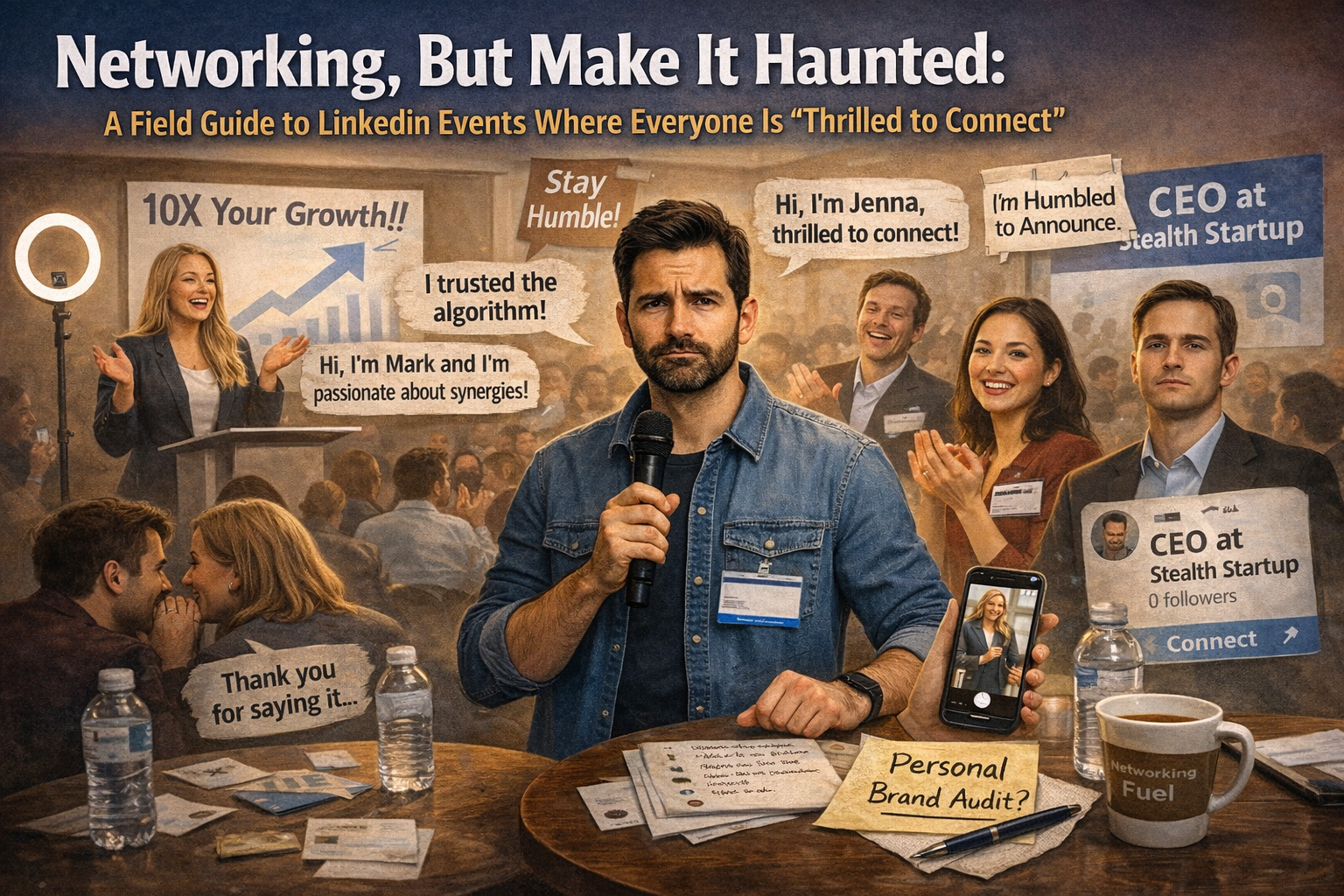
Somewhere near the front is the featured speaker: a full-time influencer and part-time motivational Wi-Fi signal, standing beneath flattering lighting like a TED Talk is about to happen, and there’s always this small, dangerous detail that should come with a warning label: a microphone.
Because once you place a microphone in a room full of LinkedIn people, you have essentially created a ceremonial weapon, a sacred object that turns ordinary statements into declarations, regular opinions into thought leadership, and mild observations into “a powerful reminder.”
And that’s when you learn the truth: these events are not networking. They are a performance review for your personality, and the only acceptable rating is “inspiring, but not disruptive.”
The Influencer Origin Story, or How We Applaud the Algorithm Like It’s a God
The influencer begins the way they always begin: with humility that arrives in a sponsored tone, the kind of humility that has a ring light attached to it, the kind that says, “I’m just like you,” while simultaneously reminding you they are not like you, because they have converted self-expression into a revenue stream and they are here to tell you, kindly, that you can do it too, if you simply show up consistently and respect the sacred rituals of the feed.
And the story is always inspirational in a way that feels suspiciously like a sales funnel. It’s not “I built relationships,” it’s “I optimized hooks.” It’s not “I learned from failure,” it’s “I iterated on content.” It’s not “I found my voice,” it’s “I tested formats.” Human life, flattened into metrics, where grief becomes a caption, confidence becomes a carousel, and personal growth becomes a weekly series you can subscribe to, like healing is a newsletter with a drip campaign.
The room claps in the exact way people clap when they want to appear supportive but also want to signal that they understand the unspoken rules of the moment: clap long enough to show you’re a good person, but not long enough to look like you’re trying too hard. Everyone is nodding, everyone is smiling, everyone is silently calculating how many followers it would take for their own pain to become “content” instead of just pain.
And here’s the part we don’t say out loud: we’re applauding the algorithm, not the human.
Because it’s not really “inspiring” that someone hit 50K followers. It’s impressive, sure, like it’s impressive to get a Costco receipt that somehow reaches the floor, but the awe in the room isn’t about the person’s craft, it’s about the mythology that followers equal validity, that reach equals impact, that visibility equals worth, that if enough strangers agree you are interesting, you become officially real.
So when the influencer says they “trusted the algorithm,” people react like this is a spiritual practice, like the algorithm is a wise, mysterious mentor who rewards the faithful. But the algorithm is not a mentor. The algorithm is a slot machine with opinions. And yet, the room treats it like a deity, because modern professionals love two things more than anything: measurable validation and someone else to blame when the validation does not arrive.
Then, after the applause has properly sanctified the moment, the influencer says the words that should immediately trigger sprinklers to descend from the ceiling: “Let’s open the mic so we can all share.”
That’s when you realize you are not at a networking event. You are at a public audition for professionalism, and the judges are everyone.
Open Mic Networking, or The Terrifying Freedom of Being Allowed to Speak
The host begins moving through the room with the microphone like they’re distributing communion, placing it gently into the hands of the safest possible participants, the people whose personalities have been trained by corporate culture to never surprise anyone.
“Hi, I’m Jenna, thrilled to connect.” Applause.
“Hi, I’m Mark, passionate about synergies.” Applause.
“Hi, I’m someone’s Head of Something at a Stealth Startup.” Applause.
And the applause isn’t about what they said. It’s about the fact they said nothing that could create consequences. This is the highest form of social safety: speaking in a way that cannot be quoted. Everyone in the room is practicing the ancient art of being memorable without being specific, authentic without being vulnerable, bold without being inconvenient.
Then the microphone comes to you, and you can feel the room stiffen slightly, because there’s a distinct energy shift when the mic leaves the padded walls of corporate-approved phrasing and enters the unpredictable wilderness of an actual person who might say something.
You stand up and you can sense the influencer smiling at you in a way that feels like a customer satisfaction survey, like you’re about to give them the quote they can put on a landing page. And you do the polite thing first, because you are not an animal. You say congratulations. You acknowledge the milestone. You offer the socially required praise so no one can accuse you of being “negative,” which in networking culture is the worst accusation, because negativity is what happens when someone refuses to pretend everything is fine.
Then you ask the question that drops into the room like a bowling ball in a glass of sparkling water: how many followers are real humans, and how many are suspicious accounts with one headshot, zero posts, and a job title that reads like a rejected spy movie character.
This is when the silence arrives. Not just silence, but that specific corporate silence where you can hear the room trying to decide if this is a joke, a threat, or a LinkedIn post forming in real time. Someone’s chair squeaks. A water bottle pauses mid-sip like it has suddenly become a witness in court.
And at this exact moment, you can choose to repair the social fabric, to laugh lightly, to soften, to redirect into safer territory, to apologize for bringing oxygen into a room that prefers fragrance. But instead, something ancient rises in you, something rebellious and exhausted, and you continue.
You mention networking being adult speed dating, except the questions aren’t “what do you like,” they’re “what’s your niche” and “are you monetizing your pain yet,” which is when you see the host blinking like a computer restarting, because the host was trained for safe vulnerability, not real commentary.
Then you add the line about “humbled to announce,” because at some point we have to put that phrase on a shelf next to “circle back” and “quick win,” and only take it down in emergencies, like if someone actually invented a vaccine or adopted three dogs or rescued a bus full of orphans while simultaneously saving a company’s Q4.
And when you sit down, the influencer laughs the way people laugh when they are deciding whether you are brave or dangerous, whether they should compliment you or quietly remove you from their life like an outdated connection request.
Afterward, people thank you in whispers, because this is how corporate truth survives: quietly, in corners, away from the main stage, where honesty is allowed to exist as long as it never becomes a headline. One person tells you they’ve been thinking that for years. Another person asks if you want to get coffee sometime, which is the networking equivalent of saying, “I felt something, and I don’t know what to do with it.” And then, naturally, one guy tries to sell you a personal brand audit on a napkin, because no moment of human connection is safe from capitalism.
And that’s the lesson: the open mic is not for sharing. It’s for rehearsing. It’s for practicing the version of yourself you want to be perceived as, and anything that interrupts the script is treated like an unexpected pop quiz on authenticity.
They love authenticity, but only if it’s been formatted correctly.
The Aftermath Post, or How Reality Gets Edited Into “A Powerful Reminder”
Later, as you leave, you see the influencer pull you aside. They say, “That was… bold.” Which is influencer for “please don’t tag me,” and also corporate for “you made me feel something I didn’t schedule.”
You respond in the only language the room truly respects: “I was just adding value.” Because if you cannot speak corporate, are you even networking, or are you just talking like a person, which is essentially public indecency in professional circles.
Then you go home and do what we all do after an event that felt like an improvisational therapy session hosted by branding experts: you check LinkedIn. And of course someone already posted.
“Tonight reminded me that growth happens outside your comfort zone.”
There’s a selfie holding the microphone like it’s the Olympic torch. Their smile is bright, their caption is vague, their takeaway is inspirational, and their narrative has been polished so clean that the moment you spoke has been erased completely. No mention of your questions. No mention of the air leaving the room. No mention of the emotional whiplash. Just vibes. Just personal development confetti. Just a tidy moral that makes everyone feel good without making anyone feel challenged.
Because this is the real magic trick of LinkedIn culture: it takes messy reality and turns it into a motivational poster with a headshot. It takes discomfort and reframes it as “growth.” It takes confrontation and calls it “courage.” It takes a room of adults avoiding eye contact and calls it “community.”
And here’s the part that really stings, if you let it: they will use your disruption as content without crediting the source. They’ll post about being “challenged,” but they won’t name the challenge. They’ll talk about “hard conversations,” but they won’t say what was hard. They’ll praise “authenticity,” but only the kind that can be summarized without consequences.
So if you see a post tomorrow that starts with “I was challenged at an event…” just know: that was you. You are the challenge. You are the unfiltered follow-up question. You are the person who asked for proof in a room built on performance.
And the strangest part is, you did network. You did connect. It just wasn’t through exchanging business cards or swapping titles. It was through a shared glance between strangers that said, “Thank you for saying the quiet part out loud,” followed by an immediate return to polite smiling because someone might be watching.
This is how modern professionals survive: half in truth, half in theater.
Final Thoughts: The Real Rule of LinkedIn Networking Is That You Can Be Real, But Not Too Real
If you’ve ever left one of these events feeling both amused and slightly haunted, it’s not because you’re cynical. It’s because you’re paying attention. The entire ecosystem is designed to reward the appearance of connection while avoiding the risk of connection, to encourage “community” as long as community never requires anyone to be uncomfortable, accountable, or honest in a way that can’t be edited.
LinkedIn networking is a place where people say “I love your energy” instead of “I disagree,” where everyone is “open to opportunities” while pretending they aren’t terrified, where personal stories are told in a way that feels brave but is also perfectly optimized to avoid messy follow-up questions. It’s a world where we insist we want authenticity, but only if it’s pre-approved, softly lit, and packaged with a takeaway that can fit neatly at the end of a caption like a little bow on a box of unresolved emotions.
And that’s why your moment with the microphone mattered more than the influencer’s follower count, even if the feed never admits it. Because you did something dangerous: you treated a networking event like real life. You asked a question that couldn’t be answered with a slogan. You pointed at the absurdity without making it cruel. You forced the room, briefly, to confront the fact that we’ve turned connection into branding and branding into survival, and some of us are exhausted from performing our own lives just to be considered employable.
This is the part where someone will try to spin it into a lesson, because we cannot experience anything without turning it into a lesson. They’ll say you were “bold.” They’ll say you “pushed boundaries.” They’ll say “growth happens outside your comfort zone,” and they’ll mean it, in the safe way they mean everything.
But the real lesson is simpler and a little more inconvenient:
We’re all starving for something honest, and we keep pretending we’re full on inspirational sound bites.
So go to the events if you want. Shake hands. Smile. Nod. Say you’re thrilled to connect. Collect business cards. Let someone explain their niche like it’s a horoscope. Let the influencer tell you to trust the algorithm like it’s therapy.
Just remember this: the moment you ask a real question, you’ll find out who is actually there to connect, and who is only there to be perceived.
And if you happen to become “the challenge” again, if you feel the mic in your hand and the room holding its breath, do what you did last time.
Speak like a person.
Worst case, someone will call you bold and hope you don’t tag them. Best case, three strangers will thank you quietly, because you named what everyone felt but nobody was allowed to say out loud, and for a brief moment, the event won’t feel like a comment section pretending to be a community.
It will feel like reality.
And reality, unlike the algorithm, is still undefeated.