There was a time when interviews were conversations. Slightly awkward, mildly performative conversations, sure, but still recognizably human. You’d sit across from someone in a conference room that smelled like printer toner and ambition, shake hands with the confidence of a person who had not yet been asked where they “see themselves in five years,” and answer a few questions that made you feel like a capable adult instead of a hamster auditioning for a TED Talk.
Now it’s 2026, and Zoom interviews have evolved into something else entirely. Not a discussion. Not a mutual evaluation. Not even a polite exchange of lies where you pretend you’re “excited about the mission” and they pretend this role won’t be frozen the moment you close your laptop.
No. Today’s Zoom interview is a ceremony.
A modern corporate ritual where everyone dresses up from the waist up, adjusts their lighting like they’re filming a hostage video for LinkedIn, and stares into a Brady Bunch grid of professional concern. Everyone nods at exactly the right moments. Everyone smiles with the exact emotional temperature of a hotel lobby. Everyone is muted just long enough to feel powerful, like silence is a leadership competency and unmuting is a privilege you earn through tenure.
And the backgrounds. Oh, the backgrounds. Carefully staged books that have never been opened, a plant that looks like it’s been threatened into survival, and at least one framed quote about grit that reads like it was purchased during a midlife crisis and installed during a team-building offsite.
This is the setting. This is the altar. This is where your career gets judged by five strangers and a sixth person who joins late, which is instantly forgiven because their title is long enough to function as a legal document.
That title arrives like a weather system. It doesn’t apologize. It doesn’t explain. It simply exists, bending time and etiquette around it like a high-ranking officer entering a room. The other panelists straighten up. Their eyes brighten with the kind of respect you only see when someone has access to budgets and calendar permissions.
Then the title begins screen sharing.
Not a slide deck. Not a presentation. A document.
A company culture document.
And immediately you can feel it. The air changes. The vibe shifts. Your instincts, which have been sharpened by years of corporate nonsense, whisper the same ancient warning humans have felt since the first caveman handed another caveman a “values statement” and called it leadership.
Healthy culture does not require a PDF.
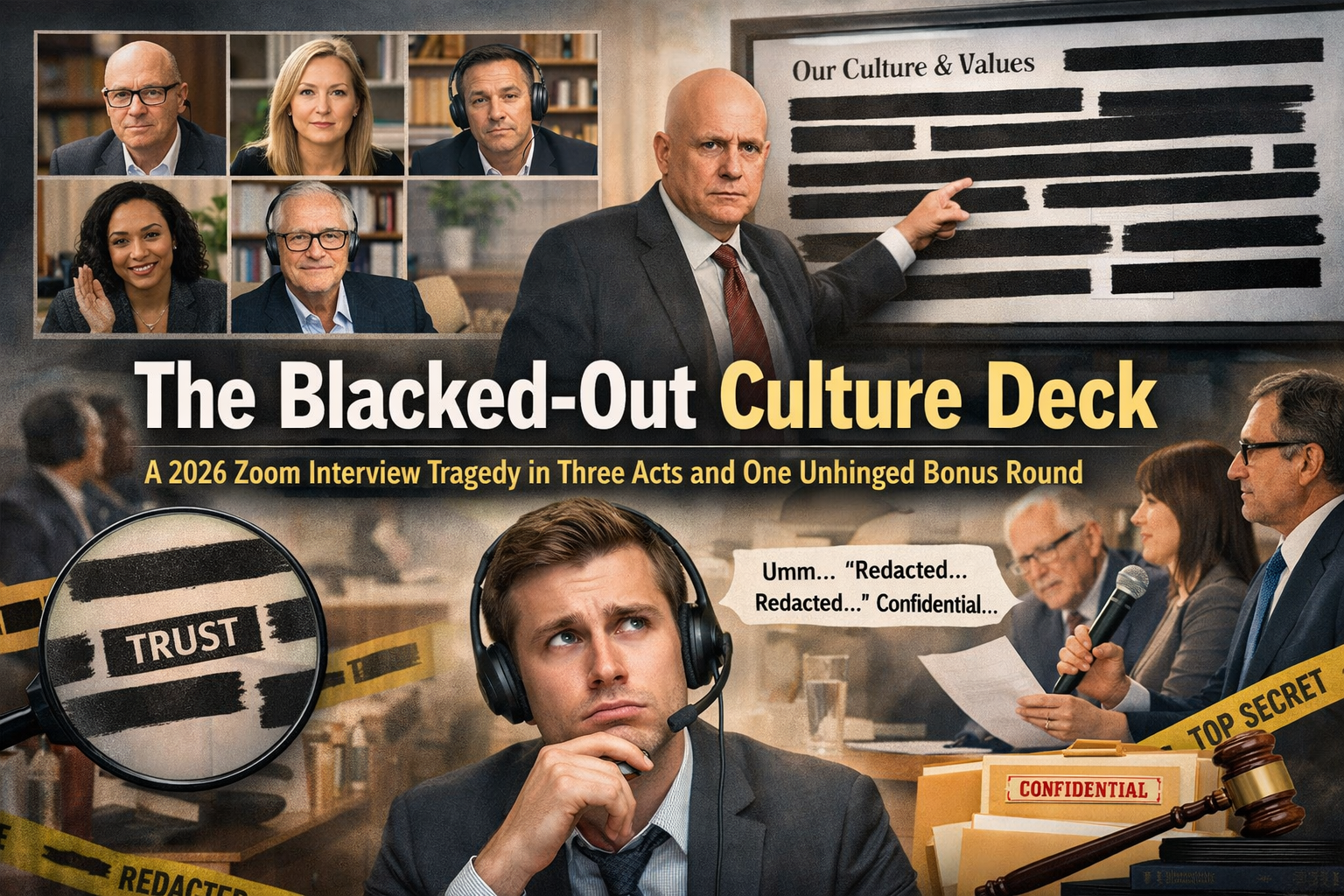
But this one does. And not just any PDF. This one has redactions. Thick ones. Aggressive ones. Whole paragraphs erased like they caught culture committing a felony and decided the only responsible thing to do was cover it up with a Sharpie.
It looks less like “Our Values” and more like the Epstein files after an afternoon of panic and a lot of ink.
And the real magic is that nobody reacts. Everyone nods. Everyone listens. Everyone pretends this is normal. Including you, because when someone with a long title shows you a censored culture document, you don’t ask questions. You smile. You nod. You quietly begin rethinking your life the way people do when the turbulence starts and the flight attendant sits down.
This is not an interview anymore.
This is a press briefing.
And you are about to be tested on your ability to endure it.
The Brady Bunch Tribunal and the Holy Art of Pretending
The first rule of the 2026 Zoom interview is simple: the more people in the panel, the less anyone is accountable for what happens.
One interviewer is a conversation. Two is a dialogue with witnesses. Three is a committee. Five is a jury. Five is an emotional obstacle course where every question feels like it was approved by legal, watered down by HR, and then rehearsed in a mirror by someone who has memorized the phrase “tell me about a time” like it’s a spell that summons competence.
And the grid itself is a character.
Five squares. Five faces. Five different interpretations of “business casual.” One person has a headset that implies seriousness. One person is too close to the camera, like they’re investigating you. One person is too far from the camera, like they’re a cryptid. One person is smiling so hard you can tell their manager is watching from offscreen. One person looks like they’re simultaneously interviewing you and remembering they left the stove on.
They all nod in unison, which is either a sign of alignment or a sign they’ve been trained to appear alive. They mute themselves with the crispness of someone closing a vault. They unmute with the gravity of a priest beginning a sermon.
Then the late arrival comes in.
And here’s where the ritual truly begins, because lateness is only rude when you are powerless. When you have a title long enough to require punctuation, lateness becomes an entrance. It becomes a statement. It becomes a strategy. Time isn’t something you follow. Time is something you delegate.
The late arrival doesn’t say “sorry.” The late arrival says “Thanks, everyone,” as if everyone else has been waiting in a lobby of their own choosing. The late arrival makes eye contact with the camera, not with you, because this isn’t about you. This is about dominance.
Then they share the document.
And you, like every other candidate who has survived the modern hiring process, immediately begin performing Normal. You become an actor in a corporate play where the script is written in invisible ink and the audience is five people who can end your livelihood with a calendar invite.
You nod when they nod.
You smile when they smile.
You laugh softly at jokes that aren’t jokes.
You say things like “That’s really interesting,” which is adult code for “I’m terrified but polite.”
Because the real interview isn’t happening in the questions. The real interview is happening in your face. In your ability to maintain a calm expression while your brain is setting off fireworks.
Can you remain composed while the company introduces itself like a classified operation?
Can you listen to sentences that begin with “We value transparency” while half the page looks like it’s been placed under witness protection?
This is what they mean by “executive presence.”
It’s not confidence. It’s not leadership.
It’s the ability to look unbothered while the room slowly catches fire.
The Culture PDF That Needs a Lawyer and a Priest
A culture deck is already a dangerous object.
Not because culture is bad, but because the moment culture is explained in a deck, culture stops being culture and becomes branding. It becomes theater. It becomes a carefully curated story told by people who have never asked an employee how they’re doing without immediately adding, “but can you hop on a quick call?”
A real culture shows up in decisions. In priorities. In how people behave when nobody’s watching. In whether your manager thinks “work-life balance” is a value or a punchline.
But a culture PDF? That’s a different beast. That’s not culture. That’s a marketing document trying to pass as a personality.
So when the long-title person opens the culture document, you’re already bracing for the usual: bold headings, glossy language, vague promises about belonging, and at least one line that says “We’re a family,” which is always followed by layoffs that feel like Thanksgiving dinner.
But then you see it.
The black boxes.
The thick, aggressive redactions.
Entire sections gone.
Not “edited for brevity.” Not “draft version.” Not “we’ll share the full handbook after onboarding.”
No, this is a document that has been actively censored. Like it knows secrets. Like it has incriminating evidence. Like culture itself has been indicted and is cooperating with investigators.
And the presenter scrolls through it with total confidence.
“This part really speaks to who we are,” they say.
The screen displays ████████████████.
They don’t flinch. They don’t laugh. They don’t acknowledge the blacked-out void. They treat it the way royalty treats peasants: it’s there, it’s relevant, and you are not entitled to the details.
They zoom in.
Which is perhaps the most unsettling part of the entire experience, because zooming in suggests they think you need a better look at what you are not allowed to see. Bigger black boxes. Louder silence. The absence becomes the message.
You begin to wonder if the redactions are intentional symbolism.
Maybe it’s a metaphor. Maybe the culture is so profound it can only be understood through implication. Maybe the values are too powerful for candidates, like a sacred text that must be revealed gradually or it will melt your brain.
Or maybe, and stay with me here, someone accidentally shared the wrong file.
Maybe the culture deck got mixed up with something else. Something subpoena-adjacent. Something that required legal review and a large marker.
But nobody reacts.
And that’s when you realize the real culture is not in the document.
The real culture is in the nodding.
The real culture is in the group decision to pretend that a censored values document is just another Tuesday.
Because a workplace that can normalize a blacked-out culture deck can normalize anything.
It can normalize meetings about productivity while you’re drowning.
It can normalize “feedback” that is actually punishment.
It can normalize “alignment” that is actually control.
It can normalize “we’re all adults here” while treating you like a child asking for permission to exist.
The redactions aren’t a mistake. They’re a preview.
They’re the mission statement, presented in the only honest format modern companies have left: partial disclosure.
Ambiguity as a Job Requirement and Other Crimes Against the Human Nervous System
At some point in the ceremony, after the culture document has been read aloud like a sacred scroll that legally cannot be quoted, they will ask you the question.
You know the one.
“How do you handle ambiguity?”
And the moment they say it, you will have an out-of-body experience.
Because you are not answering a hypothetical question. You are living in a live demonstration. You are actively sitting in ambiguity the way a person sits in traffic: trapped, resigned, and quietly furious that this is considered normal.
You want to respond honestly.
You want to say, “I handle ambiguity the same way everyone does: with anxiety, snacks, and increasingly specific fantasies about quitting and becoming a lighthouse keeper.”
You want to say, “I handle ambiguity by asking clarifying questions, but I’m noticing your company has redacted the clarifications.”
You want to say, “I handle ambiguity by observing patterns, and the pattern I’m observing is that your values have been classified for national security.”
But you don’t.
Because this is an endurance test, and you know it. You know the rules. You know that the correct response is to convert your suffering into a leadership story. To turn this moment of absurdity into a polished narrative where you demonstrate resilience without appearing like a person who has ever felt an emotion.
So you say something tasteful.
You say you thrive in dynamic environments.
You say you prioritize communication.
You say you align stakeholders.
You say you build clarity through collaboration.
And as you say it, you can feel your soul leaving your body for a brief vacation.
Because the truth is, ambiguity has become a corporate hobby. A lifestyle. A brand aesthetic. Companies don’t just tolerate ambiguity anymore. They cultivate it. They feed it. They promote it into leadership roles and then act surprised when nobody knows what’s happening.
Ambiguity is no longer a problem to solve. It’s a feature.
It allows them to change goals without consequences.
It allows them to rewrite expectations without admitting they were wrong.
It allows them to say “we’re still figuring it out” while expecting you to deliver outcomes as if it’s all crystal clear.
And the best part is that they treat your ability to survive it as a skill.
Not because it makes you effective.
Because it makes you compliant.
Because if you can sit through a censored culture briefing and still say, with warmth, that you’re excited about the role, you are exactly the kind of person who will stay calm while the organization spins in circles, rebrands its chaos as strategy, and calls it innovation.
You are not being hired for your talent.
You are being hired for your tolerance.
And somewhere in the background, one of the panelists is still nodding, still muted, still staged in front of a bookshelf that has never once contained the book “How to Run a Normal Interview.”
Final Thoughts: Congratulations, You Passed the Ceremony
Here’s the thing nobody tells you about Zoom interviews in 2026: the interview is not the questions. The interview is the environment. The interview is the vibe. The interview is whether you can keep your face neutral while your brain is screaming.
It’s whether you can politely listen to corporate myths delivered with the solemnity of a courtroom oath. It’s whether you can act impressed by “transparency” while staring at a document that looks like it’s been approved by a crisis communications team and a panic attack.
It’s whether you can participate in a ritual that everyone knows is ridiculous, without being the first one to acknowledge it.
Because that’s what modern work has become. A collective agreement to pretend.
We pretend hiring processes are “thorough” instead of bloated.
We pretend panel interviews create “fairness” instead of diffusion of responsibility.
We pretend culture decks represent reality instead of aspiration.
We pretend job descriptions are accurate instead of a wish list written by someone who has never done the job.
We pretend the candidate experience matters while ghosting people like it’s a scheduling technique.
And in the middle of all of that, you show up, you prepare, you have your resume open in another tab like a security blanket, you rehearse your stories, you test your mic, you adjust your lighting, and you sit down to be judged by six squares and a PDF that has been partially erased from existence.
And you wonder, quietly, what you’re actually auditioning for.
A job?
A team?
A career?
Or membership in a workplace where reality is always presented as a controlled release, where clarity is a perk you might unlock after ninety days, and where the culture is less a living thing and more an ongoing investigation.
The darkest part is that you will still try. You will still answer professionally. You will still smile. You will still thank them for their time. You will still send a follow-up email that says you enjoyed meeting everyone, even though “meeting” is a generous term for staring into a grid while a censored document is read aloud like classified evidence.
Because that’s the final ceremony. The last act.
The candidate, having survived the briefing, must now express gratitude.
And the company, having revealed nothing of substance, will say they’re “excited to continue the process.”
And you, with the calm dignity of someone who has seen too much, will close your laptop, stare at your own reflection in the black screen, and think:
If this is the interview, what does the job look like?
Then you’ll take a breath.
Open another application.
And re-enter the ceremony.
If you want, I can write a second version where the redacted culture deck becomes increasingly ridiculous (like the black boxes start moving, or one panelist tries to read them aloud as “confidential”), or a darker version where the candidate starts treating the interview like a press conference and asks for a FOIA request number.