Interview questions in 2026 have evolved the way office coffee evolves: slowly, quietly, and then suddenly you realize it’s no longer coffee, it’s a bitter chemical experiment being kept alive by habit, desperation, and the faint promise that tomorrow will be different. They’re not questions anymore so much as emotional obstacle courses. They don’t want proof you can do the job, because the job itself has become a vague concept, like “culture” or “synergy” or “please stop replying all,” and capability is now treated the way companies treat budgets: assumed to exist until it is inconvenient.
The interview used to be an exchange. You brought experience, examples, competence, and a face that could convincingly nod on Zoom. They brought a job description, a timeline, and at least the illusion that this role was real and not a ceremonial posting created to satisfy a process, appease a manager, or reassure a board that yes, they are “investing in growth,” which is corporate for “we are afraid and would like applause.”
Now the interview is a mood assessment. A vibe scan. A spiritual x-ray conducted by someone who has read three leadership books, joined a productivity newsletter, and believes curiosity is a KPI. The goal is no longer to confirm you can do the work. The goal is to confirm you can survive the work without making anyone feel witnessed.
And so the questions arrive, dressed as innocent conversation, but carrying the quiet menace of a compliance seminar.
Tell me about yourself, they say, like they’re asking about your favorite movie, not requesting a concise autobiography that must simultaneously demonstrate ambition, humility, resilience, charisma, and the ability to be interesting without appearing complicated.
Then the pivot happens. The tone changes. The air shifts. Someone smiles too hard.
If you were an animal, what would you be?
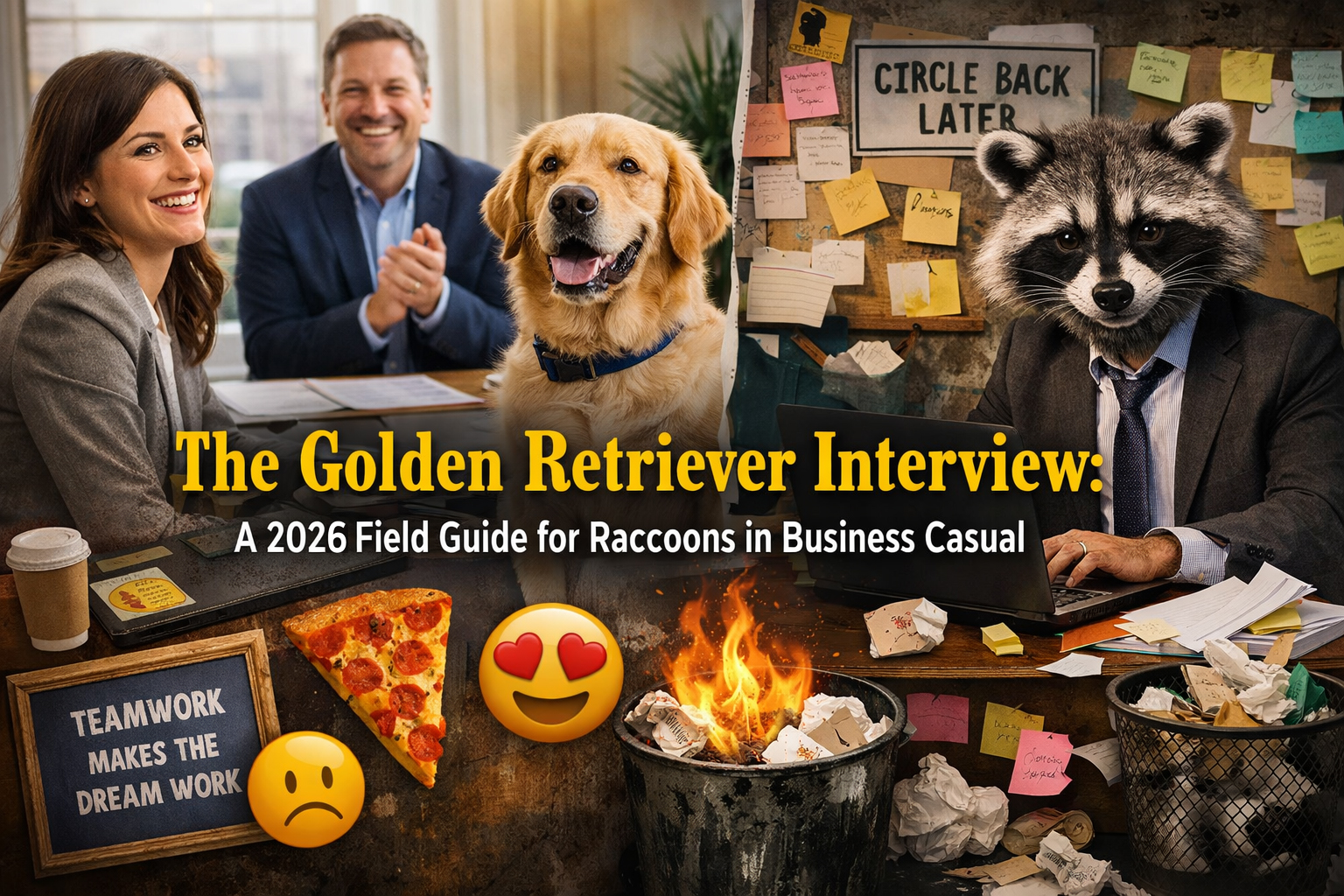
And you understand immediately: we are no longer interviewing for a job. We are auditioning for a role in the company’s ongoing fantasy, where deadlines are reasonable, conflict is just “healthy tension,” and the best employee is a golden retriever who can fetch deliverables while maintaining a grateful expression during reorganizations.
You want to say raccoon. You want to say: I am resourceful. I am relentless. I can turn garbage into output. I have survived three leadership changes and two “exciting new chapters” that looked suspiciously like cost cutting. I can locate meaning in chaos and build a plan out of three contradictory emails and an executive’s vague memory of “something we said in that meeting.”
But you don’t say raccoon.
Because raccoon is competent in a way that makes people nervous.
So you say golden retriever. And the interview continues.
The Early Rounds, When They Pretend This Is About Work
The first round still opens with tradition, like a wedding that everyone knows will end in divorce but insists on following the program anyway.
Tell me about yourself.
You deliver the polished narrative. The career arc. The highlights. The strategic pauses. The part where you mention impact without sounding like you printed your personality off a resume template. You make yourself sound effective but not intense, accomplished but not exhausting, ambitious but not the kind of ambitious that would ask why a team meeting needs seventeen attendees and a pre-read no one read.
They nod. They smile. They say something like, “Love that,” which in 2026 means, “I am acknowledging you as a human, which is our new brand.”
Then they ask about the role.
Why are you interested in this position?
This is not a question. This is a ritual. You are expected to praise them in a specific way: enthusiastic but not desperate, informed but not intimidating, flattering but not so accurate it reveals you’ve done research that might expose their last quarter results. You must compliment their culture, even though culture has become a brochure word and the brochure looks lightly redacted.
So you talk about mission. You talk about growth. You talk about collaboration. You use words that sound warm but mean nothing, because the truth would be: I am interested in this position because it is a job and I would like to exchange my labor for money in order to remain indoors.
They will not accept that answer. They want romance. They want you to pretend this is destiny, not economics.
Then comes the classic: How do you handle ambiguity?
This question has replaced “What do you do when you don’t know something?” because ambiguity is no longer an occasional inconvenience. It’s now a permanent operating system. The correct answer is not “I seek clarity,” because clarity has been deemed too controlling. The correct answer is that you thrive in it, which is insane, because thriving in ambiguity is how you end up being assigned a project that does not exist yet, with stakeholders who disagree on its purpose, and a deadline chosen because someone is traveling that week.
So you say you’re adaptable. You say you align with stakeholders. You say you ask good questions. You don’t say the real answer, which is: I have built entire strategies out of vibes, guesswork, and the silent terror of being the only person who noticed the plan has holes.
And then, just when you think you’re being evaluated for actual work, they introduce the new favorite question in the corporate zoo.
What’s your energy on a team?
Energy, in this context, is code. They want to know if you are pleasant. If you are easy. If you will smile through dysfunction and call it resilience. If you will absorb chaos without reflecting it back. If you will participate in optimism theater even when the script is on fire.
You explain your energy. You describe how you collaborate, communicate, support. You offer examples. You sound like a functional adult. You do not say: my energy on a team depends entirely on whether leadership is competent or merely loud.
The early rounds always end with the illusion of momentum. You will hear phrases like “This has been great,” and “We’re moving quickly,” and “We’ll be in touch,” which in 2026 is corporate Morse code for “We will now vanish into a fog of internal meetings and resurface three weeks from now with a question about your salary expectations as if time did not pass.”
The Middle Rounds, Where You Become a Psychological Case Study
Round three is where the interview stops being a conversation and becomes an experiment. This is the phase where they ask questions that sound like they were written on a whiteboard during a leadership retreat, right next to a doodle of a mountain and the phrase “trust the process.”
What’s your biggest weakness?
A classic. A trap. A performance. You must confess something that sounds like self-awareness but does not suggest you are difficult, human, or capable of noticing contradictions.
The acceptable weaknesses in 2026 are the corporate equivalent of saying you have a “small appetite” on a dating profile. You can say you care too much, but you must say it like you’ve already cured it. You can say you struggle to delegate, but you must say it like you learned delegation last week and now you teach a workshop on it. You can say you’re a perfectionist, but only if you’re willing to swear under oath that your perfectionism has been converted into “high standards,” which is the nicer phrase for “I will not let you submit garbage and call it excellence.”
Tell me about a time you failed.
They want a story with redemption, a moral, and a clean resolution. What they do not want is the most common modern failure: doing everything right and watching it collapse anyway because leadership changed direction mid-sprint, finance froze the budget, or an executive had a new idea after reading half a book on airplanes.
So you choose a safe failure. A failure that was technically your fault but not really. A failure that made you better. A failure that did not result in you developing a thousand-yard stare whenever someone says, “Can we just hop on a quick call?”
Then comes the motivational section.
What motivates you?
This is not about what motivates you. This is about whether you are still susceptible to the ancient corporate spells: pizza, praise, and the promise of “visibility.” They are checking for the moment your eyes light up at words like “fast-paced” and “high ownership,” which in 2026 translates to “we are understaffed and would like you to pretend it’s exciting.”
You answer with impact. You answer with learning. You answer with building things and helping teams. You do not say: I am motivated by a stable paycheck, respectful leadership, and the absence of 11 p.m. messages marked urgent because someone remembered your existence after dinner.
How do you recharge?
This question used to mean: do you have hobbies? Now it means: will you burn out quietly? Will you crumble off-screen without making it our problem? Will you recharge quickly enough to return to the front lines for another quarter of “stretch goals” that are suspiciously identical to last quarter’s unrealistic goals?
You talk about balance. You talk about boundaries. You talk about systems. You smile as though you are not fully aware that the minute you get the job, someone will say, “We love boundaries here,” and then schedule a meeting during your lunch because “it was the only time.”
And then, like a final flourish, the questions become almost poetic in their absurdity.
If you could have dinner with anyone, dead or alive, who would it be?
This question exists only because someone, somewhere, thinks interviews should be fun. It is designed to reveal your personality, but only the parts of your personality that are safe, nonpolitical, noncontroversial, and unlikely to result in you organizing a union or asking why the CEO needs a private elevator.
You answer with a leader. A thinker. Someone broadly admired. You do not answer with “the person who invented email, so I can ask what they were trying to punish.”
The Final Rounds, Where You Are Asked to Prove You Won’t Notice the Fire
By round five, you have met so many people that you feel like you’ve joined the company without receiving benefits. You know their faces. Their catchphrases. Their preferred adjectives. You’ve heard “excited,” “aligned,” “iterative,” and “scrappy” so many times you can taste them.
This is where they stop asking questions and start testing whether you can participate in the collective delusion.
How do you respond to feedback?
The correct answer is: enthusiastically, gratefully, immediately, and without visible emotion. You must treat feedback like a gift, even though feedback in many organizations has become a disguised power move delivered in the tone of someone who believes their preferences are universal truths.
You say you welcome feedback. You say you ask clarifying questions. You say you incorporate it. You do not say: I respond well to feedback when it is specific, actionable, and not delivered as a personality critique in the form of “We just need you to be more executive.”
Tell us about a time you influenced without authority.
This is how companies admit their structure is broken while pretending it’s a feature. They want to know if you can move work forward despite unclear ownership, shifting priorities, and stakeholders who won’t make decisions until you force them into a corner with a calendar invite and three proposed options.
So you tell a story about persuasion and alignment. You do not say: I influenced without authority because no one had authority, and the org chart was more of a suggestion than a system.
Why do you want to work here?
Again, romance. Again, flattery. Again, you must pretend you are not here because you can do the job, but because you have always dreamed of joining their specific ecosystem of tools, meetings, and values posters.
They want to hear that you are inspired. They want to hear that you are mission-driven. They want to hear that you admire their culture, which they define as “people being nice in meetings while quietly resenting each other.”
You answer beautifully. You paint them as a place where you can grow. You imply you are excited to contribute. You do not mention that their Glassdoor reviews read like a cautionary tale written by people who once believed in hope.
And finally, after you’ve performed your golden retriever impression for multiple stakeholders and demonstrated that you can communicate, collaborate, and spiritually levitate above ambiguity, they end with the most advanced question of all.
Do you have any questions for us?
This is the moment where you must ask questions that signal intelligence without implying skepticism. You must ask about success metrics, but not so directly that it sounds like accountability. You must ask about priorities, but not so clearly that it suggests you’ve noticed they don’t have any. You must ask about culture, but not in a way that forces them to define it beyond “We’re like a family,” which is always the beginning of a horror story.
So you ask something safe: What does success look like in the first 90 days?
They give you an answer that sounds good but means nothing, like “driving impact” and “building relationships” and “getting up to speed,” which is corporate for “we have no onboarding plan but would like you to seem grateful anyway.”
Then they smile.
We’ll be in touch.
And you smile back, because you are still in character, still performing upbeat professionalism, still pretending this isn’t a language you’ve learned through repeated exposure to disappointment.
But you know what it means.
It means the process will either end abruptly, or stretch into eternity, or result in a final interview that is identical to the previous interview except with a different person asking the same question about ambiguity like it’s a sacred tradition.
And the raccoon, deep down, already understands.
Because raccoons are not confused by mixed signals. Raccoons are trained by them.
Final Thoughts: In Defense of the Raccoon, and Other Non-Hireable Truths
There’s a reason the golden retriever has become the unofficial mascot of modern hiring. Golden retrievers represent the fantasy: loyal, cheerful, agreeable, endlessly available, and emotionally uncomplicated. A golden retriever will fetch a deadline, accept praise as payment, and stare lovingly at leadership even when leadership is actively chewing the furniture.
But the modern workplace does not survive on golden retrievers.
It survives on raccoons.
It survives on people who can locate the missing file, patch the broken process, translate the vague instruction into actual work, and keep things moving while everyone else is still debating the agenda. It survives on people who can build structure inside chaos, who can ship outcomes even when the inputs are nonsense, who can handle dysfunction without making it their entire personality, but also without pretending it isn’t happening.
The problem is that raccoon energy is honest. It is visibly adaptive. It is competent in a way that exposes the gaps. And many companies don’t want employees who can see the gaps, because gaps require decisions, and decisions require ownership, and ownership requires someone to be accountable instead of inspirational.
So interviews in 2026 aren’t searching for capability. They’re searching for emotional compliance. Are you upbeat but not disruptive? Assertive but not challenging? Smart but not enough to ask why the process takes seven rounds? Resilient but willing to call burnout “growth”?
And candidates have learned how to respond. We have learned how to perform. We have learned how to translate ourselves into the acceptable corporate animal kingdom, where you can be a golden retriever, a dolphin, maybe a wise owl if you keep it charming. You can be anything, as long as you are not the creature that thrives in the exact conditions they created.
Which is why the interview feels like theater now: everyone reciting lines they know are artificial, everyone smiling through questions that pretend to be playful while quietly enforcing conformity.
But here’s the part worth remembering, especially if you’re sitting there, exhausted, answering the fiftieth version of “Tell me about a time you overcame adversity” like adversity isn’t the entire hiring process itself.
You are not wrong for feeling like these interviews are surreal.
You are not wrong for noticing that the questions keep drifting away from the job.
You are not wrong for wanting to say, politely, with the calm of someone who has lived through enough corporate plot twists to deserve hazard pay: I can do the work. I have done the work. I will do the work. I would just like to know what the work is.
And if the process rejects you because you didn’t perfectly embody golden retriever energy, that doesn’t mean you’re not hireable. It means you weren’t willing to become harmless on command. It means you didn’t audition for their comfort. It means you showed signs of being a raccoon, which is, ironically, the exact creature they will need once the quarter turns, the priorities shift, the strategy changes, and the room catches fire.
So go ahead. Practice your golden retriever answer if you must. Smile. Nod. Speak in the approved dialect of optimism and alignment.
But keep your raccoon skills sharp.
Because when they say, “We’ll be in touch,” the raccoon already knows the truth.
And the raccoon still survives.