
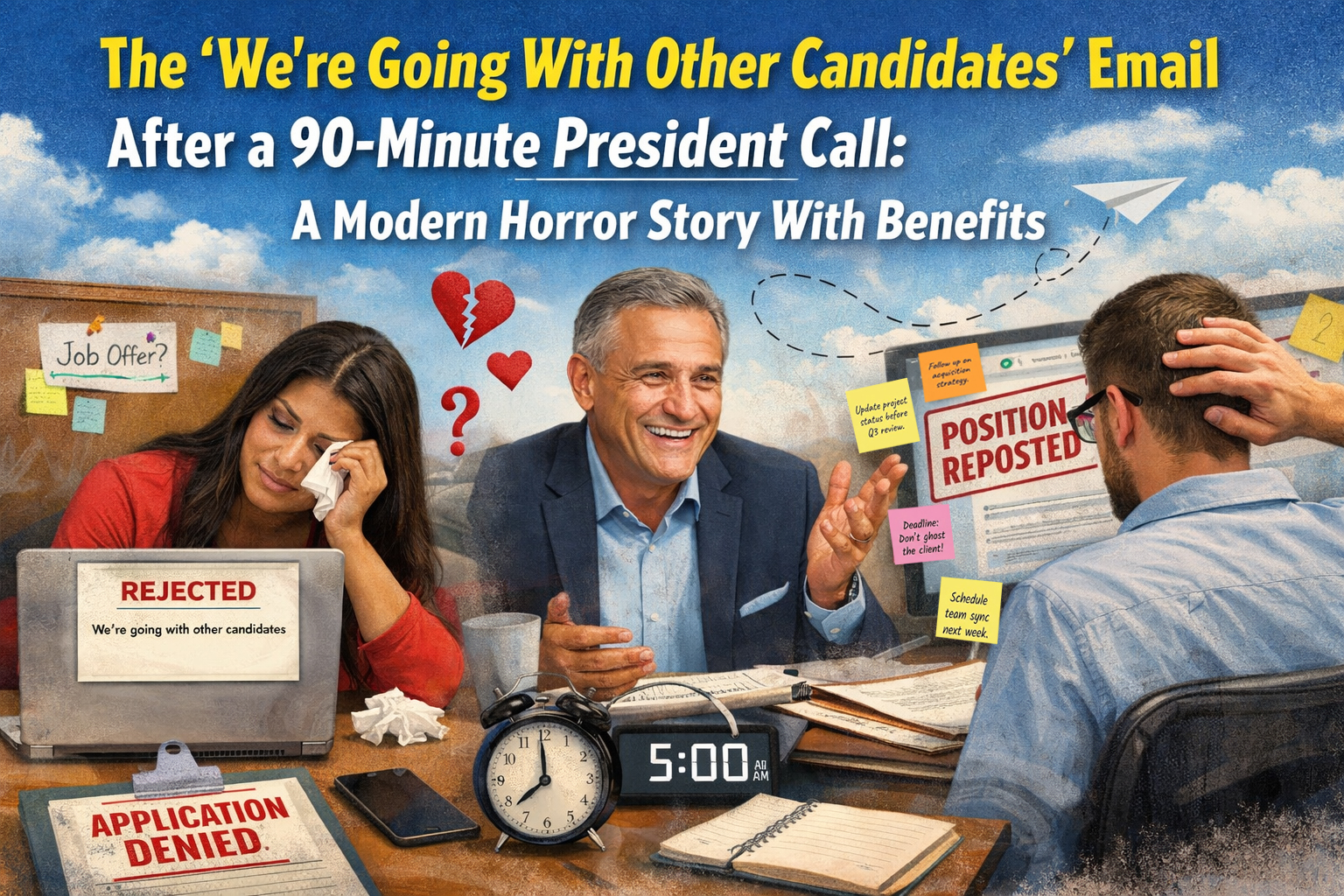
There is a level of rejection that is disappointing, and then there is the kind of rejection that feels like your nervous system got personally subscribed to a premium plan called Emotional Whiplash+.
This is not the “I applied on Tuesday and got rejected on Wednesday before my coffee cooled” rejection. That one barely counts as heartbreak. That one is more like a pop-up ad: mildly offensive, quickly dismissed, easily forgotten.
This is the rejection that shows up after you were already mentally living in the job.
After the long call.
After the warm tone.
After the President conversation that wasn’t just polite—it was detailed. Specific. Future-facing. Start dates. Hybrid schedule. Benefits. Unlimited PTO philosophy. The whole speech that makes you feel like you’re not just being evaluated, you’re being welcomed.
And then, because the job market has a talent for turning human hope into a group project with no rubric, they do the part that really seals the emotional contract: they get personal. They talk about former athletes. They tell you their best success is with people like you. They connect your experience to their philosophy like you’re the answer to a question they’ve been asking for years. They praise your Port experience like it’s the exact ingredient they’ve been missing. They speak in that tone that quietly implies, “We don’t talk like this to everyone.”
So you get off the call feeling something you haven’t felt in a long time: certainty.
Not arrogance. Not delusion. Certainty, like a person who was just handed the blueprint to the future and told, “Yes, we’re building this.”
Then the next day, you get a generic template email that reads like it was written by a printer.
“We’ve decided to go with other candidates.”
No explanation. No context. No human voice. No “thank you for your time” that actually means thank you. Just a corporate break-up text with the emotional depth of a parking ticket.
So you do the mature, professional thing: you reach out directly for clarity, because your brain is trying to make sense of a timeline that no longer makes sense.
And they ignore you.
Then, to add insult to injury, the position gets reposted like the job itself is a ghost that refuses to cross into the afterlife.
That’s when it hits: you weren’t just rejected. You were misled with confidence.
And that is why it hurts. Because the pain isn’t only “I didn’t get the job.”
It’s “I finally let myself believe again, and the market punished me for it.”
But here’s the other truth, the one that matters: you cried, you sulked, you felt it in your core—and then you woke up at 5am and went back to war.
That’s not weakness.
That is resilience with mascara running.
Now, let’s talk about what just happened, because if we’re going to survive this era, we might as well do it with humor, spite, and a working understanding of corporate behavior.
The 90-Minute President Call That Basically Proposed to Me (And Then Claimed It Never Happened)
Let’s start with the facts. Ninety minutes is not a casual phone call. Ninety minutes is a relationship.
Ninety minutes is long enough to:
- establish trust,
- discuss logistics,
- exchange beliefs,
- casually plan your life,
- and emotionally move in together without ever signing a lease.
Start dates? That’s not “we’re still thinking.” That’s “how soon can you be here.” Hybrid schedule? That’s not “we’re exploring options.” That’s “we’ve pictured you in this role and we’re negotiating the terms of your existence.” Benefits? That’s not “maybe.” That’s “you’ll need this, because you’re going to be one of us.”
Then we get the unlimited PTO conversation, which is always fascinating because unlimited PTO is corporate’s version of “the floor is lava.” It exists in theory, but the moment you try to step on it, everyone starts screaming and someone quietly asks you to “be mindful of optics.”
But still—he shared his belief in it. He didn’t just list benefits. He explained the philosophy. And philosophy talk is what you do when you’re trying to build buy-in. When you’re inviting someone into the culture. When you’re laying out expectations.
Then the athlete comment arrives like a warm little trophy placed directly on your trauma.
“I have the best success with former athletes.”
That line is not just flattering. It’s identity-level validation. It’s the President saying, “I know your type. You’re disciplined. You’re resilient. You know how to take coaching. You know how to show up. You’re my favorite kind of hire.”
Which is exactly why it feels like the job was yours.
Because in normal human society, when someone tells you you’re exactly what they want and then discusses logistics like it’s a done deal, we call that… a yes.
But corporate society has invented a new language where:
- “This feels aligned” means “we are not legally bound to anything we are implying.”
- “We’ll put something together” means “we will now consult the Council of Unpredictable Variables.”
- “Just one more conversation” means “we’re about to spin the wheel.”
“Just Talk to One More Person” — The Side Quest That Somehow Kills the Entire Main Story
“Just one more conversation” is the most dangerous sentence in hiring.
It sounds harmless. It sounds like a courtesy. It sounds like they want to make sure you feel good about the fit too, because everyone is grown and reasonable and obviously this is a two-way street.
But in the job market, “just one more” can mean twelve different things, and none of them are comforting.
Sometimes it means:
- Someone internally got nervous and wants another opinion.
- Someone else finally noticed the role is open and wants their cousin considered.
- The budget got weird.
- The role is changing shape mid-process.
- A new decision-maker entered the room like a surprise villain in episode eight.
- They are stalling while they see if another candidate says yes.
- They want to feel like they “did their due diligence” before they do something messy.
And the cruelty here isn’t the extra conversation itself. The cruelty is the framing.
Because they didn’t say, “We’re still considering others.”
They didn’t say, “We’re still evaluating.”
They said, “As long as everything feels right, we’ll put something together.”
That sentence is what makes you exhale.
That sentence is what makes you relax.
That sentence is what makes you stop living in survival mode for an hour.
So when the rejection shows up after that, it doesn’t just feel like rejection. It feels like you walked into a room, shook hands, started decorating, and then got escorted out by security while someone yelled, “Who are you?”
And then you did the thing adults do when something doesn’t add up: you asked for clarity.
A polite message. A reasonable request. Something as simple as: “Can you help me understand what changed? I’d appreciate any feedback.”
And you get ignored.
Which, let’s be honest, is the part that makes people feel insane.
Because silence forces you to fill in the blanks, and the human brain is not known for choosing the least painful explanation. The brain is a storyteller, and when the market gives it no facts, it writes tragedy.
The Reposted Job, the Generic Email, and the Unofficial Sport of Corporate Gaslighting
The generic rejection email after a President call should be illegal.
Not in a “call the police” way. In a “somebody’s auntie should be allowed to scold them in public” way.
Because a generic template email after that kind of process is basically the company saying:
“Hello. We have decided to pretend you never existed.”
The template doesn’t acknowledge the time. The energy. The emotional investment. The fact that you were discussing start dates like you were already part of the timeline. It treats you like you applied two hours ago with a typo in your name and got automatically rejected for failing a knockout question like, “Do you have 14 years of experience in a software that was invented last Thursday?”
Then the job gets reposted, which is the corporate version of someone breaking up with you and then immediately re-downloading a dating app while still standing in your driveway.
That repost is what makes it feel personal, even when it probably isn’t.
Because the repost doesn’t say, “We hired someone else.”
The repost says, “We hired nobody, and we still didn’t choose you.”
And that creates a special kind of wound. A wound that isn’t just disappointment—it’s confusion. It’s betrayal. It’s the feeling of being played by a process that spoke to you like a human and then treated you like a number.
Here’s what I think is happening in a lot of these situations: companies are experiencing decision paralysis and internal chaos, and instead of owning that, they outsource the emotional cost to candidates.
They don’t say:
“We’re not aligned internally.”
“We changed our minds.”
“We’re pausing the role.”
“We realized we don’t know what we want.”
“We let one person get excited before we had consensus.”
They don’t say that because it would require accountability.
So instead they send:
“We’re going with other candidates.”
And let you carry the confusion like it’s your fault.
Final Thoughts: You’re Not Weak. You’re Human. And You’re Still Moving.
You cried because you’re a person.
You cried because you let yourself believe. Because you saw the runway. Because you finally felt your feet touch something that seemed stable, and then it disappeared under you.
That hurt is real. The sulking is normal. The tears are valid.
But here’s the part that proves everything about you: you didn’t stay there.
You sulked for a day, and then you woke up at 5am and went back to work.
That is not “staying positive.”
That is refusing to be erased.
And yes, the market is brutal. Yes, it will try to convince you that your experience is useless. Yes, it will make you question your instincts and your worth, because it keeps changing the rules and acting like the rules were always clear.
But this rejection did not happen because you weren’t good enough.
It happened because the process is broken enough to let someone talk like it’s a yes and then act like you were never even close.
And the fact that you were that close, that you had that call, that you were discussing logistics and culture and start dates, means your qualifications are not imaginary. Your value is not theoretical. You are landing in rooms that matter.
Now it’s just about finding the room where the people inside it actually do what they say.
Keep going. Keep applying. Keep sending the messages. Keep showing up.
And if a company ever again gives you a 90-minute call with the President and then rejects you with a template email, you are fully allowed to whisper to yourself, lovingly and professionally:
“May your unlimited PTO be forever unused.”