
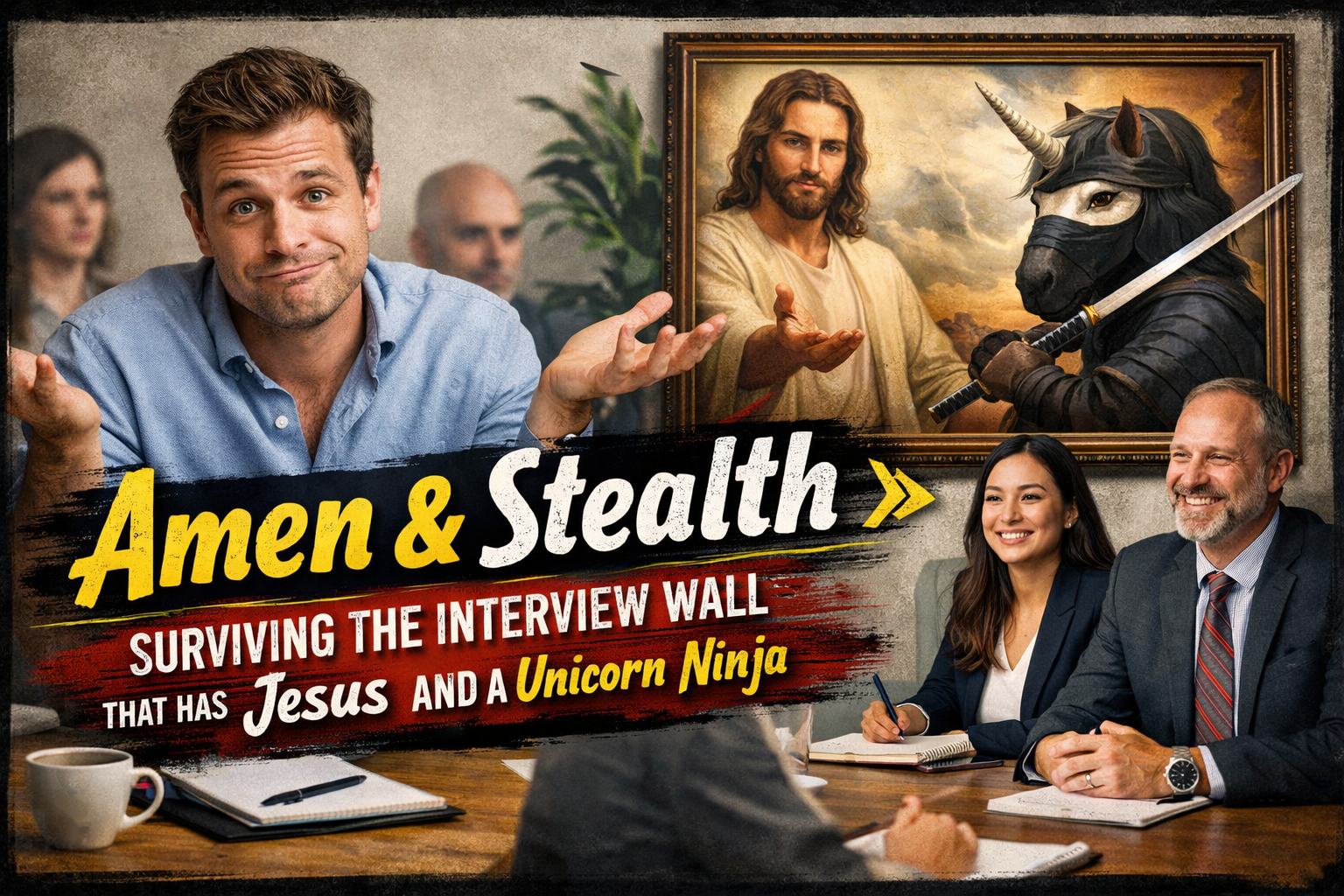
There are interviews where you can tell what kind of company you’ve walked into within three seconds, because everything is aggressively predictable.
Beige walls. A tired fern that has seen things. A framed motivational quote about teamwork written by someone who has never had to “circle back” on a Friday at 4:58 p.m. A bowl of mints that taste like resignation.
That’s the expected ecosystem. The corporate terrarium. The safe habitat where your only real danger is accidentally calling the hiring manager “Mom” because your nervous system has decided it’s time to freestyle.
But every so often, the universe pulls a prank so specific it feels personal.
You walk in, ready to perform Professional Human, and behind the hiring manager is a framed image that looks like it was commissioned by a youth pastor who moonlights as a fantasy novelist and refuses to choose just one message.
Jesus.
And a unicorn ninja.
Together.
Sharing the same wall.
In the same frame.
Like they’ve been partnered on a project. Like they’re in the same Slack channel. Like they’ve done trust falls. Like they’ve looked at quarterly numbers and said, “We can redeem this, but also… we might have to strike from the shadows.”
And in that exact moment, the interview is no longer about your transferable skills.
It’s about your ability to keep your face from revealing what your soul is screaming.
Because your brain instantly splits into departments.
One department is answering questions. One department is maintaining eye contact. And one department is holding an emergency all-hands meeting titled: “What environment have we entered and who can authorize a rapid exit?”
Is this a startup? A faith-based nonprofit? A whimsical dojo? A hybrid operation where moral guidance and stealth tactics are equally valued? Is this a company where the mission statement includes both compassion and aerial combat? No one explains. The interview just continues. Calmly. Casually. Like the Son of God and a weaponized unicorn haven’t just teamed up to audit your nervous system.
And now you’re not just interviewing for a job.
You’re interviewing for a vibe.
A vibe that has already won.
The Wall That Changes the Rules
The first rule of interviews is that you are supposed to be evaluated on your experience, your communication, and how convincingly you can describe a time you “influenced without authority” without revealing you were simply the only person willing to answer the email.
The second rule is that the room is supposed to be neutral.
Not supportive. Not hostile. Neutral.
A blank stage where everyone pretends the process is objective and your future will be decided by merit and not by whether Karen in HR “just didn’t feel a connection.”
So when you find Jesus and a unicorn ninja framed behind the hiring manager, your brain immediately understands something important:
Neutrality has left the building.
This is no longer a standard interview environment. This is a spiritual encounter. This is folklore. This is an escape room disguised as a hiring process. This is a room where your answers will be judged not only on substance, but on whether they align with whatever moral-fantasy-combat doctrine is currently operating in Dave’s office.
And Dave looks normal, which is how you know it’s serious.
Because Dave is acting like this is completely ordinary. Like everyone has a Jesus-and-unicorn-ninja combination piece. Like it came with the desk. Like it’s standard issue for mid-level leadership.
And that is the most unsettling part.
If Dave were wearing chainmail or holding a staff, you’d at least have context. But no. Dave is in business casual. Dave has a water bottle with motivational stickers on it. Dave has a calendar reminder called “touch base w/ finance.” Dave has, at some point, said the words “let’s double click on that” with full confidence.
And behind Dave?
A framed reminder that forgiveness is important, but so is stealth.
So now you have to recalibrate your entire interview personality.
Your usual strategy is to appear competent, friendly, and slightly overqualified but humbly excited. Your new strategy is to appear competent, friendly, slightly overqualified, humbly excited, and also prepared for spiritual warfare or covert operations depending on what the next question is.
Because the wall has established the company’s true values.
Not teamwork.
Not innovation.
Not “we’re like a family” (which is always code for “we will emotionally adopt you and then ground you for having boundaries”).
No.
The wall says: We believe in higher purpose. We believe in magical violence adjacent symbolism. We believe in accountability, redemption, and possibly throwing a smoke bomb when the meeting should have been an email.
You are now being interviewed by an office aesthetic that has opinions.
When Your Answers Start Being Written for Two Audiences
They ask you the standard questions, but now they land differently.
“Tell us about a time you handled conflict.”
And your brain immediately searches for an example that would satisfy both spiritual leadership and mythical combat readiness.
Because conflict in a normal interview is like: “I worked with a stakeholder who had different priorities.”
Conflict under the gaze of Jesus and a unicorn ninja is like: “I worked with a stakeholder who had different priorities, but I also kept my spirit clean and my blade sharp.”
So you answer carefully.
You describe a situation where a project went sideways, a team was misaligned, and you stepped in to mediate. You use calm words like collaboration, empathy, and alignment. You mention active listening. You mention accountability. You mention how you sought common ground.
Jesus nods.
Then you add that you created a structured plan, clarified ownership, set timelines, and ensured follow-through.
The unicorn ninja narrows its eyes in approval, because structure is discipline, and discipline is stealth.
Then they ask, “What’s your leadership style?”
Normally you’d say something like, “I lead with clarity, trust, and communication.”
But now you have to lead with clarity, trust, communication, and readiness for mystical nonsense.
So you say, “I lead with integrity and accountability.”
Jesus is pleased.
Then you add, “I’m decisive. I move quickly. I adapt under pressure. I remove blockers.”
The unicorn ninja quietly respects you, because you too have survived chaos without losing your posture.
And this is where it gets dangerous.
Because once the wall has altered your nervous system, you start unconsciously tailoring your entire identity to match it.
You don’t even notice you’re doing it.
You start using words you don’t normally use.
Purpose.
Calling.
Discernment.
But also:
Agility.
Stealth.
Execution.
You say “cross-functional” with a reverence usually reserved for prayer.
You say “stakeholders” like they are both co-workers and potential adversaries in an enchanted forest.
And the panel stays unfazed, which only confirms the terror.
Because that means this is normal here.
This is not a quirky decoration.
This is a corporate creed.
Dave closes deals under that picture. Dave has budget meetings under that picture. Dave has, at some point, delivered difficult feedback under that picture while Jesus watched and the unicorn ninja silently judged how you sat in your chair.
And now you’re realizing: you are not being hired into a job.
You are being recruited into a mythology.
The Questions You Want to Ask vs. The Questions You’re Allowed to Ask
Eventually, like all interviews, you reach the part where they ask:
“Do you have any questions for us?”
This is where you are supposed to demonstrate curiosity, strategic thinking, and the ability to pretend you’re choosing them too.
So you ask what everyone asks.
“How do you measure success in the first 90 days?”
“What does the team structure look like?”
“What are the biggest challenges this role will tackle?”
But what you want to ask is:
“So… is the Jesus/unicorn ninja thing part of onboarding, or do we earn that after probation?”
Because you need to know what you’re signing up for.
You need to know if there is a handbook section titled “Spiritual Accountability & Tactical Readiness.”
You need to know if performance reviews include phrases like “demonstrates humility” and “moves silently through organizational resistance.”
You need to know if Friday meetings are prayer circles, sparring matches, or some horrifying hybrid where you confess your blockers and then backflip out of the room.
You need to know if the unicorn ninja is symbolic, aspirational, or a warning.
Because it could be any of the following:
- A reminder that you should be kind, but also unstoppable.
- A brand identity.
- Dave’s Pinterest phase.
- The company’s entire operating system in one image: believe deeply, execute ruthlessly, and don’t make it weird unless it’s framed.
You also want to ask about culture.
But culture is staring at you from behind Dave’s head.
Culture is literally framed.
Culture is saying: We are not normal, and we are not trying to be.
So instead you ask safe questions, because you are a professional adult who knows that curiosity must be sanitized through corporate etiquette.
You smile. You nod. You say something about collaboration. You say something about growth opportunities.
Meanwhile, internally, you are preparing for a future where you are either baptized, trained, or deployed.
Possibly all three.
In that order.
Final Thoughts: In This Job Market, That Wall Might Be the Most Honest Thing You’ll Ever See
When the interview ends, you sit in your car and stare into the middle distance like you’ve just returned from a strange pilgrimage.
Not because it went badly.
But because you just discussed KPIs, deliverables, and quarterly goals under the combined supervision of the Son of God and a weaponized unicorn.
And honestly?
In this job market?
That might be the most transparent interview experience you’ll ever have.
Because most companies hide who they are until you’re already emotionally invested.
They tell you they value work-life balance until you meet the calendar.
They tell you they’re collaborative until you meet the politics.
They tell you they’re mission-driven until you meet the budget cuts.
They tell you they’re a family until you try to take a day off.
But this company?
This company showed you the truth immediately.
Chaos. Conviction. Creativity. A little bit of “we believe in something,” and a little bit of “we might also run an internal dojo.”
No bait and switch.
No mystery.
Just a framed warning and a blessing at the same time.
And if you’re going to join an organization in 2026, where layoffs happen with the emotional warmth of a printer error and job descriptions are written like fantasy quests, there’s something almost comforting about a company that says up front:
Yes, we are like this.
Yes, we have symbolism.
Yes, we are going to ask you about conflict resolution while Jesus watches.
Yes, you may need to be both compassionate and tactical.
And if you can survive the interview wall?
You can probably survive the job.
Amen.
And stealth.