
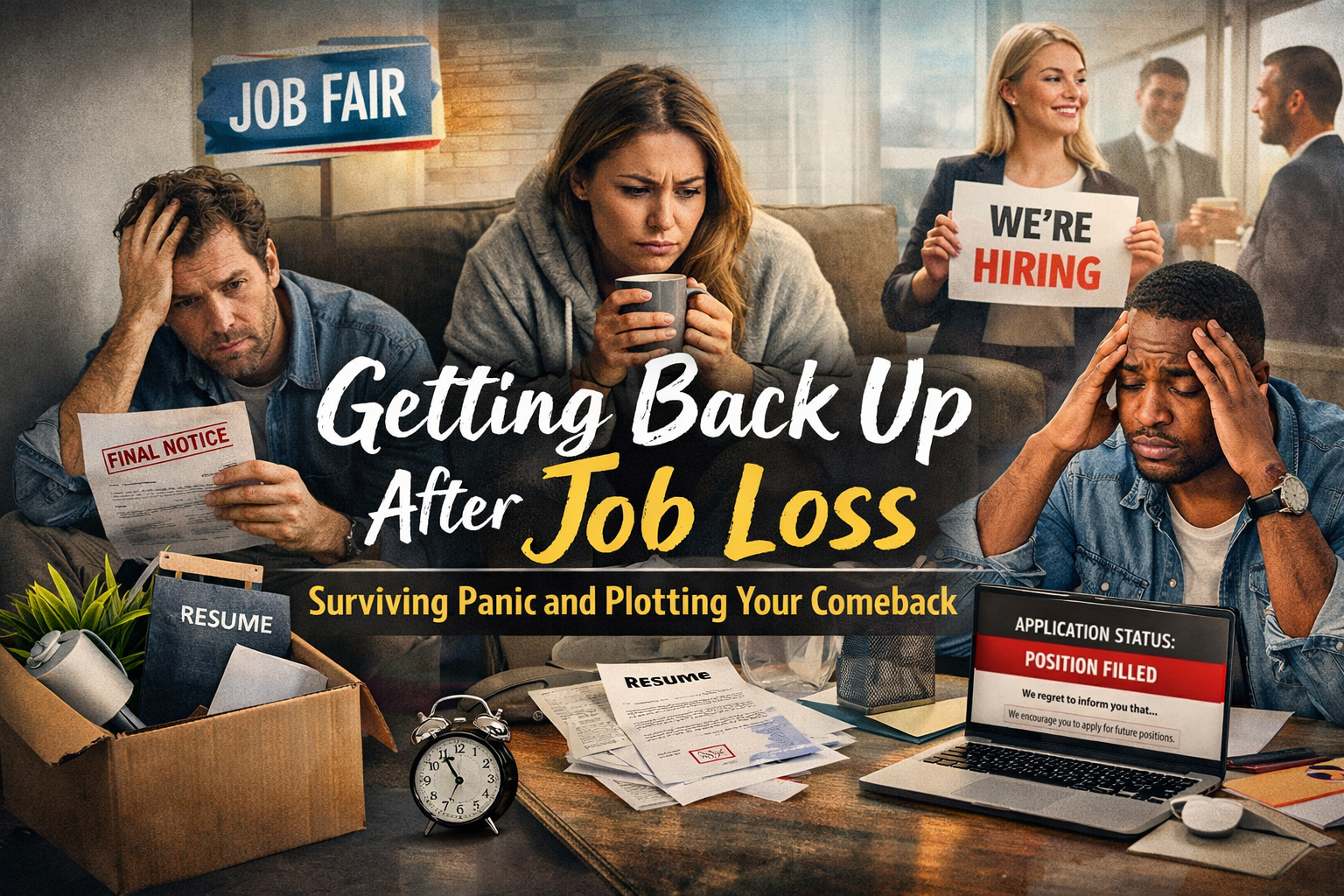
There’s a particular kind of quiet that shows up after job loss, and it’s not peaceful quiet, it’s “did the Wi-Fi go out or did my identity just evaporate” quiet.
One day you’re in meetings nodding like you’re not dying inside, throwing around phrases like “alignment,” “bandwidth,” and “circle back,” and the next day you’re standing in your kitchen holding a coffee that suddenly tastes like grief and budgeting, staring at a calendar full of nothing, realizing you no longer have a reason to pretend your laptop is a personality.
And yes, people say things. They say the same six things, like grief has a script and everyone got the memo except you.
“You’ll land on your feet.”
“This is a blessing in disguise.”
“Everything happens for a reason.”
“Something better is coming.”
“At least you have your health.”
“Have you tried networking?”
Networking. Like you’re supposed to put on a brave face and go mingle with the exact same industry that just drop-kicked you into the unemployment abyss. Like you’re supposed to be your own hype squad while your nervous system is living under a table, chewing through the legs of your confidence like it’s an emergency snack.
Here’s what nobody tells you: the first stage of job loss isn’t job searching. It’s panic. It’s waking up with a heart rate that says, “Good morning, we are being hunted.” It’s doing math you never wanted to do. It’s staring at your bank account like it personally betrayed you. It’s refreshing your email with the urgency of someone trying to resuscitate their dignity.
It’s also deeply weird how quickly your brain starts auditioning new fears. You don’t just feel sad. You become an amateur disaster filmmaker.
“What if I never work again?”
“What if I lose my apartment?”
“What if my friends find out I’m not thriving?”
“What if I end up living in a studio that also functions as a cautionary tale?”
And the worst part is that you’re still you. You still have the same skills. The same experience. The same work ethic. The same ability to get things done.
But now you also have a new side gig: emotionally surviving your own thoughts.
So if you’re reading this in the aftermath—if you’re in the fog, the panic, the humiliation, the “I don’t know who I am without that paycheck” spiral—this is your reminder that you are not broken. You are shocked. You are grieving. You are recalibrating.
And like every other dramatic season finale you’ve survived, you are going to get back up.
Not because it’s cute. Not because it’s inspirational. But because you are a human being and you have bills and a stubborn sense of self that refuses to be permanently benched by one corporate decision.
Let’s talk about how that getting-back-up actually looks.
The Free Fall (Featuring Panic, Math, and Your Nervous System Filing a Complaint)
The first 72 hours after job loss are a fever dream. Time slows down. Your brain alternates between numbness and a suspiciously productive urge to “fix everything” even though there is nothing to fix because the decision already happened and capitalism does not accept appeals based on vibes.
You walk around your house like a ghost in business casual. You keep checking your phone like someone might text, “Just kidding, come back, we realized you were the whole operation.” You open your laptop on instinct, then stare at it like it’s an ex who still has your hoodie.
And then panic arrives with a clipboard.
Panic wants spreadsheets. Panic wants worst-case scenarios. Panic wants to calculate how many days you can survive on the contents of your freezer and sheer audacity. Panic wants to rehearse catastrophic conversations with imaginary landlords.
Panic also has opinions about your worth, which is interesting, because panic has never managed a project, never built a deck, never de-escalated a crisis, never held it together in a meeting while your soul was quietly leaving your body, but suddenly panic is the loudest voice in the room.
It says things like:
“You’re behind.”
“You’re not enough.”
“Everyone else is doing better.”
“You should have seen this coming.”
“This is your fault.”
“You’ll never catch up.”
And here’s the tricky part: when you lose a job, it doesn’t just hit your bank account. It hits your identity. Even if you hated the job. Even if the culture was a mess. Even if you were running on fumes. You still attached pieces of yourself to that title, that routine, that sense of being needed.
Job loss is grief with a LinkedIn profile.
And grief does not politely file itself under “professional development opportunity.” Grief shows up as insomnia. As nausea. As sudden tears in the cereal aisle because you saw something called “Family Size” and your brain went, “Great, must be nice to afford joy.”
Grief also shows up as shame, which is the worst roommate because it doesn’t pay rent and it eats all your confidence.
Shame whispers, “Don’t tell anyone.”
Shame says, “They’ll judge you.”
Shame says, “You’re a failure.”
Shame says, “Now you’re one of those people.”
As if “those people” aren’t… literally most people at some point. As if job loss is a moral verdict and not a market reality, a leadership decision, a budget shift, a restructure, a merge, a random Tuesday where someone in a conference room decided your name could fit in the “cut” column.
This is why the first step of getting back up isn’t “update your resume.” The first step is stabilizing your nervous system long enough to remember you’re not in danger, you’re in transition.
Not a cute transition. Not a Pinterest quote transition. A real one. The kind that makes your body treat email notifications like thunder.
So you do the small things first.
You drink water like a person who plans to survive.
You eat something that isn’t pure sadness and caffeine.
You take a walk even though your brain says it’s pointless.
You tell one safe person the truth, because secrecy makes panic stronger.
You write down your expenses, not to scare yourself, but to give yourself a map.
And slowly, very slowly, the free fall starts to become ground.
Not stable ground. But ground you can stand on long enough to take the next step.
The Application Hunger Games (Where You Become a Brand While Quietly Unraveling)
Once the shock wears off, you enter the part of job loss nobody romanticizes: the job search, also known as “auditioning for your own survival while pretending it’s exciting.”
This is the stage where you become a small marketing agency for a product called You, and the product has to be simultaneously confident and humble, experienced but eager, accomplished but coachable, independent but collaborative, strategic but hands-on, and ideally willing to do the job of three people for a salary described as “competitive,” which is corporate for “we’ll tell you once you’ve cried in at least two interviews.”
You update your resume, and suddenly you’re rewriting your entire life like you’re trying to impress a robot with commitment issues.
You don’t “worked on projects.” You “spearheaded cross-functional initiatives.”
You don’t “helped customers.” You “optimized client outcomes.”
You don’t “fixed problems.” You “drove operational excellence.”
You start removing anything that sounds human.
Because the job search teaches you a painful lesson: authenticity is encouraged, but only if it’s curated.
Then comes LinkedIn, the digital town square where everyone is either “thrilled to announce” something or “honored and humbled” to exist.
You post updates with a tone that says, “I am doing great,” while your insides are doing acrobatics.
You message recruiters with the exact right amount of enthusiasm:
Not too desperate.
Not too casual.
Not too confident.
Not too unsure.
Not too alive.
And you apply. And you apply. And you apply.
You tailor your resume so many times you begin to suspect your actual profession is “professional tailoring.”
You write cover letters that feel like emotionally intelligent begging.
You answer application questions that ask you to retype your resume, which is a spiritual test designed to see if you’re willing to suffer politely.
You take assessments that measure your ability to identify patterns, like the pattern of employers wasting your time.
And the silence. The silence is loud.
You get ghosted by companies you didn’t even want. You get automated rejections that arrive at 2:14 a.m. as if their system is powered by petty insomnia. You get emails that say “we were impressed” followed by “we are moving forward with other candidates,” which is the corporate equivalent of “it’s not you, it’s us,” except it is you, because you are the one with rent.
This is where panic tries to make a comeback.
It says, “See? I told you.”
It says, “You’re failing.”
It says, “You should lower your standards.”
It says, “This is who you are now.”
But here’s the truth: the job search isn’t a reflection of your worth. It’s a reflection of a system that is chaotic, overloaded, inconsistent, and often designed to protect companies from risk rather than recognize people with talent.
It’s a funnel. It’s a filter. It’s a series of gatekeepers with different preferences, different pressures, different internal politics, and different levels of competence. Sometimes you don’t get the job because you weren’t good. Sometimes you don’t get the job because someone internally already had a favorite. Sometimes you don’t get the job because the budget changed. Sometimes you don’t get the job because the hiring manager got spooked by the concept of paying someone what they’re worth.
And in the middle of it, you have to keep yourself human.
So you set boundaries with the process.
You build a routine so your days don’t dissolve into a blur of refreshing inboxes.
You pick application windows instead of applying all day like you’re trying to outrun fear.
You keep a “wins” list: interviews landed, connections made, skills refreshed, days survived.
You do something that reminds you you’re more than a candidate ID number.
Because the hardest part isn’t the work. You can do the work.
The hardest part is keeping your spirit from shrinking while you wait for someone else to decide you matter.
The Comeback (Not a Glow-Up, a Crawl-Back)
Eventually, something shifts. Not all at once. Not dramatically. More like the slow return of your own voice.
You start noticing the moments you didn’t fall apart.
You start recognizing your resilience as a skill, not an accident.
You start seeing the difference between “I am afraid” and “I am unsafe.”
You stop treating every rejection like a prophecy.
You stop reading silence as a verdict.
You stop assuming the worst version of yourself is the truest one.
And then you begin the real work of getting back up, which isn’t the “big moment” people love to post about. It’s the small, unglamorous, consistent actions that rebuild your footing.
You refine your resume, yes, but you also rebuild your confidence by remembering what you’ve actually done.
You practice interviewing, but you also practice breathing through the trigger of being evaluated.
You network, but you do it as a person, not a performance.
You learn to talk about your job loss without apologizing, because it is not a character flaw.
You also let yourself change.
Because job loss has a way of clarifying what you will never tolerate again.
You remember the meetings that drained you.
You remember the culture that demanded everything and gave nothing.
You remember the way your body felt on Sunday nights.
You remember the version of yourself you had to suppress to fit in.
And you realize: getting back up isn’t just about getting another job.
It’s about getting your life back.
It’s about choosing a future where you aren’t constantly bracing.
Where you aren’t always proving.
Where you aren’t living on the edge of burnout like it’s a normal lifestyle.
And when the opportunity finally comes—when someone replies, when a recruiter calls, when an interview goes well, when an offer shows up—you might not even feel pure joy at first.
You might feel relief.
You might feel disbelief.
You might feel cautious.
You might feel like you don’t trust good news yet.
That’s normal too.
Because your nervous system has been through a season where uncertainty lived in your chest like a permanent tenant. It takes time to believe stability again.
But you will.
And one day you’ll realize: you’re standing. You’re working. You’re laughing again. Not because the job search was fun, but because you survived it.
Because you did what you always do.
You adapted. You endured. You rebuilt.
Final Thoughts: You Didn’t Lose Your Worth, You Lost a Role
If you’re in the thick of it right now—if you’re panicking, spiraling, ashamed, exhausted—please hear this clearly:
Job loss is not the end of your story. It’s the rude plot twist that forced a rewrite.
You are still skilled.
You are still valuable.
You are still capable.
You are still allowed to be scared and still move forward anyway.
Getting back up after job loss doesn’t look like a confident strut with a perfectly curated “thrilled to announce” post.
Sometimes it looks like crying in the car and applying anyway.
Sometimes it looks like taking a shower even though your brain says it doesn’t matter.
Sometimes it looks like rewriting your resume for the tenth time while whispering, “Please work.”
Sometimes it looks like choosing hope in smaller doses because that’s all you can hold today.
But every time you do one more thing, even a tiny thing, you are getting back up.
And one day, without fanfare, you’ll realize you’re not in free fall anymore.
You’re moving forward.
Not untouched.
Not unshaken.
But stronger in the way that only lived experience can build.
And that strength—quiet, stubborn, earned—will carry you into whatever comes next.






And some day, the tears will dry and I can blink again w/o welling up.