
There’s a moment in every content creator’s life when someone casually says, “Your posts are the highlight of my day,” and you have to do that polite, grateful, socially approved smile while your inner voice slowly stands up, adjusts its tie, and whispers, “Oh no.”
Because on paper, that’s lovely. That’s human connection. That’s impact. That’s the internet doing something other than selling you a “life-changing” water bottle that costs more than your utility bill.
But in reality, it’s also a small emotional flare gun fired into the sky that reads: WE ARE NOT DOING WELL.
Not “haha we’re tired.” Not “lol it’s been a long week.” I mean the collective, quiet realization that if a stranger’s post about corporate nonsense is the best part of your day, then your day has been structured like a hostage negotiation with Outlook. Your serotonin is being rationed in the form of funny paragraphs because your workplace has replaced basic joy with inspirational Slack messages and a mandatory “Wellness Wednesday” that begins and ends with a link to the EAP hotline.
And it makes sense, because modern professional life is a strange performance where everyone is expected to be endlessly resilient, politely enthusiastic, and capable of absorbing chaos like a sponge with a LinkedIn Premium subscription. We are all walking around pretending things are normal while the hiring process—this thing that determines whether you can pay rent, buy groceries, and stop panic-refreshing your email like it owes you money—has evolved into a reality show where the prize is a salary range they refuse to disclose.
Which is why the jokes land. Not because they’re clever. Because they’re familiar.
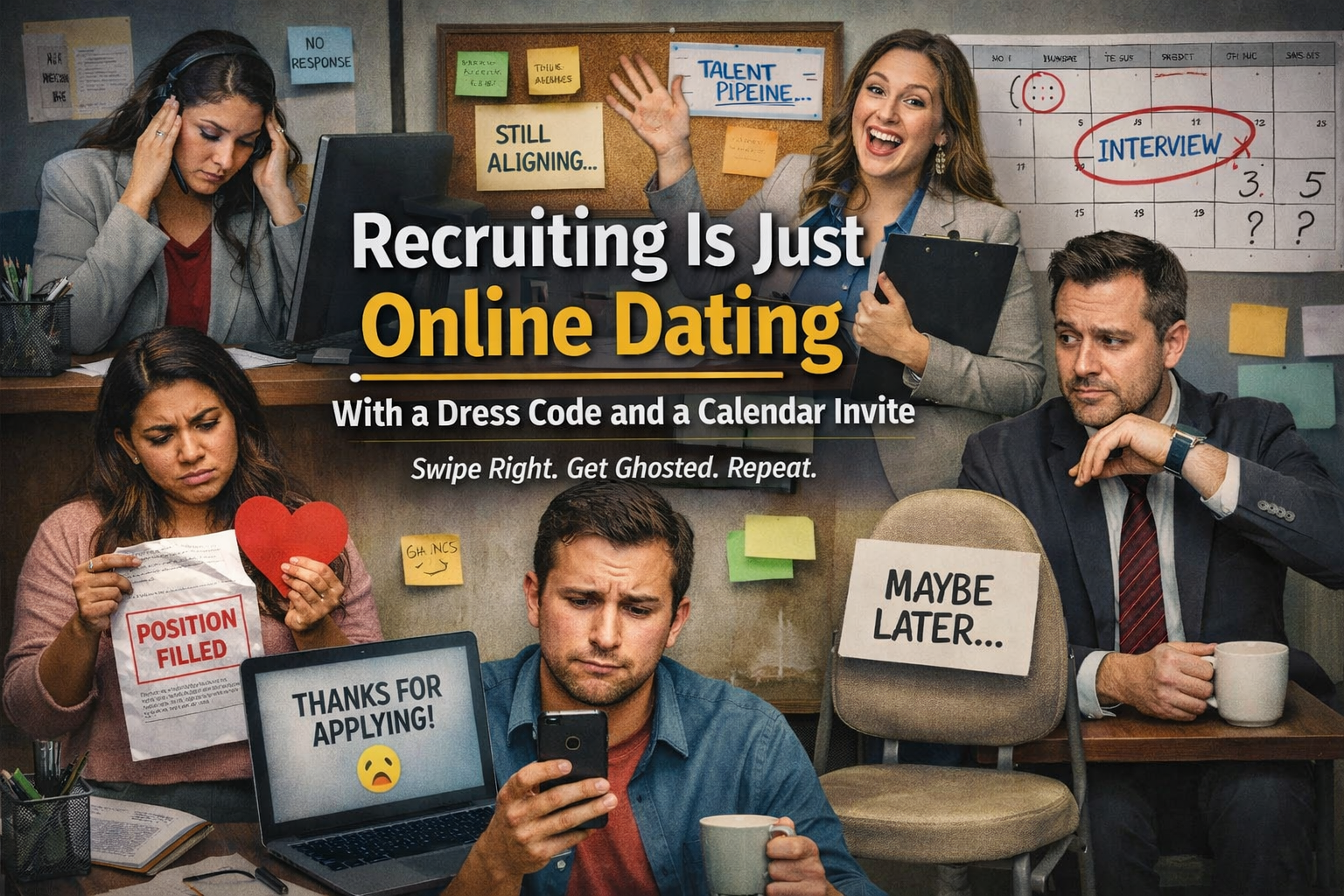
And nowhere is this more painfully relatable than recruiting, which is, at this point, online dating with worse communication and more pivot tables.
You swipe right by applying. You tailor your resume like it’s a first date outfit. You make sure you look confident but not arrogant, experienced but not threatening, ambitious but not like you want fair compensation. You match. You message. You schedule the call. You get that first little hit of hope, that tiny spark of “maybe this is it,” that sweet, delusional optimism that briefly convinces you the universe isn’t just a series of automated emails and silent rejection.
And then… ghosted.
Not “sorry, it’s a no.” Not “we’re going in another direction.” Not even the decency of a rejection letter that looks like it was written by a toaster.
Just silence.
The kind of silence that makes you wonder if you hallucinated the interview, if your Wi-Fi dropped you into an alternate dimension, or if the recruiter has been legally prohibited from acknowledging your existence.
So yes. People are right. This should be a show. Because it already has everything: recurring characters, running jokes, plot twists, emotional whiplash, and a fan base that doesn’t know whether to laugh or file a formal complaint with the Department of Human Decency.
Welcome to the series.
The Match — “We Loved Your Background” (Which Is Recruiter for “You Seemed Convenient”)
It starts the same way every time: a notification, a message, a “quick question,” a “love your experience,” the digital equivalent of someone at a bar making eye contact and pretending they didn’t just copy-paste that compliment into twelve other conversations.
“We were really impressed by your background.”
Translation: you have enough keywords to trigger the ATS like it’s a motion-activated sprinkler.
And of course you respond. Because you are a reasonable adult who would like to exchange labor for money. You answer their questions. You rearrange your calendar. You move things. You cancel things. You create “prep time” blocks like a chef on a cooking show, except instead of preparing ingredients you’re preparing your personality to be palatable.
You do the first call.
The recruiter is aggressively cheerful, which is either a coping mechanism or a personality trait developed after years of being trapped in conversations that begin with “So what are your salary expectations?” and end with “We’ll circle back.”
They ask you to walk through your resume, which is interesting because your resume is directly in front of them and also you sent it voluntarily, meaning this is less a question and more a ritual. This is the professional version of, “Tell me about yourself,” where the goal is to see if you can speak confidently about your own existence without sounding like you’re begging for validation.
You do well. You’re charming but not too charming. Competent but not intimidating. Human but not emotional. You hit the sweet spot: a pleasant coworker who won’t sue and probably knows Excel.
They say they’re excited.
They say the hiring manager will love you.
They say you’re a “strong candidate.”
And this is where things get dangerous, because your brain—your poor, hopeful, golden retriever of a brain—hears “strong candidate” and starts building an entire life off a sentence that is not legally binding and is often delivered by someone who will never speak to you again.
You start imagining the offer email.
You picture the moment you resign from your current job like a movie scene where you walk out in slow motion and the fluorescent lights flicker respectfully as you pass.
You think, maybe, just maybe, this process won’t be a psychological endurance test disguised as “talent acquisition.”
Then you get the scheduling email.
And that’s when you realize: you are now in a relationship with a calendar invite.
The Interview Arc — “Great Conversation” (Which Is Corporate for “We Will Now Disappear”)
The interview process is supposed to be about fit and skills. In practice, it’s a series of increasingly personal trials designed to determine whether you can endure discomfort while smiling.
Round one is usually polite. Round two is where they begin to act like you’re auditioning for the role of “Person Who Will Save This Company Without Asking For Anything In Return.”
By round three, you are essentially being asked to perform emotional labor on command:
“Tell me about a time you faced conflict.”
“Tell me about a failure.”
“Tell me about a time you led through ambiguity.”
Which is a funny question, because the entire hiring process itself is ambiguity. You are literally living the thing they’re asking you to describe. You are in the conflict. You are inside the failure. You are navigating uncertainty right now, and if you want a live example, I can just screen share my inbox.
The hiring manager joins late, naturally, because time is a concept that only applies to candidates. They apologize with the same tone people use when they’ve spilled coffee: casual, mildly inconvenienced, and confident you’ll still be grateful.
They ask you a question you already answered, because they didn’t read the notes, because no one reads the notes, because the notes are like “company values”—they exist primarily as a decorative idea.
Then comes the culture pitch.
“We’re like a family here.”
Which is always said with pride, as if families are known for healthy communication, clear expectations, and fair compensation.
They say they want someone who can “hit the ground running.”
Which is corporate for, “We do not train. We do not onboard. We will hand you a broken process, a vague title, and a login that doesn’t work, and we will judge you based on how quickly you stop asking questions.”
They say “fast-paced environment,” which means the company is constantly on fire, but in a motivational way.
They say “high visibility,” which means you will be blamed publicly.
They say “wear many hats,” which means you will be doing three jobs and receiving one paycheck, but you’ll get to call it growth.
And still—still—you leave the interview thinking, “That went well.”
Because you were presentable. Because you were prepared. Because you did the dance correctly. Because you have been trained, through years of professional survival, to interpret vague enthusiasm as progress.
And then you wait.
You wait like a person checking the phone after a first date, rereading the conversation for signs, replaying the interviewer’s tone like it’s evidence in a court case, analyzing every word you said until your memories start charging you rent.
You send the thank-you email. You craft it with the delicacy of a diplomatic treaty. You include one specific detail from the conversation so you sound sincere, not desperate, even though the entire premise of job searching is that you are, in fact, desperate, but in a socially acceptable way.
Then you wait some more.
And at some point, the silence becomes a character.
Not an absence.
A presence.
A thing that sits with you and grows.
The silence that says, “We had the time to interview you, but we do not have the decency to update you.”
The silence that makes you feel like you’re asking for too much when you want basic communication in exchange for the hours of unpaid emotional labor you just donated to their process.
The silence that turns grown adults into people who refresh their inbox like they’re waiting on a verdict.
Which is why the sitcom version works so well.
Because in a sitcom, the silence would be a joke.
In real life, the silence is a symptom.
The Ghost, the Reappearance, and the “Talent Pipeline” (The Professional Haunting)
And then, just when you begin to emotionally detach—just when you finally stop checking your email every six minutes like you’re monitoring a patient in critical condition—you get a message.
Not an apology.
Not closure.
A message.
“Hi! Just checking in!”
This is the recruiting equivalent of an ex texting you at 11:47 p.m. because they suddenly remembered you exist and they’re feeling nostalgic or bored or in between other options.
They’ll say something cheerful like:
“Wanted to see if you’re still interested!”
And you’ll stare at it, blinking, because your nervous system has already moved on to its next crisis and now it has to reopen an old file.
Sometimes they explain that things were “on hold.”
Sometimes they say the hiring manager was “traveling.”
Sometimes they say they’re “still aligning internally,” which is a fascinating phrase because it suggests there is an internal alignment process, like a group of executives laying down on a yoga mat and trying to synchronize their values.
Most of the time, they say nothing at all about the gap in time, as if silence is the default setting and you are the weird one for noticing.
They might mention a “talent pipeline,” which is corporate for, “We are collecting humans like trading cards.”
They might suggest another role, a different title, a lower salary, or a six-month contract that pays in exposure and gratitude.
And if you ask what happened with the role you interviewed for, they’ll hit you with the greatest hits album:
- “We went in another direction.”
- “The role evolved.”
- “We decided to pause the search.”
- “We’re restructuring.”
- “The business needs changed.”
- “We’re looking for someone with a slightly different skillset.”
Which is the job-search version of, “It’s not you, it’s my emotional unavailability and my inability to communicate like an adult.”
And the worst part?
By the time they reappear, you’ve already done the hardest thing: you got your hopes up.
That’s the part nobody accounts for when they talk about job searching like it’s a numbers game.
It’s not just applications.
It’s not just interviews.
It’s not just “keep pushing.”
It’s emotional investment. It’s imagining stability. It’s thinking about finally exhaling. It’s picturing groceries without math. It’s imagining what it feels like to not be reminded daily that your income is dependent on someone else’s inbox etiquette.
So when they ghost, it’s not just annoying.
It’s destabilizing.
But you can’t say that.
You can’t write, “Hey, your lack of response is actively turning me into a nocturnal creature who lives in Gmail.”
You have to stay polite.
Professional.
Gracious.
Which is why we end up making jokes.
Because humor is the only way to tell the truth without being labeled “difficult.”
Final Thoughts: If This Is a Sitcom, At Least Give Us Better Writers (And a Salary Range)
So yes, maybe this does need to be a show.
A workplace comedy where everyone is “excited for what’s next,” nobody knows what’s happening, and the main antagonist is a vague email that begins with “Thank you for your interest” and ends with your soul leaving your body.
A show where the recurring characters are:
- The recruiter who’s always “circling back” but never actually lands.
- The hiring manager who treats interviews like a surprise quiz they didn’t study for.
- The candidate who’s rewritten their resume so many times they now speak exclusively in bullet points.
- The executive who insists culture is everything while actively resenting human interaction.
- The ATS, a sentient raccoon guarding the dumpster of opportunity, rejecting qualified people because their resume said “collaborated” instead of “synergized.”
And the laugh track?
The sound of a thousand people chuckling quietly into their coffee because if they don’t laugh, they’ll have to acknowledge how deeply absurd it is that one of the biggest decisions in a person’s life is often handled with the emotional maturity of a bad Tinder match.
Until the pilot gets picked up, I’ll keep writing. You’ll keep reading. We’ll keep recognizing ourselves in the mess and calling it content, because apparently that’s what we do now: turn shared professional trauma into community.
And if my posts are the highlight of your day, I’m grateful.
But I’m also gently suggesting we all deserve better highlights.
Preferably ones that include paychecks. Or closure. Or at least an email that doesn’t start with “Thank you for your interest” and end with you rethinking every choice you’ve made since 2013.