
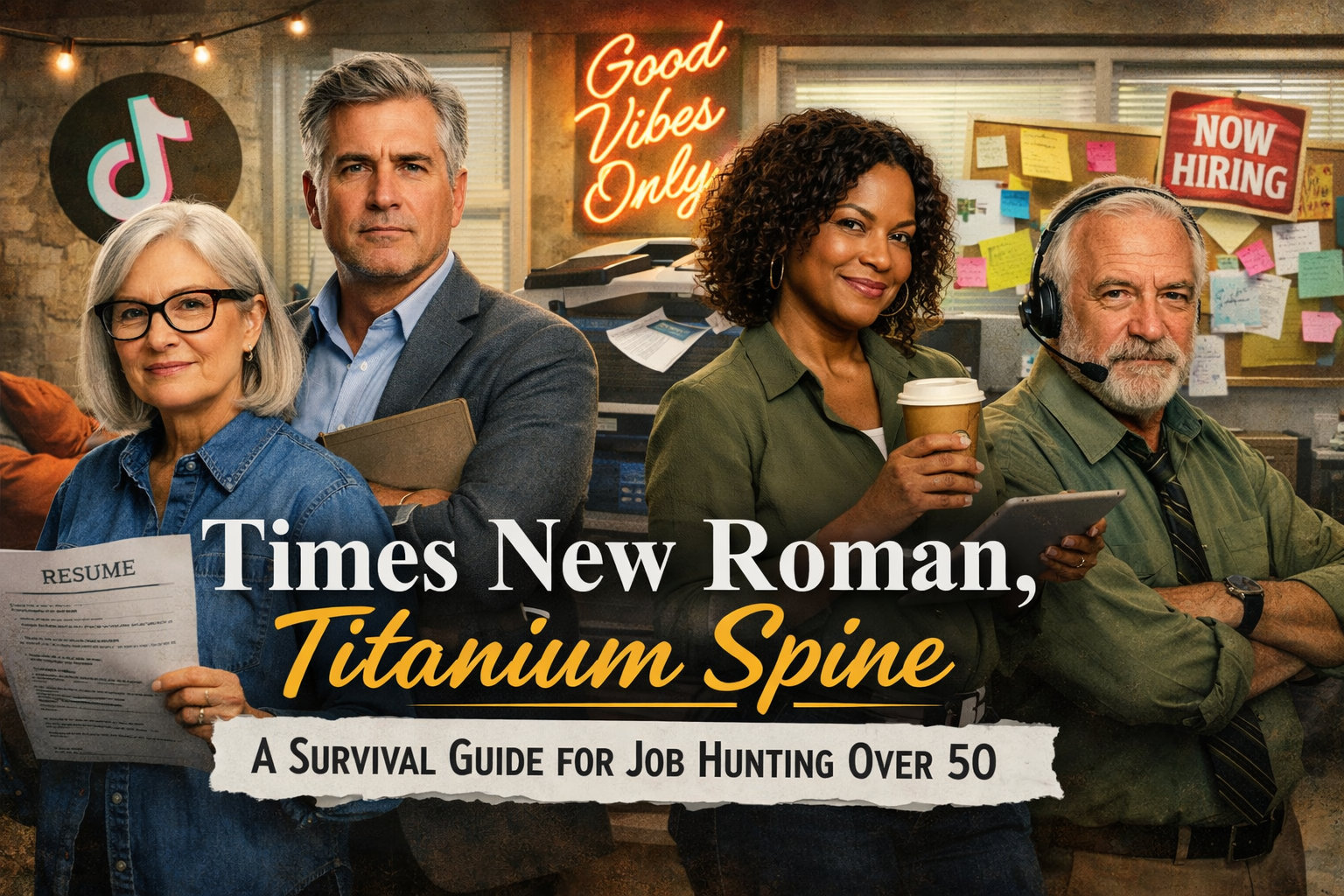
A Funny Survival Guide for Being Over 50 and Job Hunting in the Era of “Good Vibes” Hiring
Let’s start with the uncomfortable truth nobody wants to say out loud in a company-wide town hall: job hunting over 50 in today’s market feels less like “finding the right fit” and more like walking into a nightclub where the bouncer is 23, the music is an app you’ve never downloaded, and the dress code is “energy.”
You arrive with experience. Real experience. The kind that includes surviving two recessions, three CEOs, a merger that was pitched as “exciting,” and a team-building retreat that ended with an HR investigation and a lingering distrust of escape rooms.
You’ve managed budgets, people, crises, and the emotional instability of printers. You’ve sat through meetings that could’ve been emails, emails that should’ve been therapy, and therapy that became necessary because of the emails. You’ve led teams through chaos with the calm of someone who has seen the “company-wide update” subject line too many times to experience fear anymore.
And what do they ask you?
“Are you comfortable working in a fast-paced environment with loose structure and good vibes?”
Good vibes.
Not “Can you lead?”
Not “Can you build systems?”
Not “Can you stabilize a team that’s been through five managers in nine months?”
No. They want to know if you can thrive in a workplace where the org chart is basically a suggestion and leadership communication is just emojis and a motivational quote from 2014.
You’ve been managing chaos since phones had cords. You’ve watched technology evolve from “please don’t unplug the router” to “our entire company runs on Slack and vibes.” You don’t “pivot,” you execute turnarounds with a spreadsheet and a stare. You don’t “collaborate cross-functionally,” you created the function, trained the function, fixed the function, and then got asked to also be the function’s interim manager while the VP “explored a new opportunity.”
And yet here you are. Getting ghosted by companies whose entire culture is “we move fast,” which is corporate code for “we do not document anything and will blame you for not reading minds.”
But here’s the thing: you’re not outdated.
You’re not invisible.
You’re not “too much.”
You’re a walking upgrade.
And if they can’t see that, they can enjoy their bean bag decision-making and their “rockstar culture” while you continue hunting for the employer who understands that stability is not boring—it’s profitable.
Chapter 1: “Overqualified” Is Just Fear Wearing Business Casual
“Overqualified” is the most passive-aggressive compliment in the professional world.
It’s not a real reason. It’s an emotional reaction. It’s what happens when your résumé walks into the room and the hiring manager suddenly remembers they’ve been winging it for four years and calling it leadership.
When they say you’re overqualified, what they often mean is:
- You might ask questions.
- You might notice gaps.
- You might suggest improvements.
- You might say, “So what’s the process here?” and actually expect an answer.
Your experience doesn’t scare them because it’s long. It scares them because it’s specific.
You’ve seen patterns. You’ve survived bad leadership. You can smell a doomed initiative from three departments away. You know the difference between “fast-paced” and “we are understaffed and in denial.” You’ve been in enough “transformations” to recognize when transformation means, “We’re about to change everything except the actual problem.”
And let’s be honest: you probably don’t clap when someone says “synergy.”
That alone makes you dangerous.
Because the modern hiring process loves performance. It loves potential. It loves people who can enthusiastically say, “I’m obsessed with learning!” while quietly wondering how to pay rent.
But you? You show up with reality.
You show up with leadership that doesn’t need to be announced. You show up with the kind of calm that only comes from having already lived through the worst-case scenario… and then being asked to host the meeting about it.
So yes, they might label you “overqualified” because it’s easier than admitting:
“We’re afraid you’ll outgrow us.”
“We’re afraid you’ll challenge us.”
“We’re afraid you’ll expect competence.”
That’s not your problem.
That’s their organizational insecurity speaking.
Chapter 2: The “Good Vibes” Interview and Other Haunted Experiences
The modern interview is a haunted house, except instead of jump scares it’s questions like:
“Tell me about a time you failed.”
“What’s your spirit animal at work?”
“If you were a kitchen appliance, what would you be and why?”
“Describe yourself in three words, but make it brand-aligned.”
Then, after you answer thoughtfully like a stable adult, the interviewer smiles and says:
“We’re looking for someone energetic and adaptable.”
Which is interview language for: “We’re looking for someone who won’t notice the chaos until it’s too late.”
Because “good vibes” as a business strategy is just a scented candle on a dumpster fire.
You, however, are the person who puts out fires.
You’ve put out literal fires in office microwaves.
You’ve put out metaphorical fires in team morale.
You’ve put out strategic fires started by executives who read one business book and decided to restructure everything.
So when they say the role requires someone “comfortable with ambiguity,” you translate it correctly:
“There is no training.”
“No one knows who owns what.”
“Everything is urgent, and nothing is planned.”
“Please save us without making anyone feel bad about it.”
And you could do it. You absolutely could.
But here’s the hilarious part: the same companies that claim they want someone who can “handle ambiguity” will panic the minute you bring actual structure.
You’ll mention documentation and they’ll blink like you just said “tax audit.”
You’ll ask about workflow and suddenly the room gets quiet.
You’ll propose a repeatable process and someone will say, “We like to stay flexible,” as if the alternative is prison.
You’re not the problem. You’re the mirror.
And if the interview feels like a vibe check instead of a competency check, it’s because they aren’t hiring for success—they’re hiring for comfort.
Chapter 3: The Revenge of the Seasoned Professional
Here’s what they don’t understand: being “seasoned” isn’t just about years. It’s about durability.
You’ve worked through layoffs, reorganizations, budget freezes, promotions that never came, and leadership changes that were announced with the emotional depth of a weather update.
You’ve learned what matters.
You don’t fall apart when a project shifts. You don’t melt down when the tech breaks. You don’t spiral when someone sends a vague email with “Thoughts?” and no context.
You have a built-in crisis response system.
You have emotional intelligence. Real emotional intelligence. Not the corporate version where someone says “I’m an empath” while throwing everyone under the bus. The actual kind. The kind where you can read a room, calm a team, and handle conflict without turning it into a group text.
You’ve trained people. Coached people. Developed people. You’ve done leadership the hard way: by being the person everyone came to when things were falling apart.
And the best part?
You don’t need glitter fonts.
You don’t need emojis.
You don’t need your résumé to “pop.”
Your résumé doesn’t pop. It stands there like a well-built house during a storm.
So yes, keep Times New Roman if you want. Let the résumé look serious. Let it look like it’s been places. Let it look like it knows what a pension is and isn’t afraid to ask what the benefits actually cover.
Because you are not trying to win a popularity contest.
You are trying to find the employer who wants stability, leadership, and competence—not a “rockstar” who burns out in six months and posts a farewell LinkedIn novel about “growth.”
They’re out there.
And when they find you, it won’t feel like you’re begging for a chance.
It will feel like the company finally made a smart decision.
Final Thoughts: You’re Not Behind. You’re Built.
If the job market makes you feel like you’re being judged for not being 28 with unlimited energy and an aesthetic personal brand, remember this:
You are not behind.
You are not too old.
You are not “past your prime.”
You are the prime.
You are the person who knows how to lead when things are uncertain. You are the person who can bring structure without ego, calm without apathy, and results without theatrics.
And if a company can’t recognize that because they’re too busy chasing “good vibes” and “fast-paced culture,” then let them.
They can hire Chad.
They can hire the “rockstar.”
They can hire the person who says “absolutely!” to everything and quietly Googles how to do the job later.
You?
You keep going.
Because the right employer isn’t hiring you to fill a seat. They’re hiring you to upgrade their entire operation.
Now go apply.
Times New Roman and all.