
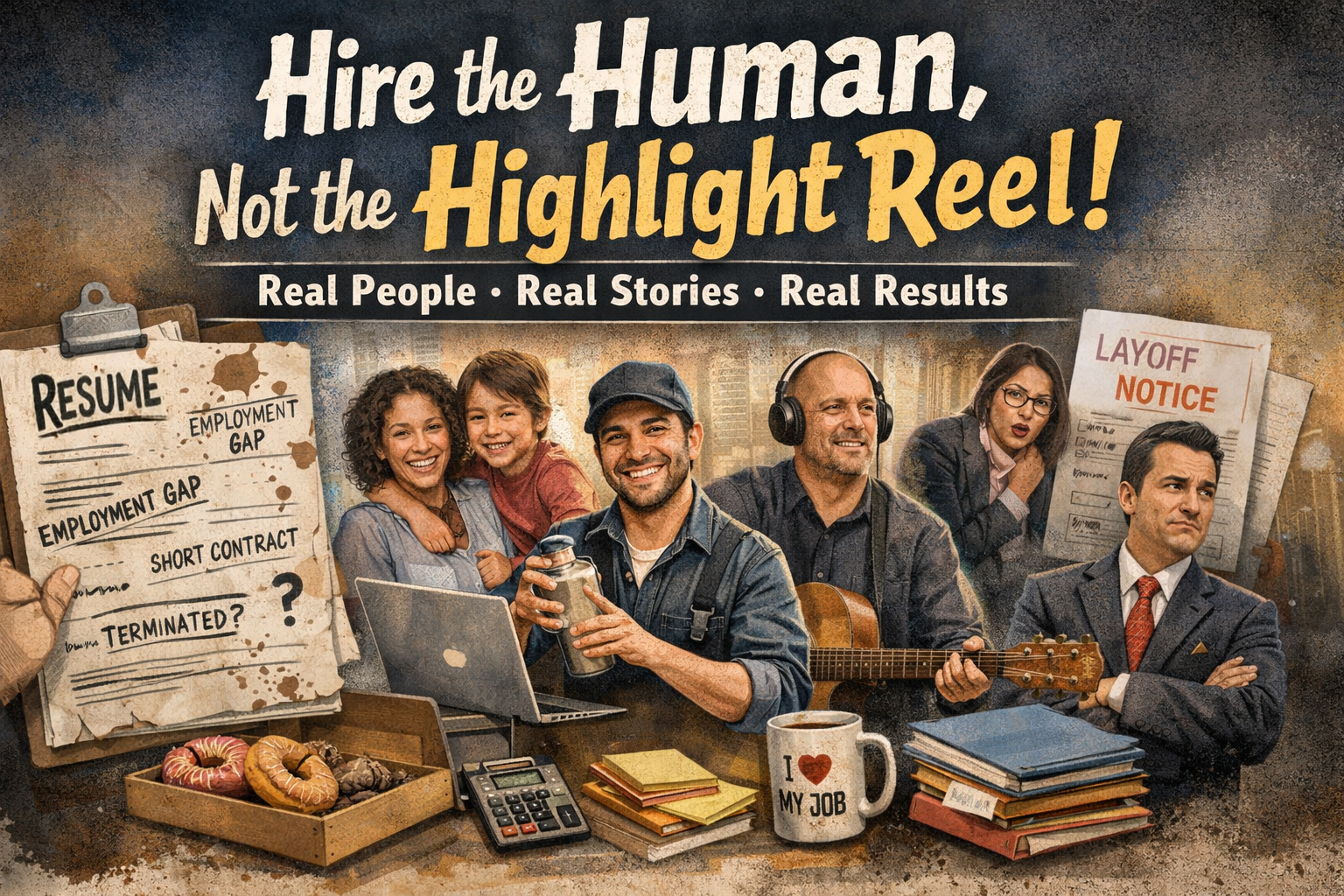
There are two types of people in corporate America:
- The ones who understand résumés are just a glorified timeline of “I survived capitalism again this year.”
- The ones who treat résumés like ancient prophecy scrolls that can predict a candidate’s moral character, future attendance record, and whether they will one day unplug the company Wi-Fi out of spite.
And unfortunately, Type 2 people are loud.
They show up in your inbox like concerned neighborhood watchdogs, clutching their pearls, whispering things like, “So… I noticed they have a gap,” the way you’d notice someone has a mysterious basement trapdoor with fresh scratches on it.
Because in hiring culture, we don’t see “laid off twice in two years.”
We see “clearly cursed.”
We don’t see “short stint labeled Contract.”
We see “they were definitely fired for stealing toner.”
We don’t see “employment gap.”
We see “they spent six months living in the woods, sharpening knives, and plotting to overthrow middle management.”
And yes, I’m exaggerating. But not by much. Because nothing ignites corporate panic faster than a résumé that looks like a real life happened to it.
A while back, I hired someone whose resume looked like it had been dragged behind a moving train and then politely formatted in Calibri. Laid off twice. Gaps. Short tenure. A contract role that basically begged, “Please don’t make me explain this in a panel interview with five strangers.”
My inbox immediately filled up with warnings, like I was about to adopt a raccoon that had been banned from three dumpsters.
“Seems unstable.”
“Can they commit?”
“They were terminated from their last job—risky.”
Which is corporate code for: “They have experienced modern employment, and that makes us uncomfortable.”
But here’s the inconvenient truth: I wasn’t looking for a résumé that told a story of uninterrupted success. I was looking for a person who could show up, do the work, learn fast, and not treat every request like a personal attack on their job title.
So I hired them.
And no, the company did not implode. No clients screamed. No executives fainted. The office plants did not die in protest.
In fact, something much stranger happened.
They were… incredible.
Which brings me to the part of the story where corporate logic collapses into a puddle of its own buzzwords.
“Unstable” Is Sometimes Just Another Word for “Has Been Through It”
Let’s talk about the résumé red flags we all pretend are scientific.
Employment gaps. Short tenures. Contract roles. A termination. Two layoffs. A career path that looks like a GPS signal dropped in the middle of a road trip and said, “Good luck, bestie.”
Some hiring teams see that and immediately assume the candidate is unreliable, uncommitted, or secretly allergic to responsibility. Which is fascinating, because we live in an era where entire departments disappear overnight and CEOs call it “strategic realignment” like it’s a yoga pose.
When someone has been laid off twice in two years, that’s not a sign they’re flaky.
That’s a sign they’ve been hit by two separate corporate meteors and still said, “Okay. I will continue paying rent anyway.”
You know what I saw in that “storm résumé”?
I saw persistence. Humility. Hunger. The kind of resilience you can’t learn in a leadership seminar featuring stock photos of people smiling at laptops.
And yes—my inbox still tried to stage an intervention.
“Seems unstable.”
What they meant: “Their timeline makes us anxious because it reminds us we are also one re-org away from updating LinkedIn.”
“Can they commit?”
What they meant: “We want someone who will commit to us, but we also reserve the right to delete their role in Q2.”
“They were terminated—risky.”
What they meant: “We don’t know what happened, but we love guessing the worst because it makes us feel like we’re doing risk management.”
Meanwhile, reality is usually much less dramatic and far more human. Maybe they had a terrible manager. Maybe the company was chaotic. Maybe they were the scapegoat in a mess they didn’t create. Maybe life came at them fast. Maybe they trusted an employer who promised stability and then surprise! layoffs.
Here’s what’s actually risky: refusing to hire people who’ve had a hard season, and then acting shocked when your team lacks grit, empathy, and problem-solving skills beyond “schedule a meeting.”
Because the best employees I’ve ever had weren’t the ones with perfect career timelines.
They were the ones who knew what it felt like to lose something—and still showed up ready to build.
The Plot Twist: They Worked Like They Had Something to Prove (Because They Did)
After I hired them, I watched the corporate myths immediately start losing oxygen.
They showed up early.
Stayed late.
Asked smart questions.
Owned mistakes without turning them into a five-paragraph excuse document.
Took feedback like a sponge.
Contributed ideas that saved us money.
Led with empathy.
And yes, they brought muffins on Mondays, which, frankly, should qualify as a leadership competency.
You know what they didn’t do?
They didn’t act entitled.
They didn’t hide behind “that’s not my job.”
They didn’t treat training like an insult.
They didn’t require seventeen follow-ups to complete a simple task.
They didn’t weaponize incompetence like it was a hobby.
They were grateful, yes—but not in a desperate way. In a grounded way. In a “I know what it’s like to be dismissed, so I’m going to make this count” way.
And that energy spread.
The team got stronger.
The vibe got better.
The culture didn’t crumble—it improved.
Which is hilarious, because the résumé police had predicted the exact opposite. According to the warnings, this hire was supposed to be the beginning of the end. The first domino. The crack in the foundation.
But nothing fell apart.
Want to know why?
Because the person was never the risk.
The real risk was our bias. Our obsession with “perfect on paper.” Our addiction to highlight reels. Our belief that the most valuable employees are the ones who’ve never been interrupted by reality.
A résumé is not a moral scorecard.
It’s a receipt for surviving.
And sometimes, the people with the messiest receipts are the ones who will protect your business like it’s personal—because for them, it is. They’ve already learned that stability is not guaranteed, and effort actually matters.
The Other “Imperfect” Hires Who Quietly Carried the Whole Place
After that hire, I started noticing something.
The candidates we overlook—the ones who don’t look like LinkedIn’s favorite success story—are often the ones who become your strongest people.
So I kept hiring humans instead of timelines.
I hired someone who took a seven-year break to raise twins.
And no, they didn’t “forget how to work.” They came back with elite logistics skills, crisis management experience, and the kind of patience you can’t train into someone who panics when Outlook freezes.
I hired someone who’d been terminated twice.
And you know what happened? They became one of the most consistent, accountable people on the team, because they’d already lived through the worst and were done with excuses.
I hired a former bartender who learned Excel on YouTube.
Which, honestly, is the most American thing I’ve ever heard. They showed up with hustle, people skills, and the ability to stay calm when everything is on fire—which is basically half of corporate operations.
I hired a guy who left corporate to chase music, then came back when rent got real.
And he didn’t come back “defeated.” He came back with creativity, discipline, and a healthy disrespect for performative meetings.
None of them were perfect on paper.
All of them were phenomenal in real life.
And here’s the part hiring teams hate hearing: the “perfect” candidates—the ones with the flawless, uninterrupted timeline—are not automatically the best ones.
Sometimes they’re wonderful.
Sometimes they’re just good at interviewing.
Sometimes they’ve never been tested.
Sometimes they melt the first time they receive feedback that isn’t wrapped in compliments and a gift card.
Meanwhile, the “imperfect” candidates? They’ve already been humbled by life. They’ve already had to rebuild. They’ve already learned that your job title won’t save you when the layoff email hits.
So they show up ready.
Not polished. Ready.
Final Thoughts: Stop Hiring Crystal Balls—Start Hiring People
If your hiring process is designed to eliminate anyone who’s been interrupted by layoffs, caregiving, illness, bad bosses, contract work, career pivots, or plain old economic chaos, then congratulations—you have built a system that filters out resilience.
And then you’ll hold meetings about how “no one wants to work anymore.”
An employment gap doesn’t mean someone is lazy.
A short tenure doesn’t mean they’re flaky.
A layoff doesn’t mean they’re not capable.
A non-traditional path doesn’t mean they won’t thrive.
It means they’re human.
And if we’re being honest, I’d rather hire someone who has fallen down and gotten back up than someone whose biggest professional hardship is “my promotion took longer than expected.”
So stop treating resumes like crystal balls.
Hire the human. Not the highlight reel.
Because the highlight reel looks great until something breaks.
And the humans who’ve been through it?
They’re the ones who know how to fix what breaks—without sending a calendar invite titled “Quick Sync” and pretending it was always part of the strategic plan.