
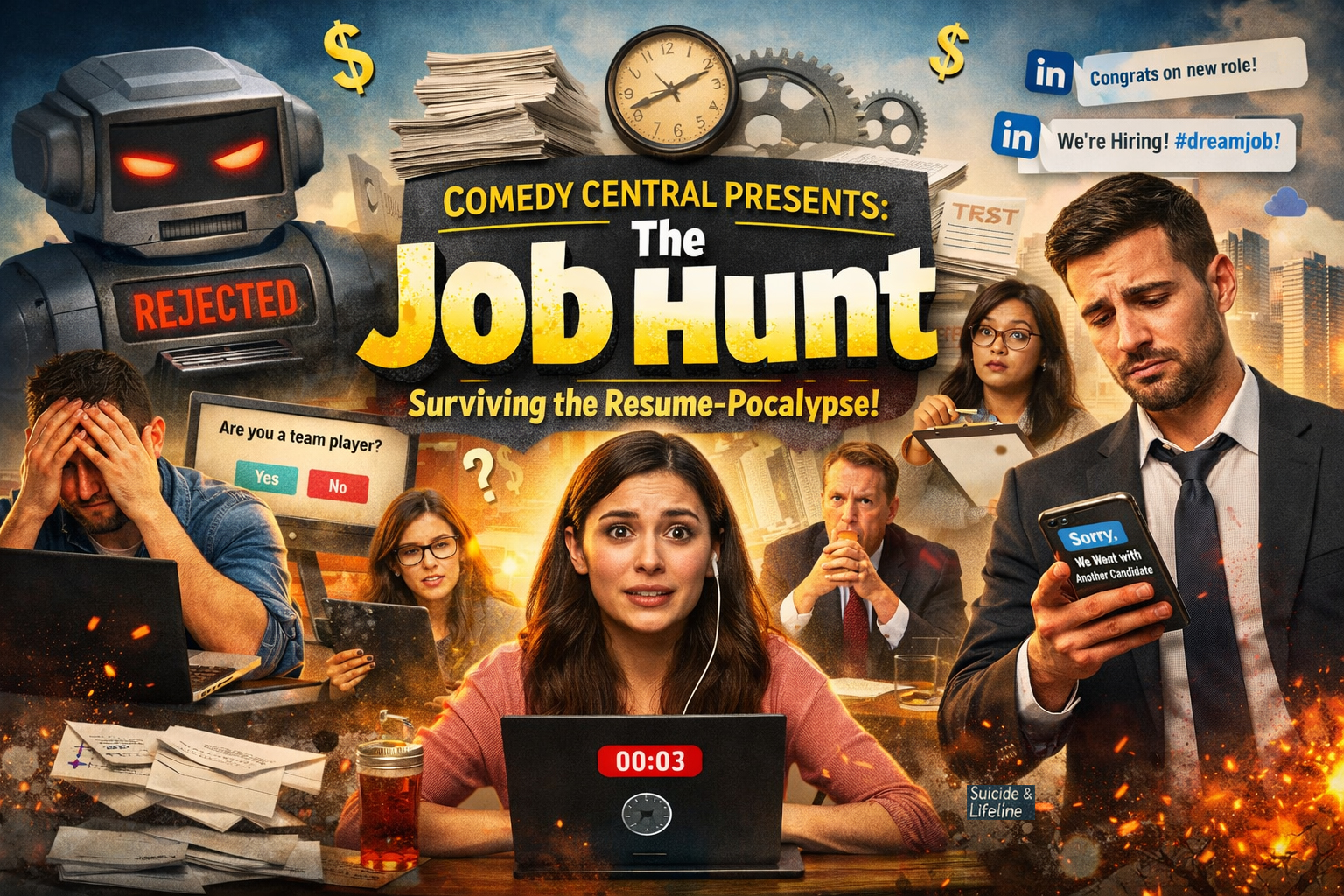
Somewhere in America right now, a talented adult with bills, a LinkedIn headshot they took in their car, and a deeply optimistic “Open to Work” banner is being asked to complete a personality assessment that was clearly designed by a haunted printer.
And we’re supposed to pretend this is normal.
We live in an era where people can order groceries, track their heart rate, and FaceTime their dog—yet getting hired for a mid-level role still requires ritual sacrifice, a cover letter written in iambic pentameter, and a final interview with someone who joined the company last Tuesday but has already absorbed the corporate personality like a sponge in a beige office kitchen.
Comedy Central, I’m begging you: bring back shows about the modern job hunt. Not “workplace comedy” with quirky coworkers and a lovable boss. I mean the real stuff. The dystopian, Wi-Fi-dependent, emotionally athletic reality show we’re all trapped in. The job hunt isn’t a process anymore—it’s an entire genre. It has villains. Plot twists. Jump scares. A soundtrack of Outlook pings. And a narrator whispering, “Congratulations! You’ve been selected to complete… another step.”
This is a golden era of absurdity and somehow we’re wasting it on reruns while the rest of us are out here getting ghosted by companies that emailed us first.
So yes, Comedy Central, you want relevance? You want cultural commentary? You want ratings? Point a camera at the average job seeker and let the world witness the chaos. The job hunt is already a comedy. It just needs better lighting and a laugh track that occasionally screams.
The ATS Is a Sentient Dumpster With a Degree in Rejection
Every great show needs a villain, and the modern job hunt delivered an iconic one: the Applicant Tracking System.
The ATS is not software. The ATS is an emotionless bouncer wearing a headset, denying entry to qualified humans because they didn’t say “cross-functional stakeholder alignment” in the exact dialect the machine learned from a 2014 whitepaper and a cursed spreadsheet.
It doesn’t read your resume; it judges your resume. It scans for keywords like itzzy the Robot Reviewer from hell, then throws your application into the void because you wrote “managed projects” instead of “program managed initiatives.” Same job. Same skills. But the ATS is a petty little linguist.
Imagine a show where the ATS is a character. It’s not even a main character—it’s a recurring menace. It shows up whenever the protagonist starts feeling hopeful. It speaks in automated emails. It has a “Do Not Reply” tattoo across its chest. It’s the kind of villain who sends “We were impressed by your background” right before punting you into oblivion like a football.
And the best part? No one can explain how it works. Recruiters will tell you it’s “a holistic process,” which is corporate for “we sacrificed your application to the algorithm and now we pretend fate did it.”
The comedy writes itself. The protagonist updates one bullet point and the ATS responds like a feral raccoon guarding its trash: “Thank you for your interest. Unfortunately—”
Comedy Central, I can already see the cold open: a candidate finally gets an interview, walks into the office, and the ATS is sitting there in a suit, sipping coffee, smiling like, “So. Tell me about a time you optimized synergy under pressure.”
Cut to credits.
Assessments Are Just BuzzFeed Quizzes With Consequences
There was a time when applying for a job meant sending a resume and maybe, if the company was feeling spicy, writing a cover letter. Now? Now you must complete an assessment that measures your personality, your moral compass, your willingness to work unpaid overtime, and whether you would betray your own family for “growth opportunities.”
Assessments in the modern job hunt are basically reality TV confessionals, except nobody is watching and you still get eliminated.
You’ll apply for a role titled “Administrative Assistant,” and within seven minutes an email arrives like, “Congratulations! You’ve advanced to the next stage.”
Congratulations? For what? For entering my name into a form? For surviving CAPTCHA? For proving I’m not a robot, even though the next stage is going to be judged by a robot?
Then comes the quiz.
Question 1: When faced with a problem, do you:
A) Collaborate cross-functionally
B) Take initiative
C) Maintain composure
D) Lie down in the shower fully clothed
You pick A. The system says you are “Not aligned with our culture.”
Next, the cognitive test. You’re asked to identify patterns in shapes while your rent quietly increases in the background. You’re doing math with triangles, sweating like you’re defusing a bomb, all for a role that will eventually pay “competitive” (which means “we will not tell you until you’re emotionally attached”).
And then the pièce de résistance: the one-way video interview.
A one-way video interview is not an interview. It is a hostage video with corporate lighting.
You are told to stare into your webcam and answer a question while a timer counts down, like you’re auditioning for a role in a dystopian film titled Candidate #347: The Reckoning.
If Comedy Central doesn’t see the potential here, I don’t know what to tell them. This is sketch comedy gold. A person practices a “Tell me about yourself” monologue twenty-seven times, hits record, says “Hi, thank you for having me,” and immediately forgets their own name. Cut to them whispering, “Why did I say ‘synergize’ like that.”
That’s a show. That’s television.
Interview Processes Have Become Corporate Escape Rooms
Interviewing used to be: recruiter screen, hiring manager, maybe a panel.
Now it’s: recruiter screen, hiring manager, panel, second panel, values interview, case study, take-home assignment, culture add conversation, final interview with the CEO’s cousin’s mentor, and then—plot twist—hiring freeze.
This is not hiring. This is a corporate escape room where the puzzle is “How much dignity can you lose before you stop smiling?”
Take-home assignments are the most hilarious modern invention because they are delivered with the confidence of someone asking you to do unpaid consulting while calling it “a chance to showcase your skills.”
Showcase? I’m trying to pay my electric bill, not perform for judges.
You’ll be asked to create a full strategic plan, a marketing calendar, a stakeholder map, a communication template, and a five-year roadmap for a role that might not exist by next Tuesday. Then you submit it, and the company says, “Thank you! We’ll be in touch.”
They will not be in touch.
They will evaporate like a mist made of HR policies and fear.
And the entire time, the questions remain the same, as if they’re passed down from an ancient corporate scroll:
“Tell me about a time you overcame a challenge.”
“Tell me about a time you influenced without authority.”
“Tell me about a time you were resilient.”
Resilient? I applied to 182 jobs and I’m currently eating dinner over my laptop like a Victorian orphan with Wi-Fi. I’m resilient in ways your leadership training could never comprehend.
Comedy Central could build an entire season around “The Final Interview” and it would still be more believable than the actual hiring process. Every episode ends with the candidate receiving the same email: “We went with someone whose experience more closely aligns.”
Translation: “We were scared you’d ask for money.”
LinkedIn Is the Show’s Glittery Narrator Who Lies Constantly
No modern job hunt series is complete without the influencer layer: LinkedIn.
LinkedIn is where your career trauma goes to be rebranded as “a lesson.” It’s where layoffs become “a new chapter.” It’s where rejection becomes “alignment.” It’s where someone posts a photo of a sunrise and claims it taught them leadership.
In the Comedy Central version, LinkedIn is a character. It’s not malicious. It’s just relentlessly optimistic in a way that feels like psychological warfare.
You’ll see posts like:
“I applied to 400 jobs and got rejected 399 times. Here are 12 reasons I’m grateful.”
No. Absolutely not. We are not grateful. We are tired.
LinkedIn is also where recruiters post “We’re hiring!” and then never respond to anyone who applies, like it’s a performance piece called Engagement Farming: The Musical.
And the job seeker? The job seeker is stuck performing. They must be confident but not cocky. Experienced but not threatening. Desperate but not desperate. Authentic but only in a way that can be used as a brand.
It’s acting. It’s improv. It’s emotional juggling while corporate spectators rate your vibe.
This is television.
A full episode could be titled: “When Your Post Gets 500 Likes But You Still Can’t Afford Groceries.” Another could be: “Congratulations, You’re a Top Voice in Unemployment.”
Tell me that’s not a Comedy Central hit.
Final Thoughts: Give Us a Show That Tells the Truth, Then Laughs Anyway
Comedy Central, the modern job hunt is begging to be turned into a show—not because it’s fun, but because it’s ridiculous, and sometimes laughter is the only thing keeping people from fully turning into feral raccoons in the digital alleyways of Workday.
Make it a sketch series. Make it a mockumentary. Make it a reality competition where contestants are eliminated every time a recruiter says “We’ll circle back.” Give us a recurring gag where the salary range is always “DOE,” and nobody knows what “DOE” means except that it stands for “Definitely Offended Everyone.”
Do it for the people who have had to record the same one-way interview three times because they blinked too confidently.
Do it for the people who have been told they were “a great fit” and then watched the role get reposted weekly like a haunted lighthouse calling ships into the rocks.
Do it for the candidates who are out here fighting for their lives in business casual, trying to sound enthusiastic while their soul quietly files a complaint.
The job hunt is modern comedy. Not because it’s light. Because it’s absurd. Because it’s broken in a way that’s almost poetic. Because if we don’t laugh, we’ll scream—and screaming is not currently a required step in the application process, but give it time.