
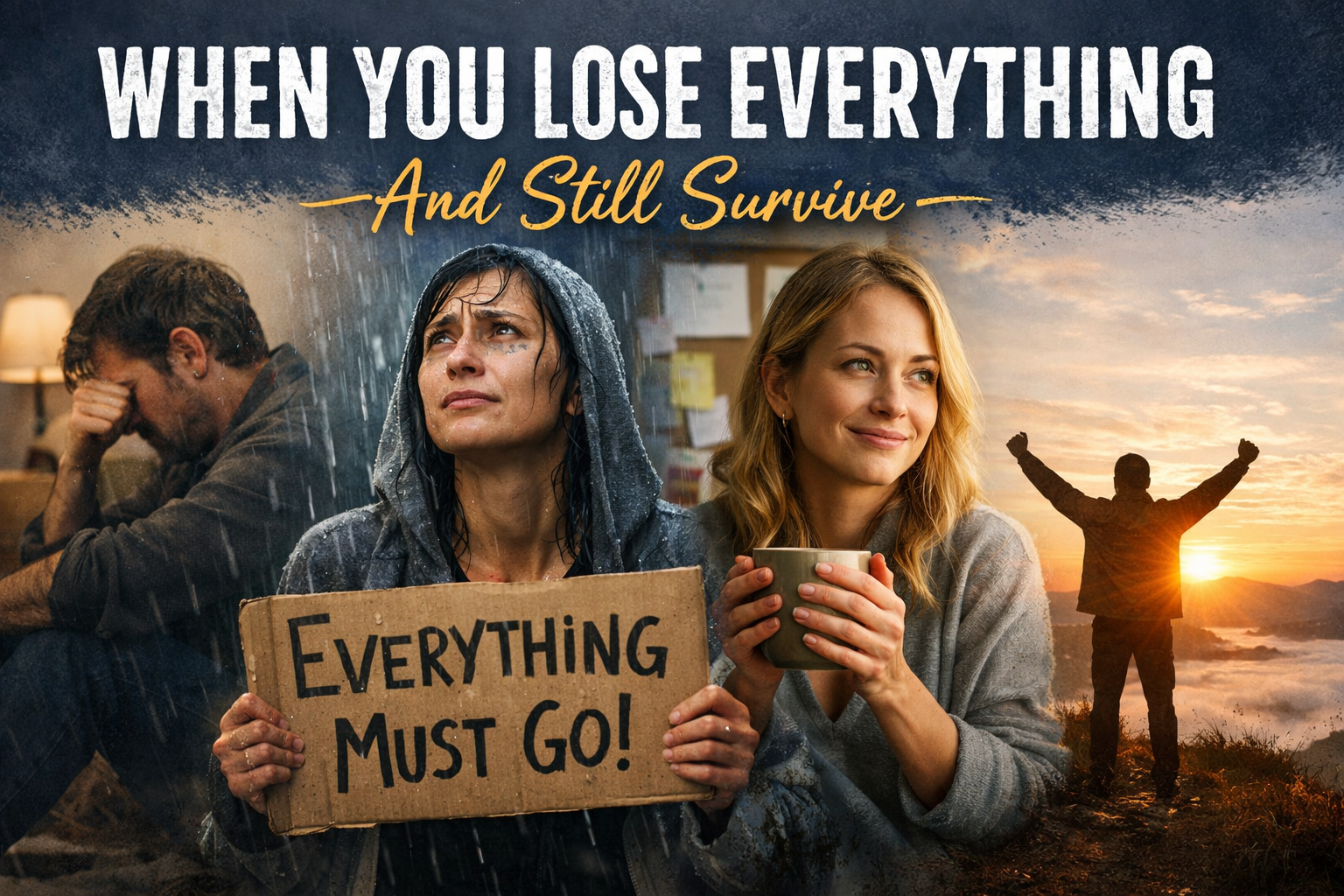
There’s a special kind of loss that doesn’t arrive with dramatic music or a slow-motion montage where you nobly stare out a window while rain performs a monologue on the glass. Real loss is quieter and ruder. It shows up like a landlord with a clipboard. It doesn’t ask if you’re ready. It doesn’t care that you were finally getting your routine together, that you’d started drinking water, that you’d put your life into color-coded categories like a responsible adult who definitely wasn’t one unexpected expense away from unraveling. Real loss doesn’t kick the door down. It simply changes the locks while you’re still inside.
And sometimes it isn’t one thing. It’s not a single thunderclap. It’s a series of tiny, cruel pop quizzes: a job disappears, a relationship cracks, a bank account makes that suspiciously quiet noise, a friend stops replying, your confidence evaporates like a puddle in July, and suddenly you’re standing in the wreckage like, “Okay. Wow. Cool. So this is happening.” You look around and realize your old life was held together by so many invisible threads—routine, identity, the illusion of stability, the ability to plan beyond next Tuesday—and now those threads are gone, and you’re learning, in real time, that adulthood is partially just agreeing to keep moving even when the map is on fire.
Nobody really prepares you for the moment when you lose the version of yourself who believed things were permanent.
Because that’s what “losing everything” is, really. It’s not just the stuff. It’s the certainty. It’s the story you were telling yourself about how your life worked. It’s the identity you could introduce at parties without hesitating. It’s the future you had pre-scheduled in your head like a calendar invite. And then—gone. You’re left holding a paper cup of shock and a handful of “What now?” like confetti no one asked for.
And yet.
Here you are.
Reading this.
Breathing.
Still alive.
Still in the game.
Which is unfair, honestly, because after you lose everything, you feel like you should at least get a complimentary nap and a voucher for emotional damage. But no. The world continues to demand things. Bills still arrive. People still ask how you’re doing in that tone that implies the correct answer is “Great!” even if you are actively dissolving inside your shoes. The sun still rises, like it didn’t just witness you get spiritually body-slammed by life.
Survival doesn’t get enough credit for how awkward it is.
It’s not heroic. It’s often pathetic in a very relatable way.
But it’s also real. And it matters.
The Collapse — When Your Life Turns Into a Before and After Photo
There is a moment after the loss, the big one or the pile-up of many, when your brain tries to negotiate with reality like a customer service representative who has never been trained for this call.
“Hello, yes, I’d like to speak with the manager of existence. This seems incorrect.”
You replay the event like it’s a scene you can edit if you rewind it enough times. Maybe you missed a detail. Maybe there’s a loophole. Maybe if you stare at the ceiling long enough, the universe will send an apology email with the subject line: Our Bad — Restoring Your Previous Life Immediately.
Instead, you get silence. Which is the universe’s favorite communication style.
So you do what humans do when they’re cornered: you start inventorying the wreckage. You look at what’s gone and what’s left and feel that cold, humiliating panic of realizing you can’t fix it by being “strong” or “positive” or “productive.” This isn’t a motivation issue. This is structural. This is foundational. This is the moment where the floor drops out and you discover you were standing on assumptions.
It’s not just grief. It’s disorientation.
You don’t know who you are without the things you lost, and it feels ridiculous to admit that, because you’re supposed to be deeper than that. You’re supposed to have a core identity that’s independent of circumstance. But the truth is, we build ourselves out of roles. Out of belonging. Out of routines. Out of the small, predictable things that make us feel anchored. When those disappear, you feel like a balloon cut loose from its string.
You start to question your judgment. You question every decision you made leading up to the collapse. You question your ability to trust your own instincts, because your instincts led you here, didn’t they? You wonder if you were naive. If you were arrogant. If you missed warnings everyone else would’ve caught. You replay conversations. You reread texts. You mentally audit your past like there’s going to be a clear moment where you can point and say, “Ah. There. That’s where I ruined my entire life.”
And then there’s the worst part: the cognitive whiplash of seeing other people continue normally.
They post photos. They go on trips. They complain about minor inconveniences. They ask you to attend things. They say, “Everything happens for a reason,” like they’re quoting a fortune cookie written by someone who has never been bullied by reality.
Meanwhile, you’re trying to remember how to be a person in a body.
You’re trying to do normal things—eat, shower, answer messages—while carrying a private apocalypse. And you do it. Not gracefully, but you do it. You show up in fragments. You smile in small doses. You laugh when something hits you just right, and then you feel guilty because how dare you laugh when your life is in shambles, as if laughter is a betrayal of grief.
But what you’re actually doing is adapting.
Slowly, unwillingly, quietly.
You’re learning the shape of your new world.
The Weird Practicality of Pain — Surviving on Autopilot and Spite
People don’t talk enough about the bureaucracy of losing everything.
Because once the initial shock fades, you enter the “administrative” phase of grief. This is the stage where emotions are still hitting you like waves, but you also have to do tasks. You have to make phone calls. You have to cancel things. You have to apply for things. You have to explain, again and again, in calm human words, that your life has recently exploded and you would like to know what forms are required to continue existing.
You become a part-time disaster manager.
You learn that survival is not one big decision. It’s a thousand small ones.
Get out of bed.
Answer one email.
Drink water.
Move your body even if it feels like carrying a wet mattress.
Eat something that has nutrients, not just rage.
Pretend to be functional for fifteen minutes so you can acquire resources.
And here’s what no one admits: sometimes you survive out of spite.
Not the cute kind of spite where you glow up and post a caption like “Watch me thrive.” I mean the gritty, exhausted spite where you’re lying in bed thinking, “If I don’t make it through this, the universe wins, and I hate that.”
So you do it. You stand up. You keep going.
You learn that your mind is capable of playing incredibly dramatic movies at 3:00 AM. You learn that anxiety is a talented screenwriter and will happily pitch you sequels: What if it gets worse? What if you never recover? What if you’re permanently broken? You learn that depression doesn’t always feel like sadness; sometimes it feels like numbness and a strangely intimate relationship with your couch.
And still—somehow—you start building tiny systems to keep yourself alive.
You create little rituals because your brain needs proof that time is passing. You make coffee. You tidy one corner. You walk around the block like a ghost trying to remember what a neighborhood is. You track your days by small victories: “Today I didn’t cry in the grocery store.” “Today I laughed at a joke.” “Today I sent the application.” “Today I washed my hair, which is honestly Olympic-level behavior right now.”
You become intimately familiar with the phrase, “This is enough for today.”
And then you begin to notice something: you are still here.
Not because you’re invincible.
But because you’re stubborn.
Because you have an internal engine that keeps turning even when you’re not sure why. Because survival is not glamorous, but it’s deeply human. Because you can be shattered and still do the dishes. You can be heartbroken and still show up. You can be terrified and still make plans, even tiny ones, even tentative ones.
You start to realize that you are not the life you lost.
You are the person who lived it.
And the person who is living this now.
The Identity Rebuild — When You Meet Yourself Again Without the Old Props
At some point, after enough days have passed that you’re not actively in shock, you start to feel the deeper ache: the loss of identity.
Because when you lose everything, you lose the structures that used to define you. You lose the easy language. You lose the confidence that comes from having a place in the world. You lose the familiar version of yourself who knew what to do on weekdays.
And rebuilding is not exciting. Rebuilding is humbling.
Rebuilding is realizing you have to start answering questions you didn’t plan to face.
Who am I without that job?
Who am I without that relationship?
Who am I without that version of my future?
What do I believe now?
What do I want now?
What can I trust now?
You begin noticing how many of your choices were made in service of stability, of approval, of a narrative you thought you were supposed to follow. You realize that some parts of your old life were genuinely good, and you miss them with a grief that feels like a bruise you keep bumping into.
But you also notice something else: some of what you lost was heavy.
Some of it was a weight you carried because you thought you had to.
Sometimes losing everything clears space you didn’t know you needed.
That doesn’t mean the loss was “meant to happen.” It doesn’t mean you should be grateful for pain. It just means that when the old scaffolding collapses, you can finally see what it was holding up—and whether it was yours, or just something you inherited, accepted, tolerated, performed.
This is when you start meeting yourself again. Slowly. Carefully. Sometimes with suspicion.
You try new thoughts on like clothes: “Maybe I don’t have to be who I was.” “Maybe my worth isn’t attached to productivity.” “Maybe I can build a life that fits me instead of impressing people who don’t even notice I’m exhausted.”
You start developing boundaries because you can’t afford to lose yourself again. You start noticing red flags faster. You start saying no with less guilt. You start protecting your energy like it’s currency, because now you know it is.
And in a strange way, you start becoming more honest.
Not because you wanted to. Because you had to.
The collapse stripped away the polite layers. It removed your ability to pretend. It forced you into clarity, and clarity can be brutal, but it can also be freeing.
You begin to rebuild, not from the outside in, but from the inside out.
And that changes everything.
The Survival Glow — Not a Glow-Up, a Glow-Through
There’s a culture-wide obsession with “bouncing back,” as if resilience is supposed to look like an inspirational Instagram reel where you emerge from hardship with flawless skin and a new wardrobe and a caption that says, “Hard times made me stronger.”
No.
Sometimes hard times made you tired.
Sometimes hard times made you slower.
Sometimes hard times made you softer in places you used to be armored, and tougher in places you used to be naive.
The truth is, you don’t bounce back from losing everything.
You crawl forward.
You inch.
You wobble.
You build.
You take breaks.
You relapse into grief on random Tuesdays because a song came on or you saw a photo or you walked past a place that still holds the ghost of your old life.
And that’s normal.
Then one day, without warning, you notice you’re not thinking about it every minute. You notice you’re making plans again. You notice you’re laughing without immediately remembering to be sad. You notice you have preferences again—real preferences, not just survival decisions. You notice you’re interested in things again.
You start seeing yourself as someone in progress instead of someone ruined.
And that’s the real survival glow.
Not the curated “look at me thriving” glow.
The quieter glow of endurance.
The glow of waking up and still trying, even when it hurts.
The glow of learning how to hold your own hand.
The glow of discovering that you can be devastated and still be kind, still be funny, still be capable, still be worthy of good things.
Because surviving isn’t just staying alive.
Surviving is continuing to believe, even faintly, that your story is not over.
And when you lose everything, that belief becomes the most courageous thing you own.
Final Thoughts: Proof of Life
If you are in the middle of losing everything—if your world has collapsed and you can’t imagine rebuilding, if you feel embarrassed by your pain, if you feel behind, if you feel like you’ve failed—listen closely:
Survival counts.
It counts when it’s messy.
It counts when it’s quiet.
It counts when nobody claps.
It counts when all you did today was get through the day.
You don’t need to turn your suffering into a motivational speech to earn your right to exist.
You don’t need to “make it meaningful” immediately.
You just need to keep going.
One day at a time. One hour at a time if that’s all you can do.
Because the fact that you are still here is not small.
It is evidence.
Evidence that you can lose everything and still survive.
And survival, even when it looks like tears and laundry and shaky breaths and stubborn persistence, is not a consolation prize.
It’s a victory.
Quiet. Unphotogenic. Undeniable.
And it’s yours.