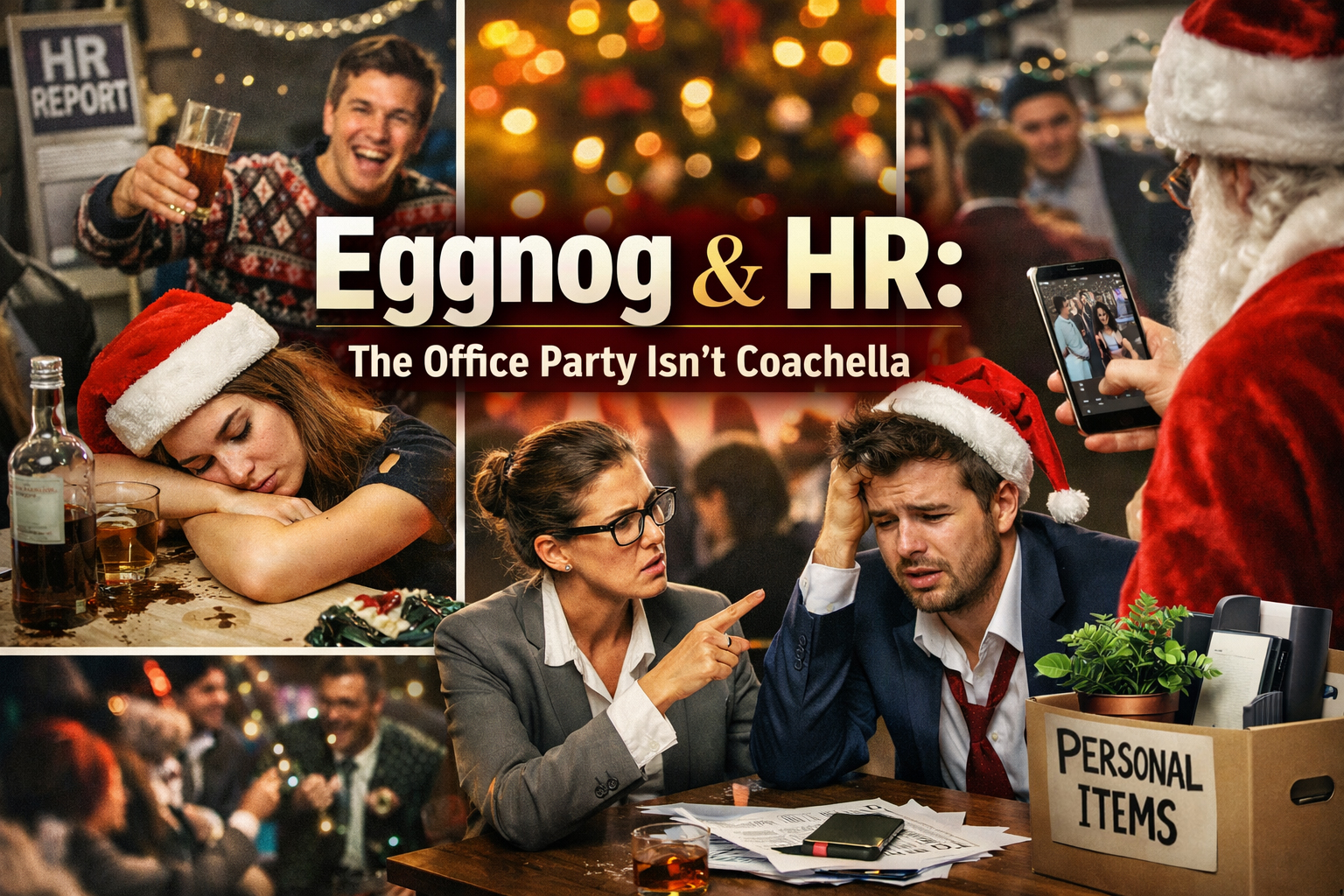
There is a special kind of lie we all agree to believe every December: the company holiday party is a party. Not a meeting. Not a workplace function. Not a roaming, fluorescent-lit deposition with a DJ. A party.
They’ll put up string lights like they’re laundering the vibe through Pinterest. They’ll hand out drink tickets like they’re issuing little permission slips to forget your job title. Someone from leadership will make a speech about how “we’re a family,” which is always an interesting phrase to hear right before you watch Accounting do the Cupid Shuffle next to the CFO like your W-2 is about to start freestyling.
And then there’s the open bar. The most dangerous sentence in corporate America isn’t “we need to talk.” It’s “first round’s on the company.” Because the moment that bar opens, half the room forgets the most important fact about the holiday party:
It’s not a party. It’s a professional environment wearing a Santa hat.
Some people treat it like a reward. A release. A sanctioned moment to “let their hair down.” Which is adorable, because HR doesn’t care if your hair is down — HR cares if your judgment is.
So yes, show up. Smile. Be seen. Make small talk with someone you only know through email signatures. But do not get drunk. Because nothing good comes from being the main character at a company event. The only prize is a cautionary tale.
The Open Bar is a Trap With Garnish
The open bar is never really “open.” It’s open in the same way a bear trap is open: technically true, emotionally devastating.
The company paid for exactly enough drinks to encourage social bonding and exactly enough alcohol to produce one person who becomes a permanent slide in next year’s harassment training.
And here’s the thing: it’s not just the 20-somethings who misjudge the “fun” level. It’s also the 50-year-old C-suite executive who thinks “leadership presence” means doing tequila shots while explaining their vision for Q1. Everyone is vulnerable. Alcohol is an equal-opportunity career speedrun.
You might think, “I’m fine. I can handle it.”
And you can. Until you can’t. Until you laugh too loud at a joke that wasn’t funny. Until you start oversharing. Until you tell someone what you really think about the re-org. Until you wake up the next morning with a brand-new email chain titled: “Regarding last night.”
Open bar logic is always the same:
- Drink 1: “I’m being social.”
- Drink 2: “I’m networking.”
- Drink 3: “I’m honest.”
- Drink 4: “I’m unemployed.”
You Don’t Know Who’s Watching, Recording, or ‘Just Checking In’
The holiday party is the only place where people who ignore your emails all year suddenly want to have a “real conversation.”
It feels friendly. It feels warm. It feels human. And sometimes it even is. But you still have to remember the invisible audience:
- The coworker who loves drama the way plants love sunlight
- The manager who notices everything but only mentions it in performance reviews
- The executive who says “no judgment” and means “I will remember this forever”
- The person who “doesn’t remember much” but somehow remembers the exact quotes
- The one employee who is basically a walking compliance hotline with a clutch purse
Also: you may not remember anything, but other people will. And that’s the part that gets folks. Because you can’t defend a version of yourself you can’t even access.
You’ll sit there the next morning like:
“Surely I was fine.”
And then you’ll get hit with:
“Hey, can we talk about what happened?”
And suddenly your entire brain is a loading screen.
The party isn’t where you prove you’re fun. It’s where you prove you’re steady. Being the “safe” person at a work event is an underrated superpower. Nobody writes you up for being slightly boring. But people absolutely write you up for being memorably chaotic.
The LIFO Method — Last In, First Out, Still Employed
Your best move is the one you already said: make a brief appearance and leave early.
Think of it like workplace cardio:
- Walk in
- Smile
- Say hello to leadership
- Compliment the decorations like you helped
- Participate in exactly one harmless conversation
- Exit before the temperature of the room shifts from “festive” to “evidence”
This is the LIFO accounting method: Last one in, first one out.
Show face, maintain aura, protect paycheck.
If you really want to let loose, do it off-site with friends. Real friends. The kind who won’t send your karaoke performance to the team Slack labeled “lol.” The kind who won’t casually mention your dance moves during Monday’s standup like it’s a fun anecdote instead of a resignation letter.
And if leadership is “pushing drinks”?
That’s not permission. That’s a test.
A weird test, yes. But still a test.
You are responsible for yourself and your behavior. Excuses don’t fly. “It was the open bar” is not a legal defense. “But the VP bought the shots” is not a policy exception. The company will absolutely let you go while still posting pictures from the party like it was magical.
Final Thoughts: You Don’t Have to Go, But If You Go—Go Smart
Yes, people feel pressured to attend. Of course they do. It’s framed as “optional,” but so is responding to emails, and we all know how that goes.
If you genuinely don’t want to go, skip it. Protect your peace. Fake a headache. Blame a cousin’s birthday. Tell them you have “a prior commitment,” which is technically true because your prior commitment is to not becoming a workplace legend for the wrong reason.
But if you do attend, treat it like a professional event with holiday music:
- Eat first
- Keep the drinks minimal (or none)
- Avoid the gossip clusters
- Don’t overshare
- Leave while it’s still fun
Because the company holiday party is not where you build your legacy.
It’s where you avoid creating a story that starts with:
“So… you’re not going to believe what happened at the holiday party.”