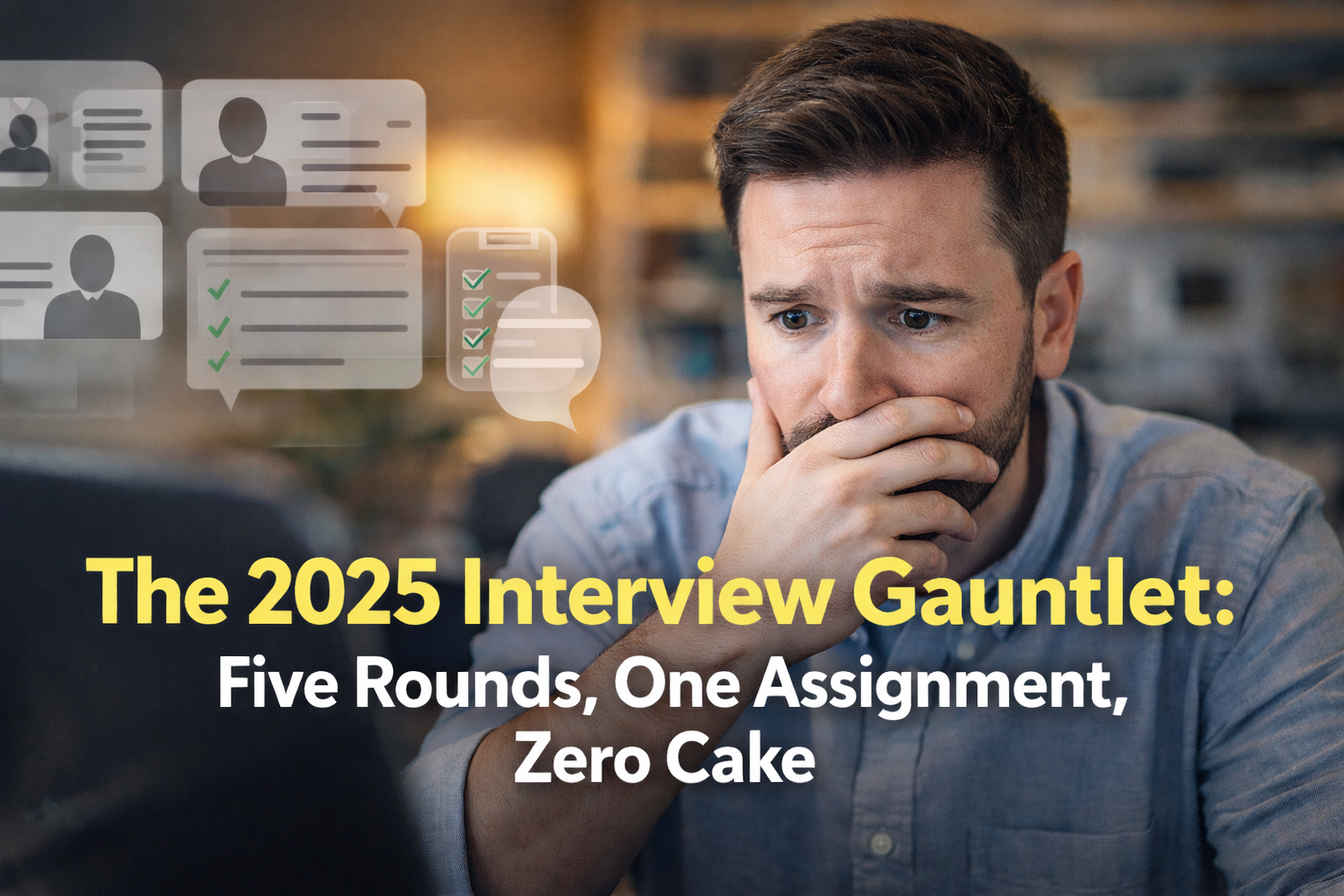
I’m officially convinced that job interviews in 2025 are not designed to find the best candidate. They’re designed to identify which human being can survive the most elaborate corporate endurance ritual without dissolving into a pile of emotional confetti on a Logitech webcam.
Because at some point, we quietly stopped calling it “the hiring process” and started running a multi-stage obstacle course that feels suspiciously like a reality TV competition where the prize is not fame or money, but the privilege of being allowed to pay for dental care again.
And yes, I know the script. I know what they want from me.
They want confidence without confidence. Passion without need. Leadership without presence. Humor without personality. Experience without opinions. They want me to speak in that specific dialect of professional optimism where every sentence starts as a human thought and ends as a LinkedIn-approved corporate prayer.
So I show up. Well-lit. Calm. Smiling. Pretending my entire nervous system isn’t currently doing interpretive dance.
I join the first call and instantly begin the game of “sound excited but not unemployed,” which is one of the hardest auditions in modern society. I tell them why I want the role, carefully balancing ambition and humility like I’m carrying a tray of champagne flutes through a moving subway car. I try to be passionate but not desperate, visionary but still practical, basically like a humble rockstar who also volunteers at an animal shelter on weekends and never once says “I need money.”
They nod. They scribble something. It could be notes. It could be a grocery list. It could be “breathes too loudly.” You never know. They say, “We’ll be in touch,” which is corporate for “this conversation is now being processed by a system named TalentFlow360 that eats hope for fuel.”
Then the rounds begin.
And the rounds do not end.
The Recruiter Screen, or “Please Perform a Personality That Is Both Human and Harmless”
Round one is always described as “casual,” which is funny because nothing is casual about a phone call where your future is being measured in vibes.
The recruiter asks, “So tell me about yourself.”
And I have to deliver the most carefully crafted version of my entire life in under two minutes, including who I am, what I’ve done, why I’m qualified, why I’m stable, and why I’m not going to ask for a salary that forces them to confront inflation. All while sounding like I’m doing great. Thriving, even. Just casually browsing roles, for fun. Like a hobby.
Then they ask, “Why do you want this job?”
And this is where you cannot tell the truth, because the truth is: I want health insurance. I want a stable paycheck. I want to stop living in a world where my budget has a chapter titled Survival. I want to be useful, respected, and allowed to plan more than two weeks into the future without consulting the mood swings of an algorithm.
But that’s not the answer.
The answer is something like: “I’m really excited about the mission and the opportunity to contribute at scale.”
At scale.
Everything is “at scale” now. You could be applying to manage a small team and you’d still be expected to say “at scale” like you’re launching a satellite.
The recruiter smiles politely. They say, “Great!”
Then they ask for salary expectations, and we all pretend this is a conversation between two equal participants instead of a hostage negotiation wrapped in friendly tone.
Finally, they end with, “We’ll be in touch.”
And you leave the call feeling like you did well, which is adorable, because the next stage is always where the process reveals itself for what it truly is: a corporate escape room where every clue is written in jargon and the door only opens if you say the word “stakeholders” with conviction.
The Manager Interview and the Return of Ancient Questions From the Year 2004
Round two is the manager interview, which is where the process shifts from polite curiosity to ritual testing.
The manager comes in with the classics, and I mean classics in the way you say “classic” about a VHS tape you found in a basement.
“What are your strengths and weaknesses?”
This question has survived layoffs, recessions, and multiple software evolutions. It’s like a corporate cockroach—unbothered, persistent, refusing to die.
You cannot answer honestly, because if you say your real weakness, it becomes a legal document.
So you say something safe, like: “Sometimes I’m too detail-oriented,” which is code for “I have standards,” and managers don’t know what to do with that.
Then comes: “Tell me about a time you dealt with conflict.”
In other words: please describe workplace trauma in a calm voice, while making it sound like personal growth and not a borderline psychological event.
So you tell a story where you handled a difficult situation, you stayed professional, you aligned stakeholders, and you achieved an outcome.
You cannot mention that the outcome was achieved because you threatened to quit in your head 37 times.
Then they ask: “Where do you see yourself in five years?”
And we all pretend we haven’t spent the past five years watching stable careers evaporate like spilled coffee on a hot parking lot.
I want to answer: “Employed. Ideally. With knees that don’t hurt when it rains.”
But instead I say: “Growing within the organization.”
Because that’s what they want: someone who sounds loyal before they’ve even seen the onboarding documents.
The manager nods. They say, “This has been great.”
Then the recruiter says they’ll schedule the panel.
The panel.
That word alone should come with a warning label and a hydration reminder.
The Panel Interview, the Culture Fit Interview, and the Take-Home Assignment That Should Be Illegal
Round three is the panel interview, which is where you log into Zoom and see nine tiny boxes of expressionless faces staring at you like you are the entertainment at a corporate zoo.
No one smiles. Everyone is muted. The energy is “court hearing,” not “conversation.”
You try to make eye contact, but eye contact on Zoom is just guessing. You end up looking at the wrong place and suddenly you look like a malfunctioning animatronic at a theme park, smiling slightly too long while your brain screams, Is this where I look? Is this a face? Is that a ceiling fan?
Then they take turns asking questions that sound normal until you realize they’re testing whether you can solve impossible problems with no resources while being watched.
“Tell us about a time you solved an impossible problem.”
Translation: describe a miracle.
“Tell us about a time you influenced without authority.”
Translation: describe workplace manipulation, but make it inspirational.
“Tell us about a time you led through ambiguity.”
Translation: describe being abandoned by leadership, but with gratitude.
By the third question, your body begins sweating from places you didn’t know had sweat glands. Your brain becomes a filing cabinet that someone just kicked down a staircase. You start talking and hope your words form sentences.
Then comes round four, the “culture fit” interview, which is always presented as fun, casual, low pressure—right before they quietly evaluate whether you would participate in their office personality rituals.
Do you like team yoga? Do you love Friday karaoke? Are you energized by spontaneous Slack GIF battles at 9:47 p.m.?
You say you’re “fun” and “flexible,” while internally screaming because you are not applying to join a friend group. You are applying for a paycheck. You do not need a company family. You need a company that pays you.
And then, as the grand finale, comes the take-home assignment.
The assignment is always framed like a simple exercise, but somehow it resembles a full consulting engagement.
“Please prepare a 37-slide presentation outlining how you’d revolutionize our global strategy, fix our Q3 numbers, improve culture, optimize margin, and bring world peace. Due tomorrow.”
Due tomorrow.
As if you don’t have a life. As if you don’t sleep. As if you are not currently being asked to deliver unpaid labor to prove you are worthy of being underpaid later.
So you stay up all night, channeling every ounce of creativity you’ve ever possessed, plus a few ounces you borrowed from your future self, plus a little bit from the version of you who had hope before 2020.
You deliver it. You polish it. You rehearse it. You submit it, exhausted but proud, like someone who just completed a marathon and expects—at minimum—a banana and a medal.
And then you receive the feedback.
“You were great! But we’ve decided to go in a different direction.”
Different direction.
The phrase is so casual. So gentle. Like they took a scenic route, not like they dragged you through five rounds of professional Hunger Games and then handed the medal to a TikTok influencer who didn’t even show up.
Final Thought: We Deserve Cake, and I’m Not Negotiating
If you’ve ever done the five-round interview gauntlet, poured your heart into a take-home project, and still got ghosted or rejected with a smiley template, please understand: you are not alone.
We are many.
We are bruised.
We are trained in corporate endurance.
We have learned to perform optimism while being evaluated by people who can’t commit to a calendar invite.
And honestly, we deserve compensation just for participation.
Not even in a dramatic way. In a basic human way.
We deserve a certificate of survival, unlimited mental health days, and a lifetime supply of cake—because if companies are going to keep turning hiring into an obstacle course, then the least they can do is provide snacks at the finish line.
Until then, keep going. Not because the system is fair, but because your ability to keep showing up in the middle of this nonsense is proof of something the system can’t measure:
resilience.
And also, a genuinely impressive tolerance for absurdity.
Now somebody bring the cake.






I don’t think the title of your article matches the content lol. Just kidding, mainly because I had some doubts after reading the article. https://www.binance.com/register?ref=IXBIAFVY