
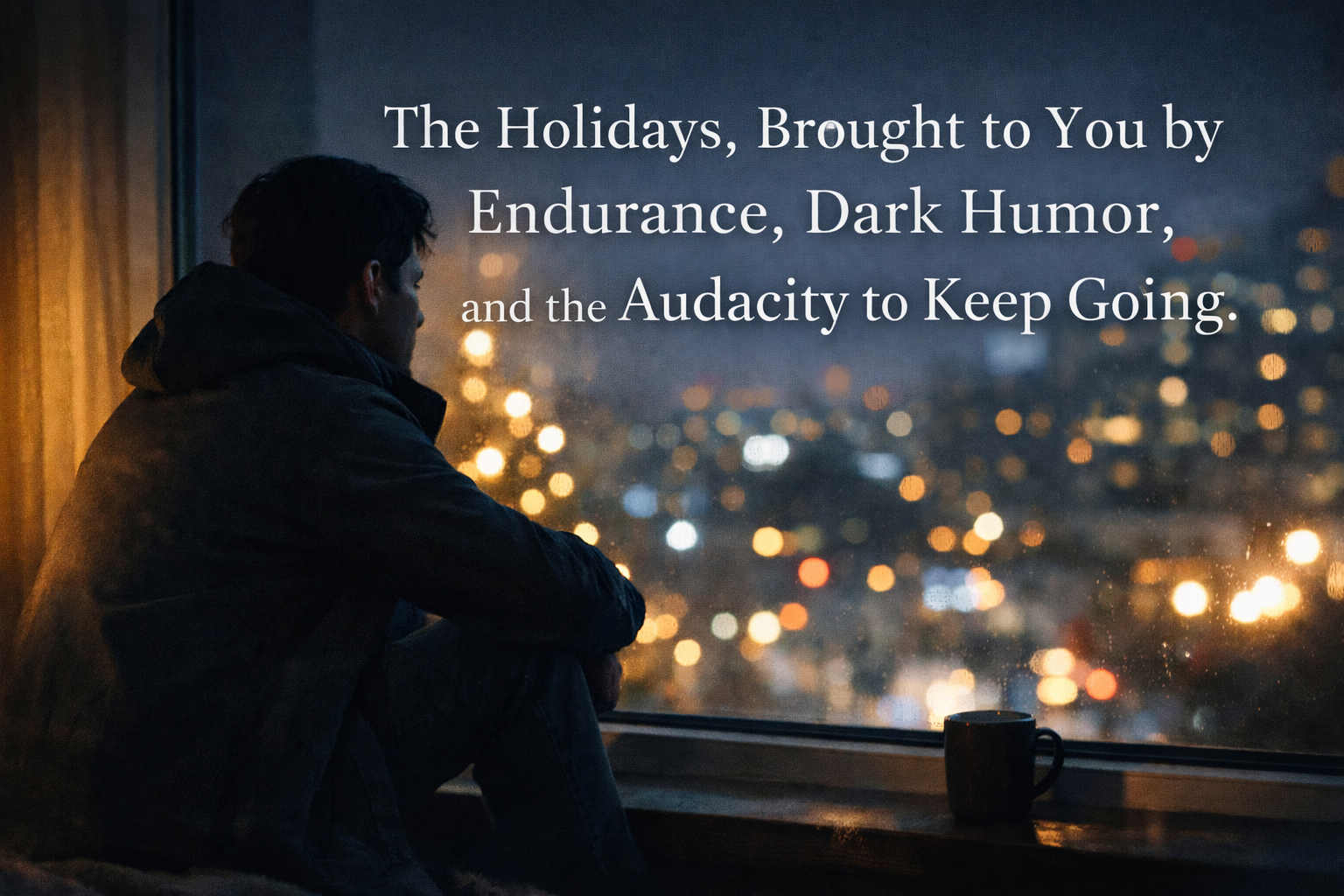
Earlier today, someone said something that did not announce itself as important. It did not come with dramatic pauses or emotional punctuation. It was delivered plainly, almost casually, which somehow made it heavier.
“This is my second Christmas without a job. First Christmas without my car, without my own place, and living under toxic circumstances.”
No buildup. No apology for oversharing. Just a sentence that landed quietly and stayed, the kind that follows you around for the rest of the day, tapping you on the shoulder while you try to do normal things like answer emails or drink coffee or pretend the world is not occasionally unkind for sport.
And it felt necessary to talk about it. Not in a motivational poster way. Not in an “everything happens for a reason” way, because sometimes the reason is not growth or destiny or a carefully curated lesson. Sometimes the reason is that the system is messy, cruel, and powered by Wi-Fi that works better than empathy, spreadsheets that matter more than people, and processes that never stop to ask whether the human on the other end can afford one more delay, one more rejection, one more polite email that starts with Thank you for your patience.
We talk about the holidays like they are a shared highlight reel. Cozy. Magical. Twinkly. A season of joy that arrives on cue, regardless of what your life actually looks like. Matching pajamas. Perfect meals. Well-timed bonuses. Carefully framed gratitude. But for a lot of people, Christmas is just a date on the calendar. It does not care about your resume. It does not care about your savings. It does not care that you have been doing everything right and still losing ground. It shows up anyway, carrying expectations you did not consent to.
And the part that does not get said often enough is this: getting through a season like that is exhausting. Not dramatic exhaustion. Quiet exhaustion. The kind that settles into your bones. The kind where you smile through conversations, nod through “any updates?” questions, and quietly calculate how many ways a person can rebuild from scratch without screaming into a pillow or disappearing into the bathroom at family gatherings just to breathe.
This is not a story about triumph yet. It is a story about endurance. And endurance deserves more respect than it gets.
Chapter One: Christmas Is Aggressively Indifferent to Your Reality
Christmas has excellent branding. It arrives with lights, music, and a very strong assumption that you are emotionally and financially prepared to participate. It does not ask if this year has already taken too much. It does not check whether your life feels stable enough to handle one more expectation. It simply shows up, cheerful and loud, like a relative who assumes you are doing great because you smiled once.
For someone without a job, without a car, without a place that feels safe or permanent, the holidays can feel less like a celebration and more like a live demonstration of everything that has been lost. Every outing becomes logistical math. Every invitation comes with an internal calculation. Can I afford this. Can I get there. Can I make it through the small talk without unraveling.
The questions are rarely malicious. They are just relentless. What have you been up to. Any news. What are your plans for next year. Perfectly normal questions that somehow feel like being gently poked in the bruise of your own life. You learn how to answer them efficiently. Vaguely. Optimistically enough to make other people comfortable, even if comfort is the last thing you feel.
There is a particular kind of fatigue that comes from pretending you are fine while your life feels temporarily removed from the normal timeline. You are not spiraling publicly. You are holding it together quietly. You are doing invisible labor every single day just to exist politely in a world that assumes stability as the default setting.
And then there is the pressure to feel grateful on top of all of it, which is perhaps the most exhausting part. As if gratitude can replace security. As if acknowledging blessings magically fills the gaps where safety and stability used to live. Gratitude is not the problem. Expecting it to do the work of survival is.
Chapter Two: When Struggle Gets Mistaken for a Character Flaw
We love clean narratives. We love stories where success arrives on schedule and hardship is neatly resolved within a few chapters. What we struggle with is the long middle, where nothing is fixed yet and the only measurable achievement is not giving up.
Losing a job is never just about income. It is about identity. Structure. Confidence. Losing the daily proof that you are needed somewhere. Losing the safety of predictability. Losing the ability to answer simple questions without feeling exposed. It chips away quietly, not all at once, but persistently.
Losing a car is not just transportation. It is freedom. Flexibility. The ability to say yes without first negotiating reality. Losing your own place is not just an address. It is privacy. Safety. The dignity of having somewhere that is unquestionably yours.
And yet, people are expected to absorb all of this gracefully. To remain upbeat. Motivated. Hireable. As if grief and resilience are mutually exclusive. As if carrying loss disqualifies you from competence.
What struck me most about that sentence was not the list of things lost. It was the fact that the person was still speaking. Still engaging. Still trying. Still existing in a world that keeps demanding optimism like it is a renewable resource, endlessly available, even when hope feels expensive and energy is gone.
There is a quiet cruelty in how quickly society assigns value based on productivity. You can spend years contributing, leading, building, helping, showing up, and the moment you stumble, the narrative subtly shifts. What happened. Why did you not plan better. What are you doing now. As if stability is a moral achievement instead of a fragile combination of timing, access, health, and luck.
Your worth does not evaporate when your circumstances collapse. It just becomes harder for people to recognize it, especially if they have never had to look beyond titles and timelines to see it.
Chapter Three: Endurance Is Invisible, But It Is Not Small
Surviving a season like this does not look heroic. It is not cinematic. It does not come with applause. It looks like getting out of bed when you would rather not. Answering messages you do not have the energy for. Laughing at jokes that barely land. Holding yourself together in public and coming apart in private.
It looks like dark humor, because sometimes that is the only language left. It looks like stubborn hope that refuses to die, even when it feels impractical. It looks like continuing to apply, to show up, to exist, even when the world keeps giving you reasons to sit down and stay there.
There is no lesson you are failing to learn. No shortcut you missed. No universal timeline you are behind on. You are not broken. You are not lazy. You are not less capable because your life currently requires more effort than it used to.
If this is you, hear this clearly. Your value is not parked in the driveway with the car you no longer have. Your worth did not leave with your paycheck. Your identity is not suspended until circumstances improve. You are not invisible because you are struggling.
And if you are reading this from a place of stability, let this be your reminder to be gentle. To stop assuming progress is linear. To understand that for some people, the holidays are not about joy or gratitude, but endurance. About surviving conversations. About getting through another week. About quietly believing that this is not the end, even when it feels like a very long chapter.
Final Thoughts: The Story Is Still Being Written
The holidays do not need you to be grateful. They need you to be human. And sometimes being human looks like showing up tired, under-resourced, and still choosing to exist in a world that does not pause when you need rest.
If you are carrying more than anyone realizes, you are not weak for feeling it. If you are holding it together with humor and sheer willpower, that counts. If this season feels heavy instead of magical, you are not doing it wrong.
This is not the end of your story. It is a hard chapter. An unfair one. A quiet one. But chapters pass, even the long ones, and the fact that you are still here, still trying, still breathing through it, is not insignificant.
It is resilience in its truest form.
And it matters.






Thanks for sharing. I read many of your blog posts, cool, your blog is very good.