
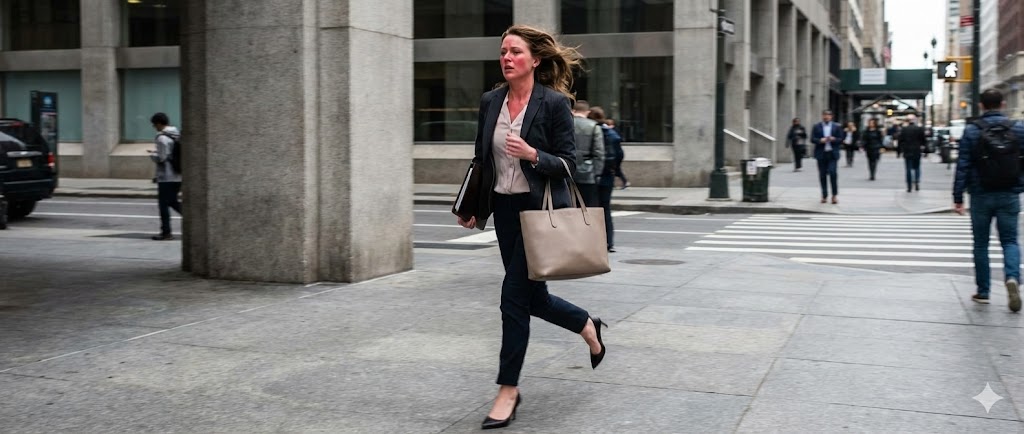
Every great interview story begins with confidence and ends with chaos.
You wake up early, shower in determination, and tell yourself, “Today’s the day.” You iron your best shirt, pick your power outfit, and stand in front of the mirror like a motivational poster: You’ve got this. You’ve researched the company, memorized your STAR stories, and practiced smiling without looking like you’re begging for employment.
You’re ready. Your LinkedIn profile says “open to work,” but your soul says “employed in spirit.”
That was the energy one woman brought to her big day — we’ll call her Alison, patron saint of effort. She had done everything right. Her outfit? Sharp enough to slice through rejection. Her resume? Proofread, formatted, scented faintly of ambition. Her attitude? A perfect balance of optimism and caffeine.
And because she was a responsible adult who didn’t want to circle downtown for twenty minutes hunting for a parking spot like a lost intern, she ordered an Uber. It was a flawless plan. Stress-free, punctual, professional.
Until the driver pulled away and she looked up at the building.
Something didn’t feel right. The signage didn’t match. The lobby looked unfamiliar. And that’s when it hit her — not metaphorically, but with the emotional force of an unpaid internship: she was at the wrong address.
Not “oops, one block off” wrong. Not “other entrance” wrong. No.
We’re talking “three-quarters of a mile, multiple crosswalks, and two blisters away from where she was supposed to be” wrong.
The kind of wrong that makes your soul leave your body for a few seconds.
She checked her phone, her calendar, her sanity — all confirmed it. The clock was ticking. The interview started in fifteen minutes, and she was fifteen minutes of sprinting away from even having a chance.
At that moment, she had two options:
- Wait for another Uber, arrive late, and send the dreaded “So sorry for the delay!” email no one ever believes.
- Or… become an action movie protagonist in heels.
She chose chaos. And cardio.
The Sprint of Shame (and Survival)
There’s a unique kind of panic that sets in when you realize your job interview has suddenly turned into a high-stakes episode of Corporate Survivor: The Job Hunt Edition.
Alison took off like she was being chased by all her past regrets. Picture it: downtown streets bustling with people, buses hissing by, pigeons scattering, and one woman sprinting like she’s late for her own destiny. Her tote bag swung like a weapon, her heels clicked like thunder, and her internal monologue was just one long “No no no no no no no.”
The irony? She had spent days preparing for behavioral questions — not physical endurance challenges. She had practiced the STAR method, not the CPR method. Her biggest fear had been “blanking on an answer,” not “tripping into oncoming traffic.”
Somewhere around the halfway point, her professional composure melted faster than her mascara. She was part runner, part disaster, fully committed. Her lungs filed an HR complaint against her legs, but she didn’t stop. Because job interviews are nothing if not endurance trials disguised as polite conversations.
When she finally arrived — fifteen minutes late, hair slightly windblown, confidence clinging to life — she didn’t crumble. She didn’t apologize fifty times. She straightened her jacket, took a deep breath, and walked in like she was the hero of her own workplace drama.
And that’s where the plot twist comes in.
The Miracle of Grace
She expected the worst.
A frown. A sigh. The cold, professional courtesy that says, “We’ve already judged you.” Maybe even the classic rejection phrase, “We appreciate your time.”
Instead, the interviewer looked up, saw the exhaustion in her eyes, and did something radical: she smiled.
“Rough morning?” she asked gently.
Alison nodded, still catching her breath. “Wrong address,” she confessed, bracing for judgment.
But there was none. No lecture. No sarcasm. No disapproval. Just empathy. The interviewer handed her a bottle of water, gave her a moment to compose herself, and said the words every human hopes to hear when life goes off script:
“Take your time. You made it. That’s what matters.”
It wasn’t pity. It was grace — something far rarer in the modern hiring process than PTO approval or an honest job posting.
What followed wasn’t an interrogation but a conversation. They talked, they laughed, and somewhere between the first and last question, the tension melted away. The interviewer saw not a frazzled candidate, but someone resilient enough to show up anyway — sweaty, late, human.
Because here’s the secret they don’t teach in career coaching seminars: perfection impresses people, but humanity connects them.
In that moment, Alison didn’t need a flawless resume. She just needed someone to see her effort.
The Marathon Mindset
A week later, she got a second interview.
Not because she crushed every question or quoted productivity buzzwords, but because she showed up. Because she didn’t quit at the first wrong turn. Because she proved, unintentionally, that grace under pressure is the best soft skill of all.
That’s the part that makes this story unforgettable. It’s not about blisters, cardio, or fashion sacrifices. It’s about what happens when life tests your limits and you choose persistence over perfection.
The truth is, most interviews test more than your qualifications — they test your composure. How you recover from chaos says more about your potential than how you perform when everything goes smoothly.
Anyone can shine in a well-rehearsed answer. But it takes a different kind of courage to walk in late, flustered, mortified, and still give your best. That’s the kind of grit companies say they’re looking for — they just don’t realize it shows up in sweat, not spreadsheets.
And maybe that’s why her story resonates so deeply. Because whether you’ve sprinted to an interview, spilled coffee before a presentation, or joined a Zoom meeting still on mute for two full minutes, you know what it’s like to keep going when dignity has already left the building.
Final Thoughts: The Grace That Hires
What sticks with me most isn’t her sprint — it’s the woman who handed her water instead of judgment.
That’s the kind of leadership we need more of. The kind that recognizes effort, not just execution. That remembers people aren’t robots with Wi-Fi; they’re humans navigating unpredictable mornings, bad GPS directions, and life’s relentless sense of humor.
We spend so much time chasing the illusion of flawlessness — the perfect answer, the perfect timing, the perfect posture — that we forget authenticity is what people remember.
So the next time someone walks into a meeting late, flustered, or halfway between laughter and tears, maybe channel your inner Alison’s interviewer. Offer patience instead of pressure. Empathy instead of critique. Because sometimes, the moment you choose grace is the one that changes someone’s entire week — or even their career.
And to every job seeker who’s ever sprinted down a sidewalk in heels, sweated through their blazer, or prayed their deodorant didn’t clock out early — you’re doing fine. You’ve already proven you’ll go the extra mile. Literally.
The resume might say “detail-oriented,” but your story says “undeniably human.”
And that, in a world full of perfectionists pretending not to sweat, is the most hireable trait of all.






Your point of view caught my eye and was very interesting. Thanks. I have a question for you.