
If you’ve been out here in the wilds of the job market, you know the script by heart. You spend hours customizing your resume to match a job description that was clearly copied from three different postings on Indeed. You painstakingly write a cover letter, though deep down you know it’s going straight into a digital void where bots chew it up and spit it into a recycling bin labeled “never read.”
Then, if you’re really lucky, you get an interview. You iron your shirt, practice your “Tell me about yourself” answer in the mirror, and maybe even splurge on Starbucks instead of brewing regret flavored coffee at home. You show up, you smile, you give them the best version of yourself that can exist on a Wednesday afternoon at 3:00 p.m.
And then—crickets.
Or worse, you get the email. You know the one. The classic: “After careful consideration, we’ve decided to move forward with another candidate.” It’s professional sounding, but it lands like a bad breakup text. Every time I read one, I half expect it to say, “It’s not you, it’s us. Let’s still be friends.”
That’s the job search in 2025: endless auditions for a part you’ll probably never get, judged by a committee that couldn’t agree on where to order lunch. Most days it feels less like looking for a career and more like competing on some twisted reality show called Corporate Survivor: HR Island.
But then someone slid into my messages with an idea so bold it made me drop everything I was doing:
“I’m waiting for the post about what happens when the applicant rejects the company. There’s something bizarre that happens when you tell someone they can’t have something. The brain seems to want it more. My theory is that one of these will suddenly have a change of heart. Would love someone to experiment!”
Now, most people would nod politely and move on. Me? I rubbed my hands together like a cartoon villain about to press a big red button. Because if the job market insists on being a circus, I’m more than happy to play ringmaster.
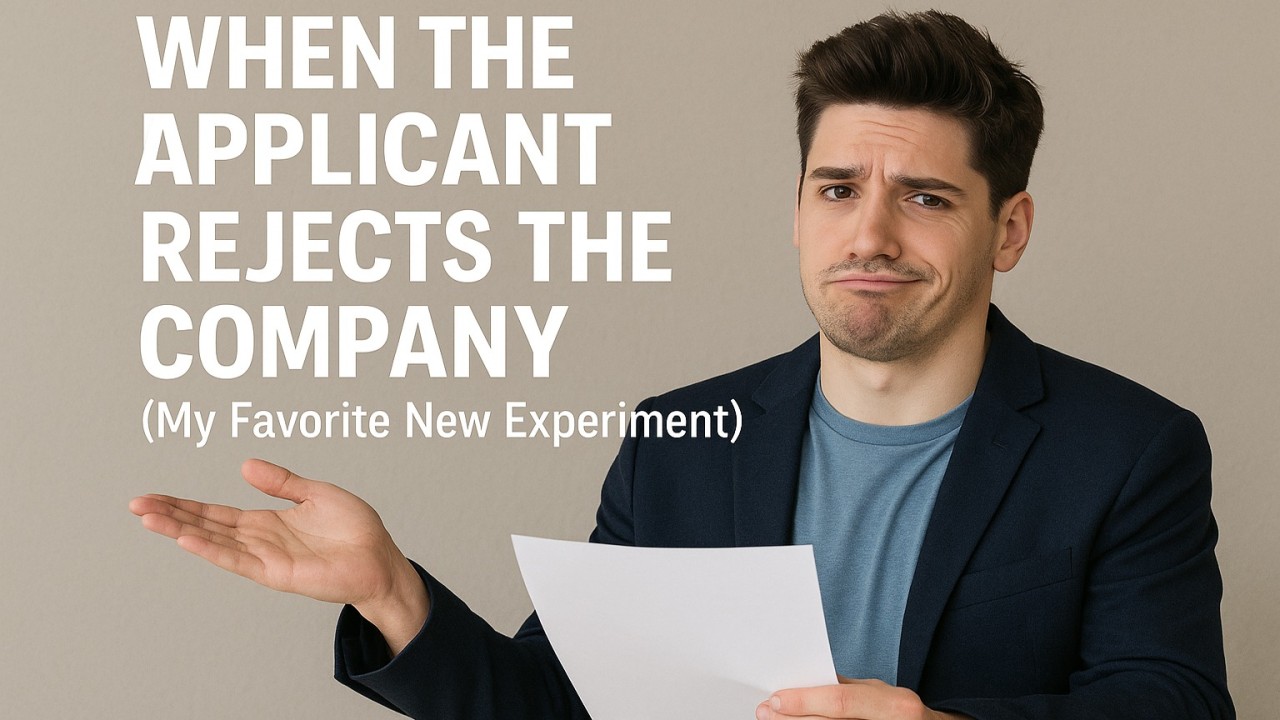
And so, my friends, I became the scientist nobody asked for and launched a brand new experiment: What happens when the candidate rejects the company first?
Phase One: The Setup
Instead of waiting around to be ghosted, I drafted a rejection email of my own. It was polite, professional, and just petty enough to make me giggle:
Dear Hiring Manager,
After careful consideration, I regret to inform you that I am unable to continue pursuing opportunities at your company at this time. The role is a strong match, but unfortunately, your communication style, salary range, and insistence on calling your culture “like a family” were not aligned with my current career goals. Please don’t take this personally. I wish you the best of luck with your search.
Sincerely,
The Candidate You Didn’t Deserve
The moment I hit send, I felt like I had just thrown down a career Uno reverse card.
Phase Two: The Results
The responses rolled in faster than any recruiter has ever responded to me in my entire life.
One emailed me back in under five minutes, after ignoring me for three weeks. Suddenly, I was their top priority. “Are you sure? We’d love to hop on a quick call.”
Another, who had rejected me two weeks earlier, circled back with, “Just so you know, we were actually moving you forward to final interviews.” Uh huh. That’s like your ex texting, “I was just about to propose.”
And then there were the LinkedIn views. You know that feeling when you see a hiring manager who ghosted you suddenly poking around your profile at 11:47 p.m.? Yeah. Let’s just say the experiment definitely triggered some late night corporate curiosity.
Phase Three: The Hypothesis
Here’s my working theory: corporate psychology runs on the same playground rules as human psychology. If you can’t have it, you want it more. Hiring managers are not immune to FOMO, they just wear better blazers.
When a candidate dares to reject them, it shifts the balance of power. Suddenly, they’re the ones with sweaty palms. Suddenly, they’re the ones refreshing their inbox, hoping for a second chance.
It’s like telling a toddler they can’t have the toy truck. The moment you say “no,” that truck becomes the most valuable object in the universe.
The Grand Conclusion (a.k.a. The Ending Nobody Saw Coming)
So yes, my experiment worked—and in ways I didn’t even predict. It confirmed what we all secretly know: rejection is universal. It stings, no matter which side of the desk you’re on.
But it also revealed something bigger: we, the applicants, have more leverage than we think. For years, job seekers have been trained to beg for approval like contestants on The Bachelor, holding out resumes instead of roses. But what if we stopped playing their game? What if, once in a while, we reminded them that we’re not just auditioning, they are too?
Because here’s the secret: a job offer is not a blessing being bestowed upon you from the mountaintop of HR. It’s a mutual agreement. It’s two parties choosing each other. And if they don’t see your value the first time around, maybe it’s time to make them chase you a little.
So try it. Send that rejection. Flip the script. Watch as the company that ghosted you suddenly remembers your name like a long lost crush from high school. Worst case? You get a little satisfaction and a great story. Best case? You realize you were never powerless in this process to begin with.
And here’s the part I didn’t expect: watching a company panic when they realize they’ve been rejected? It’s almost as sweet as landing the job. Almost.
Because in the end, this experiment wasn’t just about flipping the rejection script. It was about remembering that your worth doesn’t come from an offer letter, or a recruiter’s timeline, or a hiring manager’s shrug. It comes from you.
And sometimes, the boldest career move you can make is simply saying: “Thanks, but no thanks.”






Thanks for sharing. I read many of your blog posts, cool, your blog is very good.
Your point of view caught my eye and was very interesting. Thanks. I have a question for you.