
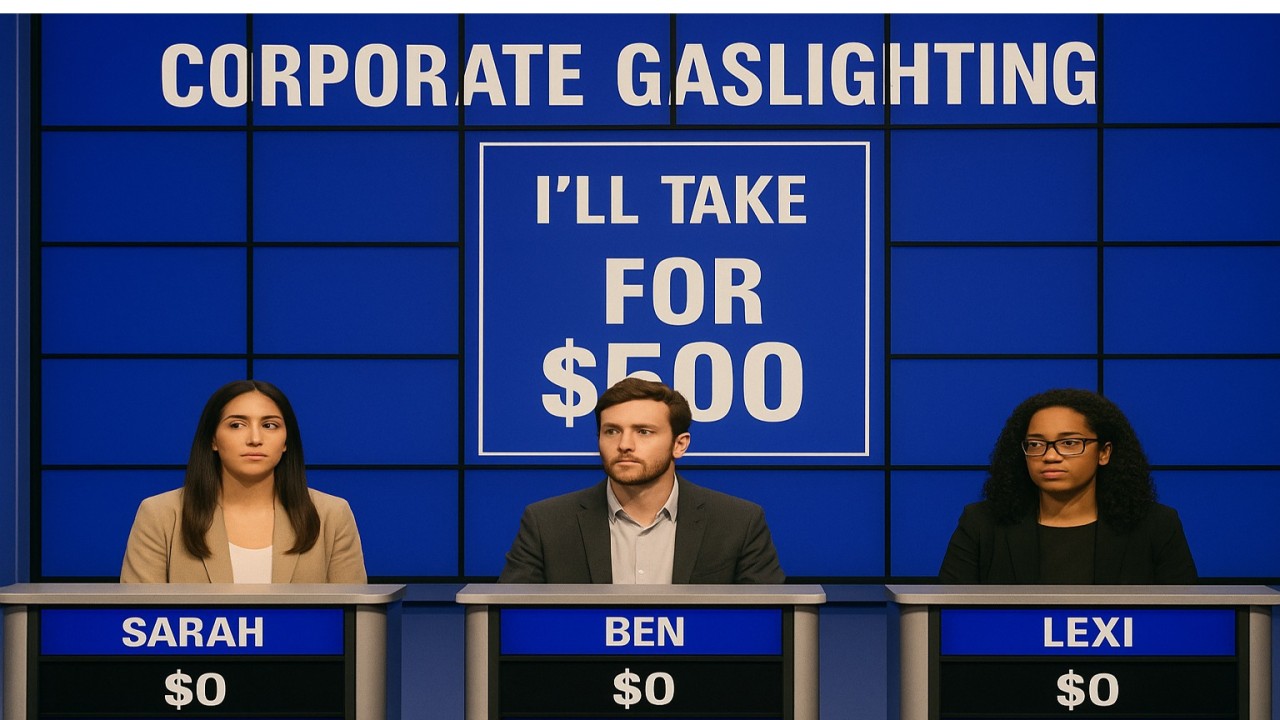
Welcome to the only game show where the prize is theoretically “employment,” but mostly just emotional damage, another password reset email, and a fresh round of existential dread. On the left podium: me, battle hardened, caffeine powered, and running on equal parts LinkedIn rage and oat milk lattes. My resume has been rebranded so many times it’s basically abstract art now, it should be hanging in MoMA with a placard that says, “Corporate trauma but make it chic.”
On the right podium: Recruiters, a mysterious species with LinkedIn Premium, motivational quote graphics, and the collective memory of a goldfish but the audacity of an entire Wall Street frat. They’ve spent exactly three minutes skimming my experience and are somehow comfortable deciding the trajectory of my next decade. Their natural habitat? A Zoom call where someone’s camera “mysteriously isn’t working.” Their mating call? “Quick chat?” followed by six weeks of radio silence.
The rules? Simple: I answer every question with professionalism, competence, and a dash of charm. They answer with “We went in another direction,” a phrase so vague it should be printed on T-shirts and sold in bulk to anyone who’s been unemployed for more than three months. Somewhere Alex Trebek is sipping tea in the afterlife, watching this chaos unfold, shaking his head at the fact that Applicant Tracking Systems, those digital gatekeepers are basically Las Vegas slot machines but with worse odds. You feed in your resume, pull the lever, and pray for a match. Instead, you get “No jackpot today” and an automated “We’ll keep your resume on file” (spoiler: they will not).
The studio lights flicker; my palms are sweaty but in a professional way (LinkedIn calls it “resilience”). A producer yells “SMILE!” as if there’s anything fun about summarizing 20 years of experience into three tidy bullet points for someone who still calls Excel “advanced tech.” And yet, here we are. Me vs. them. The show must go on and apparently, so must the unpaid emotional labor of proving I’m not a risk because I learned Windows 95 before they were born.
Let’s play.
Round One — The Categories
Our board glows menacingly, like a Vegas casino that knows exactly how to take your dignity and your wallet. The categories are set, each one a fluorescent nightmare of job market truth bombs:
AGEISM FOR 100 — Where “seasoned” means “we assume you’ll ask for healthcare and refuse to learn Slack.” Bonus points if they ask, “Do you think you’d be bored here?” while you’re mentally calculating how to save their entire broken workflow in under an hour.
GHOSTING FOR 200 — The Daily Double of modern hiring: disappear after three interviews, one unpaid take home project, a psychometric test, and a “culture coffee chat” where you bonded over golden retrievers and productivity hacks. Poof. Gone. Not even the courtesy of a “Thanks but no thanks” email just pure digital tumbleweeds.
COMPENSATION ILLUSIONS FOR 300 — The salary range is “competitive,” but only if you’re competing in the Hunger Games. They’ll talk about “generous equity,” which turns out to be a single share of stock worth less than your Uber ride to the interview. Benefits? Unlimited PTO — aka, please don’t ask because no one here actually takes it.
CULTURE FIT FOR 400 — They want “someone fun,” but not too fun. Definitely not someone with opinions. Bonus round: they post company photos of axe throwing and craft beer Fridays but quietly panic when you ask about pay transparency or promotion paths.
RELEVANT EXPERIENCE FOR 500 — Where 20 years is somehow “too much,” but two years is “not enough.” It’s like Goldilocks, but for trauma and skill sets. They want someone who’s done everything before but is still cheap and eager like an unpaid intern.
I buzz in on everything because of course I know how to do the job. My thumb is lightning fast, my credentials solid, my stories sharp. Meanwhile, they buzz in just long enough to mispronounce my name, turning it into a new species of Pokemon and then ask the one question guaranteed to make your soul exit your body: “Quick clarifying question… would you be okay with a salary that starts with the letter N as in None?”
I smile the way contestants smile when they know the judges are wrong but have no appeal system. Inside, I’m mentally invoicing them for the hours spent customizing my resume and rehearsing my “biggest weakness” answer (which, by the way, is trusting recruiters). The audience gasps; Alex Trebek’s ghost sighs. The scoreboard doesn’t budge.
Because here’s the truth: this isn’t Jeopardy; it’s psychological dodgeball. They’re throwing buzzwords and I’m dodging red flags. They say “rockstar,” I hear “underpaid multitasker.” They say “dynamic team,” I hear “we fire people when budgets sneeze.” They say “fast paced environment,” I hear “emotional CrossFit but without the benefits.”
Yet still, I keep buzzing in because what’s the alternative? Sit quietly while a panel of strangers with AirPods decides if my entire career trajectory vibes with their kombucha fridge? Nah. I came to play. My answers are polished, my sarcasm subtle but deadly, my will to survive stronger than their ping pong table perks.
Scoreboard still shows zero for me, but that’s okay. Jeopardy legends know, sometimes it’s not about winning the round. It’s about staying on the stage long enough to get to Final Jeopardy, where the real answers live.
Daily Double — “Tell Us About Yourself”
Ah yes, the recruiter’s power move. The modern day equivalent of flipping the Monopoly board and declaring victory mid game: “Tell us about yourself.”
I have a split second to decide which version of me shows up. The bullet pointed gladiator who’s built teams from scratch, hit impossible revenue targets, and survived three recessions and one CEO with a vision board that looked suspiciously like a Pinterest board for midlife crises? Or the polished, humble version that doesn’t scare anyone but also somehow convinces them I’m not just collecting LinkedIn badges for sport?
Instead, panic seizes the wheel. Out comes the default nonsense: “Well, I’m passionate about solving problems.” Which is code for: I’ve MacGyvered more dumpster fires than you have unread emails. I have turned budget ashes into quarterly wins, jury rigged systems so broken they made IT cry, and kept morale alive with nothing but caffeine and gallows humor.
But they don’t hear that. They’re too busy nodding solemnly while typing something in their sacred CRM that probably reads: “Seems… overqualified?” (Recruiter speak for “We want someone cheaper, hungrier, and maybe slightly desperate.”)
Their Slack pings light up in the background, probably about a team lunch or a meme about “quiet quitting.” Meanwhile, I’m mid monologue trying to sound enthusiastic but not threatening, experienced but not expensive, confident but not “difficult.” It’s like trying to thread a needle while blindfolded on a roller coaster.
Then comes the polite smile, the one that says, We’re totally going to ghost you after this call but we want to seem human while we do it. They lean back, arms crossed in that faux relaxed way, as if my entire work history can be distilled into a vibe check. Somewhere, Alex Trebek is flipping his note cards, muttering, “That was the correct answer, but the judges are feeling insecure today.”
I wish I could say I push back, that I interrupt with a spicy, “Overqualified? No, I’m appropriately qualified. Your org is just under prepared.” But decades of professional conditioning kick in; we’re taught to smile, to self edit, to shrink just enough to fit through whatever invisible door they’ve built.
And yet, under the table, metaphorically, I’m flipping them the gentlest of birds. Because I know what I bring: stability, creativity, battle scars that taught me how to survive, adapt, and rebuild. They might label it “too much,” but the next time a project implodes, guess who they’ll wish they’d hired?
So I finish my answer with grace, while mentally filing their reaction into my mental Jeopardy board: Recruiter doubts seasoned talent for 500, Alex. The buzzer sounds in my head. Wrong call for them. Right call for me because if my experience is “too much,” maybe their company isn’t enough.
Final Jeopardy — “Why Should We Hire You?”
I bet everything on this one, Final Jeopardy, career edition. My entire professional highlight reel queued up and ready to stun: revenue doubled, turnover halved, systems built from duct tape to elegance, chaos tamed with spreadsheets so beautiful they should hang in a gallery. I talk about leading teams through crises, taking on work no one wanted, and somehow making it all look intentional. It’s the kind of impact you dream of dropping like a mic at the end of a big interview.
And for a brief, shimmering moment, I see it land. Brows raise. Heads nod. Someone scribbles a note that looks suspiciously positive. I think, Yes. Finally. They get it. The studio lights brighten; the crowd in my head roars.
Then comes the curveball. They counter with the trifecta of rejection, the HR holy trinity:
“We loved meeting you but decided to go with someone who’s a better culture fit. Also, our budget changed mid-process. Also, Mercury’s in retrograde.”
Translation: We’re scared of your competence and can’t pay what you’re worth, but we’re going to blame the stars to keep things whimsical.
I feel the Jeopardy theme music swelling in the background as I write my answer on the little digital blue screen, except mine isn’t a question, it’s a declaration:
“Because I’m amazing and your job description is basically me in human form.”
Theirs, meanwhile, reads:
“We’ve moved on with other candidates.”
Everyone claps awkwardly, like an audience forced to applaud a magician who just sawed hope in half. Confetti doesn’t fall. Alex Trebek’s ghost just sighs and quietly adds me to the scoreboard of “people who deserved better.”
And here’s the kicker: I know I didn’t lose. Not really. Because when you play this game long enough, you realize the outcome says more about the board than the player. “Culture fit” is often code for “we want someone cheaper” or “we’re threatened by people who know what they’re doing.” “Budget changed” is code for “we were never serious; we just needed free consulting disguised as an interview.” And Mercury? Mercury’s fine. Mercury’s just living its best planetary life while recruiters use it as a scapegoat for ghosting.
So I shake it off, collect my imaginary buzzer, and walk off stage with my dignity intact. Because even if the scoreboard says zero, my value hasn’t changed. One day I’ll walk into the right Final Jeopardy, the one where the company actually means it when they say “we want the best.” The one where my answer and theirs finally match.
Until then, I’ll keep betting on myself. Because I know the right stage exists somewhere out there and when I land on it, I won’t just win the round. I’ll own the whole game.
Closing Monologue — Alex for the Win (Sort Of)
And that’s how you lose Jeopardy but somehow still keep your dignity, maybe even add a little swagger on the way out. Because here’s the quiet, defiant secret nobody writes on a job post: these rounds aren’t really about you. They never were. They’re about a broken system trying to make math out of human potential. A game show designed by people who love dashboards but have never had to rebuild a career mid storm. A place where algorithms pass judgment before conversations even begin, where “fit” is just a polite word for “comfort,” and “overqualified” really means “you scare us because you know how the sausage is made and might have ideas about seasoning.”
It’s a weird theater of control, swipe left, swipe right, buzzers and filters and hidden checkboxes no human being could ever anticipate. They’ve tried to turn possibility into a spreadsheet, and then act surprised when the spreadsheet spits out sameness and mediocrity. Meanwhile, people like us keep showing up, hearts bruised but intact, CVs dressed for battle, coffee close at hand and refuse to stop playing. Because we know our worth isn’t determined by an ATS keyword score or the comfort level of someone who’s never had to build what we’ve built.
So yeah, I’ll keep showing up to this absurd game show. I’ll keep buzzing in with answers that prove experience isn’t expired; it’s evolved, sharpened, and battle tested. I’ll keep cracking jokes so the process doesn’t swallow me whole, keep reframing rejection as misalignment instead of failure, keep laughing at the idea that “culture fit” means anything when the culture itself can’t survive one bad quarter.
And one day, maybe not today, maybe not this round, I’ll step onto a stage where the rules aren’t rigged. Where the board isn’t built to screen out wisdom in favor of cheaper enthusiasm. Where the final question isn’t “Why should we hire you?” but “Why wouldn’t we?” The scoreboard will finally catch up to the reality: resilience is a skill, reinvention is an art, and showing up again and again when the game keeps glitching is a superpower.
Until then, I’m staying sarcastic, caffeinated, and uncomfortably persistent. I’ll keep betting on myself, because the right room will see the value in a player who knows every trick, every trap, and still chooses to play.
Recruiters, pick your next category. I’m not leaving the stage, I’m just warming up, and I’ve got plenty of buzz left.






Your article helped me a lot, is there any more related content? Thanks! https://accounts.binance.info/da-DK/register-person?ref=V3MG69RO
Thanks for sharing. I read many of your blog posts, cool, your blog is very good.