
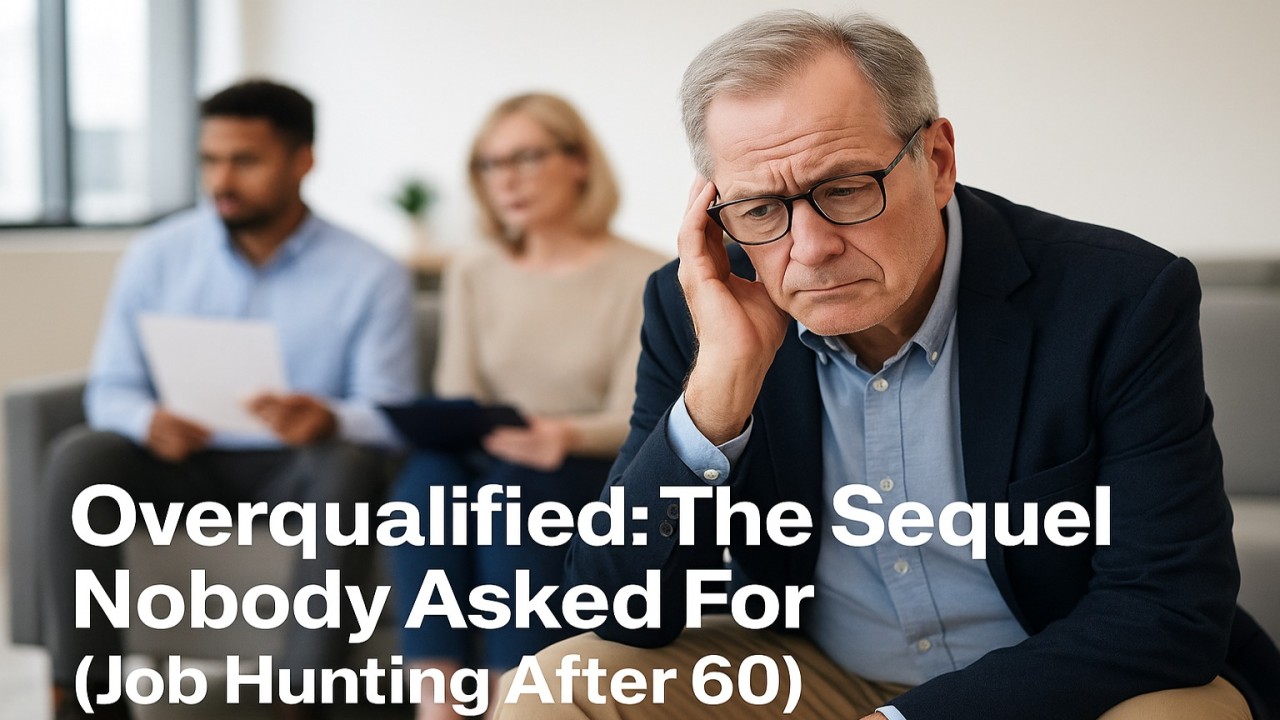
You ever notice how “overqualified” sounds suspiciously like a polite way to say, “You remind us of our parents, and that scares us”?
Because that’s what the modern job hunt feels like after 60. You’ve got experience that could power a small nation, but instead you’re out here getting ghosted by hiring managers who weren’t even born when you first learned Excel. They’re out here asking if you’re “comfortable with technology,” and you’re thinking, “Kid, I was rebooting mainframes before you figured out TikTok filters.”
Let’s be honest, job hunting at this stage isn’t just a search. It’s an endurance event. It’s running a marathon while being judged by people who think “CC” in an email stands for “Cool Collaboration.” You’ve got patience levels forged from dial-up internet, wisdom shaped by decades of surviving corporate nonsense, and yet somehow, you’re still getting passed over for someone who once put “Team Player” on their resume and meant it.
You know you’re in a different era when your interviewer starts explaining what “mentorship culture” means — to you. You smile, sip your coffee, and nod, knowing full well you were doing “mentorship” back when it was called “teaching people how not to break the copier.”
At this age, the job search isn’t about proving you can keep up. It’s about convincing the world that experience isn’t a liability, it’s the cheat code they keep ignoring. Because while everyone else is busy reinventing “work-life balance” like it’s a new app, you’ve already lived through the sequel, the reboot, and the director’s cut.
And yet, you keep showing up. Because deep down, you know your story’s not over, it’s just waiting for the right company brave enough to hire someone who’s seen it all, done it twice, and still shows up with humor, humility, and maybe a little arthritis.
The Resume That Scares Recruiters
You spend hours updating your resume, deleting all the jobs before 2010 so you don’t look like you predate Wi-Fi. You remove your landline. You shorten your email from “aol.com” to “gmail.com” just to blend in. You even swap out “25 years of experience” for “seasoned professional,” because apparently, honesty now counts as a red flag.
You trim down your bullet points, modernize your verbs, and pray the hiring algorithm doesn’t assume you’re applying from a retirement home. You leave off your graduation year, hoping to confuse the bots just long enough to land a human conversation.
Then the recruiter looks at your 30 years of experience and says, “We’re worried you might get bored.”
Bored? Sweetheart, I’ve sat through quarterly reviews that lasted longer than your entire career. I’ve survived mergers, reorgs, and bosses who thought “synergy” was a personality trait. I once made it through an all hands meeting about “embracing change” led by a man reading from index cards. I can survive boredom.
What they really mean is: “You’ll make us look bad in meetings,” or, “We can’t afford your expertise but don’t want to admit it.” Because if they were honest, they’d say, “You actually know what you’re doing, and that terrifies us.”
They want “hungry” candidates, not ones who’ve already eaten corporate jargon for breakfast. They want people who’ll work weekends for “exposure,” not those who understand that burnout isn’t a business model. They say “overqualified,” but what they really mean is “you might ask questions we don’t have the answers to.”
And that’s the irony of it all, you’ve spent a lifetime becoming the exact person they claim they want: reliable, knowledgeable, and calm under pressure. But instead of celebrating that, they hand you a participation trophy called “We’ve decided to move forward with other candidates.”
Ageism: Now in User-Friendly, Corporate Format
They don’t say “too old.” They say things like “cultural fit” or “fast paced environment” code words for “we only hire people who think burnout is a lifestyle.” They’ll praise your “impressive background” right before telling you they’ve decided to “move forward with candidates who more closely align with our stage of growth,” which roughly translates to: “You have actual life experience, and that makes us uncomfortable.”
And let’s talk about the interviews.
There you are, wearing your best shirt, logged into Zoom early like a responsible adult, double checking the lighting and muting your phone because professionalism still means something to you. The hiring manager shows up five minutes late, camera tilted toward their ceiling fan, drinking an oat milk latte like it’s part of their compensation package. Then they hit you with the classic: “So, where do you see yourself in five years?”
Buddy, at this point, alive and debt free would be nice. Ideally somewhere warm, with working Wi-Fi, and maybe a boss who doesn’t confuse ‘leadership’ with sending Slack emojis.
You try to talk about leadership, mentorship, stability, things that actually keep companies alive and they blink at you like you just quoted Shakespeare. Then they say, “We’re really looking for someone hungry.”
Sir, I packed a sandwich. I’m not here to be hungry. I’m here to help your company stop making rookie mistakes, the kind you make when you hire enthusiasm over experience and wonder why nobody knows how to write an email without 14 exclamation points.
And when they ask if you’d be “comfortable taking direction from younger managers,” you have to stop yourself from saying, “As long as they know what direction they’re going.” Because at this point, you’ve managed teams, built departments, survived every corporate buzzword trend from “Six Sigma” to “synergy,” and now you’re being interviewed by someone whose greatest leadership challenge was coordinating a group project in college.
It’s not arrogance, it’s reality. You’ve been through the wars, learned the lessons, and you’re still here, sharp, capable, and apparently, a “cultural risk.” But between us? The real risk is running a company without anyone who remembers what accountability looked like before it came with hashtags.
The Algorithm Thinks You Died in 2004
Even AI has joined the discrimination parade. You upload your resume to an applicant tracking system and immediately get filtered out because you didn’t use the word “synergy” enough times or forgot to sprinkle in “dynamic team player” between your actual accomplishments. Somewhere, a robot is scanning your decades of experience and thinking, “Hmm… this human has too much context. Reject.”
You spend hours tailoring that resume, matching every bullet point to the job description like you’re playing corporate Mad Libs and then, the moment you click “submit,” the rejection email arrives before your coffee even cools. “We’ve decided to move forward with other candidates.”
You stare at the screen, blinking. How? Did they hire someone in the time it took me to exhale? Did the system sense my enthusiasm levels drop below corporate standards?
No. The robot just took one look at your years of experience and said, “Nope, too real for us.” Because apparently, in the world of digital gatekeepers, competence looks suspiciously like a system error.
The algorithms aren’t built to recognize wisdom, they’re programmed to hunt for buzzwords. You can run a company, train a staff, and fix a balance sheet in your sleep, but if you didn’t type “collaborative problem solver” in size 11 Calibri, the system treats you like you’re applying to be the village historian.
So you sit there, watching the “Thank you for applying” email glow like a participation trophy, and wonder how a machine that can detect faces, predict weather, and finish other people’s sentences can’t comprehend that “30 years of experience” isn’t a glitch, it’s an upgrade.
And somewhere deep inside that server farm, the AI probably congratulates itself, proud of protecting the company from your dangerous ability to show up on time, spell correctly, and survive an entire workday without an energy drink.
The Intern Who Calls You ‘Sir’
If you’re lucky enough to land an interview, the person on the other side of the screen looks like they just finished prom. They call you “sir” or “ma’am,” and you can practically hear them wondering if you know what Slack is. They squint when you mention Outlook, nod like you’re referencing ancient history, and type notes into a tablet like they’re decoding an artifact.
You do know what Slack is. You also know what fax machines are, and floppy disks, and dial-up tones that could make a grown man cry. You’ve survived pagers, PalmPilots, and the rise and fall of every office buzzword from “intranet” to “metaverse.” You’ve adapted to every technological shift since the Cold War, but sure, tell me again how you’re “looking for someone tech savvy.”
You were sending files before “the cloud” meant anything other than bad weather. You learned PowerPoint when clip art was cutting edge. You can navigate an Excel spreadsheet faster than most people can find the mute button on Zoom. You don’t need a TikTok tutorial to figure out a new system, you built entire workflows before “user friendly” existed.
Meanwhile, the same people who fear your “dated experience” are still asking you to fix the office printer. Or the Wi-Fi. Or the copier that mysteriously stops working every Monday morning. And while they’re Googling how to convert a PDF, you’re already emailing them the solution, with a signature line that says “Sent from my common sense.”
It’s almost poetic, really. The same generation that doubts your ability to “keep up” is the one that still can’t find the unmute button on Teams. But you smile anyway, because deep down you know: technology changes every decade, competence doesn’t.
Overqualified: The Ultimate Plot Twist
Here’s the secret no one tells you “overqualified” is code for “you intimidate us.” It’s corporate for “you’ve seen the playbook, rewritten it twice, and know how this story ends, usually with someone like me asking you for help.”
Because the truth is, you’ve seen too much. You know when a company’s “big vision” is really just a PowerPoint with bad clip art and a mission statement copy pasted from 2008. You can smell bad leadership before the coffee finishes brewing. You’ve already lived through every corporate buzzword that Gen Z is just now discovering “pivoting,” “transparency,” “innovation.” You were doing “quiet quitting” before it had a hashtag; back then, it was called “mentally surviving a meeting.”
You’ve watched startups rise and implode faster than a pot of office coffee. You know that when a manager says, “We’re like a family,” what they really mean is: “We’ll emotionally drain you and then make you cover someone’s shift.” You’ve seen “unlimited PTO” turn into a guilt trip, “collaboration” become code for “no one’s actually in charge,” and “work life balance” quietly disappear somewhere around the third reorg.
You don’t need to be told to “bring your authentic self.” You already brought it and it comes with receipts, resilience, and a Rolodex that could probably save their business. You’ve been authentic since before it was marketable. You’ve shown up, stayed late, rebuilt departments, trained managers, and handled crises without needing a “wellness Slack channel.”
And that’s why they hesitate. Because hiring you means hiring someone who can see through the glitter. Someone who’s not dazzled by ping-pong tables, kombucha taps, or “fun Fridays.” Someone who knows that leadership isn’t about vibes, it’s about accountability.
So when they say you’re “overqualified,” what they really mean is you’re a mirror and not everyone’s ready to see what’s staring back.
Still Standing (and Still Applying)
You’re not bitter. You’re just amused. You’ve seen fads come and go, from Blackberry phones to “open office culture,” from casual Fridays to companies that call themselves “flat organizations” but still have twelve layers of approval to buy a stapler. You’ve watched entire industries reinvent themselves every few years, pretending they’ve discovered something new when really, they’ve just renamed common sense.
You know that “unlimited PTO” means “you’ll never feel comfortable taking it.” You’ve watched job descriptions balloon into wish lists for superheroes and then the actual job ends up being 80% emails and 20% cleaning up someone else’s mistakes. You’ve seen companies promise “innovation” and deliver “Zoom fatigue.”
But you keep showing up. You keep applying. You keep rewriting that cover letter like it’s the opening scene of your comeback story, the one where you prove that experience doesn’t expire, and wisdom isn’t a warning label. You may not be chasing titles anymore, but you’re chasing meaning, purpose, impact — the kind of work that outlasts hashtags and job postings.
Because after 60, you’re not trying to climb ladders anymore, you’re trying to build legacies. You’ve done the hustle. You’ve survived the chaos. Now you’re looking for work that matters, not meetings that don’t. You want to pass something on, knowledge, stability, perspective, in a world that forgets how valuable those are.
You don’t need validation from recruiters who think wisdom is a liability. You’ve been through layoffs, recessions, startups, shutdowns, mergers, acquisitions, and managers named Chad who thought “leadership” meant forwarding emails with motivational quotes. You’ve seen it all, adapted to it all, and you’re still standing — sharper, calmer, and yes, occasionally armed with a back brace.
You’re not fragile, you’re forged. You’ve built careers, raised teams, survived toxic bosses, and learned that peace of mind beats free snacks every single time. You’ve earned the right to laugh when someone says you’re “overqualified,” because deep down, you know that’s corporate code for: “You’re everything we need and everything we’re not ready for.”
So you smile, thank them for their time, and move on. Because while they’re busy chasing trends, you’re still building legacies, one rejected application, one brave interview, and one perfectly timed sarcastic comment at a time.
So to everyone out there job hunting after 60: keep your coffee strong, your humor sharper, and your patience nuclear-grade. Because you’re not just applying for jobs, you’re surviving a system that thinks “experience” is a liability and “energy” comes only in 25 year old packaging. You’ve got a resume full of real world problem solving, but you’re competing against people who list “shows up on time” as a skill.
They can ghost your application, but they can’t delete your experience. They can overlook your decades of wisdom, but they can’t replace it. They can reject your resume, but they can’t outwork your grit. You’ve seen industries rise and fall, watched technology reinvent itself, and you’re still standing, caffeinated, determined, and probably better dressed than whoever built that rejection template.
You’ve learned to laugh at the absurdity of it all, the interviews that feel like auditions for a reality show, the rejection emails that sound like breakups, the job posts asking for “entry level” candidates with “10+ years of experience.” You’ve learned that humor isn’t just a coping mechanism, it’s a survival skill. Because if you can laugh your way through this circus, you’ve already won.
And someday soon, when the system finally realizes it needs more grown-ups in the room, people who know how to handle pressure, people who’ve led teams through storms, people who can actually pick up the phone without scheduling a Zoom, you’ll be the one they call to fix the mess.
Because experience never goes out of style. It just gets underestimated, right up until the moment everything breaks, and suddenly, the same companies that once said you were “overqualified” are begging you to come back and show them how it’s done.
So keep showing up. Keep laughing. Keep proving that wisdom doesn’t age out, it just gets better at reading the room.






Your point of view caught my eye and was very interesting. Thanks. I have a question for you. https://www.binance.bh/register?ref=JW3W4Y3A