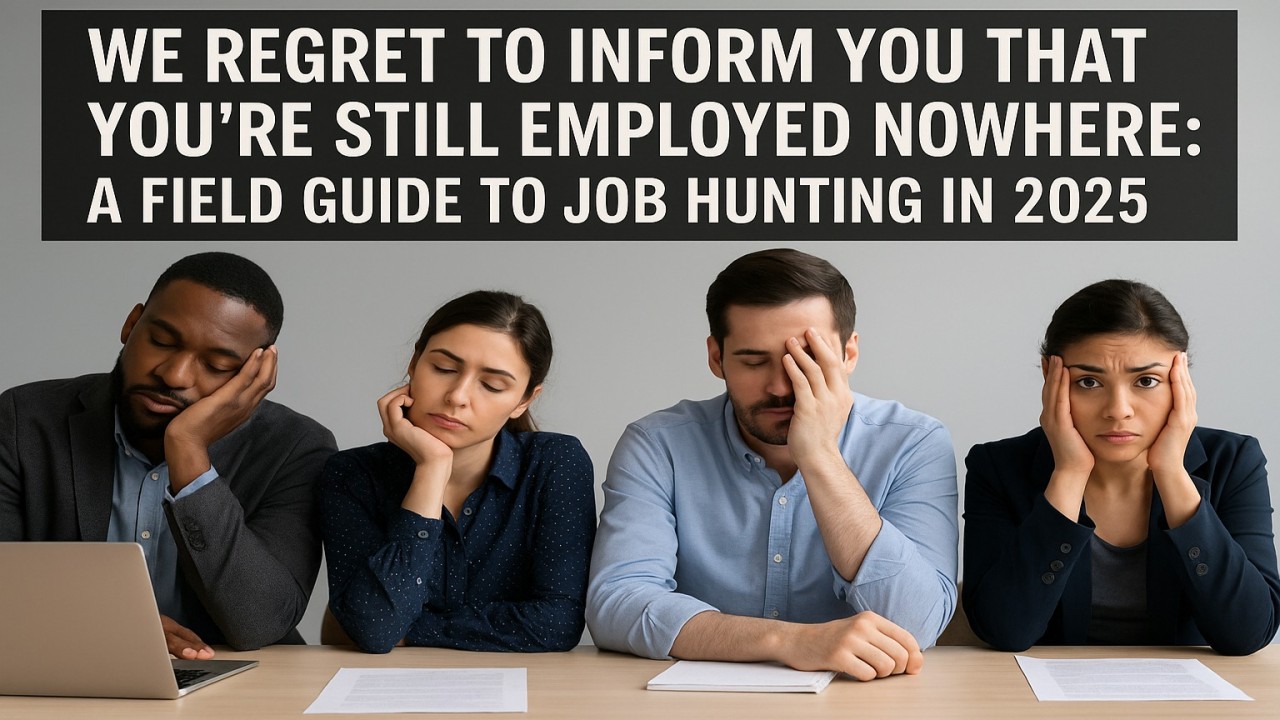
Somewhere between the 137th application and the third “unfortunately” email that arrived at 2:14 a.m., you start to realize that job hunting in 2025 isn’t about employment, it’s about endurance. It’s not a professional pursuit; it’s a psychological sport. The gym? Optional. The treadmill? Your inbox. Every rejection builds emotional stamina, every ghosted interview strengthens your sarcasm muscles, and every “we’re moving in a different direction” teaches you how to scream internally without breaking eye contact with your laptop.
The modern job seeker is no longer a candidate. They’re a contestant in a corporate game show hosted by artificial intelligence. The prize? Maybe a paycheck, maybe a polite rejection, maybe radio silence. Nobody knows anymore. You apply online with hope in your heart and LinkedIn Premium on your credit card, only to realize you’re competing with 2,946 other people who also “thrive in fast paced environments.”
Once upon a time, job applications required effort, paper, and maybe even conversation. You’d walk into a place, shake a hand, and leave behind a resume that smelled faintly of printer ink and optimism. In 2025, you upload your existence into a void labeled “Submit.” There’s no handshake, no smile, not even a confirmation that your soul survived the Applicant Tracking System — the corporate equivalent of a black hole.
You tailor your resume for the 47th time this week, trying to decode what combination of buzzwords will make the algorithm believe you’re employable. “Innovative, strategic, adaptable.” “Proven track record.” “Cross functional team synergy.” You sprinkle these phrases like digital holy water and pray the machine blesses your file. You’ve written your resume so many times you’ve started developing a Pavlovian twitch every time you hear the word “proactive.”
You no longer apply to jobs hoping to be noticed, you apply to avoid being deleted. Because the bots don’t care if you led a $2 million turnaround. They care if you used “stakeholder alignment” in the right sentence. And if you didn’t? Deleted.
You’ve become fluent in the language of the algorithm, part resume writer, part therapist, part codebreaker. You know that “leadership experience” really means “we want someone under 35 who’ll work late without asking about overtime.” You’ve learned that “competitive pay” means “you’ll need a side hustle.” And “fast paced environment” means “we’ve fired everyone and need you to do three jobs for one salary.”
You now read job descriptions like they’re written in code. “Dynamic and agile team” translates to “chaotic and understaffed.” “Opportunity for growth” means “you’ll inherit your boss’s responsibilities without the title or the raise.” “Must be comfortable with change” means “you’ll have a new manager every three weeks and no one will tell you why.”
And still, against your better judgment, you click “apply.” The screen thanks you. The void opens. And somewhere in the distance, an HR rep says, “We’ll be in touch.” Spoiler: they won’t.
But you keep going, because that’s what resilience looks like now, quietly applying into the abyss while pretending to believe in “candidate experience.” You refresh your email like it’s a slot machine, waiting for that one line that says, “We’d love to schedule an interview.” You know it’s irrational, but a part of you still hopes that somewhere, in a corporate office with bad lighting and colder coffee, someone might actually read your résumé and whisper, “Finally, this is the one.”
Until then, you’ll sit there, the modern professional warrior, armed with your Wi-Fi, your caffeine, and a heart full of half-sarcastic optimism. Because even if the system is broken, your ability to keep showing up is not.
You’ve adapted. You’ve evolved. You’ve turned rejection into motivation, silence into strategy, and irony into armor. And if job hunting in 2025 is a psychological sport, then congratulations, you’re not just playing the game. You’re still standing after every round.
The Ghosting Olympics
Ah, the great professional disappearing act. The modern workplace has perfected it. You interview, follow up, send your thank you note, even sign off with that delicate mix of enthusiasm and restraint that career blogs swear by and then, nothing. Not a peep. Not a “thank you.” Not even a “we regret to inform you.”
Just silence.
Corporate America has collectively decided that ghosting is cheaper than manners. It’s the new standard of communication. And no one ghosts harder than HR.
You go through five rounds of interviews, three virtual assessments, a team meet and greet, and one “fun personality quiz” that asks if you’d rather be a dolphin or an eagle and then poof. Gone. You refresh your email, check your spam folder, and wonder if you imagined the whole thing. Maybe the interviews were a lucid dream. Maybe you hallucinated the recruiter.
You start telling yourself comforting lies: maybe they’re still deciding… maybe they’re restructuring… maybe the CEO’s dog ate my offer letter… But deep down, you know. You’ve been professionally ghosted.
Then, to add insult to injury, you receive an automated survey:
“Tell us about your interview experience!”
Sure. Should I rank my emotional devastation on a five star scale or just write “poltergeist energy”?
And it’s not just the silence that stings, it’s the absurdity. The same companies that ghost you will flood LinkedIn with posts about “transparency,” “communication,” and “mental wellness in the workplace.” They’ll publish entire essays about empathy while leaving hundreds of applicants hanging like unsupervised Zoom calls. They’ll hashtag it #WeCare while you’re still refreshing your inbox, wondering if you accidentally offended someone by saying you prefer iced coffee over team building exercises.
You’d think a company that holds “mental health awareness webinars” could at least find the emotional bandwidth to say, “Hey, we went another direction.” But no, they’ve all adopted the same corporate coping mechanism: digital silence. Somewhere, an HR manager pats themselves on the back for saving three minutes by not sending you closure.
Interviews, too, have evolved into theatre. You’re not answering questions anymore, you’re performing emotional labor for free. You tell your “biggest weakness” story like it’s a monologue from Les Misérables. You smile through forced icebreakers like, “If you could be any kitchen appliance, what would you be and why?” You know it’s absurd, but you play along because you’re desperate to look “engaged.”
“Tell us about a time you overcame a challenge.” How about this one? you want to say.
You ask thoughtful questions, nod at buzzwords, and try not to visibly deflate when they say, “We’ll let you know next steps.” You’ve heard that phrase enough times to know it’s corporate for don’t hold your breath.
Then there are the infamous “video response” interviews. You sit alone in your room, recording yourself answering prompts like, “Why are you passionate about synergy?” You start over five times because your lighting makes you look like a witness protection interview and your cat won’t stop photobombing. Somewhere in a server farm, your face is now archived next to 800 other exhausted job seekers, all blinking through artificial smiles under the flicker of desperation.
And if you somehow make it to the final round, the sacred “last conversation before a decision” — congratulations! You’ve now unlocked the waiting game. The company will test your loyalty by making you wait two, sometimes three weeks for a “decision that’s still under review.” During that time, they’ll post new job openings that look suspiciously like the one you interviewed for.
You’ll find out later they hired internally, because apparently, the job was never really open; they just needed to “benchmark” salaries using your emotional labor.
At this point, job hunting is less about employment and more about emotional endurance. It’s not a meritocracy, it’s a marathon. You’re not competing against other candidates anymore; you’re competing against despair. Against burnout. Against the creeping suspicion that maybe you’re the problem (spoiler: you’re not).
You’ve learned to take rejection with grace, “we’ll circle back” with humor, and ghosting with caffeine. You’ve mastered the art of smiling through disappointment, of pretending to be “thrilled to be considered” while simultaneously planning your villain origin story.
You’ve become a modern philosopher, reflecting on existence at 1 a.m. while scrolling through job posts that require “10 years of experience in AI prompt engineering” (for a technology that’s existed for two). You’ve learned patience that borders on sainthood. You’ve learned to talk yourself off ledges made of false hope and unanswered emails.
And yet, you persist.
Every time you open that laptop and apply again, you’re not just sending out another resume, you’re sending a message to the entire corporate machine: I’m still here. You can ignore me once, twice, a hundred times, but I’m not going quietly.
You’ve turned rejection into fuel. You’ve learned that persistence is the only rebellion left in a system that rewards silence. You may be ghosted, but you are haunting, your determination echoing through every portal, every inbox, every “candidate review pipeline.”
Because the best revenge isn’t bitterness. It’s endurance. It’s showing up again. It’s keeping your humor, your humanity, and your hope intact in a world that keeps testing all three.
So go ahead, open that job board one more time. Brew another cup of courage. And hit “apply.” Because every click, every attempt, every ounce of resilience whispers the same thing into the void:
“I dare you to ignore me twice.”
Hope in the Age of Algorithms
And yet — despite the chaos, the rejection, the silence, you still show up. You still hit “apply.” You still believe there’s a role out there that deserves you.
You refresh your inbox with the patience of a monk and the caffeine intake of a Wall Street intern. You’ve memorized every variation of “We’ll be in touch soon,” and you’ve learned that “soon” in corporate language can mean anything between two days and the next fiscal quarter. You’ve become a master of follow-up etiquette, that delicate art of sending a polite reminder that says “Hi, I exist” without sounding desperate.
Because here’s the truth no one tells you: you’re not failing. The system is. You’re not underqualified, you’re under recognized. You’re not behind, you’re just waiting for a hiring manager who actually reads resumes instead of outsourcing empathy to software. You’re not “too experienced,” you’re just too real for companies still pretending that culture fit means cloning their existing staff.
You’ve been tested, and somewhere between the unpaid “sample projects” and the “we decided to go in a different direction” emails, you’ve become resilient, quietly, stubbornly, beautifully resilient. The kind of resilient they can’t measure in a personality test or a LinkedIn endorsement. You’ve learned how to detach your self worth from your job title and your peace from your paycheck. You’ve learned that your value doesn’t shrink every time an email begins with “Unfortunately.”
You’ve learned to laugh at rejection letters that open with “Dear [First Name].” You’ve learned to roll your eyes when a recruiter says, “We loved your energy” but somehow not enough to pay you. You’ve learned that sometimes silence is protection, that a company that ghosts candidates will probably ghost employees when things get hard. You’ve learned that rejection can be redirection, and that maybe the best “no” is the one that saves you from a miserable “yes.”
And you’ve learned that humor is survival. That sarcasm is therapy. That the only way to make it through this algorithmic circus is to find joy in the absurdity. Because if you can laugh while explaining your “five year plan” to a recruiter whose Wi-Fi keeps freezing, you can survive anything. If you can talk about “cross departmental collaboration” while your cat screams in the background, you’re already management material.
You’ve learned to treat each rejection like a plot twist, inconvenient, unexpected, but somehow pushing your story forward. You’ve learned that there’s dignity in persistence, even when the world insists on calling it delusion. You’ve learned that being overlooked doesn’t make you invisible; it just means you’re not standing in the wrong spotlight.
Job hunting in 2025 isn’t about chasing a paycheck, it’s about reclaiming your narrative from a system that treats people like data. It’s about remembering that behind the filters, algorithms, and ghosting lies the one thing they can’t automate — you. The human who still believes in connection, humor, purpose, and a job that doesn’t require three unpaid tasks before onboarding.
So you keep going. You keep showing up with your wit, your wisdom, your caffeine, and your quiet defiance. Because deep down, you know: one day, the right person, the right company, the right moment will see you. Not your keywords, not your formatting, not your “quantifiable impact metrics” but you. The human being who kept trying when the rest gave up.
And when that day finally comes, when the phone rings and the voice on the other end says, “We’d like to offer you the position” you won’t just feel employed. You’ll feel seen. You’ll feel vindicated. You’ll feel like every sleepless night and silent rejection built the armor you needed to get here.
Because through it all, the algorithms, the ghosting, the endless interviews with “synergy enthusiasts” you didn’t just survive the job hunt of 2025.
You outsmarted it. You bent the system just by refusing to quit. You turned rejection into resilience, chaos into comedy, and waiting into wisdom. You stayed human in a process designed to make you feel replaceable and that, more than any title, is the real victory.
So here’s to you, the professional ghostbuster, the resume warrior, the caffeine fueled optimist. You’ve outlasted the bots, the silence, the jargon, and the algorithms. You’ve proven that hope still has a pulse in a system running on autopilot.
And when that offer finally comes through, you won’t whisper, “I got lucky.” You’ll say, “Took you long enough.”






Thanks for sharing. I read many of your blog posts, cool, your blog is very good.