
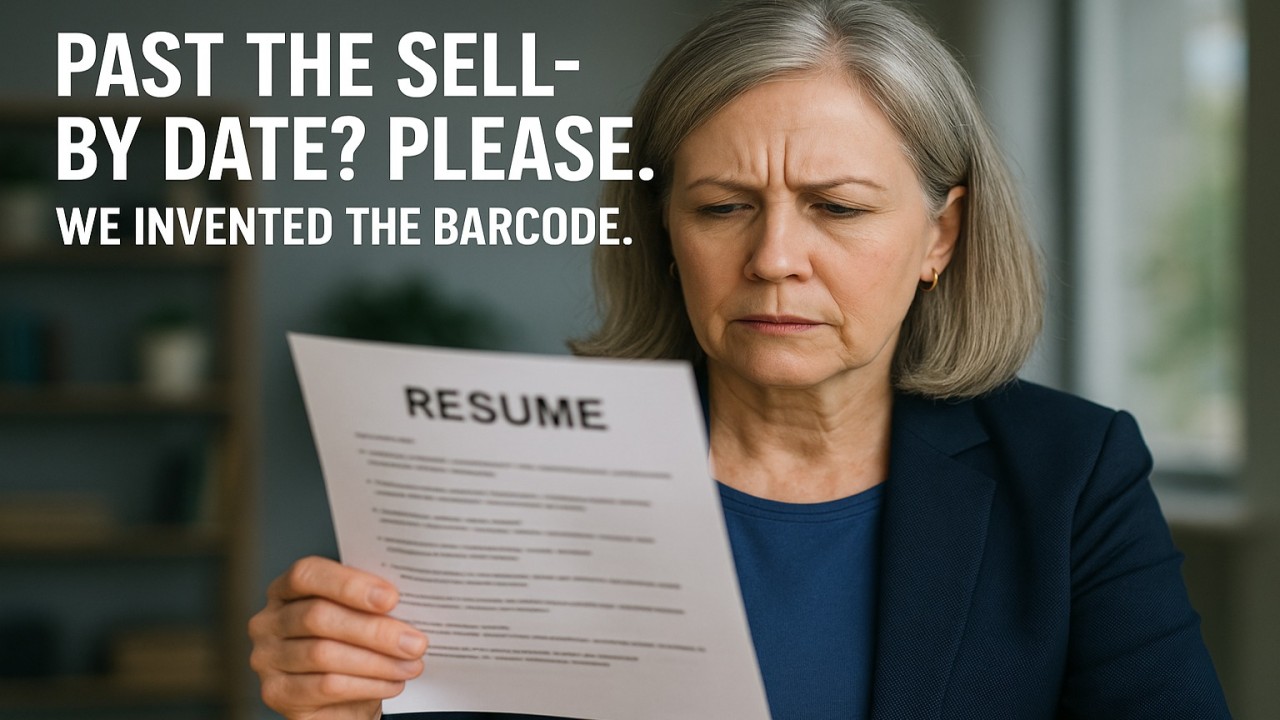
You ever notice how some hiring managers look at a resume like it’s a carton of milk? They pick it up, tilt their head, and go, “Hmm… twenty plus years of experience? Might be past the sell by date.”
As if wisdom had an expiration label. As if professionalism curdled overnight. Suddenly, you’re not a seasoned expert — you’re “potentially outdated.” Like you’re about to curdle in the interview room instead of bringing two decades of crisis management superpowers, caffeine fueled innovation, and more institutional memory than the entire onboarding department combined.
Meanwhile, those same folks proudly microwave leftover pizza for breakfast and call it “meal prep.” But somehow you’re the one who’s expired.
Let’s talk about this modern obsession with “fresh talent.” Fresh like what? Bread? Produce? Because here’s the thing, fresh doesn’t automatically mean effective. It just means “untested,” “overconfident,” and “one skipped meeting away from a nervous breakdown.”
Experience, on the other hand, is the secret ingredient no app can replicate. It’s what keeps the company running when everyone else is Googling, “How do I unfreeze Excel?” It’s the calm hand that knows the difference between an actual crisis and a Slack notification that feels like one.
Fresh talent may bring energy, but experience brings stability. When everything hits the fan, it’s not the intern with the ring light and the Canva resume who saves the day, it’s the one who’s seen this movie before, knows how it ends, and already has the sequel planned.
Because at the end of the day, experience doesn’t expire, it evolves. It gets sharper, faster, and harder to fool. It’s the reason projects finish, clients stay, and chaos gets quietly turned into progress while everyone else is still “syncing calendars.”
So maybe the next time a hiring manager sees twenty years on a resume, they should stop tilting their head like they’re checking a date stamp and start realizing they’re looking at vintage excellence.
The Myth of “Too Much Experience”
Somewhere along the line, someone in HR decided that “too much experience” was a liability. That if you’ve been working since fax machines screamed for attention and printers required actual negotiation, you must be out of touch. But here’s the plot twist, they’re the ones who lost touch with reality.
Because you, the seasoned professional, are not outdated. You’re a historical monument with Wi-Fi. You’ve survived every technological extinction event since Netscape Navigator and you’re still logging in with fewer password resets than your IT director. You’ve rebuilt teams, balanced budgets, and navigated change before “resilience” became a buzzword.
You’ve been through layoffs, buyouts, mergers, and leadership “restructurings” that were just corporate code for chaos. You’ve seen the same mistakes recycled under new acronyms, the same meetings renamed as “workshops,” and the same “innovative” ideas that were already old news in 2004.
You’re not a relic, you’re the infrastructure. You’re the unshakable framework that keeps the lights on while everyone else argues about “synergy.” You’re the reason deadlines get met, customers stay loyal, and the ship doesn’t capsize when the new captain decides to reinvent the wheel.
They call you “old school,” but that’s just another way of saying you actually know what you’re doing. You’re not clinging to the past, you’re carrying the foundation everyone else is standing on. And until someone invents an app for instinct, judgment, and grace under pressure, you’ll remain the most valuable upgrade any company could ask for.
The Office Archaeologists
I once watched a hiring manager squint at a resume like it was written in Latin. “Do you think they’ll adapt to our tech stack?” they asked. Sir. This person survived dial-up, Office 95, and the era of the floppy disk. They didn’t just adapt, they invented the concept of workarounds. They were updating databases before you were updating your Instagram story. They survived Y2K, configured routers by hand, and thought “the cloud” was just unpredictable weather that occasionally knocked out the power.
You know who panics when the Wi-Fi drops? Your Gen Z intern who suddenly forgets how to human. You know who calmly keeps the team running? Janet from Accounting. Janet has seen five CEOs, four systems, three rebrands, and one possessed copier that only prints when you bribe it with toner from 2007. When the server goes down, Janet doesn’t panic. She shrugs, pulls out her legal pad, and still gets results.
Because Janet doesn’t need Wi-Fi to function. She is the Wi-Fi. The human hotspot that’s kept that department connected since 1998. When everyone else is panicking in Slack threads, she’s on her landline, solving problems faster than your chatbots can say “We’re looking into it.”
She remembers when “troubleshooting” meant actual tools and not opening another browser tab. She remembers when multitasking didn’t require three monitors and a stress ball — just focus, grit, and a strong cup of coffee that could legally qualify as motor oil.
Janet doesn’t need to “pivot” or “upskill” every three months to stay relevant. She’s timeless. She’s seen technology rise, crash, reboot, and repeat. And through it all, she’s kept payroll accurate, invoices paid, and the office somehow functioning even when leadership was more lost than an unplugged mouse.
The truth is, people like Janet don’t just adapt to change, they anchor it. While others reboot, she recalibrates. While others freeze, she fixes. And if there’s ever an apocalypse, it won’t be the coder with three monitors who saves civilization — it’ll be Janet with her ledger, her pen, and a backup plan written neatly in the margins.
The “Tech Savvy” Illusion
Every new generation of employees arrives with the same promise: “We’re digital natives.” Sure. Until Outlook asks them to find the BCC field. Meanwhile, the so called fossils are building complex spreadsheets with macros, filters, and pivot tables that could power a small city. They’ve been doing data visualization before dashboards had color schemes, back when a bar chart meant actual bars drawn in Excel Version One, and every formula felt like a minor act of rebellion against chaos.
The modern “tech savvy” worker can navigate TikTok’s algorithm blindfolded but can’t print double sided without summoning IT. They’ll spend fifteen minutes designing a Canva presentation to explain why something didn’t get done instead of just… doing it. Meanwhile, the seasoned professionals don’t panic, they troubleshoot. They’ve been problem solving since rebooting meant turning something off and on again manually, not waiting for a helpdesk ticket to be approved.
These veterans are fluent in the language of adaptation. They know the difference between a real tech issue and a user error disguised as one. They’ve dealt with systems so old they ran on hope and duct tape, yet they still made them sing. They were “AI” before AI — not artificial intelligence, actual intelligence. The kind that comes from solving problems under pressure and learning by doing, not just by Googling.
When the Wi-Fi dies, the interns freeze. Slack goes silent. Calendars vanish. Panic sets in like a scene from a dystopian film. But the veterans? They grab a notebook, a pen, and keep the ship sailing. They don’t need internet access to remember what needs doing, it’s already filed away in muscle memory. Because not every solution requires a software update. Some just require common sense, caffeine, and the quiet confidence of someone who’s already lived through six system crashes, two office relocations, and one unforgettable “server migration” that nearly ended civilization.
These professionals don’t just know how to work, they know how to keep working when everything else stops. They’re not nostalgic; they’re necessary. And one day, when the lights flicker and the cloud goes down, everyone will realize that the real “digital natives” are the ones who kept the world running long before it went online.
The Quiet Architects of Chaos Control
Here’s what the resume doesn’t show: these so called “expired” professionals are the ones who’ve been quietly running the show for decades. They’ve trained entire departments, written procedures, soothed panicking executives, and fixed the coffee machine with nothing but a binder clip, three paperclips, and sheer willpower.
They’ve negotiated raises, resolved conflicts, kept projects afloat through five budget cuts, and somehow remembered every vendor’s name, even the one who ghosted Accounts Payable in 2012. They’re the steady hands that guide chaos into structure, the ones who know how to diffuse a crisis before management even realizes one is brewing. They don’t just know how things work, they know why they work, and more importantly, how to make them work again when they inevitably fall apart.
That’s institutional knowledge and it’s worth more than any certification a twenty something can add to their LinkedIn headline with a hashtag like #lifelonglearner. Because this isn’t knowledge you can buy, download, or binge-watch a tutorial for. It’s wisdom paid for in deadlines, late nights, and lessons that no HR seminar could ever teach.
You can’t teach foresight. You can’t teach the ability to read a room during a crisis, to sense when a meeting is about to derail, when a client is bluffing, or when the “urgent” email can actually wait until after lunch. You can’t upload intuition into the cloud, no matter how many AI tools you subscribe to.
These veterans earned their wisdom through trial, error, and probably one near death encounter with a copier toner cartridge. They’ve endured conference calls that could have been novels, learned to translate executive “vision” into practical reality, and discovered that real leadership isn’t about job titles, it’s about endurance, empathy, and execution.
They’ve learned that being the calmest voice in the room often means you’re the most valuable one. And while everyone else is chasing the next big trend, they’re the ones quietly ensuring the lights stay on, the data doesn’t vanish, and the company doesn’t implode.
Because experience doesn’t shout. It doesn’t need to. It just keeps showing up — solving, stabilizing, and succeeding, one binder clip at a time.
“You’re Too Experienced” — The Corporate Paradox
Imagine walking into a hospital and the surgeon says, “Sorry, we’re looking for someone with less experience.” Absurd, right? You’d run for the hills, or at least demand a second opinion. And yet, that’s the exact logic companies apply every day when they reject candidates who’ve seen more boardrooms, built more teams, and rescued more failing projects than the entire executive staff combined.
It’s as if experience suddenly became a threat instead of an asset. As if having actually done the work disqualifies you from doing it again. Some hiring managers act like years of expertise carry a contagious condition called “too capable.”
The truth? Some leaders fear experience because it sees through their nonsense. You can’t gaslight someone who’s been through five corporate “revolutions” and still has the original PowerPoint deck to prove it. Seasoned professionals can smell dysfunction before the second slide even loads. They’ve lived through the “bold new visions” that were really just recycled panic, and they know when “innovative pivot” really means “we have no plan.”
They’ve attended enough reorg meetings to recognize when leadership’s “fresh direction” leads straight off a cliff and they’ve mastered the art of steering the ship without embarrassing the captain. They don’t need buzzwords to lead; they rely on clarity, logic, and a deeply rooted sense of déjà vu that tells them exactly how this story ends if no one intervenes.
Experience doesn’t intimidate because it’s old. It intimidates because it’s aware. Because it notices what others ignore. It remembers history — not out of nostalgia, but to avoid repeating the same mistakes under shinier branding. It can see the cracks in the culture before they become fissures, the weak link in the process before it becomes a crisis.
And maybe that’s the real reason some organizations avoid it: not because experience can’t adapt, but because it refuses to pretend. It holds up a mirror to inefficiency, inconsistency, and ego and most companies would rather invest in “culture fit” than face that kind of reflection.
But here’s the thing, awareness is the foundation of progress. The most effective leaders aren’t the ones who chase “fresh” ideas at all costs; they’re the ones who balance energy with expertise. They know that wisdom isn’t a threat to innovation, it’s the only reason innovation survives long enough to matter.
Like a Fine Scotch, Not Spoiled Milk
Next time you see a resume that lists decades of experience, don’t treat it like a museum exhibit. Treat it like a bottle of aged scotch — complex, potent, and guaranteed to make your meetings more tolerable. You don’t toss out a twenty five year old single malt because it’s “too seasoned.” You pour it, appreciate it, and hope it doesn’t call out your poor leadership on the first sip.
Because what you’re looking at isn’t “too experienced” it’s refined. That resume represents years of pressure, mistakes, victories, and recoveries distilled into something precise, stable, and powerful. It’s the difference between a spark and a steady flame: one flickers, the other warms the room and keeps it from burning down.
These professionals aren’t stuck in the past, they built the systems your company still uses. They wrote the policies everyone else keeps rediscovering, and they’re the reason those chaotic “new initiatives” don’t collapse by Tuesday. They can out type your fastest Slack warrior, troubleshoot your printer while running a budget meeting, and predict your next reorg before HR even finishes updating the slide deck.
They’ve seen every trend, survived every “urgent pivot,” and still show up calm, caffeinated, and five steps ahead. They don’t need to panic over shifting goals or surprise deadlines, they’ve danced this dance before, and they know every step by heart. They’re the human equivalent of a backup generator: underappreciated until the lights go out, then suddenly the most valuable person in the building.
And here’s the kicker, they’re not outdated. They’re upgraded. Humans 2.0 with built-in patience patches, emotional firmware updates, and an intuitive understanding of how to keep chaos from becoming culture. They know when to push, when to pause, and when to simply say, “We’ve tried this before, here’s how to actually make it work.”
They’re not intimidated by technology; they’ve adapted to it, mastered it, and then trained three generations on how to use it. They’ve sat through enough “innovation sessions” to know that true progress doesn’t come from the loudest brainstorm, it comes from the quiet consistency of people who know how to finish what others only start.
So the next time you’re tempted to dismiss experience as “too much,” remember, that’s not excess. That’s depth. That’s the person who can walk into a meeting, decode chaos, and walk out with a solution that actually sticks. That’s not a relic of the past, that’s your competitive advantage with a coffee mug and a mental filing cabinet labeled “Everything That’s Ever Worked.”
The Hidden Strength in Longevity
Let’s talk about endurance. You don’t make it twenty, thirty years in the workforce without learning how to reinvent yourself a dozen times, sometimes willingly, sometimes because someone in upper management read a book about “disruption.” These so called “aging” professionals have already done what most of today’s “change management” gurus just tweet about between inspirational quotes. They’ve survived mergers, layoffs, acquisitions, rebrands, pandemics, recessions, and yes — office birthday cakes made entirely of frosting and regret.
They’ve learned how to adapt without losing integrity. They’ve mastered the art of disagreeing diplomatically, of saying, “That’s an interesting idea,” when what they really mean is, “That’s the same mistake we made in 2009, but sure, let’s try it again with a hashtag.” They’ve perfected the poker face in conference rooms where common sense goes missing. They’ve learned to hold the line when leadership panics, to absorb the noise so the team can focus on the work.
They don’t need micromanagement; they are the management people quietly rely on when chaos hits. They’re the ones who know where the unspoken landmines are buried, who to call when systems fail, and how to keep the lights on when the company’s “new direction” takes a hard left into confusion. They don’t need constant validation or performance pep talks, they’ve been performing under pressure since fax machines were considered cutting edge.
They’ve been the bridge between departments, the translators between generations, the mentors who turn rookies into leaders. They’re the cultural glue that holds a company together while everyone else is busy updating mission statements. They’re the first to arrive and often the last to leave, not because they have to, but because they actually care whether things get done right.
And let’s be honest, if experience had a soundtrack, theirs would be an anthem: decades of deadlines met, fires extinguished, and broken systems duct-taped back together until the next miracle fix arrived. It would be the rhythm of keyboards tapping, phones ringing, coffee brewing, and one calm, steady voice saying, “We’ll figure it out.” Because they always do.
Endurance isn’t just about longevity, it’s about legacy. These professionals aren’t coasting; they’re carrying. Carrying institutional knowledge, emotional intelligence, and a level of professionalism that doesn’t waver, no matter how many times the playbook gets rewritten. They’ve been through every kind of storm and still show up, sleeves rolled, coffee in hand, ready to lead the next generation, even if that generation still can’t find the printer settings.
Why Companies Should Stop Wasting Gold
Hiring someone with 20+ years of experience isn’t a risk, it’s a revenue multiplier. These are the people who already made the rookie mistakes years ago, learned from them, documented the solution, and probably wrote the manual everyone else still uses. They don’t need six months of onboarding or a color coded training calendar. They just need Wi-Fi, trust, and maybe a stronger coffee blend, preferably one that doesn’t come from a breakroom pod labeled “mild.”
They bring perspective in meetings where everyone else brings buzzwords. They don’t just chase metrics; they understand what those metrics mean and how they affect the bottom line. They think long-term while others chase quarterly trends. They can spot inefficiency like a hawk, sense burnout before it happens, and solve operational gaps before you even realize they’re bleeding profit. They’re not just problem solvers, they’re profit preservers.
And let’s be honest: experience doesn’t just know what to do. It knows what not to do and that’s the kind of wisdom that saves companies millions. When the room is filled with noise, the experienced professional listens, prioritizes, and acts. No theatrics. No panic. Just precision. Because while others are still “aligning strategy,” they’re already executing.
In a world obsessed with “innovation,” experience is the stabilizer. It’s what turns chaos into continuity, ambition into execution, and ideas into results that last longer than the next product cycle. Because while trends change, wisdom scales. It compounds. It grows sharper, steadier, and more valuable with every challenge survived.
So before a company dismisses that 25 year resume for being “too seasoned,” it should ask itself: Do we really want less of that? Less intuition, less accountability, less foresight? Because innovation without experience isn’t evolution, it’s just chaos with a pitch deck.
Experience isn’t the past. It’s the infrastructure of the future. It’s the quiet engine that keeps innovation from crashing and companies from repeating their own history. And if leadership is smart, they’ll realize, the best investment they’ll ever make isn’t in “fresh perspectives.” It’s in the professionals who’ve already proven they can weather every storm and still deliver results long after the buzzwords fade.
Respect Your Workplace Elders
So the moral of the story? Respect your workplace elders. They’ve got the patience of a saint, the resilience of a dial-up modem, and the survival instincts of someone who’s been through six “company rebrands,” four “cultural resets,” and one ill fated “team building retreat” that ended in an HR debrief. They’ve seen trends come and go, watched “visionary leaders” arrive with fanfare and leave with severance, and somehow kept the place running through every “strategic pivot” that made absolutely no sense on paper.
They don’t fear Slack updates or AI takeovers, they’ve already survived Clippy from Microsoft Word. They endured pop-up ads, Internet Explorer, and that one coworker who always replied-all to company wide emails. They’ve lived through every era of office evolution: cubicles, open floor plans, remote work, hybrid confusion, and now the great “return to office” disguised as a motivational campaign.
They’ve been mentoring long before “mentorship programs” became a bullet point in a corporate diversity report. They know when to speak, when to listen, and how to get things done without a single “synergy” meeting or digital whiteboard session. They can translate executive jargon into action, calm down a panicked new hire, and send an email so effective it ends three meetings before they start.
These veterans are the unsung heroes of every success story. They don’t need titles to lead, they lead by showing up, by staying steady, by knowing what actually matters. They’ve built relationships that outlast reorganizations and reputations that outshine every shiny new buzzword. They don’t waste time chasing every “next big thing” because they understand that most “next big things” eventually circle back to good communication, accountability, and follow through, three skills they mastered decades ago.
If experience were yogurt, these legends would be probiotic gold — full of culture, still active, and guaranteed to keep your organization healthy. They’re the kind of culture that doesn’t expire, it compounds. Because when everything else changes — technology, titles, office layouts, the one thing that never goes out of style is competence. And that’s what they’ve been quietly perfecting while everyone else was chasing the algorithm.
So here’s to the professionals who’ve been holding it all together long before “resilience” was a workshop. They don’t just belong in the workplace, they are the workplace. The backbone, the blueprint, and the living proof that experience isn’t something to retire, it’s something to revere.
Final Thought
To the hiring managers tilting their heads at resumes like milk cartons, remember this: milk expires because it sits still. Experience doesn’t. It evolves. It ferments into wisdom, humor, and adaptability. It ages like strategy, like insight, like the kind of calm that can only come from having solved the same “unprecedented problem” twelve different times in twelve different decades.
Experience doesn’t sour, it strengthens. It refines itself. It turns pressure into perspective and chaos into clarity. Every obstacle, every deadline, every corporate storm survived becomes another layer of instinct that no crash course can teach. It’s not stale, it’s seasoned. And the flavor it brings to your team is the difference between panic and precision, between reaction and foresight.
So next time you meet someone with decades under their belt, don’t ask if they’ll “fit into the culture.” Ask yourself if your culture deserves someone who’s already seen it all and still shows up with purpose. Because let’s be honest — most “company cultures” are just rebranded cycles of burnout with free snacks and a ping pong table. Experience doesn’t need to fit in; it needs to be respected, leveraged, and listened to. Because while everyone else is trying to “disrupt,” the experienced ones are the only ones who know how to rebuild what’s been broken.
They’re not coming in to compete, they’re coming in to contribute. They’re not here to prove their worth, they’ve already done that, over and over, quietly and effectively, long before you invented a metric to measure it. They bring context where others bring opinions, depth where others bring noise, and a kind of grounded energy that can’t be faked or fast-tracked.
Because the real sell-by date isn’t on them. It’s on your company’s mindset, the one that confuses youth with innovation and experience with stagnation. The one that keeps mistaking potential for readiness and novelty for progress. The one that fails to see that every new idea still needs an old foundation to stand on.
So before you pass on the next applicant who’s been in the game longer than your start-up’s domain registration, ask yourself: are you building a company that values growth, or just one that fears wisdom? Because only one of those will last.