
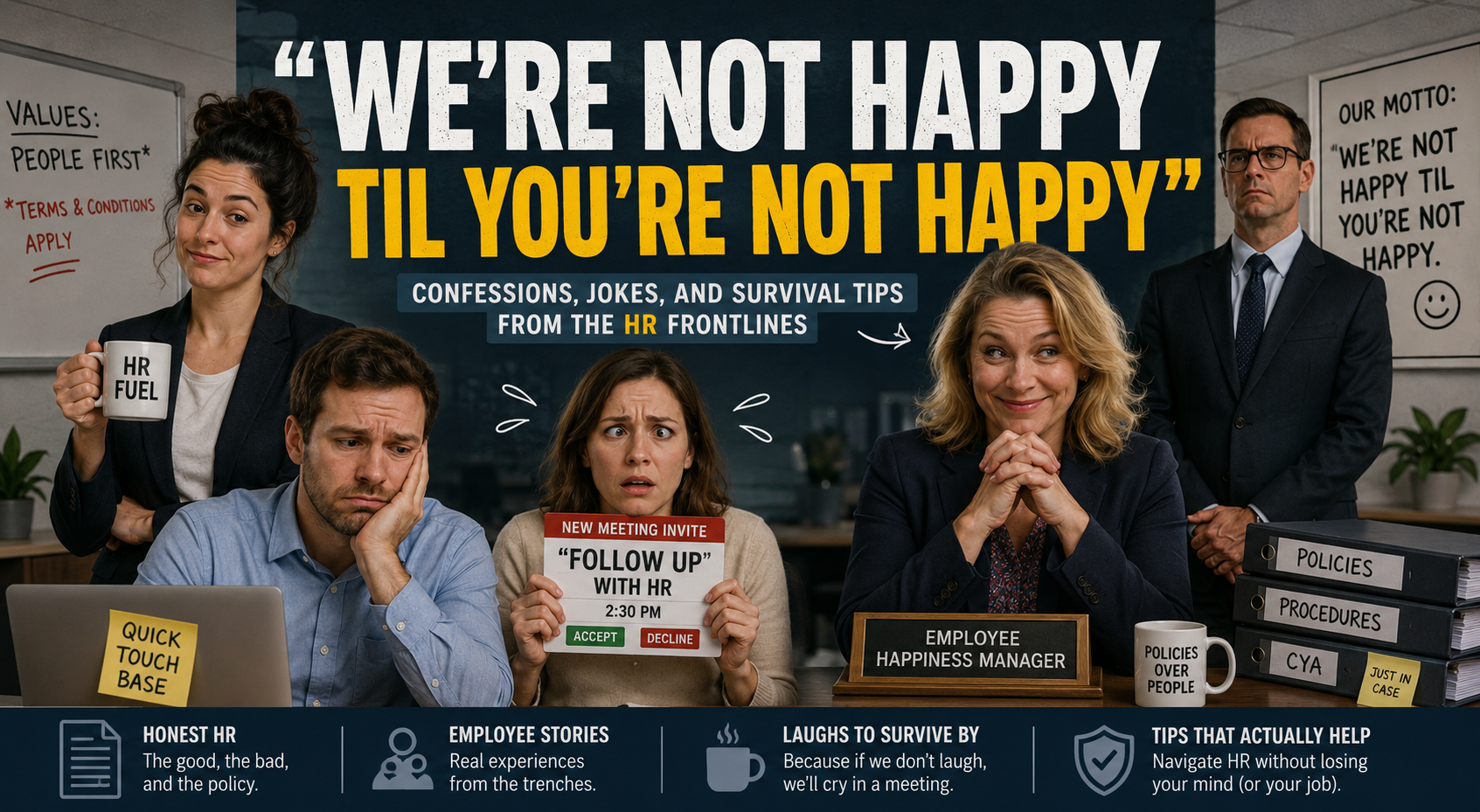
HR’s Secret Motto: “We’re Not Happy Til You’re Not Happy”
Every once in a while, someone from HR wanders into the comments section and instead of arriving with a policy binder, a laminated values card, and the emotional temperature of a locked filing cabinet, they show up with a joke so honest it deserves to be carved into the lobby wall.
Someone said, “Longtime HR leader here. I think your joke is funny. But then again, I used to joke that our HR motto was, ‘We’re not happy til you’re not happy.’”
And I have to say, that might be the most transparent corporate statement I have ever heard in my life.
Forget the fake mission statements. Forget the “people first” posters hanging next to the time clock that has rejected more vacation requests than a medieval king. Forget the company values printed in calming blue font while employees are eating lunch in their cars because the break room microwave smells like burnt popcorn and disappointment.
“We’re not happy til you’re not happy.”
Now that is branding.
That is not HR hiding behind corporate fog. That is HR kicking open the door, setting down a cup of black coffee, and saying, “Let’s stop pretending this place is a wellness retreat. We both know why you’re here.”
Because we have all worked somewhere where HR looked friendly on the outside, but every interaction felt like being invited into a courtroom where the judge also controls your dental insurance. The email always starts soft. “Do you have a few minutes to chat?” Nobody from HR says “chat” because they want to discuss weekend plans. That is not a chat. That is a workplace ambush wearing business casual.
Your stomach knows before your brain does.
The second that meeting invite hits your calendar with no agenda, your entire nervous system becomes a detective. You start reviewing every conversation you have had since onboarding. Did I laugh too hard in the break room? Did I call the printer possessed? Did I reply-all by accident? Did someone report my facial expression during the quarterly strategy update?
And HR just sits there calmly like, “How are you doing today?”
Ma’am, I was doing fine until Outlook handed me a psychological thriller.
The “Quick Touch Base” That Ruins Your Whole Nervous System
There are few phrases more terrifying in corporate America than “quick touch base.”
It sounds harmless. It sounds light. It sounds like maybe someone wants to align on priorities, circle back on action items, or discuss something equally meaningless that could have been an email written by a microwave. But when HR sends it, your soul immediately puts on a helmet.
Because “quick touch base” from HR is never quick, never casual, and rarely involves anything that feels like touching base. It is more like being summoned to a conference room that smells like carpet cleaner, old coffee, and consequences.
They always start with that calm voice too.
“Thanks for making time.”
As if you had a choice.
What were you going to say? “Actually, I’m busy at 2:30. Can we reschedule my emotional collapse for Thursday?”
Then comes the opening question. “How are things going?”
That is not a question. That is bait with a benefits package.
You cannot answer honestly. If you say, “Things are terrible,” now you are negative. If you say, “Things are great,” they write down that you admitted things were fine. If you say, “Could be better,” suddenly there is a follow-up meeting, a documentation trail, and someone named Brenda from legal is silently added to the email chain.
HR has mastered the art of asking questions that sound supportive but feel like you are testifying under fluorescent lights.
“We just want to understand your perspective.”
No, you want me to say one sentence weird enough to become Exhibit A.
And the worst part is, you never know what the meeting is really about. Maybe someone complained. Maybe your manager complained. Maybe you complained and now your complaint has been forwarded directly to the person you complained about because apparently confidentiality at some companies means “we will keep this confidential until we immediately don’t.”
Nothing builds trust like reporting a concern and then watching it boomerang back into your department with the subject line: “FYI.”
That is not a process. That is betrayal with Outlook formatting.
The Corporate Phrases That Should Come With Warning Labels
HR and corporate leadership have created an entire language that sounds comforting until you have lived through it once. After that, every phrase becomes a red flag wearing a name badge.
“My door is always open” sounds warm until you realize the door is open the same way a trap is open. You can walk in anytime, but what happens after that depends on budget, politics, and whether your manager has mastered the art of pretending every problem is a “communication opportunity.”
“We value transparency” means nobody knows the salary range, the promotion criteria, the reason three people quit last week, or why the company suddenly has a new consultant walking around with a clipboard and no expression.
“We support work-life balance” means your manager respects your time deeply, except at 4:58 p.m., when they schedule a meeting called “Urgent Sync” and ask everyone to bring ideas, energy, and a willingness to pretend this could not wait until tomorrow.
“We encourage feedback” means they want feedback as long as it is positive, vague, anonymous, and does not identify any real problem, department, policy, person, process, spreadsheet, decision, leadership failure, or unresolved emotional hostage situation.
The last person who gave honest feedback now has a LinkedIn banner that says “Open to Work” and posts inspirational quotes about new beginnings every morning at 6:12.
Then there is the classic: “We’re like a family here.”
That phrase should automatically trigger a fire alarm.
Because every time a company says, “We’re like a family,” what they usually mean is unpaid emotional labor, unclear boundaries, one person causing drama, one person avoiding accountability, one person controlling the thermostat like a dictator, and one adult who has silently updated their resume in the bathroom.
Families are complicated. Families need therapy. Families have group chats people mute for their mental health. So when a workplace says it is like a family, I immediately want to know which kind. Are we talking supportive family? Or the kind where Thanksgiving ends with someone crying in the driveway and nobody knows who brought the potato salad?
Because I have worked at companies that were “like a family,” and let me tell you, several of them needed supervised visitation.
Not All HR People Are Villains, But Some Came Prepared
Now to be fair, not all HR people are bad. Some HR professionals are genuinely great. Some are the only reason employees get paid correctly, managers get stopped before they accidentally create a lawsuit with a PowerPoint, and the company does not collapse into a Spirit Halloween by October.
There are HR people who fight behind the scenes. There are HR people who protect employees. There are HR people who hear nonsense from leadership and quietly think, “Absolutely not, we are not doing that, because I enjoy not being deposed.”
Those people deserve respect, caffeine, and possibly a small monument near the copier.
But the bad HR people? The bad ones are different.
The bad ones treat every policy like it was written on stone tablets carried down from Mount Compliance. They do not explain. They interpret. They do not support. They document. They do not listen. They nod slowly while typing something that feels like it will be used against you in a meeting you are not invited to.
They say things like, “We want this to be a safe space.”
Safe for who?
Because I have been in “safe spaces” where one person was crying, one person was taking notes, one person from management was pretending to be shocked by information they absolutely already knew, and HR was sitting there with the facial expression of someone watching a training video in real time.
The bad HR person can make anything sound terrifying.
“Can you stop by?”
No.
“We need to discuss something.”
Discuss it with God first.
“This is just procedural.”
So is an autopsy, Brenda.
They speak in soft words and firm consequences. They say, “This is not disciplinary,” and somehow you leave the room feeling like your badge has already packed its little suitcase. They say, “We appreciate your honesty,” which is corporate language for, “Thank you for giving us a quote.”
That is why the HR leader who joked, “We’re not happy til you’re not happy,” is refreshing. Because at least it is honest. At least it admits that sometimes HR has operated less like a people department and more like a tiny government agency run by a printer jam, three outdated forms, and a mysterious policy nobody can actually locate.
Final Thoughts: Somewhere, Someone Just Got a Calendar Invite
The reason this joke hits so hard is because everyone has had that moment. The calendar invite arrives. No context. No agenda. Just “Follow Up” or “Quick Chat” or the devastatingly vague “Touch Base.”
And immediately your body goes into survival mode.
Your blood pressure spikes. Your brain starts reviewing every email you have ever sent. You suddenly remember a joke from 2019 and wonder if someone kept a screenshot. You check the invite list like you are reading a cast list for a courtroom drama. HR is there. Your manager is there. Someone you have never met is there. That is when you know this is either about benefits enrollment or your final episode.
There is no middle ground.
And the funniest part is how normal everyone acts. HR opens with a smile. Your manager pretends this is routine. The mystery person says nothing, which is somehow worse. You are sitting there holding your coffee like it is the last warm object in a collapsing civilization.
That is workplace trauma in its purest form.
So yes, I respect an HR person who can laugh at the madness. I respect anyone in HR who can admit the system is weird, the phrases are fake, the meetings are scary, and half the policies sound like they were written during a thunderstorm by someone who had just been personally betrayed by a lunch thief.
Because humor is sometimes the only thing keeping employees from turning every “quick sync” into a witness statement.
And to the good HR people out there, thank you. Truly. Thank you for being human. Thank you for knowing employees are not just badge numbers with PTO balances. Thank you for pushing back when leadership tries to solve a culture problem with another mandatory training module called “Creating Belonging Through Accountability.”
But to the HR departments still sending vague calendar invites with no explanation, please understand something.
You are not creating alignment.
You are creating a national blood pressure event.
Somewhere right now, an employee just received a meeting invite titled “Follow Up.” They are sitting at their desk, pretending to work, while mentally replaying every conversation they have had since 2017. They have already checked their employee handbook, updated their resume, prayed quietly, and wondered if calling the printer “emotionally unstable” violated the code of conduct.
And as they walk toward that conference room, carrying nothing but a notebook, anxiety, and the last scraps of professional dignity, they whisper the only HR motto that ever truly made sense:
“We’re not happy til you’re not happy.”
And honestly?
At least now we finally have transparency.