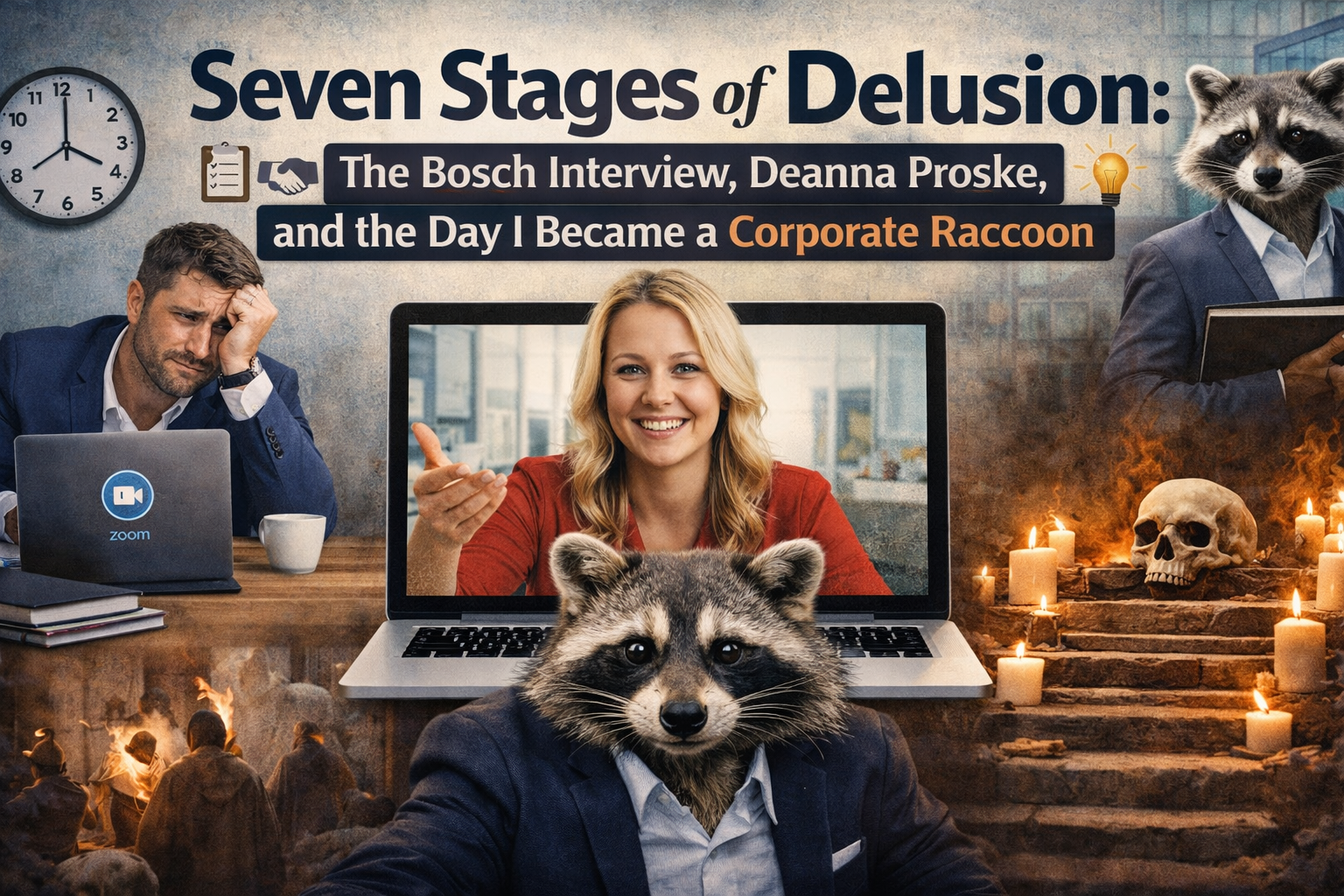
There is a very specific kind of optimism required to prepare for a job interview in modern corporate America, and it is not the healthy kind. It is not grounded optimism, mature optimism, or the sort of optimism one might reasonably possess before doing something dignified and mutually respectful. No, it is the fragile, decorative optimism of a person who has chosen to believe that a calendar invite means someone, somewhere, intends to honor time as a real concept. It is the same kind of faith people bring to airport connections, IKEA instructions, and online recipes that claim something can be made in “just twenty minutes.” It is aspirational. It is charming. It is almost never rewarded.
So when I applied for a job at Bosch and the recruiter handling the process, Deanna Proske, scheduled an interview, I did what every normal candidate does. I treated the event as though it existed in the realm of genuine human commitment. I logged into Zoom early. I had notes prepared. I had my face arranged into that polished professional setting that communicates a carefully balanced mix of intelligence, warmth, and emotional stability, as if I were a well-adjusted adult who had absolutely not spent part of the morning wondering whether any hiring process in America had been designed by someone with a personal grudge against the employed and unemployed alike.
I was ready.
And readiness, as it turns out, is very funny when placed next to indifference.
Because there I was, sitting in front of my screen like a man who had chosen dignity, while the meeting time arrived with all the promise of a wedding where the groom has already texted three people that he is “running a little behind.” The appointed minute came and went. Then five minutes passed. Then ten. Then fifteen. At a certain point, waiting for a recruiter in a blazer on Zoom stops feeling like professional ambition and starts feeling like experimental theater. You begin the scene as a candidate, but somewhere around minute twelve you evolve into an installation piece titled Hope Under Fluorescent Pressure.
By minute twenty, I was no longer participating in a hiring process. I was in the wilderness. Emotional wilderness. Career wilderness. The strange interior desert where a person is forced to confront the possibility that this company may already be showing you exactly what it would feel like to work there, and what it feels like is disorganization in a nice blouse. There is something deeply clarifying about being ignored in formalwear. It strips away the fantasy. It removes the branding. It peels the motivational language off the walls and leaves only the bones of the thing. Suddenly the job posting is no longer an opportunity. It is a warning label with benefits.
Then, at thirty minutes late, Deanna Proske appeared.
And that is an important moment in any story, because thirty minutes is not a delay. Thirty minutes is a philosophical event. Thirty minutes is enough time to drink a coffee, reconsider your entire professional direction, google “remote jobs that do not require emotional surrender,” and begin forming a bond with the squirrel outside your window who, quite frankly, seems to have clearer priorities than most hiring teams. A late arrival at that point is not an inconvenience. It is the grand opening ceremony for your loss of interest.
Which is what made the next part so beautiful.
Because after arriving half an hour late, Deanna then began explaining the hiring process as though unveiling a luxury travel itinerary. Except instead of beaches and cocktails, the package included seven steps. Seven. Not two. Not three. Not even the aggressively unnecessary four that certain organizations deploy when they want to feel important. Seven full stages, presented with the serene confidence of someone describing a perfectly reasonable sequence rather than a corporate obstacle course designed by people who think a paycheck should be earned through pilgrimage.
And that was the moment the spell broke completely.
The desire was gone. The yearning evaporated. Whatever hopeful inner candidate had logged into that Zoom room had quietly gathered his things, left through a side door, and slipped a note under my spiritual windshield wiper that read, “These people seem exhausting.” In his place remained something sharper, calmer, and far more entertaining: a man who no longer needed the outcome. A man liberated from the burden of wanting. A man transformed by disillusionment into a high-functioning, well-dressed trash panda with pattern recognition.
That is the part no one tells you about interviews. The second you stop caring whether they choose you, you become extraordinary. Not because you change into someone else, but because the fear leaves your body. Approval no longer sits on your chest like a tax. Your voice steadies. Your answers land. Your posture improves. Your spirit develops rhythm. You stop auditioning for permission and begin observing the entire circus with the quiet poise of someone who knows he could absolutely do the job, but is now mostly fascinated by the administrative audacity unfolding in front of him.
And when that happens, the interview changes shape.
It is no longer a conversation about mutual fit. It becomes a live nature documentary. One species has arrived hoping to be selected. The other has arrived late and is now describing seven rounds of evaluation as though this is not insane. Somewhere between them sits the truth, chewing thoughtfully on a granola bar, watching the ecosystem collapse.
This, then, is the story of that interview. Not merely as an inconvenience, but as a spiritual journey through time theft, corporate pageantry, and the rare transcendent freedom that comes when a candidate realizes he would rather be unemployed with standards than fully employed in a workplace that mistakes complexity for excellence. It is the story of Bosch, Deanna Proske, seven ceremonial stages of nonsense, and the beautiful moment I stopped being a candidate and became, for one glorious hour, a raccoon in business casual staring through the glass of institutional absurdity and whispering, with enormous peace, absolutely not.
The Sacred Ritual of Logging In Early for People Who Do Not Respect Time
There is no figure in modern professional life more naïve, more hopeful, and more unintentionally comedic than the candidate who logs into Zoom early. That person still believes in structure. Still believes in sequence. Still imagines that because the meeting says 2:00 p.m., the laws of time, etiquette, and civilization might all combine to produce a 2:00 p.m. event. He has not yet been fully seasoned by the wilderness. He still thinks preparedness is something other people notice and appreciate, rather than a private hobby one performs while waiting for organizations to improvise their way through incompetence.
So there I was, logged in early for Bosch, ready to speak with Deanna Proske, staring into my own webcam preview like a man rehearsing credibility. There is always something deeply humiliating about those first few minutes before an interview begins, because you are watching yourself pretend not to care too much while caring exactly the right amount to steamroll your own humanity into a tidy little rectangle. You check your lighting. You adjust your collar. You take a breath and tell yourself this might be the one. Not because you are foolish, but because job hunting requires a person to repeatedly generate hope from nearly no evidence, like a magician pulling confidence from an empty filing cabinet.
And then nobody shows up.
At first, five minutes late is survivable. Five minutes late still allows for grace. Maybe there was a previous meeting that ran over. Maybe technology betrayed someone. Maybe Outlook, that haunted spreadsheet in a trench coat, did what Outlook does best and quietly ruined a stranger’s afternoon. Five minutes late says, “Annoying, but perhaps human.” It leaves room for narrative mercy.
Ten minutes late begins to shift the mood. Now you are checking email. Refreshing the invite. Confirming the time zone. Looking inward. Asking the kind of questions people ask when they are being professionally gaslit by silence. Did I misread the link? Did I hallucinate the date? Is this interview happening in another dimension reserved for people with six years of SAP experience and no boundaries? At ten minutes, you are not just waiting. You are collaborating with uncertainty.
Fifteen minutes late is when the dignity starts leaking out of the room.
You are still sitting there, of course, because candidates are conditioned to remain available long past the point where any normal social contract would have expired. If your friend were fifteen minutes late to lunch without a word, you would assume he had been swallowed by weather, traffic, or an avoidable personality flaw. But in a hiring process, the candidate is expected to sit still and continue radiating gratitude, because somehow the power dynamic has been designed so that disrespect arrives wearing business attire and gets mistaken for process.
By minute twenty, something extraordinary happens. A kind of emotional molting begins. You no longer feel eager. You no longer feel nervous. You begin to feel anthropological. You are no longer inside the experience; you are studying it. This is the precise point at which the soul exits the candidate’s body and returns wearing field gear with a notebook. The mind becomes observational. Detached. Clinical. You are not here to get hired anymore. You are here to witness a system reveal itself accidentally.
And the thing it reveals, over and over again, is that lateness in hiring is never just lateness.
It is culture auditioning without permission.
Organizations love to speak in polished language about values, collaboration, excellence, communication, and respect, as though these are rare jewels stored in the executive vault. But culture does not live in the mission statement. Culture lives in whether the person interviewing you can be bothered to appear on time or at least communicate when they cannot. Culture lives in whether they treat another person’s time as valuable when that person has no leverage. That is the whole game, really. Anyone can perform respect upward. The true test is whether respect survives when directed at someone the company has not yet decided to need.
At Bosch, on that day, the answer floated into the room exactly thirty minutes late.
And it is remarkable how quickly half an hour can cauterize ambition. The delay itself did not merely irritate me; it educated me. Because lateness of that magnitude creates a before and after. Before, there is possibility. After, there is clarity. Before, you imagine yourself joining the team, learning the role, building relationships, solving problems, pretending not to notice whatever motivational slogan has been mounted near reception. After, you realize with complete serenity that if this is how the process begins, the process is the warning.
That is the hidden gift of corporate disrespect. It saves time in the long run.
You may enter an interview hoping to be chosen, but sometimes the organization does you the courtesy of behaving so strangely, so casually dismissively, so confidently disorganized, that your only rational response is gratitude for the early preview. Not the glossy preview. The real preview. The live demonstration. The unedited pilot episode in which the characters reveal their habits before the audience has had a chance to get emotionally attached.
And once you have seen that, once you have sat in a blazer for half an hour while silence does laps around your self-respect, something in you hardens into comedy. You become impossible to manipulate with prestige alone. The company name loses some of its perfume. The recruiter title loses some of its authority. The whole thing starts to look less like a career opportunity and more like a banquet hall trying to convince you the folding chairs are part of the luxury experience.
That was the true beginning of the interview, not when Deanna Proske joined, but when she did not. The absence told the story first. Everything else was just supporting detail.
Seven Steps, One Paycheck, and the Rise of the Corporate Escape Room
When Deanna Proske finally appeared and began explaining the hiring process, I experienced one of those moments of stillness so pure it deserves its own soundtrack. Because there are only so many ways a person can hear the phrase “seven steps” before his body starts interpreting it as a threat. Seven steps is not a process. Seven steps is a scavenger hunt designed by people who believe employment should involve side quests.
There was a time, perhaps in gentler centuries, when a job interview had a recognizable shape. A company had an opening. A human being applied. Another human being assessed whether this applicant could do the work without setting fire to the copier or filing harassment claims against gravity. There may have been one conversation, perhaps two. A decision was made. Life moved forward. Civilization continued.
Then somewhere along the line, corporations developed a taste for pageantry.
Now every role is treated like succession planning for the throne of a minor kingdom. Every employer behaves as though they are not filling a mid-level opening, but identifying the one fated soul worthy of inheriting the enchanted PowerPoint. Job seekers are marched through layers of evaluation so elaborate they would feel excessive for astronaut selection, let alone positions that mainly involve email, dashboards, and pretending certain meetings could not have been a paragraph.
Seven steps.
I still return to that number the way survivors return to the site of a natural disaster. Because numbers matter. Numbers tell you when absurdity has crossed over from inconvenience into ideology. Three steps is annoying. Four steps is self-important. Five steps means someone in leadership enjoys hearing themselves say “rigorous process.” Seven steps means the organization has disappeared entirely into its own mythology.
At seven stages, the company is no longer hiring talent. It is curating endurance.
There is always a specific tone used when these marathon processes are explained, too. They are described as though each stage adds richness, depth, and insight, as though the candidate should feel privileged to keep advancing through a labyrinth assembled by men who own too many quarter-zips. Nobody ever says what it actually is, which is a chain of bureaucratic performances designed to distribute accountability so widely that no single person ever has to simply decide.
Because that is what many long hiring processes really are: decision avoidance in premium packaging.
No one wants to be the person who made the call. No one wants to risk being wrong. So the candidate is passed from hand to hand like a ceremonial coconut while each stakeholder contributes one more round, one more opinion, one more oddly specific concern. Could they meet with the team? Could they present a case study? Could they do a project? Could they perhaps come in again so Darren from operations, who was out sick last Tuesday, can evaluate “presence”? Could they maybe complete a scenario, meet the regional leader, do an in-person panel, and then circle back for a culture conversation with someone whose main qualification is having once posted about resilience on LinkedIn?
At that point, the company is not looking for the best candidate. It is looking for someone patient enough to mistake administrative indecision for excellence.
And the project. There is almost always a project.
I love the project because it is the corporate world’s way of saying, “Before we pay you, we would like to sample your labor like a free cheese cube at the grocery store.” A project in an interview process is often presented as an opportunity to demonstrate thought process, business acumen, communication style, or strategic thinking. Beautiful language. Gorgeous language. But what it often feels like, on the receiving end, is a trust fall into unpaid effort, wrapped in the implication that enthusiasm should make exploitation feel collaborative.
So as Deanna Proske described the sequence, I nodded politely, because candidates are trained to react to nonsense with the facial expression of someone receiving museum tickets. But internally I was translating the entire thing into the dialect of reality.
Zoom interview: introductory ritual.
Additional Zoom: confidence screening.
In-person meeting: pilgrimage requirement.
Project: unpaid tribute.
Additional rounds: committee theater.
Final stage: delayed indecision, now with nicer branding.
There may as well have been a dragon guarding the benefits package.
And this is where the raccoon metaphor becomes not merely useful, but necessary.
Because raccoons, unlike corporations, are honest about what they are doing. A raccoon rummaging through your trash is not pretending to offer synergy. He is not inviting cross-functional feedback. He is not scheduling seven touchpoints to determine whether the leftover rotisserie chicken aligns with his long-term values. He sees what he wants, he investigates efficiently, and he moves on. There is integrity in that. Clarity. Meanwhile, corporate hiring has somehow managed to become less straightforward than a nocturnal scavenger animal with hands.
That was the absurdity sitting in the middle of the Bosch interview. Not simply that there were seven steps, but that the whole thing was described as though this were normal, elegant, even admirable. As though a candidate should hear “seven stages including a project” and think, yes, wonderful, exactly what I hoped for when seeking a way to exchange labor for money and continue living indoors.
And the truth is, somewhere deep inside every candidate, there is a breaking point where the mystique collapses. For me, it happened right there. The process had become too ceremonial to take seriously. I no longer saw a role. I saw a corporate obstacle course built by people addicted to the emotional aesthetics of selectiveness. It did not feel like a company trying to hire. It felt like an institution trying to cosplay as a secret society.
You do not need seven rounds to determine whether someone can do a job. You need seven rounds to convince yourselves that overcomplication is sophistication.
So while the official interview continued, another process had already concluded inside me. I was out. Not theatrically out. Not angry out. Not wounded, bitter, or dramatically typing a resignation letter to an opportunity I had not even been offered. No, this was the clean, radiant withdrawal of a person who has finally seen the machine too clearly to kneel before it. My interest did not collapse. It evaporated with elegance.
And that, ironically, is when I became the strongest version of myself in the conversation.
The Beautiful Freedom of Not Wanting It Anymore
There are few forces in professional life more powerful than detachment acquired in real time.
It is one thing to walk into an interview confident. It is another thing entirely to have your confidence reborn halfway through because the process has become so absurd that your fear can no longer survive in the environment. Fear needs stakes. Fear needs longing. Fear feeds on the possibility of loss. But once you realize you do not want what is being offered, fear loses its office badge and gets escorted from the building.
That is what happened to me in that Bosch interview with Deanna Proske. Somewhere between the thirty-minute lateness and the seven-step pilgrimage into bureaucratic madness, my internal candidate died a peaceful death and was replaced by something much more entertaining: a man with nothing left to prove to this particular room.
And let me tell you, that version of a candidate is dangerous in the best possible way.
Because once you are no longer seduced by the prospect of winning, you finally get to be fully present. You stop auditioning. You stop shaping every sentence around how it might be received by strangers with titles. You stop performing humble hunger in hopes of seeming both impressive and non-threatening. You simply answer. Cleanly. Calmly. Sometimes brilliantly. The mind opens up because it is not busy begging for approval in the background like a Victorian child asking for soup.
Suddenly your humor returns. Your timing sharpens. Your stories land. Your eye contact steadies. You discover, perhaps to your own surprise, that you are quite compelling when not psychologically crouched beneath the weight of being evaluated by people who arrived late and then described seven rounds as though unveiling the moon landing.
This is one of the great hidden ironies of job interviews: the less you need them, the better you often are in them.
Not because you become careless, but because you become honest in a higher register. Your honesty gains posture. You are no longer trying to impress someone into choosing you. You are allowing them to observe what competence looks like when it is not panicking. That is a very different performance. Quieter. Stronger. Far more expensive, spiritually speaking.
And so I answered every question well. Probably very well. Possibly well enough to create confusion. Because there is nothing more unsettling to a flawed process than a candidate who is both highly capable and no longer emotionally available for nonsense. Such a person does not flatter the system by trembling before it. He simply moves through it with composed disbelief, like a raccoon in a tie reviewing a hotel menu and quietly concluding that everyone here has lost perspective.
That was me.
A well-dressed trash panda with presence.
A blazer-clad woodland executive.
A creature of the night now forced into daylight corporate ritual, maintaining perfect eye contact while internally sorting the entire process into categories labeled needlessly elaborate, mildly delusional, and absolutely not.
And the beauty of that transformation is that it gives you something better than hope: discernment.
Hope is lovely, but discernment will save your life.
Hope says maybe this could still work.
Discernment says the recruiter was thirty minutes late and then described seven steps like she was pitching an elite wine subscription.
Hope says perhaps they are thorough.
Discernment says they are exhausting.
Hope says maybe I should stay open-minded.
Discernment says open-mindedness is not supposed to feel like volunteering for organized inconvenience.
This is the maturity job hunting drags out of a person whether he wants it or not. At first, you chase opportunity. Then, after enough interviews, delays, ghostings, and performative processes, you begin to recognize that opportunity without respect is just labor bait wearing better shoes. You stop asking only whether they like you. You start asking whether they deserve access to your time, your energy, your talent, and your remaining neurological stability.
That is a harder question. A better one. A question many candidates are discouraged from asking because the culture around employment still expects reverence where scrutiny would be more appropriate. We are told to research companies, tailor resumes, prepare stories, send thank-you notes, smile through delayed decisions, and treat every interaction like a sacred rite. But companies, in return, often behave like they are doing candidates a favor by being confusing in stages.
No.
That day with Bosch clarified something important for me. An interview is not a coronation. It is not a morality play where the worthy candidate must endure trials to prove his devotion. It is a mutual evaluation. A conversation. A test not only of whether I can do your job, but whether you can run a process that suggests adulthood has visited the premises at least once.
And if the answer is no, then my detachment is not bitterness. It is wisdom with a better haircut.
So no, it was not a fit.
But not every failed fit is a loss. Some are deliverance.
Some interviews give you rejection. Others give you revelation.
This one gave me the deep, medicinal satisfaction of realizing that for one shining hour, Bosch may have believed it was evaluating me, while in reality I was standing in the rubble of their process, calmly taking notes with my little raccoon hands, observing the architecture of corporate overcomplication and deciding, with enormous peace, that I would rather preserve my sanity than advance to round four of whatever ceremonial nonsense awaited beyond the fluorescent gate.
That is not failure. That is freedom wearing business casual.
Final Thoughts: On Time, Dignity, and Why Some Processes Deserve to Be Left in the Trash Where the Raccoons Can Study Them
What stays with me most about that interview is not the lateness, though the lateness was ridiculous. It is not even the seven-step process, though seven steps remains an almost lyrical level of professional overreach, the kind of number that should trigger either laughter or a small controlled fire. No, what stays with me is the clarity that arrived the moment I stopped trying to make the situation seem more reasonable than it was.
That is something many professionals, especially job seekers, are forced to learn the hard way. We are so conditioned to interpret company behavior generously that we become narrators for our own mistreatment. We smooth the edges. We soften the facts. We turn red flags into “busy schedules,” inefficiency into “thoroughness,” disrespect into “high standards,” and chaos into “fast-paced environments.” We become translators for nonsense because hope makes excellent interns out of all of us.
But there comes a point when the healthiest thing a person can do is let absurdity remain absurd.
Thirty minutes late is absurd.
Seven interview steps for one job is absurd.
A project, multiple rounds, and in-person pilgrimage after that opening performance is absurd.
And once you call a thing what it is, you get your dignity back.
That is the real ending of this story. Not whether Bosch wanted me. Not whether I wanted Bosch by the end, which I most certainly did not. The real ending is that I walked away with my own internal standards more intact than when I arrived. I did not leave wondering whether I had impressed them enough. I left grateful that the process had exposed itself early, before I wasted more time, more energy, more optimism, and perhaps several additional afternoons pretending that endurance is the same thing as professional compatibility.
There is an odd kind of healing in that.
Because the modern hiring world does a marvelous job of making capable people feel unstable. It asks for confidence and then manufactures conditions specifically designed to erode it. It invites preparation and then punishes people with delays, opacity, ghosting, and rituals so elaborate they begin to resemble performance art funded by middle management. Over time, if you are not careful, you start to internalize the dysfunction. You start to think maybe you are too impatient, too skeptical, too unwilling to jump through flaming hoops for the privilege of maybe being considered for dental insurance.
You are not.
Some hoops deserve not to be jumped through.
Some doors deserve not to be entered.
Some interview processes are not challenges to overcome. They are previews to heed.
And that is why I treasure this story. Because somewhere in the middle of all that polished nonsense, something honest emerged. Not from the recruiter. Not from the process. From me. A clean instinct. A well-timed internal “absolutely not.” A refusal to confuse access with value. A quiet recognition that being chosen is not always the win. Sometimes the win is seeing clearly enough to decline spiritually before the official rejection even has a chance to arrive.
That kind of clarity is priceless.
It is also, I think, the raccoon’s great gift.
The raccoon does not care for prestige. He cares for patterns. He trusts what the environment reveals. He investigates what is in front of him, not the branding on the container. He is not dazzled by polished surfaces because he knows half the world’s most suspicious things come wrapped in confidence. And if the setup looks ridiculous, if the trash can is too complicated, if the luxury hotel feels spiritually hostile, he does not sit around begging to be let in. He places his little paws on the glass, squints into the chandeliered nonsense, and moves on in search of something that resembles actual sense.
That, in the end, was me.
Not rejected. Not defeated. Not even especially angry.
Just a corporate raccoon in a blazer, briefly illuminated by Zoom light, watching a giant well-known company mistake complexity for credibility and time theft for professionalism, then stepping back into the world with my dignity intact and my interest permanently expired.
And honestly, that was better than an offer.