
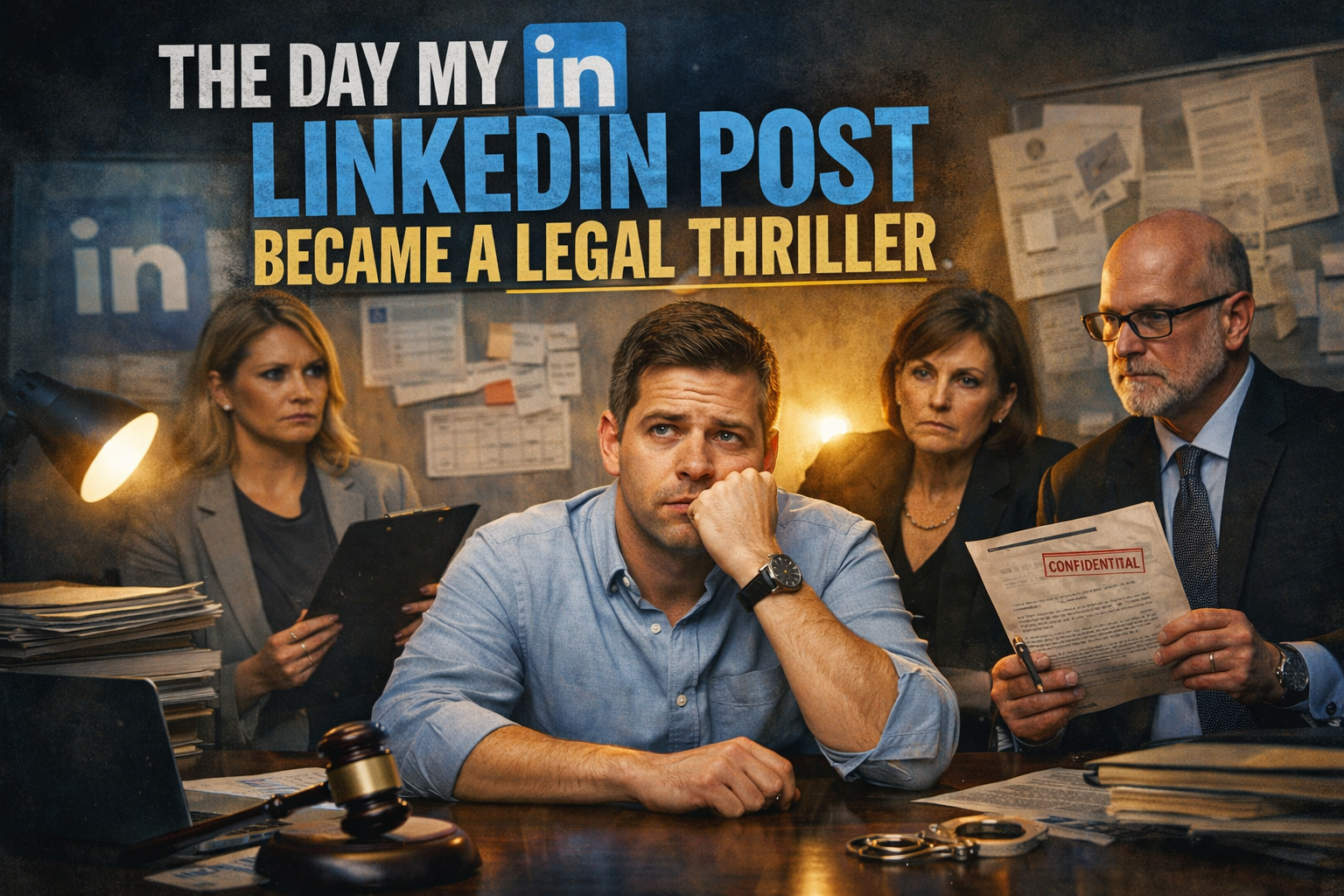
There is a very specific kind of corporate panic that only appears when an employee says something true in public with complete sentences, and it is one of the great underappreciated art forms of modern professional life. Not because it is subtle. Not because it is dignified. But because it arrives with such theatrical overreaction that you almost have to respect the commitment to the bit. A company can survive confusion, turnover, impossible expectations, leadership by mood swing, policies written like dares, communication styles shaped by smoke signals, and a management philosophy that appears to have been brainstormed during a fire drill, and somehow continue operating like this is all part of the strategic plan. But let one employee write a post online with a little honesty, a little irritation, and just enough detail to make the right people sweat through their polo shirts, and suddenly the organization transforms into a live-action courtroom drama where everybody speaks in careful tones and acts like words are more dangerous than the environment that created them.
That is what always makes me laugh. The same system that cannot locate accountability with both hands and a flashlight can suddenly become a precision-guided missile the minute somebody logs into LinkedIn and decides to stop pretending dysfunction is a personality trait. Broken processes? We can revisit that next quarter. Burnout? We hear you and appreciate your feedback. Leadership problems? Complex issue. Cultural rot? Let’s table that for now. But a public post that lands a little too close to the truth? Oh, now the wheels of justice begin to turn. Now calendars open. Now mysterious meetings appear. Now legal, a department that normally hovers in the background like a ghost with invoice access, emerges from the mist because apparently somebody in Operations had a thought in public and the empire must respond.
And that is how you know you have written something effective. Not when people clap. Not when your post gets engagement. Not when coworkers text you in secret like resistance fighters whispering from the supply closet. No. You know you hit the nerve when HR schedules a conversation, HR’s boss appears for moral support or witness protection, and legal joins like the bonus villain in the final act. That combination does not gather because they admire your communication style. That combination gathers because somewhere, in some office, someone important read your words and experienced the kind of spiritual discomfort usually reserved for tax audits and surprise jury duty.
A while back, when I worked for Pep Brothers, I made one of those posts. Not a manifesto. Not a confession. Not a documentary narrated by Morgan Freeman while dramatic piano music played over b-roll of corporate nonsense. It was just a post. A regular, human, mildly seasoned, truth-adjacent post. The kind of thing a person writes after living inside enough contradiction to develop both pattern recognition and a sense of humor. And apparently that was all it took to trigger the emergency response team. Because before I knew it, I was in a meeting with HR, HR’s boss, and legal, which is less a work meeting and more a sign that your thoughts have become an administrative weather event.
And once you have lived through that kind of meeting, you can never again pretend corporate life is not, at its core, community theater performed by anxious adults with badges. Because what unfolds in those rooms is never just policy. It is pageantry. It is control dressed up as concern. It is people who tolerated disorder for months suddenly discovering a profound commitment to structure because someone outside the walls might now notice what insiders have been swallowing for free. It is the magnificent panic of an institution realizing that a person it underestimated has both memory and internet access.
This, naturally, was deeply funny to me.
Because if a single LinkedIn post can summon HR, HR’s boss, and legal like I accidentally assembled the world’s most depressing Avengers, then the post was never really the issue. The issue was that the post had the nerve to describe reality before leadership could rebrand it into a values statement.
When HR Sends the Calendar Invite, the Music Changes
There are ordinary work meetings, and then there are meetings where the invitation itself reads like a threat wearing khakis. You know the type. No real agenda. No useful detail. Just a vague title, an oddly formal tone, and a guest list that immediately tells you this is not about birthday cake in the break room. The moment I saw HR, HR’s boss, and legal all attached to the same conversation, I knew I was no longer a man with a job. I was content. I was a case study. I was an episode summary with commercial breaks.
Nobody ever says that, of course. They never write, “Please join us so we can overreact to your ability to form a sentence in public.” They package it in the usual soft, corporate gauze. We’d just like to connect. We’d like to understand. We’d like to discuss a recent matter. Which is corporate for, someone upstairs got nervous and now we all have to pretend this is a mutual learning opportunity instead of a coordinated discomfort ritual.
So I walked in already knowing the mood. HR had the expression HR always has during these events, which is part concern, part disappointment, part hostage negotiator trying to de-escalate a situation caused entirely by leadership. HR’s boss had the look executives wear when they want to seem calm but are clearly furious that something made it to their altitude. It is a special face. Very polished. Very controlled. The face of someone whose entire inner monologue is, why is this in my week. And legal, naturally, was the star of the show. Calm. Measured. Unblinking. Giving off the energy of a person who has explained the phrase reputational exposure so many times they now use it in everyday life, probably while ordering lunch.
That trio is corporate America’s version of seeing three black SUVs pull up outside your house. Nobody is there to celebrate your authenticity.
And the questions began exactly as you would imagine, with that solemn tone people use when they are trying to make a medium-sized issue feel like a federal inquiry.
What did you mean by this line?
Who were you referring to here?
Why did you choose to share this publicly?
It was magnificent. They were reading my LinkedIn post back to me like they had intercepted enemy communications. Like I had hidden coded messages inside corporate frustration and they were about to crack the cipher. I kept waiting for someone to dim the lights and roll in a projector. Perhaps a laser pointer. Maybe a whiteboard labeled INCIDENT TIMELINE.
And that word publicly always sends me. Publicly. As if I had climbed the nearest rooftop with a megaphone and denounced them into the sunset. Ma’am, this was LinkedIn. The same website where people write thirty-seven paragraphs about resilience because their coffee machine broke before a sales kickoff. The same place where a man can compare a budget meeting to climbing Everest and receive applause. Let us not pretend I hijacked a satellite feed. I posted on the internet, where everyone else is also posting on the internet, except apparently my post committed the unforgivable sin of sounding recognizable.
That is the part companies hate the most, by the way. Not anger. Anger they can dismiss. Not exaggeration. Exaggeration they can mock. What they truly fear is recognition. They fear a sentence that makes other employees go quiet for half a second and think, unfortunately, yes. They fear language precise enough to cut through corporate fog. Because once something has been said clearly, it becomes harder to bury under leadership slogans and twelve-slide decks about culture.
So there I sat, watching adults with titles and budgets examine one online post with the seriousness normally reserved for fraud investigations, and the absurdity of it all nearly took me out. Because where was this energy when employees raised concerns internally? Where was this sudden devotion to inquiry when actual problems were happening in real time, in fluorescent lighting, every single day? Funny how context only becomes urgent once it has an audience.
The room wanted caution. The room wanted retreat. The room wanted me to behave like a man who had accidentally crossed a line and now regretted his emotional little outburst. Unfortunately for them, what they had instead was a man trying very hard not to laugh at the idea that one post had summoned this much salary into a conference room.
And that is when it hit me: I was not in a meeting about professionalism. I was in a meeting about containment.
Corporate America Loves the Truth, As Long As It Requires No Witnesses
One of the funniest lies in professional life is the idea that companies want open communication. They say it all the time. They print it on walls. They put it in onboarding packets. They say things like speak up, bring your full self, we value transparency, and my personal favorite, we encourage candid feedback, which usually means we encourage feedback that is flattering, private, and phrased like an apology. Because the moment honesty stops being decorative and starts becoming specific, the mood changes faster than a manager’s tone when their boss joins the call.
That is the real game. Companies do not mind truth in the abstract. They love truth as a concept. Truth looks incredible in mission statements. Truth sounds beautiful in town halls. Truth makes an excellent bullet point beneath a stock photo of diverse coworkers pointing at a laptop. But actual truth, lived truth, detailed truth delivered by a person who remembers names, timelines, patterns, and that one especially ridiculous phrase somebody said in a meeting six months ago? That truth is less welcome. That truth is considered disruptive. That truth is bad for morale, which is corporate language for it makes the wrong people uncomfortable.
And so my little post became a problem not because it was wild, but because it was familiar. It reflected something too cleanly. It held up the mirror at an angle management could not immediately soften with a values email and free bagels. That is what was really happening in that meeting. They were not confused. They were not seeking understanding. They were performing concern in the hope that I would voluntarily reclassify accuracy as a misunderstanding.
There is an entire ecosystem built around this process. First, leadership ignores the source material, meaning the actual environment people are living in. Then someone finally says something outside the approved channels. Then the institution rushes to examine the statement rather than the conditions that produced it. It is the organizational equivalent of ignoring a kitchen fire to interrogate the smoke alarm about its tone.
And the questions never arrive with the honesty they deserve. Nobody says, this post makes us look bad because it resembles our behavior. Nobody says, senior leadership would prefer you process your despair in silence like a team player. Nobody says, we are less upset by what happened than by the possibility that others now know it happened. No, no. Instead you get the usual pageant language. We want to make sure your comments align with company values. We are concerned about the impact of your words. We want to understand your intent.
Intent is another favorite of mine. Intent is what organizations go hunting for when impact has become too obvious to ignore. Suddenly everyone wants to know what you meant, as though phrasing is the crime scene. As though the real danger lies not in the broken system, but in your ability to describe it without stuttering.
And here is where it gets even funnier. The companies that panic most about public honesty are often the same ones that pride themselves on bold leadership. They talk constantly about courage, accountability, ownership, authenticity, all these gorgeous power words executives collect like decorative swords. But the minute an employee displays courage in a direction not approved by Communications, everybody starts moving like raccoons in a kitchen with the lights turned on.
Because courage is only inspirational when it flatters authority. The moment it inconveniences authority, it becomes insubordination with punctuation.
That room taught me more about corporate fragility than any leadership seminar ever could. It showed me how quickly concern becomes choreography. It showed me how many adults can gather to discuss one post while somehow remaining unavailable for the actual dysfunction it described. Most of all, it reminded me that organizations are often far less interested in truth than in sequence. They do not mind the truth arriving eventually, after revisions, after approvals, after whatever rough edges gave it life have been sanded into a sterile internal memo. What they cannot tolerate is truth showing up unsupervised.
That is what my post did. It showed up unsupervised.
No escort from leadership. No official framing. No translation into safer language. Just a human being saying a thing with enough clarity to travel. And that, in many workplaces, is treated like a greater offense than the original nonsense that inspired it.
Which is why those meetings always feel so absurd. They are not really about ethics. They are about authorship. They are about the company’s fury that it did not get to write the first draft of reality.
The Moment You Realize You Are No Longer Staff, You Are Plot
At some point in these situations, a switch flips in your brain and you stop experiencing the meeting as a professional event and start experiencing it as cinema. That is what happened to me. Somewhere between the third careful question and the fourth attempt to dress fear up as policy, I realized I was no longer participating in an employment conversation. I was inside a season finale. The lighting felt dramatic. The pauses grew longer. Every sentence had the energy of a trailer voice saying, this fall, one employee posts online and everybody loses their minds.
And honestly, once you see it that way, the whole thing becomes far more entertaining.
Because in normal life, people would simply acknowledge the obvious. A post struck a nerve. Leadership got rattled. The organization wanted to know whether this was a one-time annoyance or the beginning of a much more expensive narrative. But corporate life refuses to say simple things simply. Everything must be inflated into ritual. Everything must be processed through layers of caution until even basic discomfort sounds like regulatory weather.
So there I was, watching three departments analyze my writing with all the gravity of a literary tribunal, and the absurdity reached such heights that I almost wanted to ask whether notes would be provided after the reading. Was legal enjoying the pacing? Did HR have thoughts on the emotional arc? Should I tighten the third paragraph for maximum panic among senior leadership?
Because that is the secret nobody says out loud. When they bring you into one of these meetings, they are giving you a compliment in the most miserable way possible. They are telling you the words landed. They are telling you the post traveled farther inside the building than they wanted. They are telling you your little paragraph did more damage to the illusion than weeks of internal messaging did to preserve it. You do not assemble HR, HR’s boss, and legal because someone wrote something forgettable.
The post hit.
And once I understood that, the fear lost most of its power. Because what exactly was I supposed to feel ashamed of? That my observation skills were functioning? That my vocabulary had range? That I had the audacity to describe the weather while standing in the storm? The meeting wanted me to feel reckless. What I actually felt was confirmed.
That was the most revealing part of all. Not the questions. Not the tone. Not the legal presence floating through the room like a very expensive haunted lamp. The most revealing part was the scale of the response. That scale told the whole story. It told me my post was not dismissed as inaccurate, because if it were inaccurate, they would have brushed it off. It told me the discomfort was not about professionalism, because actual unprofessionalism inside companies gets tolerated every day as long as it comes with the right title. No, the scale of the response told me something much simpler: they were scared of what happens when the private reality of a workplace becomes legible in public.
Nothing terrifies shaky leadership like a credible narrator.
Especially one they thought would stay grateful, quiet, and exhausted.
And this is where companies always miscalculate. They assume fear is the strongest force in the room. They assume the possibility of consequences will make a person retreat into that familiar corporate crouch where everyone knows the truth and nobody names it. But once someone has already lived the chaos, already survived the confusion, already watched management protect image over substance enough times, fear starts losing market value. At a certain point, the threat of trouble becomes less powerful than the humiliation of pretending nonsense is normal.
That is when a person gets dangerous to the script. Not violent. Not reckless. Just impossible to fully manage with tone and procedure. Because once you stop being impressed by titles and start noticing patterns, you cannot unsee the machinery. You notice who gets protected. You notice when policy is flexible for the powerful and rigid for everyone else. You notice that many corporate investigations are less about facts than about deciding whose version of reality gets the logo.
And that is why the meeting stayed with me. Not because it scared me, though I am sure that was the intended side effect. Not because it changed my mind, though I suspect they hoped repeated eye contact from legal would inspire some sort of spiritual rewrite. It stayed with me because it was such a perfect little play about modern work: a company comfortable with dysfunction, deeply uncomfortable with description, trying to convince the witness that the real issue was the volume of his honesty.
I walked out of that room with the strange calm that comes from finally understanding the genre.
I was never in trouble for posting.
I was in trouble for narrating.
Final Thoughts
There is something darkly beautiful about the moment a company reveals what actually alarms it. Not the dysfunction. Not the turnover. Not the confusion, burnout, inconsistency, favoritism, chaos, or daily parade of small absurdities that grind people down until they begin speaking in cautious little disclaimers just to survive a Tuesday. No. What alarms a shaky company is the possibility that someone inside the machine may also be literate enough to describe it.
That is the part I keep coming back to.
Because the post was never just a post. The meeting was never just a meeting. It was a collision between two competing stories. Their story was that everything was manageable, appropriate, under control, perhaps not perfect but certainly not something that needed to be aired beyond the walls. My story was that people were living consequences in real time and the polished language around it was starting to smell less like leadership and more like air freshener sprayed over electrical fire.
And institutions hate losing narrative control.
They can survive bad practices longer than they can survive accurate descriptions of bad practices.
That is why the response was so outsized. Not because my words were reckless, but because they were recognizable. Somewhere inside that building, somebody read that post and had the terrible experience of understanding it immediately. No committee can tolerate that kind of clarity for long. Once the truth becomes portable, once it leaves the internal channels and starts breathing outdoor air, it becomes much harder to relabel as a misunderstanding.
So yes, I got questioned by HR, HR’s boss, and legal over a post. And yes, for a brief shining moment, it felt like I had accidentally become the season finale of a workplace drama nobody asked to star in. But underneath the absurdity was a lesson I have never forgotten. When an organization reacts to honest language with more urgency than it ever applied to the conditions being described, it tells you exactly where the real problem lives. Not in the post. Not in the phrasing. Not in your so-called tone. The problem lives in the gap between what people are expected to endure and what leadership is willing to admit.
And once you see that gap clearly, you start understanding why some places are so terrified of employees who can write.
Because a person with receipts is inconvenient.
A person with courage is unpredictable.
But a person with receipts, courage, memory, vocabulary, and a LinkedIn account?
That is not an employee anymore.
That is a plot twist.
And the truth is, shaky companies can survive a lot. They can survive poor decisions, bad managers, bloated meetings, empty slogans, strange reorganizations, passive-aggressive all-hands calls, and leadership strategies that feel like they were assembled from leftover TED Talks and caffeine. What they struggle to survive is the moment somebody inside the walls stops treating the dysfunction like weather and starts calling it architecture.
That is when the panic begins.
That is when legal finds its calendar.
That is when HR suddenly wants context.
That is when leadership starts speaking in those careful, polished, sterile phrases meant to make your reality sound like an interpretation issue.
But if three salaried adults need a private room to dissect one public paragraph, then congratulations to the paragraph.
It did its job.