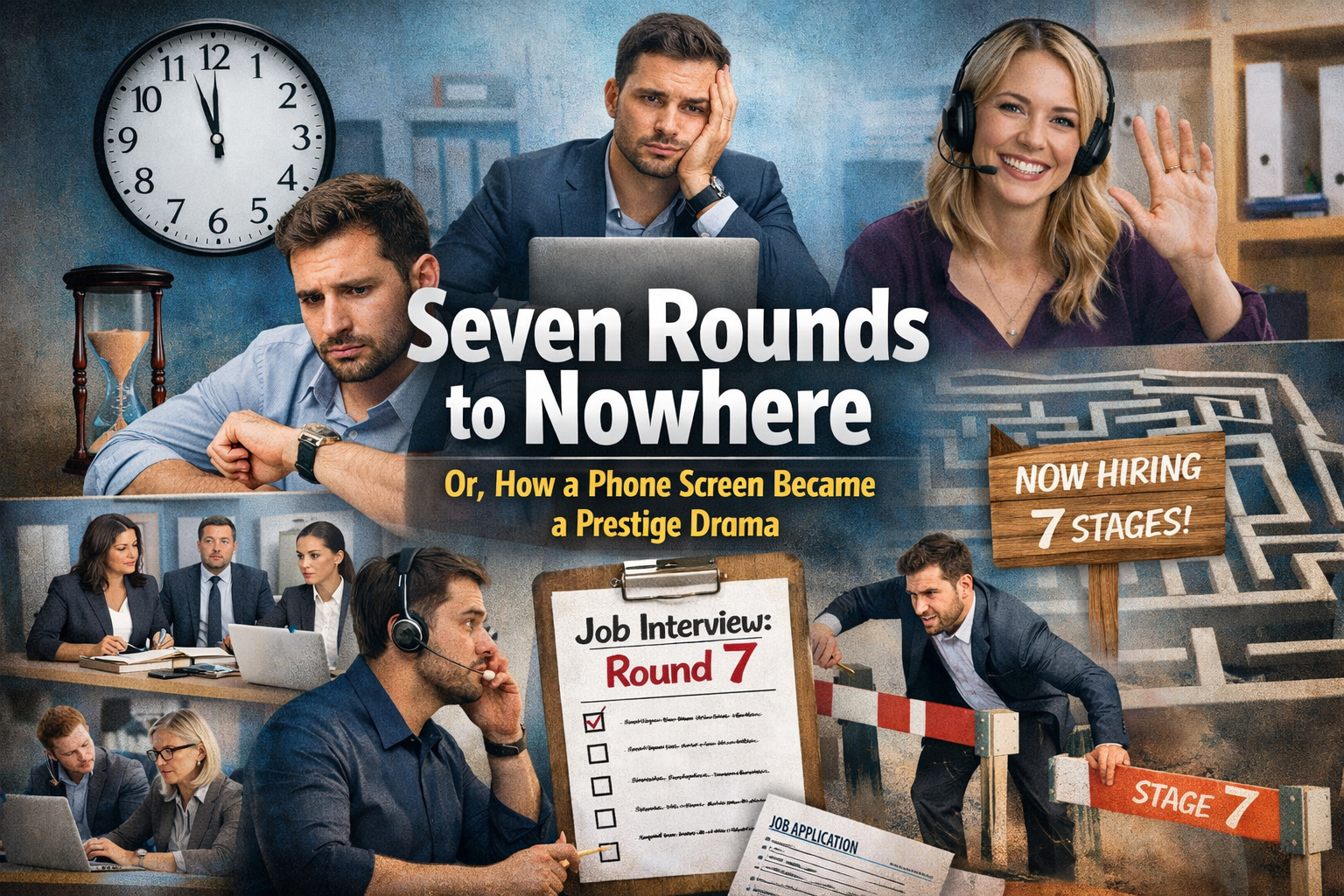
Or, How a Phone Screen Became a Prestige Drama
There is a very specific kind of optimism that enters a room when a recruiter reaches out quickly after an application, and it is the kind of optimism that only exists because human beings continue, against all available evidence, to believe that maybe this time the process will be normal. Maybe this time the calendar invite actually means a conversation will happen at the agreed upon time. Maybe this time a respected company with a polished brand, elegant website, and enough corporate confidence to use words like innovation and talent acquisition in the same paragraph will behave as though your time has value beyond its usefulness as unpaid tribute. It is a touching form of innocence, really, the kind you normally see in children, golden retrievers, and adults who have not yet been personally victimized by a seven-stage interview process for a role that will somehow still require them to beg for PTO.
The other day my friend applied for a role at Bosch, and almost immediately a recruiter named Deanna Proske reached out to schedule a conversation, which is the modern professional equivalent of hearing distant wedding bells while standing inside a casino. It sounds promising. It sounds official. It sounds like momentum. In the fragile emotional economy of job hunting, where people are expected to remain positive while uploading the same resume into seven different portals and manually typing the exact same work history into an ATS designed by raccoons with access to SharePoint, a fast recruiter response feels almost romantic. Not healthy romantic. Corporate romantic. The kind where nobody knows each other, expectations are already uneven, and somebody is about to waste forty-five minutes of your life while calling it opportunity.
So the meeting was booked. The laptop was open. The lighting was adjusted. The shirt was respectable from the chest up, which is still the official uniform of modern professionalism. My friend sat there in that familiar pre-interview stillness that all candidates eventually learn, the one where your face says calm, confident, and ready, while your nervous system quietly rehearses every mistake you have ever made since middle school. He was prepared to answer questions about his background, his strengths, his reasons for applying, his long-term goals, and whatever strange psychological scavenger hunt employers now use to determine whether someone is both ambitious and humble, strategic and hands-on, independent and collaborative, experienced but still somehow eager to be molded like a clay intern in an executive escape room.
Then the meeting time came.
And went.
And continued drifting into the horizon with the lazy confidence of a company that has never once experienced consequences for treating applicants like decorative furniture. Five minutes passed. Then ten. Then fifteen. By twenty minutes, the atmosphere had shifted from interview preparation to emotional archaeology. By thirty minutes, it was no longer a delay. It was a statement. It was an artistic installation called The Casual Disappearance of Professional Courtesy. It was a live-action demonstration of the phrase we value urgency, created by people who clearly believe urgency is something candidates should feel while employers enjoy all the flexibility of a Roman emperor selecting grapes.
And then, after half an hour of silence long enough to qualify as a minor betrayal, the recruiter arrived.
No dramatic apology. No tale of technological collapse. No story involving a blown transformer, a medical emergency, or a rogue squirrel attacking the Wi-Fi infrastructure of the greater metropolitan area. Just the smooth, unbothered entrance of someone stepping into a conversation as though time were a scented candle rather than a finite resource being set on fire in real time by unemployed people in collared shirts. And from there, as though the late arrival itself were merely the opening act, came the grand revelation: the interview process would involve seven stages.
Seven.
And just like that, what had begun as a simple recruiter conversation transformed into something much larger, much darker, and far more theatrical: a serialized endurance event disguised as hiring.
The Sacred Calendar Invite
A calendar invite in the hiring process is one of the funniest objects in modern life because it arrives dressed like certainty while containing almost none of it. It looks official. It has a time. It has a link. Sometimes it even has a polite note and a line about looking forward to speaking with you, which is corporate for “I have reserved a slot on a digital grid and may or may not honor it depending on my relationship with accountability.” Candidates receive these invites the way villagers used to read omens in the sky. They study them. They build hope around them. They rearrange real life for them. Lunch gets moved. School pickups get coordinated. Current jobs get quietly worked around. Other responsibilities get bent into strange shapes so one adult can sit in front of a camera and perform competence for another adult who may still open with, “So, walk me through your background,” despite having had your background in PDF form for several days.
The pre-interview ritual is its own form of unpaid labor. Nobody talks enough about this because job seekers are expected to absorb it with grace, like emotional interns in the Department of Personal Branding. But there is a performance that begins long before the meeting starts. You research the company. You skim leadership bios written in that eerie house style where every executive sounds like they were raised in a laboratory to maximize shareholder value. You review the job description again even though it reads like they combined three roles, a therapy requirement, and a caffeine addiction into one salary band. You prepare thoughtful questions because apparently curiosity is essential, but not too much curiosity, because then you seem difficult. You test your microphone. You adjust your camera angle to say “serious professional” instead of “recently escaped from a basement startup.” You create an atmosphere of readiness for people who often arrive with the energy of someone double-booked against their will.
All of that preparation rests on an unspoken social agreement that the meeting will happen roughly when the meeting is supposed to happen. Not perfectly. Nobody expects military precision. We are adults. Things happen. Calls run over. Technology misbehaves. A child screams in the distance. A dog launches itself into a room like a furry compliance violation. Life is messy. But there is a canyon-sized difference between life being messy and someone appearing thirty minutes late to a scheduled conversation with the calm indifference of a waiter delivering room-temperature water after the restaurant has closed.
That is what makes moments like this so revealing. They are not just scheduling issues. They are tiny accidental truth-serums. Because a late recruiter is rarely just a late recruiter. It is often a preview trailer. It hints at the internal culture. It whispers about the operational habits. It suggests the kind of chaos being defended by the phrase fast-paced environment. Companies love to frame themselves as efficient, agile, and dynamic, but sometimes what they mean is disorganized, overbooked, and spiritually unavailable. A late start tells you something. It tells you how time moves inside that organization. It tells you who is expected to flex and who is allowed to drift. It tells you whether respect is mutual or simply demanded from the bottom up like some kind of emotional tax code.
And candidates, of course, are expected to smile through this. That is the truly elegant part. Had my friend arrived thirty minutes late, the process would have ended before his face even loaded onto the screen. There would have been notes entered somewhere deep in the sacred bureaucracy. Concerns about reliability. Questions around professionalism. A subtle email thanking him for his time and explaining that the team had chosen to move forward with candidates whose experience more closely aligned with the needs of the role, which is professional language for “You committed the unforgivable sin of treating us the way we treat you.” Employers can be late because they are busy. Candidates cannot be late because that implies they are human outside the interview.
And so there sat my friend, staring at the void, participating in one of the oldest traditions in professional life: donating emotional energy to a company before the company has earned the right to spend it.
Seven Stages of Grief, But Make It Talent Acquisition
When the recruiter finally explained that the process would involve seven stages, the conversation achieved a level of absurdity so pure it should have been framed and hung in a museum. Seven stages. Seven separate checkpoints. Seven opportunities for scheduling conflicts, contradictory feedback, unnecessary delays, duplicate questions, personality shape-sorting, and that special kind of prolonged uncertainty companies call thoroughness when they want to sound disciplined instead of terrified of decision-making.
There is something beautiful about how modern hiring processes pretend complexity equals intelligence. Somewhere along the way, employers became convinced that if two interviews are good, then seven must be elite. Why stop at one hiring manager and one team conversation when you can build an entire tournament bracket around a role that mostly involves email, PowerPoint, and surviving status meetings with a neutral expression. By the fourth round, nobody is assessing qualifications anymore. They are just seeing who still has the cardiovascular endurance to remain enthusiastic while repeating the same stories in slightly different fonts to different people with slightly different titles.
Seven stages is not a hiring process. It is a character-building exercise designed by people who do not believe in internal alignment. It means nobody trusts anybody else’s judgment. The recruiter cannot trust the manager. The manager cannot trust the director. The director cannot trust the panel. The panel cannot trust the vibes. So now a candidate has to become a traveling salesman of their own resume, moving from screen to screen like a deeply hydrated pilgrim explaining for the fifth time that yes, they did in fact lead cross-functional teams, manage deadlines, solve problems, and exist professionally before this call.
What kills me is that companies often explain these elaborate processes with the solemn tone of medical researchers announcing a breakthrough. They talk about ensuring fit. About making thoughtful decisions. About protecting the candidate experience. Protecting it from what, exactly? Efficiency? Closure? A normal amount of adult dignity? Because nothing protects the candidate experience quite like making someone take PTO for six separate conversations, complete an assessment, meet three layers of management, and then wait two weeks for an update that arrives wrapped in gratitude and vague disappointment.
And the questions do not evolve nearly enough to justify the structure. That is the tragic comedy at the heart of it. Round one is usually background. Round two is background with a different audience. Round three is background but this time framed as behavioral questions. Round four is strategic thinking, which is just background wearing a blazer. Round five is culture fit, where they try to determine whether your personality will offend people who use phrases like bandwidth and circle back without blinking. Round six is the panel, where several employees collectively rediscover the exact same information your resume and LinkedIn already provided. By round seven, someone will ask what motivates you, and the honest answer will be “the desire to justify the amount of unpaid labor this process has already extracted from my soul.”
And yet companies wonder why candidates become bitter. They wonder why the enthusiasm starts to sound rehearsed. They wonder why professionals speak openly about burnout and hiring fatigue and the strange emotional erosion that comes from having to perform optimism through a process increasingly built like an escape room for middle managers. Nobody wants to admit that long interview processes are often less about finding the right person and more about spreading responsibility so thinly across the org chart that nobody can later be blamed when the hire does not work out. Seven rounds does not say excellence. Sometimes it says indecision with good branding.
It is corporate cowardice dressed as rigor.
And the cruelest joke is that after all this, the final role is often less glamorous than the audition required to get it. Imagine surviving seven interviews only to spend your mornings updating trackers, joining meetings titled Working Session, and receiving Teams messages from people who type quick question before ruining the next forty minutes of your life. Imagine scaling the mountain only to discover the summit is a swivel chair and a dashboard nobody understands.
That is what makes these processes feel almost literary. They are not just inefficient. They are narratively offensive. They build suspense with no proportional reward. They create prestige-drama tension around roles that will ultimately involve resetting passwords, reformatting decks, and being asked to take ownership without receiving authority. By the time a company reaches stage seven, the candidate should at least receive a commemorative robe, a small trophy, or partial college credit.
The Performance of Professional Gratitude
One of the most underrated indignities in modern hiring is the expectation that candidates remain endlessly grateful while being handled like luggage. You are expected to appreciate the opportunity, appreciate the time, appreciate the process, appreciate the feedback, appreciate the silence, appreciate the reschedule, appreciate the rejection, appreciate the possibility of eventually being told something concrete by people who cannot even open a call on time. Gratitude, in hiring culture, has become less of a sincere response and more of a mandatory costume.
That is why stories like this hit so hard. It is not just that the recruiter was late or that the process had seven stages. It is that the whole structure quietly assumes the candidate will absorb every inconvenience with a smile. There is a script, and only one side is truly required to follow it. The candidate must arrive prepared, polished, warm, flexible, concise but also memorable, accomplished but not arrogant, honest but not too honest, eager but not desperate, and somehow capable of treating each stage like a privilege rather than what it often is: a slow-moving parade of organizational insecurity.
The company, meanwhile, can be disorganized, delayed, inconsistent, vague, repetitive, and mysteriously overcomplicated, and still emerge looking legitimate because corporate legitimacy is one of the greatest magic tricks ever invented. Put enough logos on a website, add a mission statement, post a few photos of smiling employees wearing headsets or safety glasses, and suddenly nobody is allowed to say, “This process looks like it was designed by a committee trapped in an elevator.”
There is also something deeply funny about how employers frame these marathon interview structures as mutual evaluation. Mutual. That adorable word. As if candidates are being given equal power to assess the organization while sitting in a process where one wrong answer, one awkward pause, one perceived tone issue, one insufficiently worshipful response to “Why us?” can send them into the electronic afterlife. Mutual evaluation in hiring is like saying hostages and negotiators are both participating in a conversation. Technically true. Spiritually dishonest.
And still, candidates keep showing up because they have to. Because bills are not impressed by principles. Because rent does not care whether a process is dehumanizing as long as it ends in direct deposit. Because healthcare, groceries, child care, and basic survival have a way of making adults sit through absurdity with astonishing grace. That is why I always find it so insulting when companies confuse candidate patience for candidate consent. Just because someone tolerates your nonsense does not mean your nonsense is respectable. It means people are trying to survive.
What happened to my friend was not the worst thing ever to happen in hiring. That is the most darkly hilarious part. It was not even rare. It was almost ordinary. A recruiter late to a call. A bloated interview process. A polished company behaving like time only matters when it is being requested from others. This is not a shocking anomaly. This is modern hiring in its natural habitat, wandering freely through LinkedIn and Outlook, feeding on hope and calendar availability.
And then, after all that, if candidates dare to describe the experience honestly, someone inevitably appears to explain that public criticism is unprofessional. That is my favorite genre of professional gaslighting. The process can be absurd, but naming the absurdity is the real problem. A company can run applicants through seven rounds like they are testing a new antidepressant, but if a candidate says, “This feels excessive,” suddenly decorum enters the chat wearing pearls and asking everyone to be more measured.
No. The measured thing would have been one recruiter call, two substantive interviews, and a decision made by adults who trust one another enough to make one.
Instead, we keep watching organizations build hiring processes like haunted houses and then act offended when candidates scream.
Final Thoughts
The older I get, the more I believe modern hiring is less a business function and more a genre of theater. Everyone has a role. The recruiter plays urgency. The hiring manager plays discernment. The panel plays curiosity. The candidate plays hope. And beneath it all is this strange, unspoken agreement that nobody will say the quiet part out loud, which is that many companies do not actually know how to hire anymore. They know how to prolong. They know how to layer. They know how to create the appearance of rigor through repetition, bureaucracy, and a rotating cast of stakeholders who all need to “weigh in” before someone has the courage to choose a person and stand by it.
That is what makes this story so perfect. A quick outreach creates excitement. A thirty-minute delay establishes disrespect. A seven-stage process introduces the central villain. And somewhere in the middle of it all, one candidate is expected to keep nodding like this is a normal pathway to employment rather than a psychological endurance test sponsored by a recognizable brand name.
I keep coming back to the image of my friend sitting there, ready, on time, prepared, dressed, composed, waiting for a conversation that could not even begin with the basic courtesy of punctuality, only to be told the real journey had not yet started, that in fact he was merely standing at the mouth of a tunnel with six more tunnels hiding behind it. That is not recruiting. That is folklore. That is the beginning of a cautionary tale older job seekers will one day whisper to fresh graduates standing outside office parks with dead eyes and updated LinkedIn banners.
And maybe that is why stories like this resonate so much. Because everyone recognizes the pattern. Everyone has had some version of this moment. The late recruiter. The bloated process. The fake urgency. The request for immediate availability from people who operate on geologic time. The cheerful insistence that candidates remain enthusiastic while their time is treated like recyclable packaging. It is all so common now that absurdity has become policy.
But there is still something worth naming here, and it is simple: people are tired. Not lazy. Not entitled. Tired. Tired of being told to tailor resumes, polish narratives, research companies, follow up thoughtfully, remain resilient, and trust the process when the process itself increasingly behaves like a confused carnival ride assembled by committee. Tired of being asked to prove seriousness to organizations that cannot even offer coherence. Tired of the way professionalism is demanded from applicants and merely suggested to employers.
Your friend did not sign up for a simple recruiter screen. He wandered into a prestige drama with poor pacing, weak plot discipline, and too many episodes before the central conflict was even explained. He did not attend a first-round conversation. He entered season one of Corporate Hunger Games: Talent Acquisition Unit.
And somewhere out there, in a conference room or a Teams window lit by the soft blue glow of unnecessary process, someone is still wondering why candidates seem exhausted.
Because, dear reader, they are not applying for jobs anymore.
They are auditioning for survival.